Contents
Research Article
Brownian Motion—Wiener Process
-
- Published online by Cambridge University Press:
- 20 November 2018, pp. 257-279
-
- Article
-
- You have access
- Export citation
Permutations Related to Secant, Tangent and Eulerian Numbers
-
- Published online by Cambridge University Press:
- 20 November 2018, pp. 281-291
-
- Article
-
- You have access
- Export citation
-
It is well known that
1
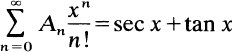
where An denotes the number of "up-down" or alternating permutations
2

of 1, 2, …, n. The numbers A2n and A2n+1 are known as the secant and tangent numbers respectively and A2n = (—l)"E2n , where En is the Euler number.
Hitting Time Distributions When Σ xk/dk Has a Smooth Density
-
- Published online by Cambridge University Press:
- 20 November 2018, pp. 293-298
-
- Article
-
- You have access
- Export citation
-
In this paper we construct the hitting time distributions for stochastic processes Xk , taking on values amongst the integers 0, 1, …, d -1 for which
 has a smooth polynomial density with respect to the Lebesgue measure on [0,1].
 has a smooth polynomial density with respect to the Lebesgue measure on [0,1].
A Proof of an Identity for Multiplicative Functions
-
- Published online by Cambridge University Press:
- 20 November 2018, pp. 299-304
-
- Article
-
- You have access
- Export citation
Hamiltonian Cycles in Strong Products of Graphs
-
- Published online by Cambridge University Press:
- 20 November 2018, pp. 305-309
-
- Article
-
- You have access
- Export citation
-
Abstract. Let
 denote the graph
  (k times) where
  is the strong product of the two graphs G and H. In this paper we prove the conjecture of J. Zaks [3]: For every connected graph G with at least two vertices there exists an integer k = k(G) for which the graph
  is hamiltonian.
 denote the graph
  (k times) where
  is the strong product of the two graphs
  is hamiltonian.
Generalized Markov Projections and Matrix Summability
-
- Published online by Cambridge University Press:
- 20 November 2018, pp. 311-316
-
- Article
-
- You have access
- Export citation
Identité Pour

-
- Published online by Cambridge University Press:
- 20 November 2018, pp. 317-325
-
- Article
-
- You have access
- Export citation
-
Dans cet article, nous établirons un théorème sur la représentation de certaines séries de Dirichlet (ceci généralise un résultat de [3]). Avec ce nouveau résultat nous donnerons seulement quelques applications qui évidemment pourraient être augmentées de beaucoup. Par exemple, nous donnerons une expression asymptotique pour
1


Permuting the Elements of a Finite Solvable Group
-
- Published online by Cambridge University Press:
- 20 November 2018, pp. 327-330
-
- Article
-
- You have access
- Export citation
Coherent Overrings
-
- Published online by Cambridge University Press:
- 20 November 2018, pp. 331-337
-
- Article
-
- You have access
- Export citation
On Derivations in Prime Rings and a Question of Herstein
-
- Published online by Cambridge University Press:
- 20 November 2018, pp. 339-344
-
- Article
-
- You have access
- Export citation
A Criterion for Taylor Summability of Fourier Series
-
- Published online by Cambridge University Press:
- 20 November 2018, pp. 345-350
-
- Article
-
- You have access
- Export citation
-
Let {ank} be a matrix defined by
1

and n taking only non-negative integer values.
Let f(x) ∈ L [0, 2π] and be periodic with period 2π outside this interval. Let the Fourier series associated with the function f(x) be given by

and let

where s is a constant.

On Surfaces of Order Three
-
- Published online by Cambridge University Press:
- 20 November 2018, pp. 351-355
-
- Article
-
- You have access
- Export citation
Bounds on Positive Integral Solutions of Linear Diophantine Equations II
-
- Published online by Cambridge University Press:
- 20 November 2018, pp. 357-361
-
- Article
-
- You have access
- Export citation
-
Let A be an m × n matrix of rank r and B an m × 1 matrix, both with integer entries. Let M2 be the maximum of the absolute values of the r × r minors of the augmented matrix (A | B). Suppose that the system A x = B has a non-trivial solution in non-negative integers. We prove (1) If r = n - 1 then the system A x = B has a non-negative non-trivial solution with entries bounded by M2. (2) If A has a r x n submatrix such that none of its r x r minors is 0 and x ≥ 0 is a solution of Ax=B in integers such that
 is minimal, then
  .
.
 is minimal, then
  .
.Note on Best Approximation of |x|
-
- Published online by Cambridge University Press:
- 20 November 2018, pp. 363-366
-
- Article
-
- You have access
- Export citation
-
In this note the best uniform approximation on [—1,1] to the function |x| by symmetric complex valued linear fractional transformations is determined. This is a special case of the more general problem studied in [1]. Namely, for any even, real valued function f(x) on [-1,1] satsifying 0 = f ( 0 ) ≤ f (x) ≤ f (1) = 1, determine the degree of symmetric approximation

and the extremal transformations U whenever they exist.
Functional Dependence and Analytic Functions
-
- Published online by Cambridge University Press:
- 20 November 2018, pp. 367-369
-
- Article
-
- You have access
- Export citation
A Note on Bernstein's Bivariate Inequality
-
- Published online by Cambridge University Press:
- 20 November 2018, pp. 371-375
-
- Article
-
- You have access
- Export citation
Approximation on Boundary Sets
-
- Published online by Cambridge University Press:
- 20 November 2018, pp. 377-379
-
- Article
-
- You have access
- Export citation
Extension of a Result of S. Mandelbrojt
-
- Published online by Cambridge University Press:
- 20 November 2018, pp. 381-384
-
- Article
-
- You have access
- Export citation
-
We extend the following result to several variables: For any sequence {Nj }, we have C{Nj } = C{Mj }, with {Mj } logarithmically convex i.e.

