Published on behalf of Australian Mathematical Society
We partner with a secure submission system to handle manuscript submissions.
Please note:
Click Proceed to submission system to continue to our partner's website.
 $KK$-THEORY
We provide sufficient conditions to factorise an equivariant spectral triple as a Kasparov product of unbounded classes constructed from the group action on the algebra and from the fixed point spectral triple. We show that if factorisation occurs, then the equivariant index of the spectral triple vanishes. Our results are for the action of compact abelian Lie groups, and we demonstrate them with examples from manifolds and  $\unicode[STIX]{x1D703}$-deformations. In particular, we show that equivariant Dirac-type spectral triples on the total space of a torus principal bundle always factorise. Combining this with our index result yields a special case of the Atiyah–Hirzebruch theorem. We also present an example that shows what goes wrong in the absence of our sufficient conditions (and how we get around it for this example).
We introduce what is meant by an AC-Gorenstein ring. It is a generalized notion of Gorenstein ring that is compatible with the Gorenstein AC-injective and Gorenstein AC-projective modules of Bravo–Gillespie–Hovey. It is also compatible with the notion of  $n$-coherent rings introduced by Bravo–Perez. So a $0$-coherent AC-Gorenstein ring is precisely a usual Gorenstein ring in the sense of Iwanaga, while a $1$-coherent AC-Gorenstein ring is precisely a Ding–Chen ring. We show that any AC-Gorenstein ring admits a stable module category that is compactly generated and is the homotopy category of two Quillen equivalent abelian model category structures. One is projective with cofibrant objects that are Gorenstein AC-projective modules while the other is an injective model structure with fibrant objects that are Gorenstein AC-injectives.
In this paper, we study a class of Brezis–Nirenberg problems for nonlocal systems, involving the fractional Laplacian  $(-\unicode[STIX]{x1D6E5})^{s}$ operator, for $0<s<1$, posed on settings in which Sobolev trace embedding is noncompact. We prove the existence of infinitely many solutions in large dimension, namely when $N>6s$, by employing critical point theory and concentration estimates.
In this paper we study three-dimensional contact metric manifolds satisfying  $\Vert \unicode[STIX]{x1D70F}\Vert =\text{constant}$. The local description, as well as several global results and new examples of such manifolds are given.
We study generalized continued fraction expansions of the form where 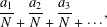 $$\begin{eqnarray}\frac{a_{1}}{N}\frac{}{+}\frac{a_{2}}{N}\frac{}{+}\frac{a_{3}}{N}\frac{}{+}\frac{}{\cdots },\end{eqnarray}$$ $N$ is a fixed positive integer and the partial numerators $a_{i}$ are positive integers for all $i$. We call these expansions $\operatorname{dn}_{N}$ expansions and show that every positive real number has infinitely many $\operatorname{dn}_{N}$ expansions for each $N$. In particular, we study the $\operatorname{dn}_{N}$ expansions of rational numbers and quadratic irrationals. Finally, we show that every positive real number has, for each $N$, a $\operatorname{dn}_{N}$ expansion with bounded partial numerators.