Contents
Syllabus of Papers
Thirty-Fifth Session, 1917–17
-
- Published online by Cambridge University Press:
- 20 January 2009, pp. v-vi
-
- Article
-
- You have access
- Export citation
Presents to the Library
The following Presents to the Library have been received, for which the Society tenders its grateful thanks
-
- Published online by Cambridge University Press:
- 20 January 2009, p. vii
-
- Article
-
- You have access
- Export citation
Office-Bearers
Office-Bearers
-
- Published online by Cambridge University Press:
- 20 January 2009, p. 1
-
- Article
-
- You have access
- Export citation
Research Article
On the Latent Roots of Compound Determinants and Brill's Determinants
-
- Published online by Cambridge University Press:
- 20 January 2009, pp. 2-9
-
- Article
-
- You have access
- Export citation
-
The roots of the equation in λ
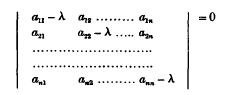
were named by Sylvester the latent roots of the determinant | a11a22 … ann |. So early as 1852, Sylvester showed that if any determinant D is given, we can at once write down a determinant whose latent roots are the squares of the latent roots of D: this determinant is in fact the square of D, the process of squaring being performed by multiplying rows into columns : so that, e.g. if the latent roots of
 are λ1 and λ2, then the roots of
 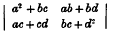 are
are  and
and  . Spottiswoode had also shown in 1851 that the latent roots of the reciprocal of a determinant are the reciprocals of the latent roots of the determinant itself. Both these theorems were soon found to be particular cases of a general theorem which was enunciated by Sylvester thus: The latent roots of any function of a matrix are respectively the same functions of the latent roots of the matrix itself.
 are λ
are λ are
are  and
and  . Spottiswoode had also shown in 1851 that the latent roots of the reciprocal of a determinant are the reciprocals of the latent roots of the determinant itself. Both these theorems were soon found to be particular cases of a general theorem which was enunciated by Sylvester thus: The latent roots of any function of a matrix are respectively the same functions of the latent roots of the matrix itself.
The Apolar Locus of Two Tetrads of Points
-
- Published online by Cambridge University Press:
- 20 January 2009, pp. 10-23
-
- Article
-
- You have access
- Export citation
The Co-apolars of a Cubic Curve
-
- Published online by Cambridge University Press:
- 20 January 2009, pp. 24-31
-
- Article
-
- You have access
- Export citation
Transformations of Axes for Whittaker's Solution of Laplace's Equation
-
- Published online by Cambridge University Press:
- 20 January 2009, pp. 32-37
-
- Article
-
- You have access
- Export citation
-
Whittaker has shown that a general solution of Laplace's equation, ∇2V = 0, may be expressed in the form

Since the harmonic property of a function is in no way dependent upon any particular set of axes it follows that the same solution must be capable of being expressed in the form

where X, Y, Z are any second set of rectangular coordinates.
On a Class of Continued Fractions
-
- Published online by Cambridge University Press:
- 20 January 2009, pp. 38-45
-
- Article
-
- You have access
- Export citation
-
The continued fractions treated in this paper are of the general form

where s0, s1, s2, … are real integers (positive, negative, or zero). An arbitrary real number can, of course, be developed in such a fraction in an infinite variety of ways. The continued fractions discussed here have a number of striking properties and present numerous contrasts with the ordinary continued fraction usually employed.
On the Theory of Continued Fractions
-
- Published online by Cambridge University Press:
- 20 January 2009, pp. 46-58
-
- Article
-
- You have access
- Export citation
A Geometrical Proof of a Theorem of Hurwitz
-
- Published online by Cambridge University Press:
- 20 January 2009, pp. 59-65
-
- Article
-
- You have access
- Export citation
-
In the study of rational approximations to irrational numbers the following problem presents itself: Let ω be a real irrational number, and let us consider the rational fractions satisfying the inequality

how small can the positive quantity k be chosen with the certainty that there will always be an infinite number of fractions satisfying the inequality whatever the value (irrational) of ω?
The Effect of a Rise in Prices upon the Amount of Small Money used
-
- Published online by Cambridge University Press:
- 20 January 2009, pp. 66-73
-
- Article
-
- You have access
- Export citation
Geometrical Illustrations of Cyclant Substitutions
-
- Published online by Cambridge University Press:
- 20 January 2009, pp. 74-77
-
- Article
-
- You have access
- Export citation
-
§1. The following three illustrations of cyclant substitutions are supplementary to those given in § 5 of a previous paper.
In the cyclant substitution in three variables with equimodular multipliers
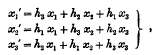
in which the coefficients are real and satisfy the relations

the following expressions, as may at once be verified, are absolute invariants:

On the Computation of a Lagrangian Interpolation
-
- Published online by Cambridge University Press:
- 20 January 2009, pp. 78-82
-
- Article
-
- You have access
- Export citation
On the Failure of Heilermann's Theorem
-
- Published online by Cambridge University Press:
- 20 January 2009, pp. 83-106
-
- Article
-
- You have access
- Export citation
-
The theorem of Heilermann can be stated thus:—
If the series

is converted into a continued fraction of the form

then the elements of the continued fraction are
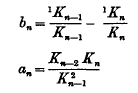
where
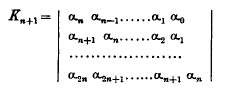
and
 is obtained from this determinant by deleting the (r + 1)th column and the last row.
 is obtained from this determinant by deleting the (r + 1)
List of Members
List of Members—Thirty-Fifth Session, 1916–17
-
- Published online by Cambridge University Press:
- 20 January 2009, pp. 107-114
-
- Article
-
- You have access
- Export citation
Fornt matter
PEM volume 35 Cover and Front matter
-
- Published online by Cambridge University Press:
- 20 January 2009, pp. f1-f5
-
- Article
-
- You have access
- Export citation