Contents
Research Article
Functoriality of the Coniveau Filtration
-
- Published online by Cambridge University Press:
- 20 November 2018, pp. 161-171
-
- Article
-
- You have access
- Export citation
An Infinite Dimensional Vector Space of Universal Functions for H ∞ of the Ball
-
- Published online by Cambridge University Press:
- 20 November 2018, pp. 172-181
-
- Article
-
- You have access
- Export citation
-
We show that there exists a closed infinite dimensional subspace of ${{H}^{\infty }}\left( {{B}^{n}} \right)$ such that every function of norm one is universal for some sequence of automorphisms of ${{B}^{n}}$ .


On the Coxeter Transformations for Tamari Posets
-
- Published online by Cambridge University Press:
- 20 November 2018, pp. 182-190
-
- Article
-
- You have access
- Export citation
Every Real Algebraic Integer Is a Difference of Two Mahler Measures
-
- Published online by Cambridge University Press:
- 20 November 2018, pp. 191-195
-
- Article
-
- You have access
- Export citation
-
We prove that every real algebraic integer $\alpha$ is expressible by a difference of two Mahler measures of integer polynomials. Moreover, these polynomials can be chosen in such a way that they both have the same degree as that of $\alpha$ , say $d$ , one of these two polynomials is irreducible and another has an irreducible factor of degree $d$ , so that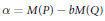 $\alpha =M\left( P \right)-bM\left( Q \right)$ with irreducible polynomials $P,Q\in \mathbb{Z}\left[ X \right]$ of degree $d$ and a positive integer $b$ . Finally, if $d\le 3$ , then one can take $b=1$ .


Plane Quartic Twists of X(5, 3)
-
- Published online by Cambridge University Press:
- 20 November 2018, pp. 196-205
-
- Article
-
- You have access
- Export citation
-
Given an odd surjective Galois representation $\varrho :{{\text{G}}_{\mathbb{Q}}}\to \text{PG}{{\text{L}}_{2}}\left( {{\mathbb{F}}_{3}} \right)$ and a positive integer $N$ , there exists a twisted modular curve $X{{\left( N,3 \right)}_{\varrho }}$ defined over $\mathbb{Q}$ whose rational points classify the quadratic $\mathbb{Q}$ -curves of degree $N$ realizing $\varrho$ . This paper gives a method to provide an explicit plane quartic model for this curve in the genus-three case $N=5$ .


Spherical Space Forms: Homotopy Types and Self-Equivalences for the Group (ℤ/a ⋊ ℤ/b) × SL 2 (
 p )
p )
-
- Published online by Cambridge University Press:
- 20 November 2018, pp. 206-214
-
- Article
-
- You have access
- Export citation
-
Let $G=\left( \mathbb{Z}/a\rtimes \mathbb{Z}/b \right)\times \text{S}{{\text{L}}_{2}}\left( {{\mathbb{F}}_{p}} \right)$ , and let $X\left( n \right)$ be an $n$ -dimensional $CW$ -complex of the homotopy type of an $n$ -sphere. We study the automorphism group $\text{Aut}\left( G \right)$ in order to compute the number of distinct homotopy types of spherical space forms with respect to free and cellular $G$ -actions on all $CW$ -complexes $X\left( 2dn-1 \right)$ , where $2d$ is the period of $G$ . The groups $\varepsilon \left( X\left( 2dn-1 \right)/\mu\right)$ of self homotopy equivalences of space forms $X\left( 2dn-1 \right)/\mu$ associated with free and cellular $G$ -actions $\mu$ on $X\left( 2dn-1 \right)$ are determined as well.


Elliptic K3 Surfaces with Geometric Mordell–Weil Rank 15
-
- Published online by Cambridge University Press:
- 20 November 2018, pp. 215-226
-
- Article
-
- You have access
- Export citation
-
We prove that the elliptic surface ${{y}^{2}}={{x}^{3}}+2\left( {{t}^{8}}+14{{t}^{4}}+1 \right)x+4{{t}^{2}}\left( {{t}^{8}}+6{{t}^{4}}+1 \right)$ has geometric Mordell–Weil rank 15. This completes a list of Kuwata, who gave explicit examples of elliptic $K3$ -surfaces with geometric Mordell–Weil ranks 0, 1, … , 14, 16, 17, 18.

AF-Skeletons and Real Rank Zero Algebras with the Corona Factorization Property
-
- Published online by Cambridge University Press:
- 20 November 2018, pp. 227-233
-
- Article
-
- You have access
- Export citation
-
Let $A$ be a stable, separable, real rank zero ${{C}^{*}}$ -algebra, and suppose that $A$ has an AF-skeleton with only finitely many extreme traces. Then the corona algebra $\mathcal{M}\left( A \right)/A$ is purely infinite in the sense of Kirchberg and Rørdam, which implies that $A$ has the corona factorization property.


A Remark on a Modular Analogue of the Sato–Tate Conjecture
-
- Published online by Cambridge University Press:
- 20 November 2018, pp. 234-242
-
- Article
-
- You have access
- Export citation
-
The original Sato–Tate Conjecture concerns the angle distribution of the eigenvalues arising from non-CM elliptic curves. In this paper, we formulate amodular analogue of the Sato–Tate Conjecture and prove that the angles arising from non- $\text{CM}$ holomorphic Hecke eigenforms with non-trivial central characters are not distributed with respect to the Sate–Tatemeasure for non- $\text{CM}$ elliptic curves. Furthermore, under a reasonable conjecture, we prove that the expected distribution is uniform.

Un nouveau point de repère dans la théorie des formes automorphes
-
- Published online by Cambridge University Press:
- 20 November 2018, pp. 243-267
-
- Article
-
- You have access
- Export citation
-
Ceux qui connaissent l’auteur et ses écrits, comme par exemple $\left[ \text{L1} \right]$ et $\left[ \text{L2} \right]$ , savent que la notion de fonctorialité et les conjectures rattachées à celle-ci ont été introduites —en suivant ce que Artin avait fait pour un ensemble plus restreint de fonctions— pour aborder le problème de la prolongation analytique générale des fonctions $L$ -automorphes. Ils savent en plus que je suis d’avis que seules les méthodes basées sur la formule des traces pourront aller au fond des problèmes. Il n’en reste pas moins que malgré de récents progrès importants sur le lemme fondamental et la formule des traces nous sommes bien loin de notre but.


Award Winners
Research Article
On the Lack of Inverses to C*-Extensions Related to Property T Groups
-
- Published online by Cambridge University Press:
- 20 November 2018, pp. 268-283
-
- Article
-
- You have access
- Export citation
-
Using ideas of S. Wassermann on non-exact ${{C}^{*}}$ -algebras and property $\text{T}$ groups, we show that one of his examples of non-invertible ${{C}^{*}}$ -extensions is not semi-invertible. To prove this, we show that a certain element vanishes in the asymptotic tensor product. We also show that a modification of the example gives a ${{C}^{*}}$ -extension which is not even invertible up to homotopy.


Research Article
Second Order Mock Theta Functions
-
- Published online by Cambridge University Press:
- 20 November 2018, pp. 284-290
-
- Article
-
- You have access
- Export citation
-
In his last letter to Hardy, Ramanujan defined 17 functions $F\left( q \right)$ , where $\left| q \right|<1$ . He called them mock theta functions, because as $q$ radially approaches any point ${{e}^{2\pi ir}}\left( r\,\text{rational} \right)$ , there is a theta function ${{F}_{r}}\left( q \right)$ with $F\left( q \right)-{{F}_{r}}\left( q \right)=O\left( 1 \right)$ . In this paper we establish the relationship between two families of mock theta functions.


Beurling's Theorem and Characterization of Heat Kernel for Riemannian Symmetric Spaces of Noncompact Type
-
- Published online by Cambridge University Press:
- 20 November 2018, pp. 291-312
-
- Article
-
- You have access
- Export citation
On Cauchy–Liouville–Mirimanoff Polynomials
-
- Published online by Cambridge University Press:
- 20 November 2018, pp. 313-320
-
- Article
-
- You have access
- Export citation
-
Let $p$ be a prime greater than or equal to 17 and congruent to 2 modulo 3. We use results of Beukers and Helou on Cauchy–Liouville–Mirimanoff polynomials to show that the intersection of the Fermat curve of degree $p$ with the line $X+Y=Z$ in the projective plane contains no algebraic points of degree $d$ with $3\le d\le 11$ . We prove a result on the roots of these polynomials and show that, experimentally, they seem to satisfy the conditions of a mild extension of an irreducibility theorem of Pólya and Szegö. These conditions are conjecturally also necessary for irreducibility.


