
Contents
Research Article
SURVEY Towards a global view of dynamical systems, for the C1-topology
-
- Published online by Cambridge University Press:
- 31 May 2011, pp. 959-993
-
- Article
- Export citation
On t-entropy and variational principle for the spectral radii of transfer and weighted shift operators
-
- Published online by Cambridge University Press:
- 25 June 2010, pp. 995-1042
-
- Article
- Export citation
A large deviations bound for the Teichmüller flow on the moduli space of abelian differentials
-
- Published online by Cambridge University Press:
- 20 July 2010, pp. 1043-1071
-
- Article
- Export citation
The chaos game on a general iterated function system
-
- Published online by Cambridge University Press:
- 13 September 2010, pp. 1073-1079
-
- Article
- Export citation
On quasi-compact Markov nets
-
- Published online by Cambridge University Press:
- 20 July 2010, pp. 1081-1094
-
- Article
- Export citation
Schmidt’s game, fractals, and orbits of toral endomorphisms
-
- Published online by Cambridge University Press:
- 05 August 2010, pp. 1095-1107
-
- Article
- Export citation
-
Given an integer matrix M∈GLn(ℝ) and a point y∈ℝn/ℤn, consider the set
 S. G. Dani showed in 1988 that whenever M is semisimple and y∈ℚn/ℤn, the set
  has full Hausdorff dimension. In this paper we strengthen this result, extending it to arbitrary M∈GLn(ℝ)∩Mn×n(ℤ) and y∈ℝn/ℤn, and in fact replacing the sequence of powers of M by any lacunary sequence of (not necessarily integer) m×n matrices. Furthermore, we show that sets of the form
  and their generalizations always intersect with ‘sufficiently regular’ fractal subsets of ℝn. As an application, we give an alternative proof of a recent result [M. Einsiedler and J. Tseng. Badly approximable systems of affine forms, fractals, and Schmidt games. Preprint, arXiv:0912.2445] on badly approximable systems of affine forms.
 has full Hausdorff dimension. In this paper we strengthen this result, extending it to arbitrary
  and their generalizations always intersect with ‘sufficiently regular’ fractal subsets of ℝ
Zero-temperature limit of one-dimensional Gibbs states via renormalization: the case of locally constant potentials
-
- Published online by Cambridge University Press:
- 04 June 2010, pp. 1109-1161
-
- Article
- Export citation
Bowen’s equation in the non-uniform setting
-
- Published online by Cambridge University Press:
- 20 July 2010, pp. 1163-1182
-
- Article
- Export citation
A connectedness result for commuting diffeomorphisms of the interval
-
- Published online by Cambridge University Press:
- 04 June 2010, pp. 1183-1191
-
- Article
- Export citation
Period doubling in area-preserving maps: an associated one-dimensional problem
-
- Published online by Cambridge University Press:
- 02 September 2010, pp. 1193-1228
-
- Article
- Export citation
-
It has been observed that the famous Feigenbaum–Coullet–Tresser period-doubling universality has a counterpart for area-preserving maps of ℝ2. A renormalization approach has been used in a computer-assisted proof of existence of an area-preserving map with orbits of all binary periods in Eckmann et al [Existence of a fixed point of the doubling transformation for area-preserving maps of the plane. Phys. Rev. A 26(1) (1982), 720–722; A computer-assisted proof of universality for area-preserving maps. Mem. Amer. Math. Soc. 47 (1984), 1–121]. As is the case with all non-trivial universality problems in non-dissipative systems in dimensions more than one, no analytic proof of this period-doubling universality exists to date. We argue that the period-doubling renormalization fixed point for area-preserving maps is almost one dimensional, in the sense that it is close to the following Hénon-like (after a coordinate change) map:
 where ϕ solves
 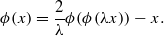 We then give a ‘proof’ of existence of solutions of small analytic perturbations of this one-dimensional problem, and describe some of the properties of this solution. The ‘proof’ consists of an analytic argument for factorized inverse branches of ϕ together with verification of several inequalities and inclusions of subsets of ℂ numerically. Finally, we suggest an analytic approach to the full period-doubling problem for area-preserving maps based on its proximity to the one-dimensional case. In this respect, the paper is an exploration of possible analytic machinery for a non-trivial renormalization problem in a conservative two-dimensional system.
Vanishing transverse entropy in smooth ergodic theory
-
- Published online by Cambridge University Press:
- 27 September 2010, pp. 1229-1235
-
- Article
- Export citation
Fixed points of symplectic periodic flows
-
- Published online by Cambridge University Press:
- 16 June 2010, pp. 1237-1247
-
- Article
- Export citation
-
The study of fixed points is a classical subject in geometry and dynamics. If the circle acts in a Hamiltonian fashion on a compact symplectic manifold M, then it is classically known that there are at least
 fixed points; this follows from Morse theory for the momentum map of the action. In this paper we use Atiyah–Bott–Berline–Vergne (ABBV) localization in equivariant cohomology to prove that this conclusion also holds for symplectic circle actions with non-empty fixed sets, as long as the Chern class map is somewhere injective—the Chern class map assigns to a fixed point the sum of the action weights at the point. We complement this result with less sharp lower bounds on the number of fixed points, under no assumptions; from a dynamical systems viewpoint, our results imply that there is no symplectic periodic flow with exactly one or two equilibrium points on a compact manifold of dimension at least eight.
 fixed points; this follows from Morse theory for the momentum map of the action. In this paper we use Atiyah–Bott–Berline–Vergne (ABBV) localization in equivariant cohomology to prove that this conclusion also holds for symplectic circle actions with non-empty fixed sets, as long as the Chern class map is somewhere injective—the Chern class map assigns to a fixed point the sum of the action weights at the point. We complement this result with less sharp lower bounds on the number of fixed points, under no assumptions; from a dynamical systems viewpoint, our results imply that there is no symplectic periodic flow with exactly one or two equilibrium points on a compact manifold of dimension at least eight.
Period-doubling cascades galore
-
- Published online by Cambridge University Press:
- 03 June 2011, pp. 1249-1267
-
- Article
- Export citation
Corrigenda
Avoiding early closing: ‘Livšic theorems for non-commutative groups including diffeomorphism groups and results on the existence of conformal structures for Anosov systems’ – CORRIGENDUM
-
- Published online by Cambridge University Press:
- 01 November 2010, pp. 1269-1272
-
- Article
-
- You have access
- Export citation
Front Cover (OFC, IFC) and matter
ETS volume 31 issue 4 Cover and Front matter
-
- Published online by Cambridge University Press:
- 12 July 2011, pp. f1-f2
-
- Article
-
- You have access
- Export citation
Back Cover (IBC, OBC) and matter
ETS volume 31 issue 4 Cover and Back matter
-
- Published online by Cambridge University Press:
- 12 July 2011, pp. b1-b8
-
- Article
-
- You have access
- Export citation