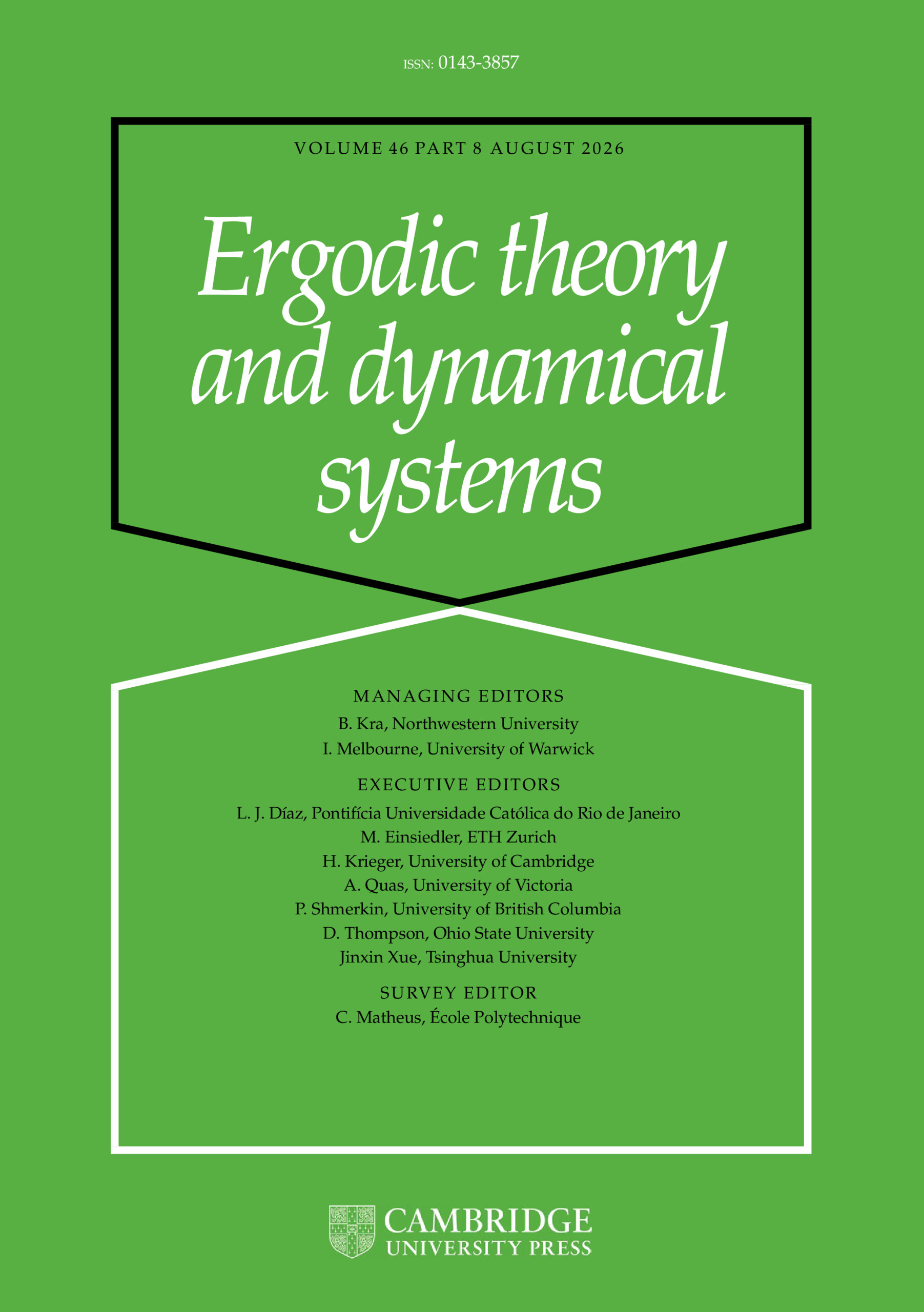
Volume 46 - Issue 8 - August 2026
Latest issue of Ergodic Theory and Dynamical Systems
Contents
Original Article
The two-boost problem and Lagrangian Rabinowitz Floer homology
- Part of:
-
- Published online by Cambridge University Press:
- 10 April 2026, pp. 1877-1935
-
- Article
-
- You have access
- Open access
- HTML
- Export citation
Regularity of the variance in quenched CLT for random intermittent dynamical systems
- Part of:
-
- Published online by Cambridge University Press:
- 07 April 2026, pp. 1936-1968
-
- Article
- Export citation
Bounded geodesics on locally symmetric spaces
- Part of:
-
- Published online by Cambridge University Press:
- 07 April 2026, pp. 1969-1993
-
- Article
- Export citation
-
Let $\Gamma $
 be a torsion-free subgroup of $\mathrm {SL}_3(\mathbb {R})$
 commensurable with $\mathrm {SL}_3(\mathbb {Z})$
 , and $Y=\mathrm {SO}_3(\mathbb {R})\backslash \mathrm {SL}_3(\mathbb {R})/\Gamma $
 be endowed with the natural locally symmetric space structure. We prove that for any point $y\in Y$
 , the set of directions in which the geodesic ray starting from y is bounded in Y, is hyperplane absolute winning.


Square functions and variational estimates for Ritt operators on $L^1$

- Part of:
-
- Published online by Cambridge University Press:
- 17 April 2026, pp. 1994-2017
-
- Article
-
- You have access
- Open access
- HTML
- Export citation
-
A power-bounded operator T satisfying $\sup _n n\lVert T^n-T^{n+1}\rVert <\infty $
 is a Ritt operator. For such operators, we study the generalized square function $Q_{\alpha ,s,r}^Tf=(\sum _n n^{\alpha } |T^n(I-T)^rf|^s)^{1/s}$
 . It is known that when T is a positive contraction and a Ritt operator on $L^p$
 , $1<p<\infty $
 , then for any integer $r\ge 1$
 , the square function $Q_{2r-1,2,r}^Tf$
 defines a bounded operator [17] on $L^p$
 . In this work, we extend the theory to the endpoint case $p=1$
 . We show that if T is a Ritt operator on $L^1$
 , then the generalized square function $Q_{\alpha ,s,r}^Tf $
 is bounded on $L^1$
 whenever $\alpha +1<sr$
 . In the particular setting where T is a convolution operator of the form $T_{\mu }=\sum _k \mu (k) U^kf$
 , with $\mu $
 a probability measure on $\mathbb Z$
 and U the composition operator induced by an invertible measure-preserving transformation, we provide sufficient conditions on $\mu $
 under which $Q_{2r-1,2,r}^{T_{\mu }}f$
 is of weak type $(1,1)$
 , for $r>0$
 . We also establish bounds for variational and oscillation norms, $\lVert n^{\beta } T^n(1-T)^r\rVert _{v(s)}$
 and $\lVert n^{\beta } T^n(1-T)^r\rVert _{o(s)}$
 , for Ritt operators, highlighting endpoint behavior.


Feldman–Katok pseudometric and the GIKN non-hyperbolic ergodic measures
- Part of:
-
- Published online by Cambridge University Press:
- 07 April 2026, pp. 2018-2046
-
- Article
-
- You have access
- Open access
- HTML
- Export citation
-
We introduce Feldman–Katok convergence for invariant measures of a topological dynamical system. This can be seen as a counterpart to the convergence with respect to the $\bar {f}$
 -metric for finite-state stationary processes (shift-invariant measures on a symbolic space). Feldman–Katok convergence is based on a dynamically defined Feldman–Katok pseudometric. This convergence is stronger than weak$^*$
 convergence. We prove that Feldman–Katok convergence preserves ergodicity and makes the Kolmogorov–Sinai entropy lower semicontinuous, thereby preserving zero entropy. We apply our findings to non-hyperbolic (having at least one vanishing Lyapunov exponent) ergodic measures constructed using the GIKN method as axiomatized by Bonatti, Díaz and Gorodetski [Nonlinearity, 23 (2010), 687–705]. The GIKN method, originally introduced by Gorodetski, Ilyashenko, Kleptsyn and Nalsky [Functional Analysis and its Applications, 39 (2005), 21–30], has been widely adapted to produce non-hyperbolic ergodic measures for diffeomorphisms of compact manifolds. We prove that an ergodic measure satisfying the conditions provided by the axiomatized GIKN method is the Feldman–Katok limit of a sequence of periodic measures, which implies that it is either a periodic measure or a loosely Kronecker measure (a measure Kakutani equivalent to an aperiodic ergodic rotation on a compact group) and has zero entropy. This classifies all these measures up to Kakutani equivalence and confirms that geometric constructions of non-hyperbolic measures via periodic approximations based on the axiomatized GIKN method presented in Bonatti et al. [op. cit.] systematically produce zero-entropy systems.


A saturated theorem along cubes for a measure and applications
- Part of:
-
- Published online by Cambridge University Press:
- 24 February 2026, pp. 2047-2075
-
- Article
- Export citation
-
We show that for a minimal system $(X,T)$
 , the set of saturated points along cubes with respect to its maximal $\infty $
 -step pro-nilfactor $X_\infty $
 has a full measure. As an application, it is shown that if a minimal system $(X,T)$
 has no non-trivial $(k+1)$
 -tuples with arbitrarily long finite IP-independence sets, then it has only at most k ergodic measures and is an almost $k'$
 to one extension of $X_\infty $
 for some $k'\leqslant k$
 . In particular, for $k=1$
 , we prove that $(X,T)$
 is uniquely ergodic (even regular with respect to $X_\infty $
 ), which answers a conjecture stated by Dong et al [Infinite-step nilsystems, independence and complexity. Ergod. Th. & Dynam. Sys. 33(1) (2013), 118–143].


$\mathbf {\textit {U}}$
 -Gibbs measure rigidity for partially hyperbolic endomorphisms on surfaces
- Part of:
-
- Published online by Cambridge University Press:
- 26 March 2026, pp. 2076-2130
-
- Article
- Export citation
-
We prove that, for a $C^2$
 partially hyperbolic endomorphism of the 2-torus which is strongly transitive, given an ergodic u-Gibbs measure that has positive center Lyapunov exponent and has full support, then either the map is special (has only one unstable direction per point) or the measure is the unique absolutely continuous invariant measure. We can apply this result in many settings, in particular, obtaining uniqueness of u-Gibbs measures for every non-special perturbation of irreducible linear expanding maps of the torus with simple spectrum. This gives new open sets of partially hyperbolic systems displaying a unique u-Gibbs measure.


On the structure of sequences with minimal maximal pattern complexity
- Part of:
-
- Published online by Cambridge University Press:
- 17 April 2026, pp. 2131-2148
-
- Article
-
- You have access
- Open access
- HTML
- Export citation
-
In 2002, Kamae and Zamboni [Ergod. Th. & Dynam. Sys. 22(4) (2002), 1191–1199] introduced maximal pattern complexity and determined that any aperiodic sequence must have maximal pattern complexity at least $2k$
 . In 2006, Kamae and Rao [European J. Combin. 27(1) (2006), 125–137] examined the maximal pattern complexity of sequences over larger alphabets and showed that sequences which have maximal pattern complexity less than $\ell k$
 , for $\ell $
 the size of the alphabet, must have some periodic structure. In this paper, we investigate the structure of sequences of low maximal pattern complexity over $\ell $
 letters, where $\liminf _{k \to \infty } p_{\alpha }^*(k) - 3k = -\infty $
 . In addition, we show that the minimal maximal pattern complexity of an aperiodic sequence which uses all $\ell $
 letters is $p_{\alpha }^*(k) = 2k + \ell -2$
 and give an exact structure for aperiodic sequences with this maximal pattern complexity.


Front Cover (OFC, IFC) and matter
ETS volume 46 issue 8 Cover and Front matter
-
- Published online by Cambridge University Press:
- 07 July 2026, pp. f1-f2
-
- Article
-
- You have access
- Export citation
Back Cover (OBC, IBC) and matter
ETS volume 46 issue 8 Cover and Back matter
-
- Published online by Cambridge University Press:
- 07 July 2026, pp. b1-b2
-
- Article
-
- You have access
- Export citation