

1. Introduction
Human beings take territoriality to an extreme level. As a species, we seem very strongly predisposed towards partitioning and demarcating our spatial surroundings for the purposes of controlling access to natural resources and maintaining oversight of the activities of other individuals and groups. This apparent imperative is not enacted in an arbitrary or unconstrained way, of course: the earth’s surface is already divided into zones according to geographical terrain, habitat type, and climatic factors, and the boundaries between these zones are sometimes abrupt rather than gradual. Deserts, rivers, lakes, and mountain ranges can be significant obstacles to movement, and the oceans present barriers that have been insuperable for the great majority of human history. Within these limits, though, we have sought to carve up the earth’s land surface into larger and smaller units in ways that, in time, come to seem natural or inevitable. The processes by which borders between territories are rationalised and justified are complex and fascinating ones, combining as they do the collective histories and mythologies of tribal groups, religious and ethnic ideologies and, latterly, the political states that co-exist at the global level. Rather soon after a new state is founded, its inhabitants may come to believe that the status quo is effectively how things have always been, and that it could not tolerably be any other way (see Breuilly Reference 211Breuilly and Breuilly2013).
It seems almost self-evident that language plays a crucial part in how territories bounded by borders with their neighbours are defined. In the early nineteenth century – this side of the watershed in European political history that has been dubbed ‘The Great Divide’ (Burke Reference Burke and Breuilly2013: 21) – the emergent nation states of Europe sought to codify national languages that would be spoken everywhere that fell under the state’s control, right up to the territory’s outermost edges. A common language would, it was thought, help to unite citizens of the same state who might previously have felt more affinity with their neighbours just across the border than they did with the inhabitants of a distant capital city or remote provinces hundreds or even thousands of miles away. However, two centuries of language standardisation, linguistic prescriptivism, and the suppression of minority languages and dialects did not wipe the European map clean of state-internal linguistic variation as many of the founders of the nation states might have wished. Although a lamentably large number of European languages and dialects have been lost in recent centuries, some minority varieties have been remarkably tenacious. Others have flourished as, following the quite sudden volte face in late twentieth century national language planning policies across Europe, relegitimated ethnic identities and linguistic traditions have been given governmental endorsement and financial support, and celebration of cultural diversity is now strongly encouraged (Baldauf and Kaplan Reference Baldauf and Kaplan2006). In a significant number of cases, the areas in which minority languages and dialects are spoken straddle international borders, producing especially fruitful contexts in which to explore the dynamics of the interaction between language and identity.
It must not be supposed, having said this, that only minority languages and dialects are worth considering in such borderland contexts. It is equally interesting to consider how speakers of powerful majority languages like English make use of linguistic resources to mark their national and regional affiliations at state boundaries. The border between the Republic of Ireland and Northern Ireland, for instance, has been the focus of a number of studies (Zwickl Reference Zwickl2002; Kallen Reference Kallen, Watt and Llamas2014), as has that between the United States and Canada (Chambers Reference Chambers1995; Dollinger Reference Dollinger2012; Boberg Reference Boberg, Llamas and Watt2014). In each of these contexts, and others like them, the complex connections between linguistic behaviour, identity, and place are particularly intriguing to social scientists, not least sociolinguists. In this chapter we consider further the last of these concepts as it relates to the language and identity issues in the Scottish-English border area.
2. Place
Later in this chapter we will look more closely at aspects of how the distributions of linguistic forms in the Scottish-English borderland correlate with identity factors, and how these forms are used to encode information about place. First, though, it is worth posing the following question. What, in fact, do we mean by ‘place’? The Oxford English Dictionary defines the term in two different ways. The first set of definitions, which relate to space or location, are what we might call the ‘literal’ ones:
a. A particular part or region of space; a physical locality, a locale; a spot, a location. Also: a region or part of the earth's surface; 10. A particular spot or area inhabited or frequented by people; a city, a town, a village.
These are, in other words, positions which do not necessarily bear any direct relation to entities found within them, but which might merit identification as a discrete position in space by virtue of their significance to human habitation or activities.
Secondly, there are somewhat more figurative definitions, which pertain to position or situation with reference to its occupation or its occupant, for example:
a. A proper, appropriate, or natural position or spot (for a person or thing).
When we talk of people ‘being in place’, ‘finding their place’, ‘having their proper place’, ‘being well placed to do something’, or ‘having a firm place to stand’, we are not necessarily talking about their physical location. Place is about geographical positions that can be pointed to on maps or identified using GPS coordinates, to be sure, but it is also about states of mind, stances and attitudes, and the status that individuals hold within their social networks and society at large. We will focus in this chapter chiefly on place in its more concrete senses, but will not neglect the other ways in which the concept of place can inform how we interpret our linguistic data.
The notion of place has been subjected to a number of stringent theoretical treatments since classical times, and has come to preoccupy scholars across a spectrum of research disciplines including linguistics (see Auer and Schmidt Reference Auer and Schmidt2010; Auer et al. Reference Auer, Hilpert, Stukenbrock and Szmrecsanyi2013) and also encompassing cognitive and social psychology, geography, history, anthropology, town and transport planning, communications and informatics, archaeology, and numerous others (see Scheider and Janowicz Reference Scheider and Janowicz2010, Reference Scheider and Janowicz2014; Winter and Freksa Reference Winter and Freksa2012; Raubal et al. Reference Raubal, Mark and Frank2013; Richter and Winter Reference Richter and Winter2014). Scheider and Janowicz’s (Reference Scheider and Janowicz2010: 1) ‘requirements for non-reductionist accounts of place’, which build on the work of human geographers concerned with the ‘phenomenological aspect’ of place, are comprised of the following axioms:
1) Places are located, but are not locations.
2) Places are primary categories of human experience and social constructs.
3) Places have stabilizing functions that afford insideness.
4) Places have material settings (surface layouts).
In (1), we can talk of places which are not locations as such, in that they are potentially mobile (e.g. the deck of a ship, or a market which might appear only once a week and perhaps in different locations). Places must also be distinguished from locations, according to (2), in that locations can feasibly be anywhere and hence are isomorphic and arbitrary, whereas places are ‘meaningful aspects of human experience [that] involve emotional attachment and social identification’ (Scheider and Janowicz Reference Scheider and Janowicz2010: 1–2). Naming, or the association of linguistic forms with places, is a crucial component of their construction as places. Thirdly, the functions of places to ‘stabilise’ or arrest motion, as in (3), give them sets of properties that ‘fix mutual expectations among people, allowing them to meet and communicate’ (Scheider and Janowicz Reference Scheider and Janowicz2010: 2). Finally, (4) proposes that places ‘always have a concrete identifiable material form’ (Scheider and Janowicz Reference Scheider and Janowicz2010: 2). This might seem too narrow a requirement when one considers that places need not exist in any objective sense (where, e.g., are ‘the developed world’, ‘suburbia’, or ‘the street’?). However, Scheider and Janowicz extend the scope of Gibson’s (Reference Gibson1979) term surface layout to imagined places, which can be argued to share properties, if only on the conceptual level, with physically observable places.
It is worth stressing the point that even in work on place that derives from research in fields quite far removed from linguistics, matters of language are often ascribed an important, even crucial, role. Places become part of the social environment through being thought significant enough to be given names, and language is of course the principal medium by which these names and other information about places are transmitted across space and time. Language is also used as a proxy for place, in the sense that pronunciations, grammatical structures, words, and writing systems come to be associated with particular localities or regions, meaning that we can deploy linguistic resources to index non-linguistic information about our geographical provenance. Moreover, the choices that speakers make among alternative forms in their linguistic repertoires act as signals that help listeners to align speakers with relevant ingroups and outgroups. Discovering how this kind of knowledge is acquired and activated in interactions is of course one of the key objectives of sociolinguistic inquiry.
The theorisation of place and space in sociolinguistic research has progressed significantly in recent decades, thanks to the work of scholars such as Peter Auer, Joan Beal, David Britain, and Barbara Johnstone (e.g. Beal Reference Beal2006; Auer and Schmidt Reference Auer and Schmidt2010; Britain Reference Britain, Llamas and Watt2010, 2014, this volume; Johnstone Reference Johnstone, Auer and Schmidt2010, this volume; Auer et al. Reference Auer, Hilpert, Stukenbrock and Szmrecsanyi2013). Britain proposes a taxonomy of space which depends on its conceptualisation as simultaneously physical, social, and perceptual. Physical space, he argues, is objective and geometric. In this view, space is scaled linearly, such that if measured in miles or kilometres, places X and Y could be said to be the same distance apart as Y and Z. However, with respect to social distance, the gap between X and Y may be much larger than that between Y and Z. An international border may divide X and Y, for example. But even within contiguous territories, social space may present bigger divides than geography alone would predict. There are many cities around the world in which adjacent neighbourhoods may be so socioeconomically segregated (e.g. an exclusive gated community abutting a shanty town) that the inhabitants of the respective communities may never come into contact with one another. The residents of the affluent neighbourhood may have much higher levels of interaction with people from a similar suburb miles across the city. The mapping of social space onto physical space may thus be complex and distorted.
Perceptual space, finally, is a useful notion when attempting to understand how people construct their perceptions of the world around them, and how they orient to their ‘home patch’ and to places that are physically or socially removed from it. Inhabitants of a community which is well connected by transport links to a large faraway city may think of it as closer in some sense than a nearby town which is poorly connected to their own. Issues such as journey time may be a major factor in how the space is perceived, but other relevant psychological factors might include whether a state or provincial boundary intervenes, or whether there is a significant geographical barrier (for instance, a large river or mountain range) between two places. Britain (Reference Britain, Chambers, Trudgill and Schilling-Estes2002, Reference Britain, Llamas and Watt2010, Reference Britain, Chambers and Schilling2013) argues that perceptual space is constructed by people’s everyday practices, and that ‘place’ and ‘region’ emerge through the routinisation of these practices. That is, through the mundane day-to-day routines that people perform – such as travelling to work, shops, or leisure facilities – locations and areas acquire coherence in psychological space that need not map in any direct way to physical geography. Viewed in this way, place can be seen as a ‘process’ that is shaped by practice, operating within the constraints of institutional and infrastructural factors. Factors of the latter sort may force the inhabitants of a place to revise their notions of social and perceptual space: a stark example from recent British history would be the radical reconfigurations of social networks caused by the relocation of city-centre slum dwellers to peripheral housing estates during the post-war period. Perceptions of distance and proximity were also influenced by the closure of large sections of the UK’s railway network during the 1960s, and then changed again by a growth in car ownership (Vannini Reference Vannini2010).
On a subtler level, the reassignation of some towns and cities to new higher-order political units (such as counties, states) may affect how people see themselves. As Beal (Reference Beal, Llamas and Watt2010: 225) puts it, ‘the stroke of a bureaucrat’s pen can have as much effect on a speaker’s sense of place and identity as … innovations in transport infrastructure and communication’. The potential knock-on effects of this kind of restructuring of social and perceptual space on speakers’ linguistic behaviour has been investigated by Llamas (Reference Llamas2007) in the north-eastern English town of Middlesbrough. Middlesbrough was originally in the North Riding of Yorkshire but was subsequently reallocated to the County Borough of Teesside (1968), then to a new county (Cleveland, in 1974), and finally to its own unitary authority (1996). Llamas found correlations between the distribution in informants’ speech of a range of consonants and vowel variants, the political unit to which Middlesbrough belonged during individual speakers’ formative years, and the identity labels that speakers assigned to themselves, to indicate that they thought of themselves as natives of Yorkshire, Teesside or Middlesbrough.
Beal (Reference Beal, Llamas and Watt2010) reports something similar for Warrington, in north-west England, which became part of Cheshire after a redrawing of local county boundaries divided it from its original county of Lancashire. That decision met resistance among some older Warringtonians, many of whom cleave to Warrington’s historical links with the working-class ‘northern’ culture of Lancashire and resent the association of the town with the north-midland county of Cheshire, a relatively affluent part of England widely perceived to be ‘middle-class’. These perceptions may mean little to young Warringtonians, however, whose view of their hometown appears to be influenced less – perhaps not at all – by its erstwhile Lancastrian affiliation. As Beal points out, place ‘is not a given, to be taken for granted in our research designs: what appears to be a town or city delimited by boundaries on the map may actually be several different places to different groups of speakers, whose allegiance to these “places” may be indexed by linguistic variables’ (Beal Reference Beal, Llamas and Watt2010: 226).
As test sites for the investigation of how linguistic behaviour is connected to identities and perceptions of place, boundary zones of this kind could scarcely be bettered. Long-standing political divides, such as those between Britain’s historic counties, or indeed between the constituent countries of the United Kingdom, are ideal. It was for this reason that the Scottish-English border area was identified as a zone of particular sociolinguistic interest. It must also be acknowledged that the presence of the Scots language in the region weaves additional threads into the local linguistic fabric, but because English was the language spoken by all our informants as well as by our interviewer, we will not concern ourselves here with questions of the degree to which local people have competence in Scots per se.
3. The AISEB Project
The Accent and Identity on the Scottish/English Border (AISEB) project Footnote 1 sought to address a number of problematic questions concerning the degree to which impedance of the progress of sound changes can be attributed to identity factors and attitudes among speakers, and the part that speaker agency may play in the synchronic and diachronic distribution of phonological forms (Llamas Reference Llamas, Llamas and Watt2010; Watt et al. Reference Watt, Llamas, Johnson and Lawson2014a, Reference Watt, Llamas, Docherty, Hall, Nycz, Watt and Llamas2014b; Reference Watt, Llamas, Kendall and Fabricius2014c). Rather than attempt to survey every community along the border’s length, we opted to collect sociolinguistic data in four towns: Gretna (Scotland) and Carlisle (England) at the border’s western end, and Eyemouth (Scotland) and Berwick upon Tweed (England) at its eastern end (Figure 9.1).

Figure 9.1: Map of Scottish-English border region, showing the four fieldwork sites (labels in bold type).
Our initial hypotheses led us to expect that the speech patterns of people on the Scottish side of the border would differ markedly from those of people living just a few miles away on the English side, not least because the existing dialectological literature seemed unequivocally to suggest that the political border coincides with an entrenched linguistic divide (e.g. Ellis Reference 212Ellis1889; Zai Reference Zai1942; Kolb Reference Kolb1966; Kolb et al. Reference Kolb, Glauser, Eimer and Stamm1979; Aitken Reference Aitken and McArthur1992; Glauser Reference Glauser2000). There were also good grounds for thinking that towns at either end of the border would be sociolinguistically divergent from one another, even if they were in the same country (e.g. Gretna versus Eyemouth), owing to their geographical separation and a lack of significant contact between their inhabitants.
We also thought it important to take account of the presence of the border from the socio-psychological point of view, through probing people’s attitudes towards it. Political borders are objective boundaries insofar as they may be physically visible (fences, walls, signage, customs posts, clear-cut felling lines through forests) and/or can be pointed to on maps, and to that extent we may suppose there to be an absence of variation in how they are perceived. However, for those living in close proximity to a border, and assuming that their movement across it is not restricted, borders may acquire more subjective, symbolic qualities (Diener and Hagen Reference Diener and Hagen2010; Donnan and Wilson Reference Donnan and Wilson2010). The border may be perceived and evaluated differently by inhabitants living on either side of it, and even by people living in the same locality. In the case of the four towns investigated in the AISEB study, it seemed plausible that being close to the border might be a common factor that lent a sense of common identity to people in the four towns. Though physically at the margins of their respective nations, the towns may alternatively be seen as being at the centre of a borderland region that straddles the political divide. The border, in other words, might not be defined principally by its demarcative properties that emphasise difference, but could be seen as something that gives people in towns on either side of it a sense of affinity as ‘borderlanders’. Indeed, the region is sometimes termed ‘The Borders’, though the tendency is now to use this name just for the Scottish part of the area (‘Scottish Borders’ is the official name for the unitary authority that now subsumes the old counties of Berwickshire, Peeblesshire, Roxburghshire, and Selkirkshire). But even in a region where the border may be crossed freely, it does not necessarily follow that sharp inter-group categorisations will not emerge and persist, as theorists of borderlands such as David Newman (Reference 213Newman2006) have demonstrated. Linguistic behaviour is arguably the foremost member of the suite of cues that borderlanders can draw upon to flag their allegiances and stances. In the following section we examine one facet of the AISEB informants’ speech production, by way of illustrating this principle.
3.1 AISEB Project Design
AISEB took a tripartite approach to the analysis of sociophonetic variation in the Scottish/English border region, by gathering data on speech production, social/political/linguistic attitudes and identity factors, and speech perception. Focussing solely upon production patterns would reveal little about informants’ motivations for adopting or resisting phonological changes, and it could tell us only indirectly about their subjective evaluations of the pronunciations used by speakers in and beyond the fieldwork sites. We therefore attempt to integrate the three types of evidence, such that, as well as seeing how speech forms are distributed in the region, we may also come closer to understanding why the observed patterns of linguistic variation and change come about.
A total of 160 speakers (40 per town), balanced according to gender and age group (Young = 16–25; Older = 57+), were recruited via the ‘snowball’ method (Milroy and Gordon Reference Milroy and Gordon2003) and interviewed for the most part in self-selected pairs in their own homes or another familiar setting. They were assigned to two social class groups (working and middle-class) according to educational criteria. Samples of read speech (word lists, text passages) were collected, but the majority of the interview was based on a questionnaire designed to elicit responses on topics relating to attitudes towards the border and the linguistic habits of people living near it, national identities (Scottish, English, British), social and political orientations, relevant ingroups and outgroups, and other issues of local concern. Interviewees were recorded using Marantz and Zoom solid-state digital recorders with professional-quality external microphones.
The variable we examine in the sections that follow is the voice onset time (VOT) of the stop consonants /p t k b d ɡ/, which was hypothesised to vary in line with the location and age groups of our speakers. We then assess the patterns in the production data in the light of responses that our informants gave to the questionnaire. We opted to focus on VOT as a phonetic feature that is relatively subtle compared to other features examined in the AISEB material, in order to look closely at comparatively non-salient speech parameters (that may vary systematically in line with non-linguistic factors), alongside features that speakers are more likely to be consciously aware of. Finding consistent patterns correlating with locality, speaker age, gender, and so forth, would lend weight to our claims that the speech of people in this region is influenced by the proximity of the border in ways that are unlikely to be under their conscious control.
3.2 Voice Onset Time
VOT is a measure of the lag between the release of the stop closure (‘occlusion’) and the onset of voicing for the following vowel. English is usually said to feature short-lag VOT for /b d ɡ/ and long-lag VOT for /p t k/, with substantial post-aspiration accompanying the latter set where they occur in initial pre-vocalic positions (Lisker and Abramson Reference Lisker and Abramson1964; Docherty Reference Docherty1992), but there are varieties for which typical values are lower across the board, notably in southern Scotland (Johnston Reference Johnston and Jones1997; Scobbie Reference Scobbie, Goldstein, Whalen and Best2006; Watt and Yurkova Reference Watt and Yurkova2007). Given the heavy functional load of the stop consonants in English, there is likely to be considerable pressure to maintain audible phonetic distinctions between the pairs /p b/, /t d/ and /k ɡ/, such that if aspiration on /p t k/ is minimal there is a greater likelihood of finding negative VOT values (‘pre-voicing’) among tokens of /b d ɡ/, as per the contrasts found in languages like French and Spanish (Lisker and Abramson Reference Lisker and Abramson1964; Cho and Ladefoged Reference Cho and Ladefoged1999). It has also been claimed that the stop consonants in some accents of northern England are characterised by somewhat shorter VOT values than those reported for British Received Pronunciation (Lodge Reference Lodge1966; Wells Reference 214Wells1982; Catford Reference Catford1988). We have reasons to expect, then, that in the four borderland varieties investigated here we will observe relatively short VOT values for /p t k b d ɡ/, with the difference being more pronounced on the Scottish side of the border.
The data discussed in Section 3.4, which were originally described in Docherty et al. (Reference Docherty, Watt, Llamas, Hall and Nycz2011), are drawn exclusively from the read material, so as to reduce the effects of interspeaker variation in speech rate and stress placement, and to maximise lexical comparability from speaker to speaker.
3.3 Method
VOT values were measured using Praat (Boersma and Weenink Reference Boersma and Weenink2014) for a total of approximately 4,600 tokens of word- or syllable-initial pre-vocalic /p t k b d ɡ/, drawn from the AISEB wordlist and text passage recordings. The VOT interval was defined by the portion of the pressure waveform lying between the abrupt transient signalling the stop release, and the start of the first complete phonation cycle corresponding to the periodic vibration of the vocal folds, i.e. voicing (Foulkes et al. Reference Foulkes, Docherty, Jones, Di Paolo and Yaeger-Dror2010; Thomas Reference Thomas2011).
The data were then subjected to multiple regression analysis using the lme4 library in R to investigate the magnitude of the effects on VOT distribution of the following non-linguistic variables: Nation (England vs. Scotland), Coast (west vs. east), and Speaker, the last of which subsumed the variables Age (older vs. young), Sex (male vs. female) and Class (working vs. middle). All of these were treated as fixed effects; additional models in which Speaker was included as a random effect made a negligible difference to the results, so we report below on the fixed-effects models only. Two separate analyses were run: one for the voiced stops (/b d ɡ/ together), the other for the voiceless stops (/p t k/ together).
3.4 Results
Figure 9.2 shows, in the form of probability density function curves, the VOT results for the /p t k/ and /b d ɡ/ sets pooled across place of articulation within each set, for each of the four fieldwork sites. Speaker age is also represented, where the solid lines represent the data for older speakers and the dashed lines those for young speakers.

Figure 9.2: VOT values (represented by probability density functions) across the four AISEB fieldwork sites, split by speaker age group (solid lines = older speakers; dashed lines = young speakers). The pooled results for /b d ɡ/ are shown in the upper panel in each pair (‘voiced’), those for /p t k/ in the lower panel (‘voiceless’).
It is immediately clear that there are differences in each town with respect to age group, particularly for /b d ɡ/ (main effect for speaker age: t1,1337 = 20.02, r2 = 0.2589, p < 0.001).Footnote 2 In the upper panel of each pair, the curve for the young group is a sharp peak centred on approximately 20 milliseconds (ms), while the corresponding curves for the older speakers in each town are bimodal, and consequently considerably flatter. The bimodality – which is not unexpected for English (see Lisker and Abramson’s [Reference Lisker and Abramson1964] results for American English) – indicates significant levels of pre-voicing, with VOT values tending to cluster between −50 and −100ms. In all four cases the other peak falls within the same positive VOT range as that found for the young speakers. The older speakers, in other words, use a combination of long-lead and short-lag VOT for /b d ɡ/, while the young speakers favour short-lag VOT almost exclusively (see the very similar results for Aberdeen English reported by Watt and Yurkova Reference Watt and Yurkova2007). It is also noticeable that for Eyemouth, unlike the other three localities, the peak corresponding to pre-voiced tokens is more prominent than that for the short-lag VOT tokens, skewing the density curve markedly leftwards.
Looking next at the pooled data for the voiceless set /p t k/, it appears that there are small but consistent differences between the age groups in each town. Again, the VOT values for the young speakers are higher overall, as we might predict if contrast between the voiced and voiceless sets is to be maintained (/p t k/ main effect for age: t1,3313 = 16.15, r2 = 0.1693, p < 0.001). As we saw for /b d ɡ/, the VOT values for older Eyemouth speakers are on average the lowest of the four communities. This finding is in line with Johnson’s (Reference Johnston and Jones1997) account of VOT in Scots-influenced varieties of English spoken in the Scottish Borders, whereby a lack of aspiration on /p t k/ correlates with a greater incidence of zero or negative VOT in the /b d ɡ/ set.
Overall, for /p t k/, the average VOT for the two Scottish varieties is lower by approximately 10ms than it is for the two English ones. Although the difference is a slight one, and there is a substantial overlap in the distributions, it nonetheless yields a significant effect for the Nation variable (t1,3313 = 14.19, r2 = 0.1693, p < 0.001). There is also an east/west split, with Eyemouth and Berwick having shorter /p t k/ VOT values than Gretna and Carlisle (effect for Coast: t1,3313 = 7.40, r2 = 0.1693, p < 0.001). Durational differences on this scale are not imperceptibly small: experimental studies have shown listeners to be sensitive to discrepancies in VOT values of as little as 10ms (Cole et al. Reference Cole, Jakimik and Cooper1978; Blumstein et al. Reference Blumstein, Myers and Rissmann2005).
Before proceeding any further, it is important to consider the results of studies that have shown a link between speaker age and VOT (Benjamin Reference Benjamin1982; Liss et al. Reference Liss, Weismer and Rosenbek1990; Ryalls et al. Reference Ryalls, Zipprer and Baldauff1997; Torre and Barlow Reference Torre and Barlow2009). Their findings reveal that, as a result of physiological changes, older speakers tend to use shorter VOT durations than younger speakers. The age effect found in the present study supports that generalisation. It does not explain, however, why the disparities in VOT values between the age groups are different across the four towns, nor why the Nation and Coast variables also appear to have an influence on VOT durations. We would suggest instead that the use of longer and shorter VOT among the AISEB speakers is related to attitudes and identity in the area, about which we say more in the following section.
4. Identity Factors
In view of its long history as a zone of conflict and contestation, and lately as a focal point for questions pertaining to issues of political autonomy – questions that culminated in the 2014 independence referendum (see, for instance, Daniel Reference Daniel2014)Footnote 3 – the Scottish-English border region is fertile ground for the investigation of social and political attitudes. The AISEB interviews were completed in 2011, prior to the announcement of the referendum but well after the establishment of the Scottish Parliament in 1999, so questions relating to the benefits or otherwise of recent and potential future constitutional changes were a reliable way of garnering opinions from interviewees.
Accompanying these relatively weighty questions were ones which sought information about participants’ attitudes towards the local area (including questions concerning the border in particular), their day-to-day routines, and how language is used in the region. Examples of the set of twenty-one identity questions are shown below.
If you were watching a regional news programme, what places would you expect to hear news from?
If you wanted a day out shopping, where would you go?
How often do you cross the border?
Do you see the border as a divide of some sort?
Where, geographically, would you say people stop talking the same as you and start sounding different?
Are there any pronunciations or ways of saying things that you would hear and think, that sounds really Scottish or really English?
Participants were also asked to complete tasks based upon Visual Analogue Scales (VAS; Redinger and Llamas Reference Redinger, Llamas, Watt and Llamas2014; Llamas and Watt Reference Llamas and Watt2015). In one task a VAS was used as a means of quantifying a participants’ strength of agreement with authentic statements made by people from one of the four AISEB localities – for example, ‘I’ve been abroad and everybody thinks about Britain as England so when they’re talking about Britain, they’re really talking about England’– by drawing a vertical stroke somewhere along a horizontal line representing a continuum between ‘agree’ and ‘disagree’. In another task, the one we focus on in the present chapter, participants drew multiple vertical lines across a ‘most important’ to ‘least important’ cline (the ‘Relational Analogue Scale’, RAS) to represent identity labels they felt applied to them. A list of suggested labels was shown above the RAS, tailored to the locality in question. In Gretna, for instance, the suggested labels were Borderer, British, English, European, from Gretna and Scottish (Figure 9.3).
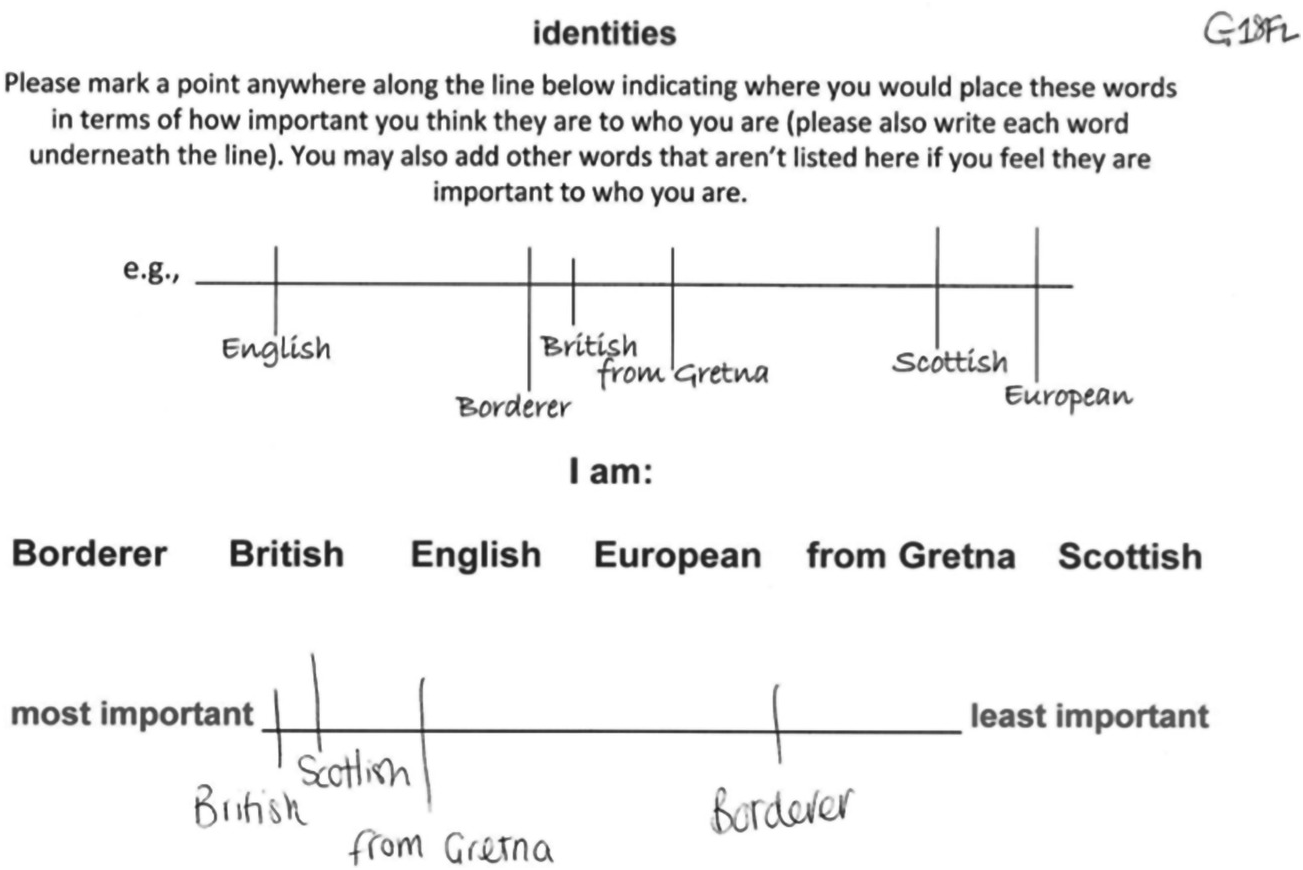
Informants could opt to place all, any, or none of these along the RAS cline, and were free to add labels of their own choosing. The completed RAS thus shows not just the ranking of labels along a gradient of importance, it also allows the fine-grained measurement of distances between each vertical stroke and (a) the ends of the RAS cline and (b) the other vertical strokes. The latter was achieved by scanning the hard copies of the RAS and using an on-screen measuring tool in the software package ImageJ.Footnote 4 Because all of the AISEB informants can be described as British (even if they choose not to attribute this label to themselves), we used the British label as the anchor point, expressing its position as a percentage based on its distance from the ‘least important’ end of the cline, and the positions of other labels relative to it (also as percentages; for the speaker shown in Figure 9.3, British was placed at 97.4%, exceeding Scottish on the importance scale by 5.7%, from Gretna by 20.6%, and Borderer by 71.2%). Where participants placed British at the ‘least important’ pole of the RAS we assigned a nominal score of 0.1% so as to distinguish these cases from those in which British was not used at all (0%).
Figure 9.4 is a summary of the RAS data relating to the relative rankings of British and Scottish (for informants in Gretna and Eyemouth) and British and English (for those in Carlisle and Berwick) among the 132 participants who used both British and one of the national labels on their RAS. The scores for individual participants are split according to age group, and the age group means are superimposed on each plot. These have been linked by a connecting line to highlight the magnitude and direction of the difference between the age groups in each of the four towns.

Figure 9.4: Relational Analogue Scale (RAS) data for the four fieldwork sites, showing individual and mean group distances (%) between the British and national (Scottish or English) labels, split by speaker age group. Individual speakers are represented by crosses, while the age group means are shown by filled circles linked by a solid line, the slope of which is an indication of size of the difference between group means. Points falling above the zero line denote a preference for ranking Scottish or English higher in importance than British.
Points falling above the zero line indicate that the individual participant preferred either Scottish or English over British. In each locality there is a spread of positive and negative values, but the greatest concentration of high positive values among the Eyemouth speakers indicates that they tended to rank Scottish considerably higher than British, and the very few points with negative values in the Eyemouth plot show that ranking British over Scottish was quite strongly disfavoured there. This is true for both the older and young groups: of the older group members, only 16.1% placed British higher than Scottish, and among the young group the figure was still lower (15.4%). The means for the older and young groups are consequently relatively high, even if the trend appears to be a downward one overall, such that Scottish is not ranked so highly above British among the young Eyemouthers as it is among their older counterparts.
Similar patterns can also be seen for the Gretna and Carlisle participants, though the average distances between British and Scottish/English are lower overall. In Carlisle, a clear age distinction is apparent, whereby the general preference for English over British among the older informants is not shared by the young group, who are evidently more likely to feel more strongly British than they do English (26.7% of the older group members ranked British higher than English, as opposed to 68% of the young group). An age-related trend is not apparent in Berwick, where speakers in both the older and young groups seem overall to be fairly equivocal about the British and English labels. Only around a third (34.8%) of the older speakers in Berwick said that English was a more important label than British to them, while the young Berwickers were split evenly (50%).
Looked at another way, it seems that on both sides of the border young people are more ready to describe themselves as British than are older ones (if older ones expressed a preference for their relevant national label), but that resistance to this trend is stronger in the two Scottish towns – and particularly Eyemouth – than it is south of the border. The proportion of informants who did not choose British at all during the RAS task was overall considerably higher in Eyemouth (17.5%) than in the other localities (Gretna = 7.5%; Carlisle = 3.6%). In Berwick it was 10.2%, but an equal proportion there chose not to use English at all either; see the sociological research of Kiely et al. (Reference Kiely, McCrone, Bechhofer and Stewart2000), who found that Berwickers tended to reject the identity labels that Kiely and his colleagues had expected them to embrace; see Section 5).
On the basis of earlier findings that have emerged from the AISEB project, we have ascertained that national identity preferences and production patterns in certain key phonological variables – notably (r) (Llamas et al. Reference Llamas, Watt and Johnson2009; Llamas Reference Llamas, Llamas and Watt2010; Watt et al. Reference Watt, Llamas, Johnson and Lawson2014a) – correlate closely in the Scottish-English border region. In the final section of this chapter, we consider how the RAS responses might relate to the VOT data from these informants’ wordlist readings.
5. Linking VOT Production to the Attitudinal Data
As mentioned in Section 4, the regression analysis carried out on the data revealed that the Nation, Coast, and Speaker Age variables all had significant effects on the distribution of VOT values. That is, VOT was shorter among older speakers than among their young counterparts in all four towns but, in line with the claims made by Johnston (Reference Johnston and Jones1997) and others, it was found to be significantly shorter overall in the Scottish localities (Gretna and Eyemouth) than in the English ones (Carlisle and Berwick). It was also shorter on the east coast (Eyemouth and Berwick) than on the west (Gretna and Carlisle). As anticipated, then, VOT in /p t k b d ɡ/ was shortest in Eyemouth and longest in Carlisle. This observation tallies with our expectations, given that in respect of several other phonological variables we have investigated – (r) and the nurse vowel, amongst others – Eyemouth speech is the most conservatively Scottish of the four AISEB varieties, while the Carlisle dialect is the most congruent with those of northern England, and indeed England generally. The Gretna and Berwick varieties each occupy an intermediate ‘hybrid’ space between these two extremes. Consequently, it is unsurprising that our Gretna speakers often say that they are thought to be English when they talk to other Scots. Similarly, it is unsurprising that Berwickers are reported by fellow Northumbrians to sound Scottish, but are described as Northumbrian or ‘Geordie’ (Newcastle) (and indisputably English), by their near-neighbours living just across the border in Eyemouth (Kiely et al. Reference Kiely, McCrone, Bechhofer and Stewart2000).
The fact that the VOT figures seem to correspond rather well with the attitudinal data reported in Section 4 confirms that there appear to be parallels between the speech patterns of the informants in our sample and the ways in which they choose to attribute identity labels to themselves. The changes we see in VOT values, which are undergoing a wholesale upward shift across the region, are reflected in the changing preferences for the British and Scottish/English identity labels, whereby young Scottish informants tend to place Scottish closer to British than older ones do, on both the west (Gretna) and east (Eyemouth) coasts. In the latter town, the tendency to rank Scottish higher than British is considerably stronger. On the English side of the border, we see in Carlisle an increase in VOT values and a sharp decrease in the preference for English over British as an identity label. In Berwick no such correlation seems to hold, however. In both age groups there seems to be a lack of any consistent tendency to rank English over British, recalling Kiely et al.’s (Reference Kiely, McCrone, Bechhofer and Stewart2000: 1.6–1.7) conclusion that, by not readily claiming English identity and by rejecting the label British altogether, their Berwick interviewees were declining to ‘play by the prevailing identity rules’ and ‘claiming, attributing, rejecting, accepting and side-stepping national identity, in ways that we had seldom or never previously encountered’. VOT values in Berwick speech are nonetheless evidently on the rise overall, to that extent Berwick speakers appear to be participating in a sound change that is in train both north and south of the border.
It would be hard to argue that there is any direct link between the trend to increase VOT in /p t k b d ɡ/ and a closing of the gap between the use of the national labels Scottish/English and British in the results of an identity questionnaire. It does seem likely, though, that this and other phonetic changes that appear to be taking place in the speech of the four AISEB localities do coincide with a reappraisal among younger people of what it means to be Scottish, English, and British. It would not be especially controversial to suggest that changes in the relative importance of identity choices might, over the course of a generation or two, have knock-on effects on pronunciation preferences, even at a level as comparatively subtle as that seen in the VOT data.
However, in spite of the similarity between the patterns found in the two Scottish towns and Carlisle, we must not lose sight of the significance of the border as a robust and persistent linguistic divide. Eyemouth and Berwick lie a mere 9 miles (15km) apart by road, and yet there remain a host of significant phonological differences between the varieties spoken there, in spite of regular and plentiful contact between the two localities. Gretna and Carlisle are about the same distance apart as Eyemouth and Berwick, and though the distinctiveness of Gretna English and Carlisle English is less marked than that between the eastern varieties, we have still been able to catalogue a series of systematic differences between them (e.g. with respect to rhoticity and the nurse vowel; see Llamas Reference Llamas, Llamas and Watt2010; Watt et al. Reference Watt, Llamas, Kendall and Fabricius2014c). Corroboration of our observations about accent similarity across the four sites has recently been provided via automated analysis of AISEB recordings, using metrics imported from the domain of speech and speaker recognition technology (Brown Reference Brown2014; Brown and Watt Reference Brown and Watt2014), on which we will report more fully in future publications.
6. Conclusions: The Border as a Place
As we have explored the AISEB corpus, we have found increasingly compelling evidence that the Scottish-English border has a multiplicity of meanings to people living in the region, and that its effects on their linguistic behaviour take many forms. The VOT data reported in this chapter are just a fragment of the complex mosaic of interconnections between language, attitudes, and identities that characterises the sociolinguistic landscape of this part of the English-speaking world. Nonetheless, they illustrate how, even at the level of slight durational differences in the pronunciation of stop consonants, we can find correspondences between speakers’ locations and how speakers orient themselves socio-psychologically towards these places, the larger geopolitical units within which they fall, and towards neighbouring communities. Though the border satisfies Scheider and Janowicz’s fourth criterion in that it has a ‘concrete identifiable material form’ (Reference Scheider and Janowicz2010: 2) manifested by the signage, flagpoles, boundary stones, and monuments that mark its presence, it is also highly porous, offering no obstacle to free movement from one side to the other. To this extent, it is more relevant in the present context to think of its significance in more abstract terms, as per those laid out in Scheider and Janowicz’s (Reference Scheider and Janowicz2010) axiom (2): the border can be thought of as a place by virtue of its effects on how people behave linguistically and non-linguistically, and how their linguistic behaviour influences and is influenced by the notion of the border as an historical, political, cultural and ideological divide. We should also take account of the third criterion – ‘places have stabilizing functions that afford insideness’ (Scheider and Janowicz Reference Scheider and Janowicz2010: 1) – in our evaluation of the extent to which the border serves on the one hand to compartmentalise people into their respective national territories and, on the other, to bring them together as ‘borderers’, even if this particular label is not one that appears to resonate very strongly among the AISEB participants. The border is thus simultaneously a place that can be conceptualised as an edge, a sharp interface between places, and as a zone or region. In some senses it is also an interstice, a narrow space between Scotland and England proper, where, as Kiely et al. (Reference Kiely, McCrone, Bechhofer and Stewart2000) found in Berwick, some of the normal rules of national identity have been suspended.
Britain’s (Reference Britain, Llamas and Watt2010) taxonomy also provides a cogent framework for the interpretation of our results. The border is fundamentally a demarcation of physical space, but on top of this basic property it also represents a bundle of divisions in social space: the boundary between two jurisdictions, between two distinct religious traditions, between two education systems (Kearney Reference Kearney2006; Torrance Reference Torrance2013), and between two linguistic continua, that of English and that of Scots (e.g. Britain Reference Britain2007). The physical and social aspects of the border respectively underpin its various meanings to local people in the domain of perceptual space, according to which the border may be seen as almost inconsequential to some borderers, but as a highly valued symbol of national distinctiveness to others.
A key lesson to be learned from AISEB and studies like it (see Watt & Llamas Reference Redinger, Llamas, Watt and Llamas2014) is that when it comes to drawing conclusions about the relationships between language and identity along national or regional borders it can at times be exceedingly difficult to make generalisations. At less than 100 miles in length, the border between Scotland and England is by most standards a short one. Yet we find that changes in the English spoken in towns at either end of it are proceeding in different ways, and that the lack of east/west symmetry appears to correlate with the ways in which the inhabitants of these towns choose to describe themselves. We believe that future research projects which attempt to treat borders all of a piece, as AISEB set out to do, are likely to yield results that are equally rich and multi-layered with respect to the evidence they provide in support of our theoretical models of the relationships between language, identity, and place.


