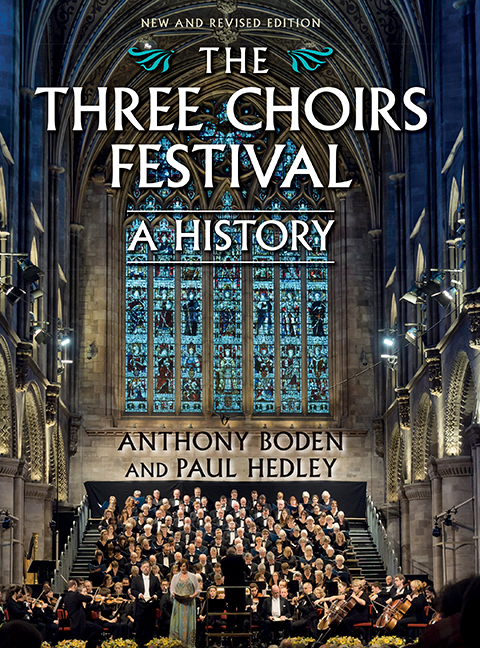
Book contents
- Frontmatter
- Contents
- List of Illustrations
- Preface
- Acknowledgements
- List of Abbreviations
- List of Cathedral Organists
- 1 Origins
- 2 A Fortuitous and Friendly Proposal
- 3 A Numerous Appearance of Gentry
- 4 ‘The Musick of my Admiration Handel’
- 5 The Gentlemen and the Players
- 6 Avoiding Shipwreck
- 7 Prima voce
- 8 Favourites and Flops
- 9 Sacred and Profane
- 10 Froissart
- 11 The Unreasonable Man
- 12 The Dream
- 13 Beyond these Voices
- 14 An Essentially English Institution
- 15 The Elgar Festivals
- 16 Dona nobis pacem
- 17 Recovery
- 18 Association
- 19 A New Epoch
- 20 Jubilee
- 21 Theme with Variations
- 22 Houses of the Mind
- 23 ‘A Gold-Plated Orchestra’
- 24 A New Millennium
- 25 Reorganisation
- 26 An Invitation to the Palace
- Appendix Three Choirs Festival Timeline
- Select Bibliography
- Index
- Plate section
1 - Origins
Published online by Cambridge University Press: 11 August 2017

Book contents
- Frontmatter
- Contents
- List of Illustrations
- Preface
- Acknowledgements
- List of Abbreviations
- List of Cathedral Organists
- 1 Origins
- 2 A Fortuitous and Friendly Proposal
- 3 A Numerous Appearance of Gentry
- 4 ‘The Musick of my Admiration Handel’
- 5 The Gentlemen and the Players
- 6 Avoiding Shipwreck
- 7 Prima voce
- 8 Favourites and Flops
- 9 Sacred and Profane
- 10 Froissart
- 11 The Unreasonable Man
- 12 The Dream
- 13 Beyond these Voices
- 14 An Essentially English Institution
- 15 The Elgar Festivals
- 16 Dona nobis pacem
- 17 Recovery
- 18 Association
- 19 A New Epoch
- 20 Jubilee
- 21 Theme with Variations
- 22 Houses of the Mind
- 23 ‘A Gold-Plated Orchestra’
- 24 A New Millennium
- 25 Reorganisation
- 26 An Invitation to the Palace
- Appendix Three Choirs Festival Timeline
- Select Bibliography
- Index
- Plate section
Summary
THE most frequently asked question about Three Choirs history is a simple one: ‘when exactly did the Festival begin?’ Finding an answer, however, has from the outset proved to be far from simple. The engraver and publisher Valentine Green, writing in 1796, stated that the first Meeting of the Three Choirs took place at Worcester in August 1722, whereas we now know that the inception of the Music Meetings (as they were termed until 1836, when the designation ‘Festival’ was adopted) must pre-date that by some years. Even as long ago as 1812, the Rev. Daniel Lysons, the earliest chronicler of the Festival to write a detailed history, was forced to admit that ‘It is in vain that I have endeavoured … to trace anything like the time of their first establishment.’
Two lengthy suspensions of Three Choirs, both of them caused by war, added to the confusion. The Festival was discontinued for six years during World War I: from 1914 to 1919. In 1920, Sir Ivor Atkins, Organist of Worcester Cathedral, was charged with restarting Three Choirs on the return to peace; he gave official recognition to the year 1715 ‘by reckoning the first Festival after the suspension … as the two hundredth’. This was generally accepted, such that Dennis Stoll, writing in 1938, in his book Music Festivals of Europe, felt able to state with confidence that ‘The three choirs met for the first time in 1715.’ But neither Atkins nor Stoll based his claim upon firm documentary proof. The outbreak of World War II, in 1939, silenced debate on the matter for seven more years: the Festival was again suspended throughout the duration of hostilities.
As late as 1966, in an historical note for a Worcester Festival programme book, the music critic A. T. Shaw pronounced that ‘any attempt to fix the date of the [first] meeting is predestined to failure’. But even so, the search for a start-date has continued. Dr Percy M. Young (1912–2004) – musicologist, writer, conductor, authority on Elgar, frequent lecturer at Three Choirs Festivals, and a distinguished scholar of English music of the eighteenth and nineteenth centuries – contributed a valuable essay, ‘The First Hundred Years’, to a booklet published in 1977 in association with the celebrations at Gloucester marking 250 years of the Festival.
Information
- Type
- Chapter
- Information
- The Three Choirs Festival: A HistoryNew and Revised Edition, pp. 1 - 14Publisher: Boydell & BrewerPrint publication year: 2017
Accessibility standard: Unknown
Why this information is here
This section outlines the accessibility features of this content - including support for screen readers, full keyboard navigation and high-contrast display options. This may not be relevant for you.Accessibility Information
Accessibility compliance for the PDF of this chapter is currently unknown
and may be updated in the future.