Book contents
- Frontmatter
- Contents
- List of Illustrations
- Preface
- Acknowledgements
- List of Abbreviations
- List of Cathedral Organists
- 1 Origins
- 2 A Fortuitous and Friendly Proposal
- 3 A Numerous Appearance of Gentry
- 4 ‘The Musick of my Admiration Handel’
- 5 The Gentlemen and the Players
- 6 Avoiding Shipwreck
- 7 Prima voce
- 8 Favourites and Flops
- 9 Sacred and Profane
- 10 Froissart
- 11 The Unreasonable Man
- 12 The Dream
- 13 Beyond these Voices
- 14 An Essentially English Institution
- 15 The Elgar Festivals
- 16 Dona nobis pacem
- 17 Recovery
- 18 Association
- 19 A New Epoch
- 20 Jubilee
- 21 Theme with Variations
- 22 Houses of the Mind
- 23 ‘A Gold-Plated Orchestra’
- 24 A New Millennium
- 25 Reorganisation
- 26 An Invitation to the Palace
- Appendix Three Choirs Festival Timeline
- Select Bibliography
- Index
- Plate section
4 - ‘The Musick of my Admiration Handel’
Published online by Cambridge University Press: 11 August 2017

Book contents
- Frontmatter
- Contents
- List of Illustrations
- Preface
- Acknowledgements
- List of Abbreviations
- List of Cathedral Organists
- 1 Origins
- 2 A Fortuitous and Friendly Proposal
- 3 A Numerous Appearance of Gentry
- 4 ‘The Musick of my Admiration Handel’
- 5 The Gentlemen and the Players
- 6 Avoiding Shipwreck
- 7 Prima voce
- 8 Favourites and Flops
- 9 Sacred and Profane
- 10 Froissart
- 11 The Unreasonable Man
- 12 The Dream
- 13 Beyond these Voices
- 14 An Essentially English Institution
- 15 The Elgar Festivals
- 16 Dona nobis pacem
- 17 Recovery
- 18 Association
- 19 A New Epoch
- 20 Jubilee
- 21 Theme with Variations
- 22 Houses of the Mind
- 23 ‘A Gold-Plated Orchestra’
- 24 A New Millennium
- 25 Reorganisation
- 26 An Invitation to the Palace
- Appendix Three Choirs Festival Timeline
- Select Bibliography
- Index
- Plate section
Summary
FOLLOWING the first known Three Choirs performance in 1736(G) of one of his Te Deums, the music of Handel rapidly rose into a position of absolute command at the Music Meetings. Alexander's Feast was repeated, and L'Allegro, Il Penseroso introduced at Gloucester in 1751. In the following year the Worcester Journal gave a detailed programme for the 1752(W) Meeting:
On Wednesday will be perform'd, at the Cathedral, in the Morning, Purcel's [sic] Te Deum and Jubilate, an Anthem by Dr. Boyce, and Mr. Handel's celebrated Coronation Anthem; and at the Town-Hall in the Evening, a concert of Vocal and Instrumental Musick. On Thursday will be perform'd, at the Cathedral, in the Morning, Mr. Handel's Te Deum and Jubilate, A New Anthem by Dr. Boyce, and the same Coronation Anthem; and at the Town Hall, in the Evening, the Oratorio of Samson.
J. Arnold, StewardThe Te Deum and Jubilate of Purcell would be that in D, which he wrote for St Cecilia's Day 1694, the year before his death. Handel wrote a set of four anthems for the coronation of George II in 1727, but the ‘celebrated’ one is most likely to have been either of the two most popular: ‘The King shall rejoice’ or ‘Zadok the Priest’. Handel's Te Deum and Jubilate could have been either that written in 1713 for the Treaty of Utrecht or, more likely, that written in 1743 for the victory of Dettingen which, according to Lysons, was introduced to the Music Meetings at Gloucester in 1748. But, as Watkins Shaw has pointed out:
one notices that whereas in 1752, for example, we hear of a Te Deum by Handel, in 1755 and 1756 the announcement speaks of the ‘New Te Deum’ by Handel. (Those dates, however, refer to Worcester and Hereford Meetings.) After 1755 there is no doubt that the ‘Dettingen’ setting was in regular use.
The anthem by Boyce would have been either Lord, thou has been our refuge or Blessed is he that considereth the poor. But it was the performance of Samson which incurred the greatest expense.
Information
- Type
- Chapter
- Information
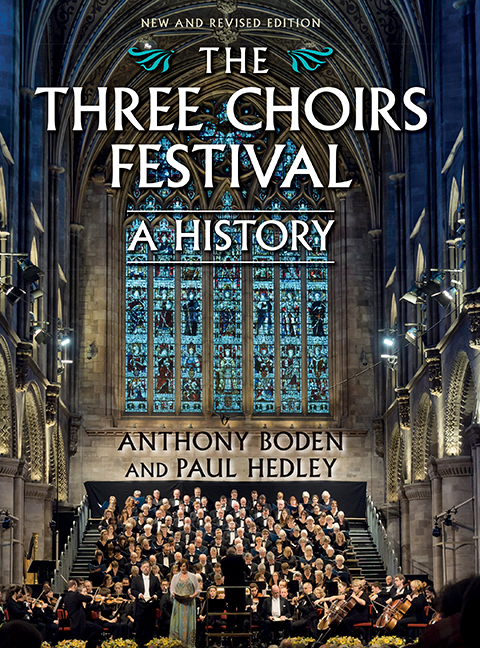
- The Three Choirs Festival: A HistoryNew and Revised Edition, pp. 40 - 55Publisher: Boydell & BrewerPrint publication year: 2017
Accessibility standard: Unknown
Why this information is here
This section outlines the accessibility features of this content - including support for screen readers, full keyboard navigation and high-contrast display options. This may not be relevant for you.Accessibility Information
Accessibility compliance for the PDF of this chapter is currently unknown
and may be updated in the future.