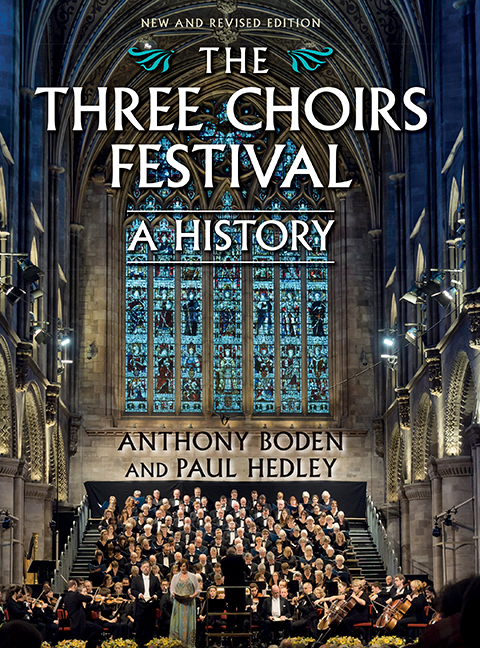
Book contents
- Frontmatter
- Contents
- List of Illustrations
- Preface
- Acknowledgements
- List of Abbreviations
- List of Cathedral Organists
- 1 Origins
- 2 A Fortuitous and Friendly Proposal
- 3 A Numerous Appearance of Gentry
- 4 ‘The Musick of my Admiration Handel’
- 5 The Gentlemen and the Players
- 6 Avoiding Shipwreck
- 7 Prima voce
- 8 Favourites and Flops
- 9 Sacred and Profane
- 10 Froissart
- 11 The Unreasonable Man
- 12 The Dream
- 13 Beyond these Voices
- 14 An Essentially English Institution
- 15 The Elgar Festivals
- 16 Dona nobis pacem
- 17 Recovery
- 18 Association
- 19 A New Epoch
- 20 Jubilee
- 21 Theme with Variations
- 22 Houses of the Mind
- 23 ‘A Gold-Plated Orchestra’
- 24 A New Millennium
- 25 Reorganisation
- 26 An Invitation to the Palace
- Appendix Three Choirs Festival Timeline
- Select Bibliography
- Index
- Plate section
22 - Houses of the Mind
Published online by Cambridge University Press: 11 August 2017

Book contents
- Frontmatter
- Contents
- List of Illustrations
- Preface
- Acknowledgements
- List of Abbreviations
- List of Cathedral Organists
- 1 Origins
- 2 A Fortuitous and Friendly Proposal
- 3 A Numerous Appearance of Gentry
- 4 ‘The Musick of my Admiration Handel’
- 5 The Gentlemen and the Players
- 6 Avoiding Shipwreck
- 7 Prima voce
- 8 Favourites and Flops
- 9 Sacred and Profane
- 10 Froissart
- 11 The Unreasonable Man
- 12 The Dream
- 13 Beyond these Voices
- 14 An Essentially English Institution
- 15 The Elgar Festivals
- 16 Dona nobis pacem
- 17 Recovery
- 18 Association
- 19 A New Epoch
- 20 Jubilee
- 21 Theme with Variations
- 22 Houses of the Mind
- 23 ‘A Gold-Plated Orchestra’
- 24 A New Millennium
- 25 Reorganisation
- 26 An Invitation to the Palace
- Appendix Three Choirs Festival Timeline
- Select Bibliography
- Index
- Plate section
Summary
THE 1991 Hereford Festival began on Sunday 18 August. Roy Massey, resplendent in the robes of his Lambeth doctorate, conducted the Festival Chorus and RLPO in a most impressive Opening Service, marred hardly at all by the lady who, during the prayer ‘that through music we may raise man from the sorrows of this world to the joy of Your divine presence’ called out loudly: ‘and women!’ A sign of the times?
The first cathedral concert of the 1991(H) Festival, given in memory of the late Bishop John Easthaugh, who had died in office in 1990, was a performance of the Beethoven Missa solemnis. ‘There was much to admire’, wrote David Hart in the Birmingham Post:
the Festival Chorus was in fine collective voice, with tenors displaying a lively robustness and sopranos thrilling in the stratospheric upper reaches. And Julie Kennard, Catherine Wyn-Rogers, Neil Jenkins and John Noble made an extremely homogenous and tireless solo quartet. But this was largely negated by an orchestral accompaniment [RLPO] of often overwhelming proportions … The result was a performance light on subtlety, but full of grand gestures and a lot of noise.
On Monday a tremor of apprehension disturbed the festive atmosphere as news came through that in the USSR Mikhail Gorbachev had been toppled in a leadership coup. Were ‘the sorrows of this world’ again to overwhelm the nascent optimism in a new order? Against this background the performance of Morning Heroes on Monday evening was particularly piercing. The largest of the works by Sir Arthur Bliss included in the Festival to mark his centenary year, Morning Heroes was, for Roy Massey and many in his audience, an overwhelming emotional experience. Written by a composer who had seen the brutality of war at first hand through a soldier's eyes, its impact in performance is greater than can be anticipated from the printed score – especially so when the narration of ‘Hector's Farewell to Andromache’ (from The Iliad) and Wilfred Owen's ‘Spring Offensive’ are entrusted to a narrator of Brian Kay's ability.
Information
- Type
- Chapter
- Information
- The Three Choirs Festival: A HistoryNew and Revised Edition, pp. 301 - 335Publisher: Boydell & BrewerPrint publication year: 2017
Accessibility standard: Unknown
Why this information is here
This section outlines the accessibility features of this content - including support for screen readers, full keyboard navigation and high-contrast display options. This may not be relevant for you.Accessibility Information
Accessibility compliance for the PDF of this chapter is currently unknown
and may be updated in the future.