We partner with a secure submission system to handle manuscript submissions.
Please note:
You will need an account for the submission system, which is separate to your Cambridge Core account. For login and submission support, please visit the
submission and support pages.
Please review this journal's author instructions, particularly the
preparing your materials
page, before submitting your manuscript.
Click Proceed to submission system to continue to our partner's website.
To save this undefined to your undefined account, please select one or more formats and confirm that you agree to abide by our usage policies. If this is the first time you used this feature, you will be asked to authorise Cambridge Core to connect with your undefined account.
Find out more about saving content to .
To send this article to your Kindle, first ensure no-reply@cambridge.org is added to your Approved Personal Document E-mail List under your Personal Document Settings on the Manage Your Content and Devices page of your Amazon account. Then enter the ‘name’ part of your Kindle email address below. Find out more about sending to your Kindle.
Find out more about saving to your Kindle.
Note you can select to save to either the @free.kindle.com or @kindle.com variations. ‘@free.kindle.com’ emails are free but can only be saved to your device when it is connected to wi-fi. ‘@kindle.com’ emails can be delivered even when you are not connected to wi-fi, but note that service fees apply.
Eimeria species, the causative agents of avian coccidiosis, are major pathogens in poultry, resulting in substantial economic losses and welfare concerns worldwide. Understanding their complex life cycle, including different developmental stages and host interactions, is essential for advancing control strategies. Traditional cultivation systems, such as primary cell cultures and immortalised cell lines, have provided valuable insights, but they present limitations in supporting complete parasite development, host–pathogen interactions and immune response evaluation. Recent advances in intestinal organoids offer a promising alternative for Eimeria research. Initially developed in human models, intestinal organoids have been successfully adapted to avian systems, replicating the architecture, cellular diversity and physiological functions of the chicken gut epithelium. These 3D models provide now a physiologically relevant platform for studying parasite development, host–pathogen interactions, immune responses and drug screening in vitro. Complementary tools, such as intestinal explants, could further enhance the experimental repertory available for investigating Eimeria species. Additionally, insights from studies on related apicomplexan parasites support the translational value of these systems. These innovative systems could support significant advances in Eimeria cultivation, enabling more robust and ethical research while reducing the use of experimental animals.
Coccidiosis, caused by Eimeria spp., leads to substantial economic losses in the poultry industry globally. These protozoan parasites invade the intestinal epithelium of birds, impairing nutrient absorption, causing diarrhoea and potentially leading to mortality. The complex endogenous life cycle of Eimeria spp., particularly the gametogony phase, presents significant challenges for in vitro cultivation. This study aimed to develop mature chicken intestinal organoids as an in vitro model capable of supporting the complete endogenous life cycle of Eimeria tenella. Two commercially available culture media, 3dGRO L-WRN conditioned medium (L-WRN) and IntestiCult™ Organoid Growth Medium (OGM), were evaluated for their ability to support chicken intestinal organoid development. The results demonstrated that basolateral-out organoids embedded in Matrigel and cultured in the L-WRN medium expanded more rapidly. In contrast, those apical-out organoids in the OGM developed more microvilli structures on enterocytes. Apical-out organoids, initially cultured in L-WRN medium and subsequently matured in OGM, were selected as the optimal host for the Eimeria infection model. Sporozoites of E. tenella successfully invaded the organoids and progressed through both the schizogony and gametogony phases. Moreover, the parasites produced a new generation of oocysts in this study. The presence of schizonts, gametocytes, and sporulated oocysts confirmed that the model can support the full endogenous life cycle of the parasite in vitro. This organoid-based infection model serves as a promising platform for studying host–pathogen interactions and developing novel interventions to control avian coccidiosis.
Gastrointestinal (GI) nematode infections represent a significant health burden globally, affecting both humans and livestock. Traditional in vitro models to study host–parasite interactions, such as immortalized cell lines, have limitations that hinder the full understanding of these complex relationships. Organoid technology has emerged as a promising alternative, offering a physiologically relevant platform to study host–nematode interactions in vitro. Organoids are three-dimensional structures comprising differentiated cell types that recapitulate features of the corresponding organ. Technological advances for growing, maintaining and manipulating organoids have increased their applications to model infections, inflammation and cancer. This review discusses recent work using GI organoids to advance understanding of nematode–host interactions and modulation of GI epithelial cells. Additionally, we review studies that co-cultured GI organoids with innate lymphoid cells to study epithelial-immune cell cross-talk in the context of nematode infection. By bridging the gap between reductionist cell culture systems and whole-organism studies, organoids offer a powerful platform for investigating complex host–nematode interactions, and for developing and screening novel therapeutics.
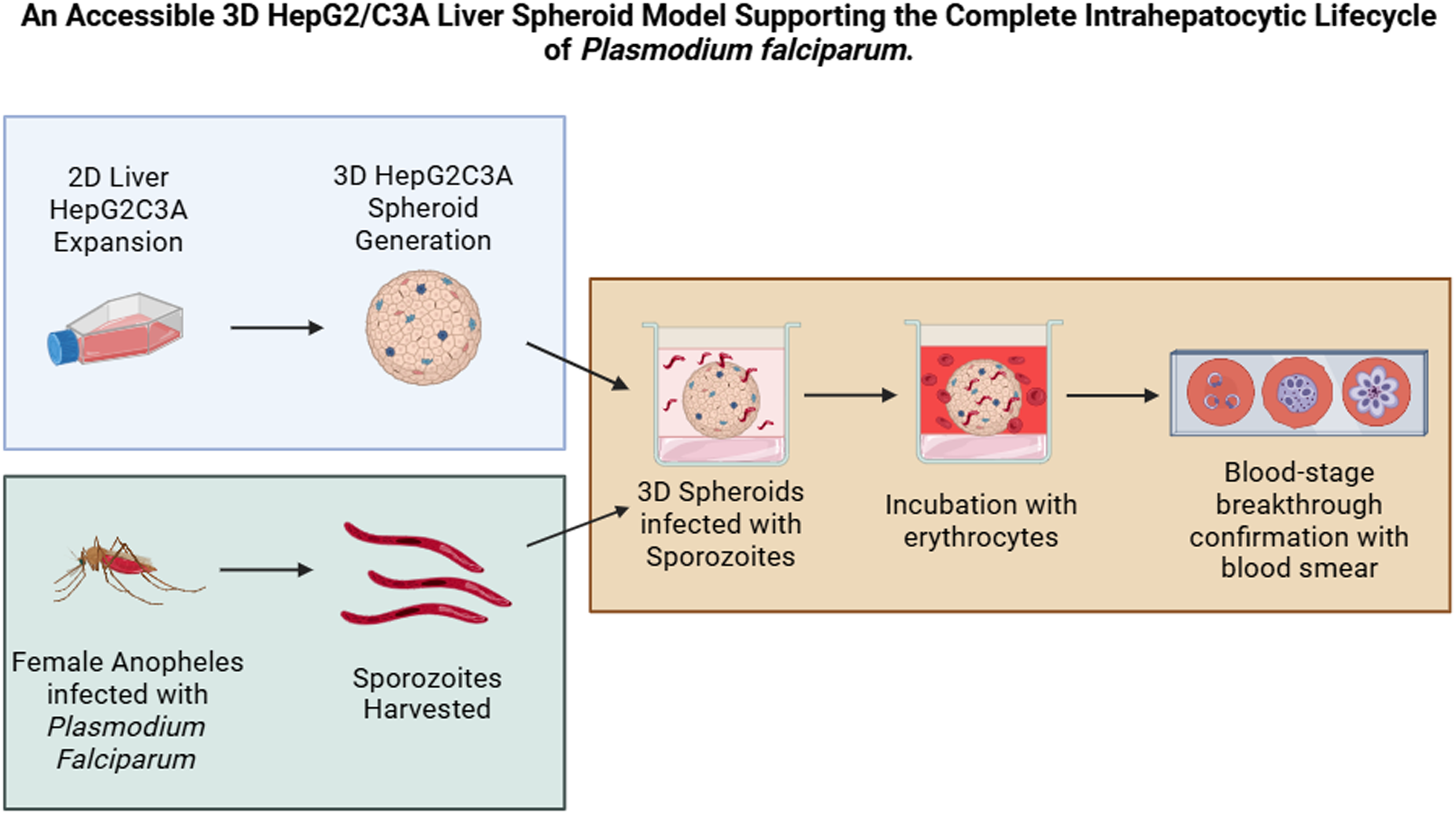
Current liver-stage Plasmodium falciparum models are complex, expensive and largely inaccessible, hindering research progress. Here, we show that a 3D liver spheroid model grown from immortalized HepG2/C3A cells supports the complete intrahepatocytic lifecycle of P. falciparum. Our results demonstrate sporozoite infection, development of exoerythrocytic forms and breakthrough infection into erythrocytes. The 3D-grown spheroid hepatocytes are structurally and functionally polarized, displaying enhanced albumin and urea production and increased expression of key metabolic enzymes, mimicking in vivo conditions – relative to 2D cultures. This accessible, reproducible model lowers barriers to malaria research, promoting advancements in fundamental biology and translational research.