Cambridge Companions are a series of authoritative guides, written by leading experts, offering lively, accessible introductions to major writers, artists, philosophers, topics, and periods.
To save content items to your account,
please confirm that you agree to abide by our usage policies.
If this is the first time you use this feature, you will be asked to authorise Cambridge Core to connect with your account.
Find out more about saving content to .
To save content items to your Kindle, first ensure no-reply@cambridge.org
is added to your Approved Personal Document E-mail List under your Personal Document Settings
on the Manage Your Content and Devices page of your Amazon account. Then enter the ‘name’ part
of your Kindle email address below.
Find out more about saving to your Kindle.
Note you can select to save to either the @free.kindle.com or @kindle.com variations.
‘@free.kindle.com’ emails are free but can only be saved to your device when it is connected to wi-fi.
‘@kindle.com’ emails can be delivered even when you are not connected to wi-fi, but note that service fees apply.
Stand-up comedy is one of the simplest theatre forms in existence. The comedian stands on a (usually) bare stage, talking straight to the audience in the hope of getting laughs. Yet it has never been more popular, with national scenes developing across every continent except Antarctica. In this insightful and accessibly written volume, diverse chapters explore the subject from many angles, ranging from national scenes, live venues, and recordings to politics, race, sexuality, and the question of offensiveness. Chapters also consider the performance dynamics of stand-up in detail, examining audience, persona, and trauma. Interspersed throughout the chapters are a series of originally commissioned interviews with comedians from nine different countries, including Maria Bamford, Jo Brand, Aditi Mittal, and Rod Quantock, providing rare insights into their craft.
This chapter explores stand-up comedy in the UK arising out of comic song in the music hall. Spoken patter rather than songs became the centre of performances of the front cloth comedians in variety theatres, which continued until the 1950s. Subsequently, stand-ups found other places to perform, notably the working men’s club (WMC), with varied performance styles but a shared canon of jokes. The working-class Londoner is a performer and type existing across the development of stand-up. Alternative comedy arose from 1979 as a critique of the perceived sexism, racism and limited creativity of WMC comedy, and most comedians since have careers within these broad parameters. Despite this, inequalities still exist in the UK stand-up scene, and the consequences of the Covid pandemic were greater for comedians affected by inequalities of class, gender, race, disability, and sexuality who suffered more severe career setbacks, being less able to garner income online.
In 2018, Hannah Gadsby created a sensation through her stand-up show Nanette. In it she shocked audiences by telling her hard-hitting trauma narrative, revealing the impact of sexual abuse, male violence, and homophobia on her mental health. Controversially, Gadsby also claimed that stand-up as a form and the mainstream stand-up industry itself were significant agents in deepening her psychological harm. This chapter examines Gadsby’s dramaturgical strategies and struggles in attempting to construct a means of speaking about the pain of her lived experience and seeking a therapeutic means of addressing her trauma through stand-up. Luckhurst analyses Gadsby’s interest in ethical story-telling and her notion of educating audiences about laughter and political complicity. Finally, Luckhurst argues that Gadsby draws on therapy models to transform her trauma narrative into a story of healing for herself and her audiences.
Early African American humour functioned as a method of cultural formation, an in-group way of communicating based on the needs and experiences of the enslaved community. Contemporary Black stand-up has been a foundation upon which to reveal realities of Black life and make those realities accessible and entertaining to an increasingly global audience. This chapter explores the innovative styles and approaches to the artform as an indication that the limits of Black stand-up are expanding. Using three case studies, it demonstrates the Afrofuturistic trajectory of the genre. Elements of resistance have given way to comedic approaches that centre imagination; fleeting moments of revenge are superseded by the materiality of the emancipated Black body; a sense of contentment and personal growth are foregrounded, ephemeral pleasures looming still; and rituals of play produce Afrofuturistic otherworlds where difference matters, disabused of its regulatory power to rank and marginalise.
The comic persona lies at the very centre of the art of stand-up, despite being inherently ambiguous. The relationship of the person on display in a performance and the private individual in everyday life is never clearly defined. This chapter starts by using a routine by Mae Martin to show how wafer thin the line between life and art is in stand-up, before examining how comedians inspire affection in their audience, using Sarah Millican’s Outsider as an example. It explores how comedians’ careers can be damaged by revelations about their private lives, using Louis CK and Aziz Ansari as contrasting examples. It then examines the rise of the ‘dead dad show’, in which comedians create full-length shows based on personal trauma, tracing this tendency back to a 1980 routine by Tony Allen. This leads into a case study of Russell Kane’s show Smokescreens and Castles, about his troubled relationship with his father.
This chapter tells the story of Jewish stand-up in America. It charts the importance of Jewish performers to the emergence of modern stand-up by focusing on the idea of schtick and its shift in definition. Where the concept once defined the humorous patter of vaudeville and Borscht Belt comedians, in the routines of Mort Sahl and Lenny Bruce there emerged a particularly personalised schtick – a deeply ingrained and disproportionately Jewish phenomenon. This schtick formed the basis for their comic personae and laid the foundation for the wide-reaching, socially critical comedy of today. Analysing the performances of Bruce and Sahl alongside their inheritors, Joan Rivers, Sarah Silverman, Marc Maron, and others, this chapter brings to light some essential issues that have continued to shape the development of stand-up – what can be said, who can say it, under what circumstances, and why?
Stand-up comedy is one of the simplest theatre forms in existence. The comedian stands on a (usually) bare stage, talking straight to the audience in the hope of getting laughs. Yet it has never been more popular, with national scenes developing across every continent except Antarctica. In this insightful and accessibly written volume, diverse chapters explore the subject from many angles, ranging from national scenes, live venues, and recordings to politics, race, sexuality, and the question of offensiveness. Chapters also consider the performance dynamics of stand-up in detail, examining audience, persona, and trauma. Interspersed throughout the chapters are a series of originally commissioned interviews with comedians from nine different countries, including Maria Bamford, Jo Brand, Aditi Mittal, and Rod Quantock, providing rare insights into their craft.
This origin story of stand-up comedy in the United States begins with eighteenth-century Black signifyin’ performances by working-class immigrants and African Americans in northern marketplaces and those enslaved on southern plantations. These earliest comedic performance traditions spawned blackface minstrelsy, the first distinctly American form of comedy. The lineage of white performers appropriating Black performance tropes as well as Black and Asian performers being forced to perform in ways that satisfied racist white imaginings of the Other connects comedic entertainment to the racial caste system of the Antebellum era to contemporary protests – on stage and off – against racial injustice today. From blackface minstrelsy to vaudeville, to comedians hustling in the Borscht Belt and Chitlin Circuit and in dive bars on the east and west coasts, to the 1980s comedy boom and arena comedy today, this chapter traces the history of stand-up comedy from the early Republic to the twenty-first century.
Offensiveness is a key issue in contemporary public discourse, especially in relation to media content. Stand-up comedy has provided an important site for discussions of offensiveness, both inside of performances and in the commentary on comedy in other forms of popular media. This chapter provides a brief summary of some well-known examples of stand-up comedy that are embroiled in debates on offensiveness, before engaging in a discussion of what constitutes offensive stand-up comedy. The chapter theorises the discursive work that offensive stand-up comedy does in contemporary contexts through concepts of rhetoric, the performative, and symbolic violence. Comedy and harm are discussed and an explanation of what researchers have described as the impacts of humour and comedy is given. Throughout the chapter, the points made are elaborated with extracts from British stand-up comedian Ricky Gervais’ Netflix special Supernature (2022), especially through an analysis of jokes made by Gervais about transgender people. These and other jokes are examined alongside the disclaimers used in the stand-up comedy performance.
While stand-up comedy is conventionally thought of in terms of liveness and live performance, it is also the case that recorded media – such as radio and television – have a long, intertwined relationship with stand-up. Beginning from a historical perspective, this chapter outlines how recorded comedy media drew on live forms from its inception, taking inspiration from music hall and vaudeville. Recorded stand-up remains a fundamental component of contemporary recorded media, via stand-up specials on platforms such as HBO and Netflix. But the grammar of recorded media offers challenges to the pleasures associated with stand-up – especially in terms of liveness – and this chapter therefore explores the particularities of stand-up on radio and television, and its ongoing relationship to the live forms that predated it and continue alongside it.
One of the most interesting, and rapid, recent changes in live stand-up comedy is the increased number of disabled comedians performing. This chapter examines the performances of two disabled comedians – Laurence Clark and Rosie Jones – to explore how their performances may be viewed as social justice comedy through an analysis of the techniques used, and themes explored, in their performances. The chapter begins by considering the ways in which disability has been represented in comedy across history. Attention then shifts to how stand-up comedy can be considered a tool for social justice. The focus then turns to the methodological framework used to gather and analyse performances by Laurence Clark and Rosie Jones, before examining how the techniques used, and themes explored, in their performances may have social justice potentials and impacts for disability and disabled people and how the limits to these potentials and impacts can be understood.
This chapter argues that stand-up comedy events are never apolitical. Politics are expressed and embedded not only in the words that are said but also in the production decisions that shape the context in which they are delivered. The Guilty Feminist podcast is used as an example through which to demonstrate this principle. The podcast presents segments of stand-up comedy within an unconventional format: one that has been designed to serve the political aims and principles of its creators. Key creative decisions are interpreted through the stated political philosophy of the podcast’s co-creator and permanent host, Deborah Frances-White. Her intersectional, feminist politics underpin three important aspects of the podcast’s creative policy: the decision to prioritise women and minority performers, an emphasis on collaboration over competition, and a challenge to conventional wisdoms regarding the nature of comic licence.
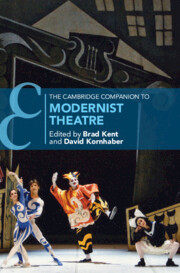
The first panoramic survey of its kind, The Cambridge Companion to Modernist Theatre is a wide-ranging guide to modernism's myriad theatrical manifestations and permutations. Covering such diverse movements as naturalism, symbolism, expressionism, surrealism, dadaism, futurism, and absurdism and ranging over many genres, including comedy, tragedy, the play of ideas, agitprop, and epic theatre, the book provides a comprehensive examination of how theatre was shaped by modernism – and in turn shaped it – as it was practised around the globe. Arranged into two halves focusing respectively on theatrical forms and major themes, the volume features chapters examining how modernist playwrights, scenographers, actors, and directors engaged with such key social, political, and cultural issues of the day as philosophy, science, religion, sexuality, gender, race, intermediality, and interculturalism. An authoritative resource for students and researchers alike, this Companion attests to the pertinence of theatre and modernism both historically and in the contemporary world.