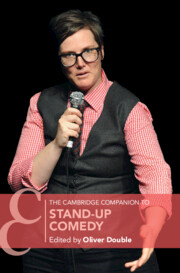
Cambridge Companions are a series of authoritative guides, written by leading experts, offering lively, accessible introductions to major writers, artists, philosophers, topics, and periods.
To save content items to your account,
please confirm that you agree to abide by our usage policies.
If this is the first time you use this feature, you will be asked to authorise Cambridge Core to connect with your account.
Find out more about saving content to .
To save content items to your Kindle, first ensure no-reply@cambridge.org
is added to your Approved Personal Document E-mail List under your Personal Document Settings
on the Manage Your Content and Devices page of your Amazon account. Then enter the ‘name’ part
of your Kindle email address below.
Find out more about saving to your Kindle.
Note you can select to save to either the @free.kindle.com or @kindle.com variations.
‘@free.kindle.com’ emails are free but can only be saved to your device when it is connected to wi-fi.
‘@kindle.com’ emails can be delivered even when you are not connected to wi-fi, but note that service fees apply.
Stand-up comedy is one of the simplest theatre forms in existence. The comedian stands on a (usually) bare stage, talking straight to the audience in the hope of getting laughs. Yet it has never been more popular, with national scenes developing across every continent except Antarctica. In this insightful and accessibly written volume, diverse chapters explore the subject from many angles, ranging from national scenes, live venues, and recordings to politics, race, sexuality, and the question of offensiveness. Chapters also consider the performance dynamics of stand-up in detail, examining audience, persona, and trauma. Interspersed throughout the chapters are a series of originally commissioned interviews with comedians from nine different countries, including Maria Bamford, Jo Brand, Aditi Mittal, and Rod Quantock, providing rare insights into their craft.
Ezra Pound called Ulysses ‘a triumph in form’. In contrast, Holbrook Jackson deplored it as ‘chaos’, referring to ‘the arrangement of the book’ as ‘the greatest affront of all’. T. S. Eliot justified the ‘formlessness’ of Ulysses as a reflection of Joyce’s dissatisfaction with the novel form. Taking such comments as a springboard, this chapter attends to Ulysses’s capacity to produce pronounced effects of both form and formlessness, arguing that its longstanding position at the apex of the modernist canon is connected to this artful duality. Through its extensive intertextuality and practice of a gamut of generic forms, Joyce’s shape-shifting book invites its own critical insertion into ‘the tradition’. Simultaneously, it resists full absorption into any singular critical scheme through its flouting of expectations of stylistic unity and narrative closure. Ulysses achieves that exquisite balancing of pattern and disorder, or novelty and familiarity, that maximizes a work’s chance of being rated as ‘high art’. Yet its recognition as such was also considerably aided by the interpretations formulated by Joyce and his champions in the early days of the book’s reception.
This chapter makes a case for a historical materialism in the study of Ulysses. The historical materialism in question is conditioned by Joyce’s work. The historical contexts it considers as most relevant are those indicated by Ulysses itself, not ours nor continental European ones. They are, firstly, Irish and, secondly, British. A Joycean historical materialism seeks to deepen and complicate our knowledge of those contexts in all their myriad detail, and to read Ulysses accordingly. Assuming the historical priority of Irish and British preoccupations, what is it likely Joyce cared about, in any given episode, passage, or detail? The chapter contrasts a historically materialist method with others relying on a more idealist historicism. In line with this case, the chapter moves from concrete detail – a lengthy, highly particularized discussion of ‘Sirens’ – to a more theoretical conclusion whilst seeking to avoid the limitations of an unreflective empiricism.
This chapter discusses how writers in the twenty-first century have responded to the legacies of postmodernism. It details various attempts at configuring a post-postmodernism before offering close analysis of a series of British writers who have entered a critical dialogue with postmodernism through their fiction. The novelists are discussed with respect to three main areas. First, the identification of an ethical turn in selected fiction produced by writers associated with postmodernism whose careers were established in the last quarter of the twentieth century (Amis, Barnes, Byatt, McEwan, Winterson). Second, British writers who emerge after 9/11 who, although they adopt several techniques associated with postmodernism, incorporate a new, tentative idealism and elements of realism in terms of both literary form and philosophical belief (Mitchell, Barker, Ali Smith). Third, it looks at how discourses around postcolonialism and multiculturalism impact with postmodernism in selected fiction (Ali, Levy, Rushdie, Zadie Smith).
This chapter follows Joyce’s exilic trajectory out of Dublin to embrace a rejuvenated Europe, from early efforts at modernizing Ireland against the archaizing tendencies of the Irish Revival to a modernist program entailing the choice of Europe against England. Joyce found a model in Italian writers like Vico and Ferrero, who rejected the myth of the purity of a national identity and trusted that a universalized history would bring different groups together, thus heralding today’s Europe, a community of nations in which Dublin is the capital of the only English-speaking country. Such a ‘globalatinized’ Europe ought to be able to critique previous imperialist tendencies and practice hospitality by an openness to minorities in concordance with the linguistic melting pot announced by Finnegans Wake.
Finnegans Wake and confession, in both secular and religious contexts, are each examined through the lens of the other. The aim is to ‘de-confuse’ the fusion, thrice repeated in the Wake, of ‘confession’ and ‘confusion’. Eight observations are illustrated through close reading: i) confession directs the text in two chapters, Shem’s in I.7 and HCE’s in II.3; ii) both present as public not private confessions; iii) there is no auricular confession; iv) widespread inadvertent confessions found in the Wake’s ‘fallen’ language, supposedly Freudian slips, are a source of sense-making power; v) any confession is always a qualified confession – blame is always dispersed; vi) there is no torture leading to involuntary confession; vii) the book doesn’t operate within the tradition of classical confessional texts; viii) it knows that confession split Christianity and projects that split onto the dialectical operations of the narrative. The chapter argues for the productive and overlooked potential of ‘syntagmatic’ or narrative approaches that read the text as sequential form, and it suggests that the plurality of narratives undermines theoretical generalizations of the human as ‘a confessing animal’.
Ecocriticism is catching up with James Joyce. Moving beyond the heritage of Romanticism’s binary opposition between human and nonhuman nature, contemporary critics have explored the entanglement of nature, culture, and the built environment in Joyce’s works. This chapter focuses on Joyce’s evolving presentation of the human body as a natural–cultural entity. His early fictions depict the body as a humbling counterweight to notions of transcendence, especially to Catholic ideas glorifying the spirit. The evolution of his thinking culminates in his portrayal of the body, in Ulysses and Finnegans Wake, as a site of constant transformation, where the human and the nonhuman interpenetrate and shape each other. An influential concept of material ecocriticism is Stacy Alaimo’s ‘trans-corporeality’, which reveals the interlinkage and imbrication of our bodies with each other and ‘more-than-human nature’. Thus, in Ulysses and Finnegans Wake, even biologically dead bodies of the solar system intersect the characters’ lives, through both their material environments and the senses, microbes, and atoms of their bodies.
At first glance, Joyce’s shorter works – his poems and epiphanies, Giacomo Joyce, and Exiles – seem to bear a tenuous relationship to the books for which Joyce has become famous. It is questionable whether the epiphanies and Giacomo Joyce should even be called ‘works’: Joyce published neither in its original form, choosing instead to loot both for the more ambitious undertakings that followed. Only forty of at least seventy-one epiphanies are extant, and their relationship to one another had to be reconstructed from manuscript evidence: the sketches that comprise Giacomo Joyce were similarly composed, arranged, and abandoned, but not destroyed. Chamber Music, although published in 1907, was orphaned when Joyce delegated the final arrangement of the poems to his brother Stanislaus. Pomes Penyeach, as the title suggests, is a modest offering of twelve and a tilly poetic ‘fruits’. Only Exiles continued to hold Joyce’s interest as an autonomous composition not destined for immediate verbal recycling.
Joyce wrote as a kind of archaeologist: Ulysses, Henri Lefebvre wrote, marked ‘the momentous eruption of everyday life into literature’, in which Joyce’s sprawling prose ‘rescues, one after the other, each facet of the quotidian from anonymity’. Famously, Joyce even risked censorship in order to drag into view details about the career of the human body that other novelists had ignored. This chapter analyzes Joyce’s engagement with the everyday by focusing on scenes of mourning, when the everyday suddenly becomes at once visible and painfully fragile. These moments – funerals, wakes, and death rites – constitute a steady yet largely unexamined through-line running from Joyce’s first story to his last novel. Death itself is at once the most common and the most shocking of experiences, an event that rends the fabric of our everyday life as we try to readjust our habits around an often abrupt and painful absence. Seen this way, Joyce’s works become not only archaeological digs into the ever-vanishing everyday but also documents of human and cultural resilience amid the fury of modernity.
Postmodernity is characterised by a thoroughgoing alteration in the ways in which space is both experienced and conceived. During the post-war period, social and spatial relations were substantially transformed by the far-reaching effects of economic globalisation, neo-imperial conflicts, new transport and communications technologies, mass migrations, political devolution, and impending environmental crisis. Concurrently, space and geography have become existential and cultural dominants for postmodern societies, to an extent displacing time and history. Given such a spatio-temporal conjuncture, this chapter explores the significance of space for British postmodern fiction and describes some of its characteristic geographies, focusing upon three distinctive kinds of spaces: cities; non-places; and regions. Among the texts discussed are novels by J.G. Ballard, Julian Barnes, Christine Brooke-Rose, Angela Carter, Maureen Duffy, Alasdair Gray, Hanif Kureishi, Salman Rushdie, Iain Sinclair, Zadie Smith, Graham Swift, Adam Thorpe, and Jeanette Winterson.
This chapter surveys the centrality of sex and sexuality to Joyce’s modernist experiment. Representing sexuality was vital to Joyce’s creative method because it demanded strategies that would define his prose: ambiguity, ellipsis, opacity, and obscurity. Gaps and silences marked the emergence of an inchoate modernism that characterized Joyce’s writing about sex – the subject of his fiction where form and content were most intimately entangled. A self-consciously radical frankness was essential to his commitment to innovation of subject and style, as he sought to define his creative practice against the ‘prudery’ of an imagined Victorianism. Sexual daring became an important aspect of his success in establishing himself at the heart of experimental international modernism, through little magazines and coterie publishing houses.
This chapter focuses on Neo-Victorian fiction as a sub-genre of the historical novel. It examines how British neo-Victorian texts are informed by Anglo-American and European postmodernist theories that challenged the division between history and literature. In this context, it contains discussions of a wide range of novels including Jean Rhys’s Wide Sargasso Sea (1966), John Fowles’ The French Lieutenant’s Woman (1969), A.S. Byatt’s Possession: A Romance (1990), and Sarah Waters’s Victorian trilogy that have now become part of an ever-growing Neo-Victorian canon, while also engaging with more recent manifestations of Neo-Victorianism in TV and film adaptations. It explores how Neo-Victorianism has intersected with British political discourse; how authors’ investment in Britain’s history and Victorian literary culture problematises the Neo-Victorian novel’s position in the academy; the form’s perceived prestige; and its contribution to debates surrounding accuracy and authenticity to argue that neo-Victorianism can be read as a symptom of decadent postmodernity.