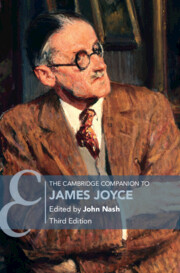
Cambridge Companions are a series of authoritative guides, written by leading experts, offering lively, accessible introductions to major writers, artists, philosophers, topics, and periods.
To save content items to your account,
please confirm that you agree to abide by our usage policies.
If this is the first time you use this feature, you will be asked to authorise Cambridge Core to connect with your account.
Find out more about saving content to .
To save content items to your Kindle, first ensure no-reply@cambridge.org
is added to your Approved Personal Document E-mail List under your Personal Document Settings
on the Manage Your Content and Devices page of your Amazon account. Then enter the ‘name’ part
of your Kindle email address below.
Find out more about saving to your Kindle.
Note you can select to save to either the @free.kindle.com or @kindle.com variations.
‘@free.kindle.com’ emails are free but can only be saved to your device when it is connected to wi-fi.
‘@kindle.com’ emails can be delivered even when you are not connected to wi-fi, but note that service fees apply.
This chapter examines the serialization of Ulysses in The Little Review (New York) and The Egoist (London). Each and every issue of The Egoist and The Little Review in which Ulysses appears has a specific geography, cultural meaning, and temporality. Though there are overviews dealing with the whole process of serialization, the significance of the individual periodical issues in which Ulysses appeared has not been closely examined, particularly in respect of The Egoist. This chapter pays close attention to the contexts of periodical publication, including editorial matters, and focuses in particular on early versions and revisions to the episode ‘Nestor’.
The Dubliners stories arose from a chance opportunity when George Russell, a prominent revivalist figure, invited Joyce to make a little money by submitting stories to The Irish Homestead. Russell didn’t want the readers to be disconcerted – but that would precisely be the effect of Joyce’s stories. Eventually published ten years later, having overcome threats of censorship and libel law, the expanded collection made a significant intervention in the Irish Literary Revival, pointing unerringly at some unpleasant truths and establishing Joyce as a noted prose realist who disrupted a movement more associated with poets and dramatists. These stories would later come to be seen also as key documents in the development of modernist fiction, their naturalism tempered by symbolism and a multi-layered interpretative openness that makes them among the most prized of modern short stories.
This chapter argues that the resurgence of genre fiction in the contemporary period demonstrates alterations in the status of romance kinds rather than the direct impact of postmodernism. Novels make possible worlds; the actions staged in imagined worlds need not be verisimilar or plausible. Though realism has been the dominant mode of the novel, it is not the only option, especially for writers who have read widely in genre fiction since childhood. Postmodernism is not required to explain why the characteristics of romance narratives persist. Genre fiction’s thrilling plots, strong affects of suspense, curiosity, and wonder, larger-than-life characters, and reliance on supernatural explanations or conspiracy theories, have invigorated contemporary fiction. Postmodernism is best understood as a style whose adoption expresses a writer’s desire to be considered experimental, irreverent, up-to-date, and still “literary.” Emergent patterns of prize-winning novels show the erosion of the distinction between literary and genre fiction.
This chapter maps out the trajectory of British postmodern fiction in three specific phases: a gradual emergence characterised by slowly increasing textual experimentation in the 1960s and 1970s; a second phase notable for a high level of fictional critique of the political and economic order in the 1980s and 1990s; and a third period in the early twenty-first century, by which point both the techniques and ideas associated with postmodern literature had become so commonplace that they could no longer be considered critically oppositional. In identifying these phases, the chapter departs from Fredric Jameson’s famous suggestion that postmodernism embodies the cultural logic of late capitalism and is therefore completely unable to generate any effective criticism of the dominant ideology of global capitalist societies and shows that at its height British postmodern fiction constituted a genuinely critical form of writing with regard to that ideology.
This chapter is about the flourishing of a variety of distinctively postmodern ‘alternative realisms’ in the early Twenty-First Century, which are predicated on the ontological questions Brian McHale famously identified as a recurrent element of postmodernism. It shows how a range of novels – especially examples by David Mitchell, Ali Smith, Maggie Gee and Kazuo Ishiguro – are charged with a postmodern sense that literature evokes a ‘plurality of worlds’, as dream-logic and mundane reality collide in comic and destabilizing ways, and the boundary between the mundane and the magical is rendered porous. These novels, the chapter contends, might productively be considered apocalyptic, a form of narrative in which veiled, hidden or buried stories are revealed. As a result, twenty-first-century alternative realism redoubles the impetus of late twentieth-century postmodernism to convey a distrust of authoritarianism by preserving a sense of the sublime.
The sociology of the text has been instrumental in the development of the discipline of book history, but it has also had (and is still having) an impact on genetic criticism. This chapter argues that a rapprochement between both disciplines can be mutually beneficial, exploring a sociology of writing. Joyce was well aware of the ‘human agency’ involved in his literary enterprises. He had a knack for finding all kinds of textual agents to help him produce his works. The increased attention to human agency beyond the myth of solitary authorship has had quite an impact on textual scholarship, including in Joyce studies. The chapter discusses how this development impacts on our study of the writing, reading, revising, editing, and archiving of Joyce’s works, as well as on the ways in which we present them in the digital age, enabling a next generation of Joyce scholars to examine not only the teleological development of Joyce’s works towards a published text but also the dysteleological dead ends, the ‘vestigial’ notes that did not make it into Joyce’s published texts yet played a discreet, but no less valuable, role in the creative ecology of Joyce’s writing practice.
The story of how Joyce moved from an apparently unassuming strain of naturalism in his early fiction to the kaleidoscopic deconstruction of language and form in his final work, is one of the great arcs of world literature. Joyce produced landmark publications that would disrupt and re-imagine the writing of fiction across the globe, while remaining centered on the social conditions of early twentieth-century Dublin. His achievement is staggering: he re-wrote the terms of engagement for modern short fiction, the Bildungsroman, and the novel; he made a critical intervention in the Irish Literary Revival and became a touchstone of modernism; he invented new modes of naturalism and narration; he re-mapped classical and mythical influence on literary form; and, finally, he created his own riotous subversion of the English language. Associated with the heyday of European modernism, rooted in Irish history and culture, engaging in anti-imperial politics, with frank and challenging depictions of bodies and sex, Joyce’s oeuvre, despite censorship and snubbing, has had colossal influence over the past century and more.
The Cambridge Companion to James Joyce is an indispensable scholarly guide to one of the world's most important and influential writers. Fifteen chapters, each written by a leading Joyce scholar, address each of Joyce's major works, key contexts and important themes. This is both an accessible introduction for students and a lively resource for teachers and researchers. This is a much revised and expanded third edition, featuring eleven entirely new essays and four revised essays. The editorial matter (chronology and guide to further reading) has been written from scratch. The third edition creates more space for Joyce's fascination with gender, sex and bodies, and provides renewed attention to his engagement with Irish history. Scholarship on ecocriticism, serialization, editing and publishing is also represented for the first time. Joyce's most influential work, Ulysses, has two dedicated chapters covering different aspects and perspectives, as well as an chapter on its serialization.
This chapter offers an overview of the various spaces which have led to the racialisation of rap music in France using tools available to cultural sociology. It relies on several extensive case studies conducted in the past ten years on French rap music, its production, its consumption, and its media treatment. With the help of the “production of culture perspective”, the chapter describes how the music industry seized the opportunity to exploit a commercial niche that would later become a racialised professional segment central in its business. Focusing on the consumption of music, we then contest the representation of rap audiences as exclusively or initially male, non-White and working-class based, and demonstrate how these audiences have been socially diversified from the outset. These empirical findings are not contradictory with the capacity of rap to serve as a formative medium for racial self-understandings in contemporary France. Finally, the sociology of cultural legitimacy offers a framework to examine the political, legal, and mediatic racialisation processes which have incited moral panic relating to rap and rappers, such as lawsuits or attempts to censor their work.
This chapter centres Paul Gilroy’s warning at the dawn of hip-hop studies against a scholarly trend wherein “the phenomenology of musical forms is dismissed in favour of analysing lyrics, the video images that supplement them and the technology of Hip hop production.” This chapter is thus a methodological overview examining how leading journalists and scholars have approached the tricky job of writing about hip-hop’s musical sound. Drawing examples from the history of writing about rap music, it offers tips on how to develop our sound writing toolkits and challenges us to improve our understanding of the relationship between the sonic and the social. Because “music” remains such a conservative frame in the university, this chapter approaches the topic with a broadly decolonial, practical, and sound-centred approach. Such an approach opens us up to the important sonically minded contributions of arts practitioners, journalists, and scholars outside of music departments, while focusing in on the recent methods of scholars in the increasingly interdisciplinary fields of musicology, ethnomusicology, music theory, popular music studies, and sound studies. The chapter is a resource to help hip-hop scholars enrich their thinking (and feeling) about sound and make their research and writing more musical.
This introductory chapter begins with a provocation from Busta Rhymes at the 2023 BET Awards, where he advocates for the multi–locational precedents of hip-hop music, most notably its Jamaican forebears. Accordingly, and following this, it sets out this book’s core agenda and goals. Firstly, through calling for a a deepening of our gaze on rap, as a performed verbal art, specifically. Secondly, a widening of our gaze to acknowledge the truly global significance of this art form. It also addresses the dangers of lionising ‘foundational’ figures and moments in popular histories rap, and advocates for a critical engagement with global rap and the myriad cultures produced through this art-form. The introduction closes by detailing the book’s four key sections – “Historical and Cultural Perspectives”, “Approaches to Rap”, “Applications of Rap”, and “Contexts for Rap”. In both its theoretical and empirical endeavours, the Cambridge Companion to Global Rap enters into communion with artists, their work, and their lives. Rap’s status as a global force therefore demands appreciation of myriad cultural contexts, approaches to performance, and means by which this art form is sustained.
This chapter argues that rap has been undervalued by English studies. It conducts a close analysis of the work of Roots Manuva to develop a nuanced account of how his rap songs engage with contemporary human experience, and to demonstrate how literary critics might respond to them. It draws on the work of Jaques Derrida and Giorgio Agamben to examine the literary singularity of Roots Manuva’s third album Awfully Deep. Rodney Smith can be seen to play with with forms of temporality, the tension and difference between sound and sense, and understandings of the self in a digitally mediated world. The chapter proposes that by drawing on the concept of the semiotic-performative alongside that of the semantic and semiotic-poetic, students of English literature might be better able to engage with the significance of Smith’s oeuvre.
This chapter contributes an Australian perspective to a growing body of scholarship that explores “applied” hip-hop programs. It begins by introducing international studies that examine how and why hip-hop is used for applied aims, including concerns that hip-hop culture may be trivialised or exploited in institutional settings. The focus then shifts to Australia, where hip-hop workshops have been running since the 1980s. This background informs a literature review that outlines how hip-hop is drawn on in diverse settings from schools to youth centres with an emphasis on hip-hop music (rhyme writing / music production). The review suggests that applied programs are important creative outlets that achieve diverse educational and wellbeing outcomes. However, a recurrent theme is the need for further research. The chapter concludes by linking the literature review with a case study: a pilot project that evaluated hip-hop workshops for First Nations young people in Adelaide. This project found that mentors who run applied programs view hip-hop as a vital tool for self-expression and emotional healing. Together, the literature review and case study demonstrate the potential power of hip-hop but also the need for more evaluations of applied hip-hop programs especially in settings outside of North America, like Australia.