A collection of out-of-copyright and rare books from the Cambridge University Library and other world-class institutions that have been digitally scanned, made available online, and reprinted in paperback.
To save content items to your account,
please confirm that you agree to abide by our usage policies.
If this is the first time you use this feature, you will be asked to authorise Cambridge Core to connect with your account.
Find out more about saving content to .
To save content items to your Kindle, first ensure no-reply@cambridge.org
is added to your Approved Personal Document E-mail List under your Personal Document Settings
on the Manage Your Content and Devices page of your Amazon account. Then enter the ‘name’ part
of your Kindle email address below.
Find out more about saving to your Kindle.
Note you can select to save to either the @free.kindle.com or @kindle.com variations.
‘@free.kindle.com’ emails are free but can only be saved to your device when it is connected to wi-fi.
‘@kindle.com’ emails can be delivered even when you are not connected to wi-fi, but note that service fees apply.
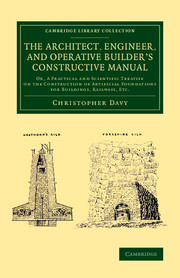
Little is known about Christopher Davy (c.1803–49), despite his regular contributions to architectural and engineering magazines in Britain and America. Describing himself as an 'architect and teacher of architecture', he also took an interest in steam engines and railway construction. In this work, published in 1839, and using information gathered from experiments by the Board of Ordnance, Davy begins by describing the characteristics of the geology of England and Wales, with regard to its suitability for obtaining building materials and laying strong foundations. He describes the means by which soil and rock samples may be taken, and gives details relating to the construction of the foundations of St Paul's Cathedral on the troublesome London clay. Later chapters discuss the practicalities of pile driving, the use of concrete, and the properties of limestone. Reflecting the progress of technical knowledge in the early nineteenth century, the work features several illustrations of contemporary apparatus.
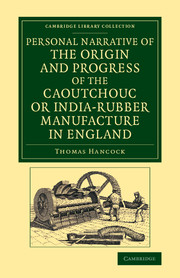
Over the course of three decades, the English businessman and inventor Thomas Hancock (1786–1865) took out sixteen patents relating to the potential applications of natural rubber. Hancock's fascination with this material, the properties of which had not been fully appreciated in England, drove him to experiment extensively with manufacturing methods. This led to the development of the mechanical process of 'mastication' and the chemical process of vulcanization, the end product of which was used by Macintosh to create waterproof garments. This illustrated account of Hancock's discoveries and methods was first published in 1857. It covers the origin of his interest in natural rubber and his subsequent experiments and patents. Also included are details about the plants from which natural rubber is extracted. The result is an informed chronicle of the commercial exploitation of a versatile and lucrative resource.
An Austrian Dominican priest, Heinrich Denifle (1844–1905) carried out painstaking research in the archives of the Vatican and in libraries throughout Europe, resulting in several major publications on medieval history and theology. In 1887 he was appointed to edit the medieval records of the University of Paris, with the assistance of the palaeographer Emile Chatelaine (1851–1933). Paris was the centre of theological learning in Europe in the Middle Ages, and the records here contain important information regarding the university's organisation, teachers, students, relations with popes and kings, religious orders, and intellectual controversies. The four volumes published between 1889 and 1897 contain the texts of some 2,700 records, with references to many more in the notes. Volume 4 (1897) contains almost a thousand records from the period 1394–1452, a difficult time for the university owing to the Western Schism and the Hundred Years War.
Serving in Bengal as a captain of the East India Company, Jonathan Scott (1753–1829) became a private Persian translator to Governor-General Warren Hastings in 1783. A gifted orientalist, he was elected a member of the Asiatic Society of Bengal in 1784, returned to England in 1785, and a year later published the first of his many translations, Memoirs of Eradut Khan (also reissued in the Cambridge Library Collection), shedding light on the Mughal empire in the seventeenth century. This two-volume work, published in 1794, narrates the fortunes of the Islamic kingdoms in southern India from the thirteenth century onwards. Volume 1 comprises a translation of the work of the Persian chronicler Ferishta (1560–1620), documenting the history of the Deccan Plateau to the end of the sixteenth century.
As a civil engineer, Sir John Fowler (1817–98) devoted his life to the railways. His best-known achievements include the first railway bridge across the Thames in London, Manchester Central Station, the development of the London Underground and (with Sir Benjamin Baker) the Forth Bridge - arguably the most remarkable feat of engineering of the nineteenth century. Given access to friends and family papers, the author and social theorist Thomas Mackay (1849–1912) portrays a man who was fascinated by engineering as a child, and who continued to work up until his death. As a portrait of one of the architects of Victorian Britain, this biography, first published in 1900, will be of great interest to historians of the period as well as readers wishing to know more about the development of iconic infrastructure.
Although cast iron was used in pagoda construction in ancient China, it was in Britain in the eighteenth century that new methods allowed for its production in quantities that enabled widespread use. An engineer who had educated himself tirelessly in technical subjects from carpentry to architecture, Thomas Tredgold (1788–1829) first published this work in 1822. It served as a standard textbook for British engineers in the early nineteenth century, and several translations extended its influence on the continent. Reissued here in the fourth edition of 1842, edited and annotated by the structural engineer Eaton Hodgkinson (1789–1861), who presents his own research in the second volume, this work addresses both practical and mathematical questions in assessing metallic strength. In Volume 1, wherever progress has been made since the original publication, Hodgkinson adds notes to Tredgold's original text, pointing out certain errors.
The leading antiquary of his day, Richard Gough (1735–1809) served as director of the Society of Antiquities for over twenty-five years. The only son of a wealthy family, Gough benefited from being free to pursue his interests without hindrance. His independent fortune allowed him both to conduct his own research and to aid others with theirs. While the topography and Roman antiquities of the whole of Great Britain and Ireland formed his primary focus, he was also an eager proponent of Saxonist scholarship, as the panoply of his collected books on both subjects attests. These, together with a variety of maps, plans, drawings and charts, he bequeathed to Oxford's Bodleian Library. Originally published in 1814, this catalogue constitutes proof of a lifelong interest in, as well as generous support for the continuation of, antiquarian and topographical enterprises.
In 1759, David Crantz (or Cranz) was sent to Greenland for a year by the Moravian Church. Writing in German, Crantz (1723–77) published in 1765 his detailed observations on the country, its people and their way of life, including a history of the Moravian mission there. This English translation appeared in two volumes in 1820, prepared by staff at the Fulneck School in West Yorkshire, where a Moravian community existed. The text is illustrated with several engravings that depict landscapes as well as kayaks, weapons and tools used by the Greenlanders, providing a valuable visual record of eighteenth-century life among the native population. Volume 2 contains an account of Moravian missionary activity in Greenland since 1733, tracing how the Moravians managed to brave the conditions while spreading the Gospel among the people. An appendix looks at the Moravian settlement established on the coast of Labrador.
Charles Knight (1791–1873), the son of a Windsor bookseller, was apprenticed to his father at fourteen. He read widely and systematically, and began to buy, collect and sell rare books. He also worked as a journalist, and, on moving to London, set up as a publisher, then took to freelance writing, and acted as manager of the publications of the Society for the Diffusion of Useful Knowledge. In 1832, he launched the Penny Magazine, offering the working classes useful information, within a moral context of thrift and self-discipline. Knight continued to write - on Shakespeare, on Caxton, on English history - while at the same time being at the centre of the British publishing industry. His 1864–5 three-volume autobiography (reissued here in its posthumous 1873 edition) provides insights into the economics as well as the personalities of the mid-Victorian publishing world. Volume 1 covers Knight's life up to 1826.
Commissioned by the enterprising actor-manager John Rich, Covent Garden's Theatre Royal first opened its doors in December 1732. Principally a playhouse during its first century, the venue has had an eventful history involving two disastrous fires and riots over ticket prices. Most notably, it hosted Handel's incomparable operas and oratorios, and was where he presented regular seasons from 1735 until his death in 1759. Not until 1847, under Michael Costa, did the theatre dedicate itself to opera, and in 1892 it received the name by which it is known today: the Royal Opera House. Secretary of the Guildhall School of Music from 1901 to 1935, Henry Saxe Wyndham (1867–1940) published this richly illustrated two-volume account in 1906, celebrating the venue's legendary personalities and productions. Volume 1 covers the period 1732 to 1819 and includes discussion of John Rich, John Philip Kemble, Sarah Siddons, and Handel's operas.
Perhaps the first celebrity chef, Alexis Soyer (1810–58) was a flamboyant, larger-than-life character who nonetheless took his profession very seriously. As the chef of the Reform Club, he modernised its kitchens, installing refrigerators and gas cookers. In 1851, during the Great Exhibition, he prepared spectacular (but financially ruinous) culinary extravaganzas at his restaurant, the Gastronomic Symposium of All Nations. In stark contrast, he organised soup kitchens during the Great Famine in Ireland and volunteered his services in the Crimea in 1855 to improve military catering. This work, first published in 1857, gives a vivid account of his efforts to prepare nutritious meals for the soldiers using a newly invented portable field stove, which remained in use until the Second World War. Also reissued in this series are Soyer's Gastronomic Regenerator (1846) and The Modern Housewife or Ménagère (1849).
The Indo-Aryan language of Sanskrit is the primary language of Hinduism and also a scholarly language of Buddhism. Dating back to the second millennium BCE, it is considered to be the parent of most modern languages of India, and remains central to work in Indo-European studies, philology and linguistics today. First published in 1806, this is a comprehensive grammar of Sanskrit, compiled by the Baptist missionary William Carey (1761–1834) during his time in India. Its purpose was to make the language accessible to European learners, presenting its complex systems of verb conjugation, compound words and affixation in a straightforward way. Reissued here in a two-volume set, Volume 1 contains Books 1–3 of the work, covering characters, pronouns and verbs, and clearly laying out the rules of their formation by way of numerous illustrative examples. Carey's reference works on Marathi and Bengali are also reissued in this series.
This short work, featuring a number of attractive engravings, traces an abortive expedition to the Canadian Arctic. George Francis Lyon (1795–1832), naval officer and explorer, had accompanied William Parry on a previous expedition in search of the North-West Passage. In 1824 Lyon was instructed to return to Repulse Bay and to explore the mainland. Unfavourable weather conditions forced Lyon to turn back after a few months, and he published this account of the experience the following year. Lyon's text is notable for his descriptions of encounters with Inuit, with whom he spent a great deal of time. The book also includes the text of the official instructions issued by the Admiralty. Chronicling the 1821–3 expedition with Parry, The Private Journal of Captain G. F. Lyon (1824) is also reissued in the Cambridge Library Collection, along with his Journal of a Residence and Tour in the Republic of Mexico (1828).