A collection of out-of-copyright and rare books from the Cambridge University Library and other world-class institutions that have been digitally scanned, made available online, and reprinted in paperback.
To save content items to your account,
please confirm that you agree to abide by our usage policies.
If this is the first time you use this feature, you will be asked to authorise Cambridge Core to connect with your account.
Find out more about saving content to .
To save content items to your Kindle, first ensure no-reply@cambridge.org
is added to your Approved Personal Document E-mail List under your Personal Document Settings
on the Manage Your Content and Devices page of your Amazon account. Then enter the ‘name’ part
of your Kindle email address below.
Find out more about saving to your Kindle.
Note you can select to save to either the @free.kindle.com or @kindle.com variations.
‘@free.kindle.com’ emails are free but can only be saved to your device when it is connected to wi-fi.
‘@kindle.com’ emails can be delivered even when you are not connected to wi-fi, but note that service fees apply.
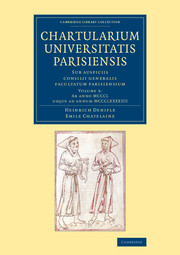
An Austrian Dominican priest, Heinrich Denifle (1844–1905) carried out painstaking research in the archives of the Vatican and in libraries throughout Europe, resulting in several major publications on medieval history and theology. In 1887 he was appointed to edit the medieval records of the University of Paris, with the assistance of the palaeographer Emile Chatelaine (1851–1933). Paris was the centre of theological learning in Europe in the Middle Ages, and the records here contain important information regarding the university's organisation, teachers, students, relations with popes and kings, religious orders, and intellectual controversies. The four volumes published between 1889 and 1897 contain the texts of some 2,700 records, with references to many more in the notes. Volume 3 (1894) covers 1350–94, as the university dealt with the aftermath of the Black Death, and with the Hundred Years War.
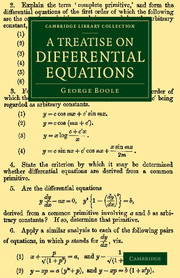
The need to support his family meant that George Boole (1815–64) was a largely self-educated mathematician. Widely recognised for his ability, he became the first professor of mathematics at Cork. Boole belonged to the British school of algebra, which held what now seems to modern mathematicians to be an excessive belief in the power of symbolism. However, in Boole's hands symbolic algebra became a source of novel and lasting mathematics. Also reissued in this series, his masterpiece was An Investigation of the Laws of Thought (1854), and his two later works A Treatise on Differential Equations (1859) and A Treatise on the Calculus of Finite Differences (1860) exercised an influence which can still be traced in many modern treatments of differential equations and numerical analysis. The beautiful and mysterious formulae that Boole obtained are among the direct ancestors of the theories of distributions and of operator algebras.
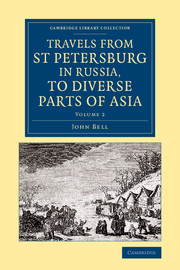
John Bell (1691–1780) trained as a physician, but preferred a life of travel and diplomacy. He entered the service of Tsar Peter the Great of Russia, and had already taken part (as the expedition's doctor) in a government mission to Persia in 1715–18 when he was asked to join a further embassy to China. This two-volume work, published in 1763, describes both these journeys. Volume 2 takes up the story with the embassy's reception in Beijing, with accounts of the Chinese emperor and his court, and the return journey. It also includes the journal of Lorenz Lange (c.1690–1752), a Swede in Russian service who was an agent at the court of Beijing at the time of Bell's own mission, and short accounts of Bell's later visits to Derbent on the Caspian Sea, and to Constantinople. This is a delightful account of an area then hardly known in the west.
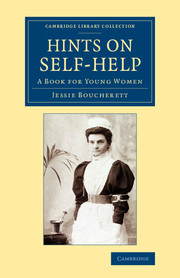
A determined campaigner for women's rights, Jessie Boucherett (1825–1905) helped to draft Britain's first female suffrage petition in 1866 and founded the Englishwoman's Review in the same year. Originally published in 1863 and reissued here in its 1866 printing, the present work is her call to arms for young women of all classes to pursue their independence through education and employment. Emphasising the risk of trusting in men to provide for women, she urges her readers to support themselves, first through education and then through remunerative work. She includes examples of the various trades open to women and examines the cases of women who have not only succeeded but excelled in their occupations. The appendices give details of institutions where women could receive training. Reflecting and refining the Victorian concern with self-improvement, this work remains relevant to social historians and readers interested in the women's movement.
The Austrian scientist Ernst Mach (1838–1916) carried out work of importance in many fields of enquiry, including physics, physiology, psychology and philosophy. Many significant thinkers, such as Ludwig Wittgenstein and Bertrand Russell, benefited from engaging with his ideas. Mach delivered the twelve lectures collected here between 1864 and 1894. This English translation by Thomas J. McCormack (1865–1932) appeared in 1895. Mach tackles a range of topics in an engaging style, demonstrating his abilities as both a researcher and a communicator. In the realm of the physical sciences, he discusses electrostatics, the conservation of energy, and the speed of light. He also addresses physiological matters, seeking to explain aspects of the hearing system and why humans have two eyes. In the final four lectures, he deals with the nature of scientific study. The Science of Mechanics (1893), Mach's historical and philosophical account, is also reissued in this series.
An Irish officer in the British army, William Francis Butler (1838–1910) travelled widely during a career which took him from India to Africa. In 1867 he made for Canada with his regiment, and he recalls his adventures in this lively account, first published in 1872 to immediate success, and followed by this second edition in the same year. The book covers Butler's risky reconnaissance mission during the Red River Rebellion, during which he met the Métis leader Louis Riel. Later chapters describe subsequent journeys into the sparsely populated Manitoba and Saskatchewan territories, as well as the US states of Illinois, Minnesota and North Dakota. In vivid detail, Butler describes the landscapes and peoples he encountered, including many Native American tribes. This region of North America was later transformed by an influx of settlers, and Butler's work captures the final days of what was then an underexplored wilderness.
Before the painter Benjamin Robert Haydon (1786–1846) committed suicide, he had left instructions that an account of his life should be published, using his autobiography up to 1820 and his letters and journals for the rest. The writer and dramatist Tom Taylor (1817–80) took on the editing, and the three-volume work was published in 1853. (The slightly enlarged second edition, also of 1853, is reissued here.) Haydon was a history painter at a time when that genre was perceived as the greatest form of the art, and his friends included Wordsworth, Keats, Shelley, Charles Lamb, Hazlitt and Elizabeth Barrett Browning. However, he was constantly in financial difficulties, and in later life a sense of failure seems to have turned into outright paranoia. Volume 1 reproduces Haydon's autobiographical writings up to 1820. His Conversations and Table-Talk, edited in two volumes by his son, is also reissued in this series.
One of the greatest mathematicians of the nineteenth century, Carl Gustav Jacob Jacobi (1804–51) burst into the limelight with his redevelopment, together with Niels Henrik Abel (1802–29), of the theory of elliptic functions. His pioneering work was characterised by the variety of problems tackled and the power of the tools used to tackle them. His lasting influence on rational mechanics, number theory, partial differential equations, complex variable theory and computation is marked by the number of fundamental concepts that bear his name (the Jacobian, the Jacobi sum and the Jacobi symbol, among others). His collected works, comprising treatises, letters and papers written in German, Latin and French, were published in eight volumes between 1881 and 1891. Edited by fellow German mathematician Karl Weierstrass (1815–97), Volume 6 appeared in 1891.
After the death of the younger Carl Linnaeus in 1783, the entirety of the Linnean collections, including the letters received by the elder Linnaeus from naturalists all over Europe, was purchased by the English botanist James Edward Smith (1759–1828), later co-founder and first president of the Linnean Society of London. In 1821, Smith published this two-volume selection of the letters exchanged by Linnaeus père et fils and many of the leading figures in the study of natural history, revealing some of the close ties of shared knowledge and affection that bound the European scientific community at that time. Where necessary, Smith translates the letters into English, with the exception of those written in French, which are presented in the original. The varied correspondents of Linnaeus senior, whose letters appear in Volume 2, include the botanists Johann Dillenius and Bernard de Jussieu, and the philosopher Jean-Jacques Rousseau.
Friedrich Wilhelm Sturz (1762–1832) published his edition of the Etymologicum Gudianum in 1818. It is based on the Greek manuscript Gud. gr. 29 / 30 in the famous Herzog August Bibliothek at Wolfenbüttel, and was the first printed edition of the complete work, introduced by a Latin preface. The Etymologicum Gudianum is a Greek lexical encyclopaedia compiled in southern Italy during the tenth century. It was one of the main sources of the better known Etymologicum Magnum compiled in the middle of the twelfth century. Not only is the Gudianum a rich and valuable source of citations from lost ancient Greek works, it represents the high point of medieval encyclopaedia-writing and Greek scholarship. Sturz's edition was a key reference work for generations of classicists, Byzantinists and medievalists.
A distinguished mathematician and notable university teacher, Isaac Todhunter (1820–84) became known for the successful textbooks he produced as well as for a work ethic that was extraordinary, even by Victorian standards. A scholar who read all the major European languages, Todhunter was an open-minded man who admired George Boole and helped introduce the moral science examination at Cambridge. His many gifts enabled him to produce the histories of mathematical subjects which form his lasting memorial. First published between 1886 and 1893, the present work was the last of these. Edited and completed after Todhunter's death by Karl Pearson (1857–1936), another extraordinary man who pioneered modern statistics, these volumes trace the mathematical understanding of elasticity from the seventeenth to the late nineteenth century. Volume 2 (1893) was split into two parts. Part 1 includes the work of Saint-Venant from 1850 to 1886.