A collection of out-of-copyright and rare books from the Cambridge University Library and other world-class institutions that have been digitally scanned, made available online, and reprinted in paperback.
To save content items to your account,
please confirm that you agree to abide by our usage policies.
If this is the first time you use this feature, you will be asked to authorise Cambridge Core to connect with your account.
Find out more about saving content to .
To save content items to your Kindle, first ensure no-reply@cambridge.org
is added to your Approved Personal Document E-mail List under your Personal Document Settings
on the Manage Your Content and Devices page of your Amazon account. Then enter the ‘name’ part
of your Kindle email address below.
Find out more about saving to your Kindle.
Note you can select to save to either the @free.kindle.com or @kindle.com variations.
‘@free.kindle.com’ emails are free but can only be saved to your device when it is connected to wi-fi.
‘@kindle.com’ emails can be delivered even when you are not connected to wi-fi, but note that service fees apply.
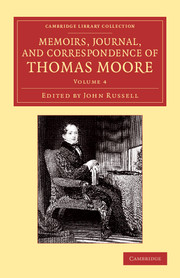
Throughout his professional life, the poet Thomas Moore (1779–1852) was variously celebrated and vilified for both his verse and his politics. Born in Dublin, he remained an ardent Irish patriot until his death. This eight-volume collection of Moore's memoirs, diaries and letters, edited by his friend Lord John Russell (1792–1878) and first published between 1853 and 1856, provides rare insights into a man whose genius was applauded by the Morning Chronicle as 'embracing almost all sides of imaginative literature, of criticism and philosophy'. Volume 4 contains Moore's diary for the period 1822–5, during which time his reputation for sensuousness and political satire was confirmed with the publication of The Loves of the Angels (1823) and Fables for the Holy Alliance (1823). The volume opens with engravings of his fellow radical poet Samuel Rogers and the cottage at Mayfield where Moore wrote much of Lalla Rookh.
John Irving (1815–1847?) was a lieutenant on board H.M.S. Terror during Sir John Franklin's fateful expedition, and had the melancholy distinction of being the first identifiable body to be found by a subsequent search party - that of the US officer Frederick Schwatka - in 1878. Irving was identified by a silver medal, won for mathematics in 1830. His remains were brought back to Britain and reburied in his home town, Edinburgh, and at the request of Irving's father this 'memorial sketch', including some of the young lieutenant's letters to his family, was published in 1881 by Benjamin Bell (1810–83), great-grandfather of the surgeon Joseph Bell, Conan Doyle's model for Sherlock Holmes. As well as the touching memoir, the work includes details of the various search and rescue attempts, and a reconstructed chronology by Clements Markham of the Franklin expedition up to its disastrous end.
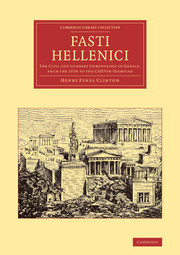
Educated at Christ Church, Oxford, Henry Fynes Clinton (1781–1852) distinguished himself as a classical scholar following an unsuccessful parliamentary career. He first published Fasti Hellenici in 1824; reissued here is the 1827 second edition, which contained a number of additions and corrections. The work received such a favourable reception that it was followed by further instalments in 1830 and 1834. His two-volume Fasti Romani (1840–5) is also reissued in this series. Featuring chronological tables of the civil, military and literary affairs of Greece from 560 to 278 BCE, Fasti Hellenici includes references in the extant sources to the rulers, philosophers and poets of the period. Alongside an essay on demography, the extensive appendices provide further information on kings, tyrants, orators, statesmen and other notables. A valuable contribution to the study of the ancient world, this work testifies to its author's immensely wide and methodical reading in Greek literature.
In 1860, naval officer Sherard Osborn (1822–75), a veteran of both Opium Wars, published this collection of remarks and predictions on Chinese affairs in relation to British imperial interests. Osborn writes in forthright style of his time in the East and his negative experiences of Chinese diplomacy to support his view that 'the European has ever to use force rather than argument to obtain his ends in China, be they however moderate, however just'. He also sets out some advice on how to prevent British smugglers from taking advantage of the Chinese. A number of Osborn's other publications are also reissued in the Cambridge Library Collection, including Stray Leaves from an Arctic Journal (1852), The Discovery of the North-West Passage by HMS Investigator (1856), and The Career, Last Voyage, and Fate of Captain Sir John Franklin (1860).
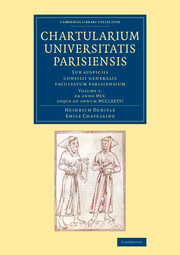
An Austrian Dominican priest, Heinrich Denifle (1844–1905) carried out painstaking research in the archives of the Vatican and in libraries throughout Europe, resulting in several major publications on medieval history and theology. In 1887 he was appointed to edit the medieval records of the University of Paris, with the assistance of the palaeographer Emile Chatelaine (1851–1933). Paris was the centre of theological learning in Europe in the Middle Ages, and the records here contain important information regarding the university's organisation, teachers, students, relations with popes and kings, religious orders, and intellectual controversies. The four volumes published between 1889 and 1897 contain the texts of some 2,700 records, with references to many more in the notes. The university came into being around 1160, and Volume 1 (1889) covers the period up to 1286, with some 55 documents dating from before 1200.
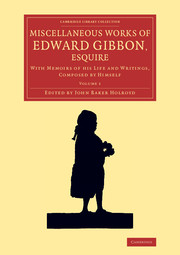
On the death of Edward Gibbon (1737–94), his unpublished papers were left to his friend John Baker Holroyd, first earl of Sheffield, who published them in two volumes in 1796. Gibbon had written six manuscript accounts of his own life, and, according to Sheffield, had always intended to publish his autobiography in his lifetime. The memoir as edited by Sheffield begins with Gibbon's family history, and taking in his education, travels, and career as a historian, finishes with his anxiety over the future of Europe in 1788. Sheffield then continues the story until Gibbon's death through his correspondence, providing a linking narrative, and this, together with 210 other letters to and from Gibbon, takes up Volume 1. His great work, The History of the Decline and Fall of the Roman Empire, is also reissued (in the 1896–1900 edition by J. B. Bury) in the Cambridge Library Collection.
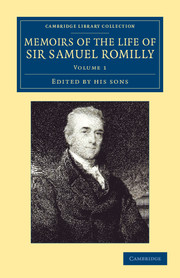
A friend of Wilberforce and Bentham, Sir Samuel Romilly (1757–1818) combined considerable legal expertise with commitment to progressive political causes such as the abolition of the slave trade. During his time in Parliament - he was Solicitor General in Lord Grenville's 'Ministry of All the Talents' - he sought to lessen the archaic severity of English criminal law regarding corporal and capital punishment. Though he met with resistance, his efforts raised awareness and influenced later reforms. Compiled by his sons and published in 1840, this three-volume collection of autobiographical writings and varied correspondence illuminates the development of his outlook and the principles which guided him. Volume 1 includes Romilly's two-part narrative of his life from 1757 to 1789, letters about English affairs sent to his brother-in-law in Lausanne (1780–3), letters from eminent friends such as the French revolutionary Mirabeau (1783–7), and selected correspondence with the Genevan writer Étienne Dumont and others (1788–91).
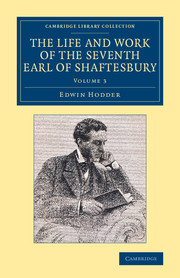
In the preface to this three-volume work of 1886, Edwin Hodder (1837–1904) writes that the seventh earl of Shaftesbury 'resisted every appeal that was made to him to allow his biography to be written'. In the end, he succumbed to the inevitable, and shared with Hodder, a professional author, both his archives and his memories. Anthony Ashley-Cooper (1801–85) was an evangelical Christian with a profound sense of the duty owed by the aristocracy to their country and to the less fortunate. He first came to prominence as the leader of the parliamentary campaign for shorter working hours, which led to the Factory Act of 1833. Entering the House of Lords on his father's death, he extended his activities, becoming the best-known philanthropist of his age. Volume 3 begins by considering Shaftesbury's religious views, and continues to describe his energetic and practical charitable activities until his death.
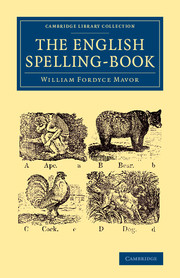
Variously a teacher, clergyman and town mayor, William Fordyce Mavor (1758–1837) wrote prolifically on a range of literary, historical and educational topics. This work, first published in 1801 and reissued here in a corrected and improved edition of 1843, is Mavor's most famous. Intended to 'sow the seeds of useful learning', it is both a reading primer and a compendium of general knowledge. Beginning with the alphabet, with each letter illustrated by the delightful wood engravings of Thomas Bewick, the book presents vocabulary of increasing complexity together with simple and amusing stories for reading practice, as well as guidance on spelling and grammar. General knowledge is addressed through sections on such topics as weights and measures, geography, key dates in history, and the solar system. So successful was the work that it ran to 500 editions, had sold more than 2 million copies by 1823, and was translated into Hindi and French.
The German linguist Hugo Schuchardt (1842–1927) made significant contributions to the study of the Basque and Romance languages, publishing also on pidgins and creoles. A critic of the Neogrammarian hypothesis of sound laws, he subscribed to the 'wave model' of language change. His Über die Lautgesetze: Gegen die Junggrammatiker (1885) has been reissued in this series in a volume with Die Verwantschaftsverhältnisse der indogermanischen Sprachen (1872) by Johannes Schmidt (1843–1901). Based on Schuchardt's doctoral dissertation and the painstaking study of extant sources, the present three-volume work appeared between 1866 and 1868. He explores here the development and characteristics of Vulgar Latin, the language of the general population, as opposed to the classical, literary variety. The work focuses on the distinctive vowel changes that took place in Romance vernaculars over many centuries. Volume 2 (1867) includes discussion of both qualitative and quantitative vowel changes.
A distinguished mathematician and notable university teacher, Isaac Todhunter (1820–84) became known for the successful textbooks he produced as well as for a work ethic that was extraordinary, even by Victorian standards. A scholar who read all the major European languages, Todhunter was an open-minded man who admired George Boole and helped introduce the moral science examination at Cambridge. His many gifts enabled him to produce the histories of mathematical subjects which form his lasting memorial. First published between 1886 and 1893, the present work was the last of these. Edited and completed after Todhunter's death by Karl Pearson (1857–1936), another extraordinary man who pioneered modern statistics, these volumes trace the mathematical understanding of elasticity from the seventeenth to the late nineteenth century. Volume 2 (1893) was split into two parts. Part 2 covers the work of Neumann, Kirchhoff, Clebsch, Boussinesq, and Lord Kelvin.
The British naval officer George Francis Lyon (1795–1832) survived extremes of African heat and Arctic cold during his colourful career. Remembered chiefly for the engaging journals he kept, and for his watercolours of the Arctic, he was fascinated by the indigenous peoples of the lands he explored, notably being tattooed by Inuit and eating raw caribou and seal meat with them. In 1826 he sailed to Mexico, then recovering from its war of independence, to serve as a commissioner for an English mining company. His vivid and often entertaining two-volume account of his experiences was published in 1828. In Volume 2, Lyon encounters notorious bandits outside Guadalajara, ponders the potential navigation of rivers for commercial shipping, and writes of a visit to the Guadalajara theatre: 'had it not been for the universal smoking, and the silence and good manners of the audience, I might have almost fancied myself in England'.
This joint reissue comprises two works on military medicine, providing instruction on the treatment of ailments common to soldiers, and methods for preventing their occurrence. The title work, written by Charles Alexander Gordon (1821–99) and published in 1873, is followed by A Guide to Health for the Use of Soldiers by fellow surgeon R. C. Eaton (1842–1902), which first appeared in 1890. Intended to be read by infantrymen and officers, both works offer succinct and practical advice on topics ranging from malaria to drunkenness. The texts take slightly different approaches in their presentation of advice: Gordon adopts a crisp and formal style, while Eaton incorporates instructive medical facts in his brief yet fluent explanations. Together, the works provide an effective exposition of problems and practicalities that would assume tremendous significance decades later in the trenches of the First World War.
A German classical scholar, philologist and pioneer of Byzantine studies, Gottlieb Lukas Friedrich Tafel (1787–1860) had already published two volumes of his own commentaries on the Greek poet Pindar when, in 1832, he prepared this edition of the minor works of the twelfth-century Greek scholar Eustathius (c.1115–c.1194), metropolitan of Thessalonica, whose valuable commentaries on Homer, as edited by Johann Stallbaum, are also reissued in this series. Tafel's edition gives various works from a Basel codex, principally orations, as well as a preface to Eustathius' lost commentary on Pindar and some of his observations on religious and monastic practices. The Paris codex contains numerous letters from Eustathius to a variety of recipients, including the Emperor and the Patriarch of Constantinople. Furthermore, this collection contains fourteenth- and fifteenth-century pieces relating to Trebizond by Michael Panaretos and John Eugenikos respectively. Following a Latin introduction, all texts are in Greek.
By the early nineteenth century, meteorologists were equipped with plenty of useful devices: barometers, thermometers, hygrometers, and any number of variations thereon. But the nature of these instruments was not wholly understood. While it was possible to take accurate measurements with a barometer, what physical process made the mercury move? What exactly is atmospheric pressure? And how can one measure sunlight? Ranging from wild theories of gravity-resistant air particles to the latest experiments in altitude, chemist and physicist John Frederic Daniell (1790–1845) presents his answers in this collection of essays. First published in 1823, this enlarged second edition of 1827 includes his work on the climate of London, the effect of atmospheric conditions on human health, and suggested improvements for the design of a new hygrometer. Daniell later became the first professor of chemistry at King's College, London, and foreign secretary of the Royal Society.
Having studied medicine at Guy's Hospital, London, John Kidd (1775–1851) established himself as a physician and educator at Oxford, where he lectured widely on chemistry, anatomy, mineralogy and geology. Regius professor of medicine and a fellow of the Royal Society from 1822, he rooted his scientific understanding and teaching in natural theology. Published in 1833 as the second Bridgewater Treatise, the present work attempted to bring science and religion into harmony, drawing on such disciplines as anthropology and comparative anatomy. Seeking to demonstrate the superiority of humans in the natural world, Kidd argues that animals, minerals and plants had been adapted by God to serve mankind. Founded upon a belief in the antediluvian world and the revealed existence of God in nature, the work exemplifies the influence of natural theology within the scientific establishment before the era of Darwin.
John William Polidori (1795–1821) was, for a brief period, the personal physician to Lord Byron. Half Italian, he was the uncle of the Rossetti siblings, and it was William Michael Rossetti, in his role as family recorder, who published Polidori's manuscript diary after nearly a century, in 1911. This account of his time with Byron (which ended two months later when they quarrelled and parted company) is the only contemporary account of the few weeks, crucial to the development of the Romantic movement, during which Mary Shelley's Frankenstein arose from a storytelling competition at the Villa Diodati. Polidori's later career as a physician and writer was hampered by a severe accident in 1817 which left him with brain damage. His most famous work, The Vampyre, was published in 1819, but attributed to Byron, leading both men to threaten the publisher with lawsuits. Polidori died (probably a suicide) two years later.
One of the greatest mathematicians of the nineteenth century, Carl Gustav Jacob Jacobi (1804–51) burst into the limelight with his redevelopment, together with Niels Henrik Abel (1802–29), of the theory of elliptic functions. His pioneering work was characterised by the variety of problems tackled and the power of the tools used to tackle them. His lasting influence on rational mechanics, number theory, partial differential equations, complex variable theory and computation is marked by the number of fundamental concepts that bear his name (the Jacobian, the Jacobi sum and the Jacobi symbol, among others). His collected works, comprising treatises, letters and papers written in German, Latin and French, were published in eight volumes between 1881 and 1891. Edited by fellow German mathematician Karl Weierstrass (1815–97), Volume 7 appeared in 1891.
Of the many accounts of Lord Byron's mission to Greece and his death at Missolonghi in 1824, very few were by eyewitnesses. In this 1825 book, William Parry (1773–1859) describes in detail Byron's last days, and records the poet's wishes and intentions with regard to the Greek independence movement. Parry was working in the naval dockyard at Greenwich when he was recruited by the London Greek Committee to organise an artillery brigade to join Byron in Greece. The original plan was scaled down, but in February 1824 Parry and some companions arrived in Missolonghi. Byron took to him, and Parry, effectively his right-hand man, was with him when he died. His book is in part a score-settling activity against the opposing factions of the Committee both in Greece and England, but it is also an important and detailed account of the death, and of the creation of a myth.
In 1871 the British government agreed to support an expedition to collect physical and chemical data and biological specimens from the world's oceans. Led by Charles Wyville Thomson (1830–82), the expedition used HMS Challenger, refitted with laboratories. They sailed nearly 70,000 nautical miles around the world, took soundings and water samples at hundreds of stops along the way, and discovered more than 4,000 new marine species. Noted for the discovery of the Mid-Atlantic Ridge and the Pacific's deepest trench, the expedition laid the foundations for modern oceanography. This acclaimed two-volume account, first published in 1877, summarises the major discoveries for the Atlantic legs of this pioneering voyage. Illustrated with plates and woodcuts, Volume 1 describes the laboratories and equipment, the observations from Portsmouth via Tenerife to the Caribbean, and the detailed studies on the Gulf Stream.