A collection of out-of-copyright and rare books from the Cambridge University Library and other world-class institutions that have been digitally scanned, made available online, and reprinted in paperback.
To save content items to your account,
please confirm that you agree to abide by our usage policies.
If this is the first time you use this feature, you will be asked to authorise Cambridge Core to connect with your account.
Find out more about saving content to .
To save content items to your Kindle, first ensure no-reply@cambridge.org
is added to your Approved Personal Document E-mail List under your Personal Document Settings
on the Manage Your Content and Devices page of your Amazon account. Then enter the ‘name’ part
of your Kindle email address below.
Find out more about saving to your Kindle.
Note you can select to save to either the @free.kindle.com or @kindle.com variations.
‘@free.kindle.com’ emails are free but can only be saved to your device when it is connected to wi-fi.
‘@kindle.com’ emails can be delivered even when you are not connected to wi-fi, but note that service fees apply.
A keen collector and sketcher of plant specimens from an early age, the author, educator and clergyman Charles Alexander Johns (1811–74) gained recognition for his popular books on British plants, trees, birds and countryside walks. Flowers of the Field (1851), one of several works originally published by the Society for Promoting Christian Knowledge, is also reissued in this series. First published by the Society between 1847 and 1849, this two-volume botanical guide for amateur enthusiasts focuses on the trees found in British woodland. Johns describes each species, noting also pests and diseases, uses for the wood, and associated myths and legends. The work is noteworthy for its meticulous engravings of leaves, seeds and blossom, and of the trees in natural settings. Volume 2 (1849) covers such species as chestnut, birch, elm, willow, ivy, yew and cedar. An index to the whole work is also provided.
After qualifying as a physician, Robert Richardson (1779–1847) joined the household of the earl of Belmore, and accompanied him and his family on a tour of the eastern Mediterranean in his yacht the Osprey, converted from a captured American schooner. Richardson dedicated this two-volume work to his patron in 1822. Having spent several months in Naples, the party travelled through the Greek islands to Constantinople, arriving in Alexandria in September 1817. Volume 2 describes further exploration in Egypt, before the party travelled into Palestine, where they visited Jerusalem and the Holy Places, and the cities of the Old Testament, continuing through Syria and Lebanon. Their intention of revisiting Greece on their return was thwarted by reports of the plague, and they arrived back in Malta in July 1818. Richardson's account is full of detail, both of the archaeological remains and of everyday life in the Middle East.
After qualifying as a physician, Robert Richardson (1779–1847) joined the household of the earl of Belmore, and accompanied him and his family on a tour of the eastern Mediterranean in his yacht the Osprey, converted from a captured American schooner. Richardson dedicated this two-volume work to his patron in 1822. Having spent several months in Naples, the party travelled through the Greek islands to Constantinople, arriving in Alexandria in September 1817. Volume 1 recounts their journey up the Nile, exploring both the antiquities of Egypt and the modern cities, especially Cairo, where Richardson made the acquaintance of Burckhardt (whose death he witnessed), Belzoni, Henry Salt and other early explorers of Egypt's past. Having reached the Nile's second cataract, they returned to Thebes, where they were greeted with news of Princess Charlotte's death. Richardson's account is full of detail, both of the archaeological remains and of everyday life in modern Egypt.
A Scottish doctor and botanist, George Watt (1851–1930) had studied the flora of India for more than a decade before he took on the task of compiling this monumental work. Assisted by numerous contributors, he set about organising vast amounts of information on India's commercial plants and produce, including scientific and vernacular names, properties, domestic and medical uses, trade statistics, and published sources. Watt hoped that the dictionary, 'though not a strictly scientific publication', would be found 'sufficiently accurate in its scientific details for all practical and commercial purposes'. First published in six volumes between 1889 and 1893, with an index volume completed in 1896, the whole work is now reissued in nine separate parts. Volume 5 (1891) contains entries from Linum (the flax genus) to oyster (the subcontinent's best oyster beds were to be found 'on the coast near Karachi, Bombay and Madras').
According to even his most forgiving biographers, Edgar Allan Poe (1809–49) was a difficult man. Arrested whilst touring Europe, and expelled from the United States Military Academy at West Point, he tended to lose both work and friends through drunkenness. Best known for his goriest stories, Poe is often presented to the modern reader as a writer of horror. However, this collection, published in 1852, offers a broader selection of his work. It includes one of his first pieces of detective fiction, 'The Gold-Beetle', resulting from his preoccupation with cryptography; 'A Descent into the Maelström', an early example of science fiction; the mesmeric verse of 'The Raven'; and some of his lesser-known love poetry. A pioneer of modern genre fiction, Poe remains important and influential in the American literary canon. This lavishly illustrated collection represents an excellent introduction to his work.
Published in 1842, this important monograph by Charles Darwin (1809–82) formed the first part of a trilogy of geological studies based on observations made during the celebrated second voyage of the Beagle. Influenced by Charles Lyell's Principles of Geology, Darwin drew in particular on data from the survey of the Keeling Islands in the Indian Ocean to support his theory that subsidence of the ocean floor can account for the formation of coral atolls. He first presented his findings in a paper for the Geological Society of London in 1837, but a heavy workload and illness delayed the appearance of this elegantly argued and illustrated study. For this and his work on barnacles, Darwin would receive the Royal Society's royal medal in 1853. The other studies in the trilogy, Geological Observations on the Volcanic Islands (1844) and Geological Observations on South America (1846), are also reissued in this series.
Educated at King's College, London, the naturalist and marine biologist William Saville-Kent (1845–1908) went on to work at the British Museum and in aquariums at Brighton, Manchester and Westminster. He spent many years in Australia as a fisheries expert, and during this time he made extensive surveys of the natural world. The present work, first published in 1897, was intended to give a non-scientific audience a glimpse of the fantastic array of wildlife in Australia. The author discusses the many varieties of birds, lizards, fish and other sea life, insects (an entire chapter is devoted to termites), and vegetation. He was also able to take advantage of the photographic technology of the time and include around fifty collotype images, which complement the many other illustrations of the plants and animals he writes about, providing a vivid overview of the natural world in late nineteenth-century Australia.
Best known for his 1906 discovery of lost texts in the Archimedes Palimpsest, Danish scholar Johan Ludvig Heiberg (1854–1928), professor of classical philology at Copenhagen, published numerous editions of ancient mathematicians, including Archimedes and Apollonius of Perga (also reissued in this series). Between 1898 and 1907, he published in three parts the extant astronomical works of Ptolemy, active in second-century Alexandria. The Ptolemaic system, his geocentric model of the universe, prevailed in the Islamic world and in medieval Europe until the time of Copernicus. Volume 2, published in 1907, contains a brief preface and a substantial prolegomena in Latin, followed by the Greek text of Ptolemy's shorter astronomical works, including Phaeis aplanon asteron, a treatise on the phenomena of the fixed stars, and Hypotheseis ton planomenon, his planetary hypotheses representing the most influential statement of his geocentric model, provided here with a facing-page translation into German.
In 1759, David Crantz (or Cranz) was sent to Greenland for a year by the Moravian Church. Writing in German, Crantz (1723–77) published in 1765 his detailed observations on the country, its people and their way of life, including a history of the Moravian mission there. This English translation appeared in two volumes in 1820, prepared by staff at the Fulneck School in West Yorkshire, where a Moravian community existed. The text is illustrated with several engravings that depict landscapes as well as kayaks, weapons and tools used by the Greenlanders, providing a valuable visual record of eighteenth-century life among the native population. Volume 1 is primarily concerned with the geography of Greenland, the local weather patterns, and flora and fauna, as well as the attitudes, traditions, social habits and hierarchies of the people of Greenland.
Although first to suggest the possibility of light frequencies beyond the visible spectrum, the natural philosopher John Elliott (1747–87) was better known at his death for his failed suicide in front of the woman he loved. Tried for attempting to shoot her, he was acquitted but died in prison awaiting trial on the lesser charge of assault. First published in 1780, this work was his most important. Contemporary science held that vibrations of the air were directly communicated to the optic and auditory nerves and passed on to the sensorium, while Elliot proposed, through experimentation upon himself, the existence of sensory receptors, each tuned to only a limited part of the spectrum of physical frequencies. This insight led him to postulate the existence of what we now know to be ultraviolet and infrared radiation, thus paving the way for further discoveries in human sensory perception.
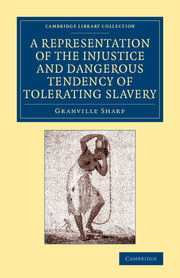
This work by the anti-slavery campaigner Granville Sharp (1735–1813) brings together legal and historical documents, as well as the author's own legal arguments, demonstrating that slavery was illegal and therefore could not be upheld in England. Furthering his own intellectual development while working for a linen draper, Sharp later became a government clerk and pursued a writing career. His awakening to the horrors of the slave trade resulted from a chance encounter with an injured slave seeking help from his physician brother. Carrying out the necessary legal research, Sharp published this book in 1769 to demonstrate that slavery has no basis in English law. In 1772, the landmark case of James Somerset was brought before Lord Mansfield, who upheld Sharp's contention: as a result, it was henceforth understood that any slave reaching the shores of England became free. Sharp's memoirs of his life are also reissued in this series.
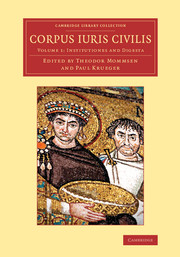
The most famous legal work of the ancient world was compiled at the order of the emperor Justinian (c.482–565) and issued in the period 529–34. It was intended to be a complete codification of all law, to be used as the only source of law in all the courts of the empire. The work was divided into three parts: the Codex Justinianus contained all of the extant imperial enactments from the time of Hadrian; the Digesta compiled the writings of great Roman jurists; and the Institutiones was intended as a textbook for law schools. However, Justinian later found himself obliged to create more laws, and these were published as the Novellae. This three-volume Latin edition of 1872–95, prepared by the great classical historian Theodor Mommsen (1817–1903) and his colleagues, is the culmination of centuries of palaeographical and legal studies. Volume 1 contains the Institutiones and Digesta.
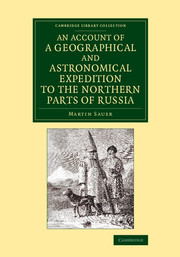
Impressed by the discoveries of Captain Cook, and conscious that Russia was lagging behind other countries in terms of navigation and exploration, Catherine the Great commissioned an expedition in 1785 to chart the coastline in the far north-east of her empire. Born in Middlesex, Joseph Billings (1758–1806) had sailed under Cook but entered Russian service in 1783. He was chosen to lead the expedition, which would last for nine years. Written up by Martin Sauer, secretary and translator to the expedition, this illustrated account was first published in English in 1802, documenting the sheer scale of the task and the range of scientific activities carried out. Notable for producing the first accurate maps of the shoreline and islands of east Siberia, the expedition also contributed to the ethnographic and zoological knowledge of this most inhospitable of environments.
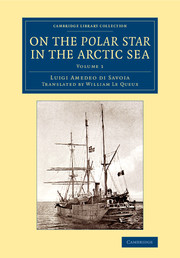
Prince Luigi Amedeo of Savoy, a grandson of King Vittorio Emanuele II of Italy, was well known as a mountaineer and traveller when, in 1899, he organised an expedition to the Arctic, obtaining a steam whaling ship in Oslo which he renamed the Stella Polare. His ambition was to reach the highest possible latitude (and possibly the North Pole itself) by careful logistical arrangements, wintering on the ice in Franz Josef Land and using dog-sledges to travel further north. He also intended a scientific survey of the area in which the team passed the winter. His account of the expedition was published in Italian in 1902 and this two-volume English translation by William Le Queux (better known as the author of sensationalist spy and crime novels) appeared in 1903. Volume 1 recounts the genesis and progress of the expedition, including the crew's efforts to free the ice-bound ship using explosives.
A prolific philologist of both the German and classical languages, Moriz Haupt (1808–74) enjoyed a successful academic career at the universities of Leipzig and Berlin. As well as founding the Zeitschrift für deutsches Altertum, which is still published, he was a painstaking yet somewhat bold editor of many classical texts. In the years immediately following his death, his shorter works were gathered together in this three-volume collection, edited by fellow philologist Ulrich von Wilamowitz-Moellendorff (1848–1931). Volume 3 (1876) originally appeared in two parts, which are reissued here together. Among the articles in German and Latin are a discussion of a fragment of the eulogy for the Ostrogoth king Theodahad and a talk given at the celebration of the Kaiser's birthday in 1871. This work remains of value to researchers interested in nineteenth-century philology, particularly the significant contributions made by its German practitioners.
Charles Knight (1791–1873), the son of a Windsor bookseller, was apprenticed to his father at fourteen. He read widely and systematically, and began to buy, collect and sell rare books. He also worked as a journalist, and, on moving to London, set up as a publisher, then took to freelance writing, and acted as manager of the publications of the Society for the Diffusion of Useful Knowledge. In 1832, he launched the Penny Magazine, offering the working classes useful information, within a moral context of thrift and self-discipline. Knight continued to write - on Shakespeare, on Caxton, on English history - while at the same time being at the centre of the British publishing industry. His 1864–5 three-volume autobiography (reissued here in its posthumous 1873 edition) provides insights into the economics as well as the personalities of the mid-Victorian publishing world. Volume 2 covers the 1820s to the late 1840s.
Having acquired a Shakespeare folio for a few shillings, anthropologist Daniel Wilson (1816–92) found in The Tempest a source of scientific intrigue. Writing more than two hundred years before Darwin propounded his theory of evolution, in his final play Shakespeare had created a missing link caught between the animal and the human. In this monograph, first published in 1873, Wilson uses the strange and unfortunate character of Caliban as a means through which to explore the principles of evolution. He traces many of the play's plot devices back to real events that perhaps inspired them - from storms in Bermuda to records of semi-human creatures around the world - and brings literary commentary into science as he links the relationships set out in the play to anthropological principles. This interdisciplinary approach makes the book both an entertaining exegesis of the play and a uniquely accessible explanation of contemporary scientific theories.
First published in 1840, this two-volume treatise by Cambridge polymath William Whewell (1794–1886) remains significant in the philosophy of science. The work was intended as the 'moral' to his three-volume History of the Inductive Sciences (1837), which is also reissued in this series. Building on philosophical foundations laid by Immanuel Kant and Francis Bacon, Whewell opens with the aphorism 'Man is the Interpreter of Nature, Science the right interpretation'. Volume 1 contains the majority of Whewell's section on 'ideas', in which he investigates the philosophy underlying a range of different disciplines, including pure, classificatory and mechanical sciences. Whewell's work upholds throughout his belief that the mind was active and not merely a passive receiver of knowledge from the world. A key text in Victorian epistemological debates, notably challenged by John Stuart Mill and his System of Logic, Whewell's treatise merits continued study and discussion in the present day.
Peter Heywood (1772–1831) became known for his involvement in the 1789 mutiny aboard the Bounty. After evading a death sentence thanks to a royal pardon, he was able to advance himself in a distinguished naval career, achieving the rank of post-captain. The question of the North-West Passage, a sea route through the Arctic that would connect the Atlantic and Pacific oceans, remained an obsession for the British for much of the nineteenth century. Drawing on his experience as a naval hydrographer and writing under the pseudonym 'Scrutator', Heywood considers the question of the North-West Passage in this 1824 publication by surveying accounts of recent expeditions to the Arctic. While he does not dispute the existence of the much-sought route, he argues that the icy waters would not be navigable for ships. It was not until the early twentieth century that Roald Amundsen and his crew achieved the seemingly impossible.
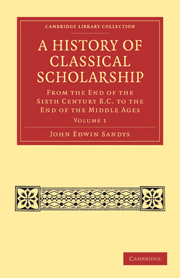
Sir John Edwin Sandys (1844–1922) was a leading Cambridge classicist and a Fellow of St. John's College. His most famous work is this three-volume History of Classical Scholarship, published between 1903 and 1908, which remains the only large-scale work on the subject to span the entire period from the sixth century BCE to the end of the nineteenth century. The history of classical studies was a popular topic during the nineteenth century, particularly in Germany, but Sandys stands out for the ambitious scope of his work, even though much of it was based on earlier scholarship. His chronological account is subdivided by genre and region, with some chapters devoted to particularly influential individuals. Volume 1 covers the Classical period, Byzantine scholarship, and the medieval West to 1350.