A collection of out-of-copyright and rare books from the Cambridge University Library and other world-class institutions that have been digitally scanned, made available online, and reprinted in paperback.
To save content items to your account,
please confirm that you agree to abide by our usage policies.
If this is the first time you use this feature, you will be asked to authorise Cambridge Core to connect with your account.
Find out more about saving content to .
To save content items to your Kindle, first ensure no-reply@cambridge.org
is added to your Approved Personal Document E-mail List under your Personal Document Settings
on the Manage Your Content and Devices page of your Amazon account. Then enter the ‘name’ part
of your Kindle email address below.
Find out more about saving to your Kindle.
Note you can select to save to either the @free.kindle.com or @kindle.com variations.
‘@free.kindle.com’ emails are free but can only be saved to your device when it is connected to wi-fi.
‘@kindle.com’ emails can be delivered even when you are not connected to wi-fi, but note that service fees apply.
French explorer Réné Caillié (1799–1838) was the first European to document a successful expedition to Timbuktu, Africa's elusive 'city of gold'. Europeans were not welcome there, and until Caillié's expedition no explorer had returned alive. Encouraged by the 10,000 francs offered by the Société de Géographie to the first non-Muslim to bring back information on the city, he set out from Senegal in 1824 and eventually reached Timbuktu in 1828. His travels are recounted here in this two-volume work, first published in English in 1830. Volume 2 covers the final part of his journey to Timbuktu, where he stayed for two weeks. Including his impressions of the peoples, tribal conflict, slavery, customs and commerce, the volume concludes with an account of his journey home across the Sahara Desert, and his survival in spite of suffering from fever and fatigue. Vividly written, Caillié's work remains a landmark in the history of African exploration and adventure.
'To the poet, if to any man, it must be justly conceded to be estimated by what he has written rather than by what he has done, and to be judged by the productions of his genius rather than by the circumstances of his outward life.' At the time of his death, John Keats (1795–1821) was often unfavourably appraised, not only with regard to his poetry, but also his character. In this 1848 collection of his letters, the first of its kind, editor Richard Monckton Milnes (1809–85) sets out to show the poet's true colours through his personal correspondence. Adding insightful commentary and context, he builds up a portrait of an extraordinary young man. Keats' epistolary style is often humorous and salted with miniature flights of fantasy, but he is never far from the monetary concerns that dogged him. Volume 2 traces his demise and includes a selection of his work.
The composer and music teacher John Pyke Hullah (1812–84) enjoyed considerable success with The Village Coquettes, his 1836 opera with a libretto by Charles Dickens. He is best remembered, however, for his 'singing school for schoolmasters' which he directed at London's Exeter Hall in the 1840s and later at the specially built St Martin's Hall. Although his use of the French fixed sol-fa system was quickly superseded by Curwen's tonic sol-fa approach, his efforts - with the support of Sir James Kay-Shuttleworth - embedded music firmly in the school curriculum. An influence on the rapid growth of British amateur choral societies, he was also appointed the first government inspector of music in training colleges in 1872. First published in 1886, this biography was prepared from Hullah's notes by his second wife, Frances Rosser Hullah (1839–c.1921), a professional sculptor and writer on music for women's periodicals.
Clergyman, schoolmaster and writer on aesthetics, William Gilpin (1724–1804) is best known for his works on the picturesque. In his Essay on Prints, published in 1768 and reissued in this series, he defined picturesque as 'a term expressive of that peculiar kind of beauty, which is agreeable in a picture'. First published in 1798, the present work is one of a series which records his reflections on the picturesque across British landscapes. It traces the journey he made, equipped with notebook and sketching materials, westwards from Wiltshire through Somerset and Devon to Cornwall, returning via Dorset, Hampshire and the Isle of Wight. He describes his impressions of famous landmarks such as Stonehenge, Glastonbury Abbey, the River Tamar and Carisbrooke Castle, and includes several evocative reproductions of his pen-and-wash drawings. The companion volumes of Observations on other parts of Britain are also reissued in the Cambridge Library Collection.
The novelist and essayist Elizabeth Hamilton (1756?–1816) received her education at a day school from the age of eight, and later recalled her childhood and schooldays fondly. However, intellectual girls in the period were regarded with some suspicion, and she remembered hiding from visitors those books that might be deemed inappropriate for a young woman. Later embarking on a literary career, she published in 1801 her Letters on Education, republished in this second edition of 1801–2. Owing much to the theories of John Locke as well as the period's standard conduct-book advice on the education of girls, Hamilton's work offers detailed theoretical explorations of how children learn. 'Be not afraid my good friend,' she writes, 'that I intend making speculative philosophers of your daughters.' Volume 2 begins with a comment on the necessity of obtaining knowledge of our intellectual faculties, and how this knowledge is to be acquired.
Although without formal scientific training, Henry John Elwes (1846–1922) devoted his life to natural history. He had studied birds, butterflies and moths, but later turned his attention to collecting and growing plants. Embarking on his most ambitious project in 1903, he recruited the Irish dendrologist Augustine Henry (1857–1930) to collaborate with him on this well-illustrated work. Privately printed in seven volumes between 1906 and 1913, it covers the varieties, distribution, history and cultivation of tree species in the British Isles. The strictly botanical parts were written by Henry, while Elwes drew on his extensive knowledge of native and non-native species to give details of where remarkable examples could be found. Each volume contains photographic plates as well as drawings of leaves and buds to aid identification. The species covered in Volume 1 (1906) include beech, spruce and yew.
A pioneering Egyptologist, Sir William Matthew Flinders Petrie (1853–1942) excavated over fifty sites and trained a generation of archaeologists. A great many of his publications have been reissued in this series. In the 1890s, the Irish scholar Sir John Pentland Mahaffy (1839–1919) took the lead on the considerable task of cataloguing, transcribing and commenting on the Greek papyri found by Petrie in mummy cartonnage on recent digs in Egypt. This three-volume collection is the result of his labours. The texts, comprising private correspondence, legal records, petitions and many other types of document, reveal a great deal about life in Egypt in the third century BCE. Volume 1, first published in 1891, contains thirty autotype reproductions of key examples, as well as a detailed introduction on palaeography and the circumstances surrounding the discovery of some of the papyri.
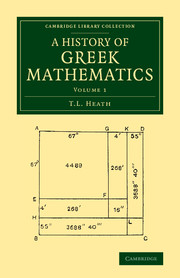
'If one would understand the Greek genius fully, it would be a good plan to begin with their geometry.' As early as the sixth century BCE, Thales of Miletus used geometrical principles to calculate distance and height. Within a few hundred years, Euclid had produced his seminal Elements, which was still used as a textbook when this two-volume work was first published in 1921. A distinguished civil servant as well as an expert on ancient Greek mathematics, Sir Thomas Little Heath (1861–1940) includes here sufficient detail for a modern mathematician to grasp ancient methodology, alongside explanatory sections aimed at classicists. This remains a rigorous and essential exposition of a vast topic. Volume 1 includes an introduction that touches on the conditions which made possible the rapid development of philosophy and science in ancient Greece. The coverage begins with Thales and ends with Euclid.
First published in 1909, this illustrated study considers the work of the artist and satirist William Hogarth (1697–1764), focusing on his depiction of London and its inhabitants. A devoted Londoner, Hogarth won great acclaim in his lifetime for the wit displayed in his many paintings and engravings. His work explored the many facets of London life, from the highest to the lowest social classes, from scenes of politics and business to churches, hospitals and prisons. Bibliographer, editor and prolific author, Henry Benjamin Wheatley (1838–1917) places Hogarth's work in the context of the artist's background and early life. Wheatley's attention to detail complements the selected examples of Hogarth's work, providing a portrait of eighteenth-century manners as seen through the eyes of one of the most acute observers of the age. Several of Wheatley's other works, including London Past and Present (1891), are also reissued in this series.
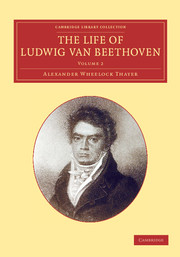
This authoritative biography of Ludwig van Beethoven (1770–1827) was a landmark in its meticulous research and use of source material. For the American author Alexander Wheelock Thayer (1817–97), it represented a lifelong labour of love, yet it remained unfinished at his death. His friend Hermann Deiters (1833–1907) edited and translated Thayer's work into German, publishing three volumes which covered Beethoven's life to 1816. Since Deiters also died before the biography could be completed, musicologist Hugo Riemann (1849–1919) was called upon to conclude the work. The final German volumes appeared in 1907 and 1908. It was the American critic Henry Edward Krehbiel (1854–1923) who prepared the present work, the first and considerably revised English version, published in three volumes in 1921. Volume 2 covers the period 1803–18, including the custody wrangles over Beethoven's nephew.
Ad antiquissimos testes denuo recensuit apparatum criticum omni studio perfectum apposuit commentationem isagogicam praetexuit Constantinus Tischendorf
The German biblical scholar Constantin von Tischendorf (1815–74) published his monumental eighth edition of the Greek New Testament between 1869 and 1872. Influenced by the pioneering scholarship of Karl Lachmann (1793–1851), who had first moved away from relying on the Textus Receptus, Tischendorf placed key emphasis on the witness of older uncial manuscripts, most notably the Codex Sinaiticus (which he rediscovered) and the Codex Vaticanus. His painstaking work laid the foundations for the creation of modern critical texts, and the vast amount of manuscript evidence he collated has ensured that this edition remains a standard work of reference for biblical scholars and textual critics. Following Tischendorf's death, the work's Latin prolegomena was issued in separate parts by Caspar René Gregory (1846–1917), assisted by Ezra Abbott (1819–84). First published in 1894, this part contains sections IX-XIII and addresses the versional and patristic evidence.
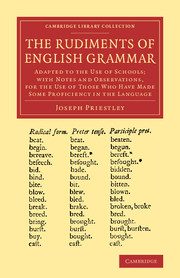
The English polymath Joseph Priestley (1733–1804) defined grammar as nothing more complicated than a system of rules for the correct use of language. This enlarged second edition of his influential 1761 textbook first appeared in 1769; it had by then established him as one of the major grammarians of his age. With little patience for the confusing and superfluous application of Latin rules to English, Priestley champions a simple style of grammatical explanation here, questioning even such fundamental concepts as an English future tense. The text follows a clear question-and-answer structure designed for students. Priestley's determination to modernise the teaching of English and to promote usage as the crucial linguistic standard remain relevant today. A companion work, A Course of Lectures on the Theory of Language and Universal Grammar (1762), is also reissued in this series, along with other works by Priestley ranging in coverage from oratory to oxygen.
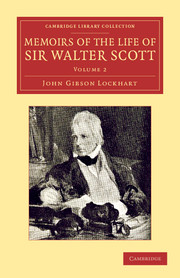
As son-in-law and literary executor to Sir Walter Scott (1771–1832), John Gibson Lockhart (1794–1854) was uniquely placed to produce a definitive biography of the great poet and novelist. First published in 1837–8, shortly after Scott's death, this celebrated seven-volume work is based on personal memories, correspondence, and Scott's own autobiographical sketches. Wide-ranging in his purview, Lockhart is also detailed in his descriptions: the Aberdeen Journal of the day observed that the volumes trace Scott's life and literary efforts with 'the most minute distinctness'. Incorporating accounts of Scott's correspondence with Southey, Wordsworth and Byron, Volume 2 opens with the death of Walter's uncle, Captain Robert Scott, in 1804, leading readers through the commencement of Waverley and the foundation of the Ballantyne publishing firm. This portion of Lockhart's account concludes in 1812.
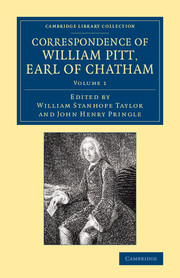
Famed for his masterful oratory and fearless criticism of parliamentary opponents, William Pitt the Elder (1708–78) distinguished himself through the strong leadership he provided during Britain's struggle against France in the Seven Years' War. Edited by his great-grandsons and first published between 1838 and 1840, this four-volume collection presents nearly forty years' worth of letters to and from the great statesman. Each volume also contains a useful list of the principal officers of state for the period covered, along with facsimile plates of letters and signatures by some of Pitt's eminent correspondents. Volume 1 (1838) covers the period 1741–59, although most of the letters date from 1754 onwards. Pitt's early political career saw him launch attacks on Sir Robert Walpole, contributing to the latter's resignation in 1742. Once Pitt had himself taken up the reins of power, the annus mirabilis of 1759 marked a high point of his wartime strategy.
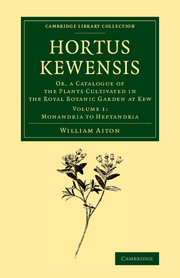
Trained as a gardener in his native Scotland, William Aiton (1731–93) had worked in the Chelsea Physic Garden prior to coming to Kew in 1759. He met Joseph Banks in 1764, and the pair worked together to develop the scientific and horticultural status of the gardens. Aiton had become superintendent of the entire Kew estate by 1783. This important three-volume work, first published in 1789, took as its starting point the plant catalogue begun in 1773. In its compilation, Aiton was greatly assisted with the identification and scientific description of species, according to the Linnaean system, by the botanists Daniel Solander and Jonas Dryander (the latter contributed most of the third volume). Aiton added dates of introduction and horticultural information. An important historical resource, it covers some 5,600 species and features a selection of engravings. Listing the printed works consulted, Volume 1 provides plant descriptions from Monandria to Heptandria.