A collection of out-of-copyright and rare books from the Cambridge University Library and other world-class institutions that have been digitally scanned, made available online, and reprinted in paperback.
To save content items to your account,
please confirm that you agree to abide by our usage policies.
If this is the first time you use this feature, you will be asked to authorise Cambridge Core to connect with your account.
Find out more about saving content to .
To save content items to your Kindle, first ensure no-reply@cambridge.org
is added to your Approved Personal Document E-mail List under your Personal Document Settings
on the Manage Your Content and Devices page of your Amazon account. Then enter the ‘name’ part
of your Kindle email address below.
Find out more about saving to your Kindle.
Note you can select to save to either the @free.kindle.com or @kindle.com variations.
‘@free.kindle.com’ emails are free but can only be saved to your device when it is connected to wi-fi.
‘@kindle.com’ emails can be delivered even when you are not connected to wi-fi, but note that service fees apply.
The literary career of Anna Seward (1742–1809) had many frustrations. Erasmus Darwin once printed her poetry under his own name. Horace Walpole accused her of having 'no imagination'. And despite her evident talents, she was unable to find a patron willing to support a woman. Yet her letters reveal the breadth of her interests and the strength of her literary criticism. In addition to writing to newspapers and magazines, she counted many eminent figures among her correspondents, including James Boswell (who begged for a lock of her hair) and the young Walter Scott. This six-volume selection of her letters, edited by the publisher Archibald Constable (1774–1827), first appeared in 1811. Volume 4 covers the years 1794–7. Unfailingly pragmatic, Seward begins with a discussion of the French Revolution and the unlikelihood of a similar occurrence in England, and ends with a cheerful account of her efforts to regain her good health.
Published between 1909 and 1955, this ten-volume collection contains deeds relating to all of Yorkshire, from the twelfth to the seventeenth century. The deeds are of local historical interest, and provide topographical, philological and genealogical information, as well as insights into daily life. The majority of the records here are presented as abstracts, while documents in the vernacular that are of greater interest or importance are printed in full. Where possible, the documents are dated. Thorough background information and discussion of the deeds is included, as are notable physical descriptions, in particular of the seals. Each volume concludes with an index of people and places. Published in 1924, Volume 4 was edited by Charles Travis Clay (1885–1978), who was much admired for the quality of his work. This volume contains several documents held by the Yorkshire Archaeological Society as well as a group of valuable documents from the Middleton collection.
Louis Figuier (1819–94) was destined to remain in academia until disagreements with fellow scholars led him to abandon this path and instead pursue 'the idea that scientific knowledge, which until then had been almost exclusively the property of the learned, should be put within the reach of the reading public'. Published in 1863, La Terre avant le déluge became a classic of popular science and introduced palaeontology to a wider readership; that this English translation appeared only two years later is an indication of its impact. Figuier wrote that his aim was 'to trace the progressive steps by which the earth has reached its present state … and to describe the various convulsions and transformations through which it has successively passed'. The book was also celebrated for its inclusion of more than 200 illustrations by a pupil of Doré, Édouard Riou (1833–1900), who became famous as Jules Verne's illustrator a few years later.
From humble origins, and trained by the London Missionary Society in theology, printing and rudimentary medicine, William Ellis (1794–1872) sailed for the Society Islands in 1816. He found himself at the cusp of major cultural change as Western influences affected the indigenous Polynesians. During his time there, Ellis became a skilled linguist and able chronicler of the traditional yet rapidly shifting way of life. He succeeded in capturing vivid stories of a leisured people who, without written language, had developed a rich oral tradition, social structure and belief system. Published in 1829, this two-volume collection proved to be an important reference work, notably for its natural history; it soon accompanied Darwin aboard the Beagle. Volume 1 covers the voyage to Tahiti, the development of Tahitian orthography, the conversion of chief Pomare II, the establishment of a printing press on Moorea, and Ellis's first sermon in Tahitian, delivered on Huahine.
Great mathematicians write for the future and Georg Friedrich Bernhard Riemann (1826–66) was one of the greatest mathematicians of all time. Edited by Heinrich Martin Weber, with assistance from Richard Dedekind, this edition of his collected works in German first appeared in 1876. Riemann's interests ranged from pure mathematics to mathematical physics. He wrote a short paper on number theory which provided the key to the prime number theorem, and his zeta hypothesis has given mathematicians the most famous of today's unsolved problems. Moreover, his famous 1854 lecture 'On the hypotheses which underlie geometry' set in motion studies which culminated in Einstein's general theory of relativity. Even Riemann's over-optimistic use of the Dirichlet principle to prove the conformal mapping theorem turned out to be immensely fruitful. The alert reader will further profit from finding here the seeds of modern distribution theory, algebraic topology and measure theory.
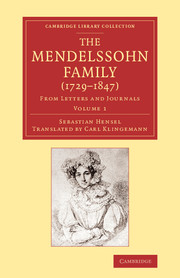
Sebastian Hensel (1830–98), nephew of the composer, virtuoso pianist and conductor Felix Mendelssohn (1809–47), originally intended this work to be 'not only of the family but for the family', drawing on their letters and diaries. Persuaded by friends to publish his narrative in 1879, Hensel in particular provides a first-hand insight into the lives of his uncle, lionized by the music-loving public of his day, and Felix's beloved sister Fanny (1805–47), herself a talented composer and pianist. Translated from the German revised second edition by Felix's close friend, diplomat Carl Klingemann (1798–1862), this 1881 two-volume collection made available for the first time in English a great deal of valuable source material. Covering the period 1729–1835, Volume 1 charts the family's history from the birth of philosopher Moses Mendelssohn to the death of his son, banker Abraham Mendelssohn Bartholdy, who was the father of Felix.
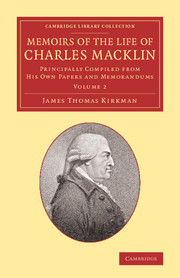
Drawing on his own papers and first published in 1799, this two-volume account traces the colourful life of the actor and playwright Charles Macklin (c.1699–1797). His long career serves as the focal point in a history of the eighteenth-century theatre and its most celebrated performers. Hailed for his enduring interpretation of Shakespeare's Shylock, a role he played for some fifty years, Macklin has been credited with the theatre's move towards realism. His life was just as dramatic offstage, marked as it was by a series of controversies and fierce rivalries. In 1735 he was convicted of the manslaughter of a fellow actor in a quarrel over a wig, and in 1775 he successfully pressed charges of conspiracy against theatregoers who had rioted during his performances. Volume 2 covers the latter part of Macklin's career up to his death. Also included is a selection of letters written to his son.
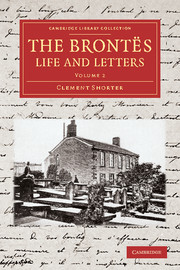
First published in 1908, this two-volume collection was prepared by journalist, critic and Brontë enthusiast Clement King Shorter (1857–1926), following the appearance of Charlotte Brontë and her Circle (1896) and Charlotte Brontë and her Sisters (1905). Building on the research of Elizabeth Gaskell, the volumes document through correspondence the remarkable lives and literary careers of Charlotte (1816–55), Emily (1818–48) and Anne (1820–49). The use of previously unpublished manuscripts and letters served to broaden significantly the scope of the work. Volume 2 covers the period 1848–55, addressing the deaths of Emily and Anne while offering many small, poignant details of daily life. Charlotte's marriage and final years bring the volume to a close. Presenting a wealth of source material, this collection remains a treasure trove for those seeking to understand how classics of English literature came to be shaped by the world their authors inhabited.
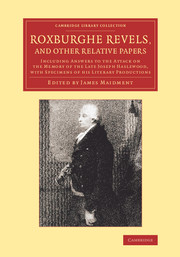
Lawyer, book collector and friend of Sir Walter Scott, James Maidment (1793–1879) displayed a talent for antiquarian research. Many of his works were printed privately in small quantities, such as the present publication, which first appeared in 1837. Established in 1812 and named after the great eighteenth-century book collector, the Roxburghe Club remains the oldest and most distinguished society of bibliophiles in the world. Joseph Haslewood (1769–1833), respected as an editor of early English literature, was a founder member and enjoyed the club's tradition of informal fun alongside more serious business. After his death, his manuscript account of these early activities, Roxburghe Revels, was unaccountably included in the sale of his books; extracts and critical comments on Haslewood and the club subsequently appeared in The Athenaeum in 1834. Maidment then prepared this defence, presenting and discussing his friend's remarks. The appendices include a biographical sketch of Haslewood.
One of the most widely studied texts of ancient philosophy and politics, Plato's Laws is his last and most substantial dialogue, debating crucial questions on the subject of law-giving and education. This two-volume edition of 1921 was prepared by the classicist Edwin Bourdieu England (1847–1936), who describes the dialogue as 'the treasury of pregnant truths which Plato in extreme old age left … as his last legacy to humanity'. Generally held to have been written after Plato's failed attempt to influence Syracusan politics, it concerns the just city and its constitution, including discussions of divine revelation, the role of intelligence in the creation of laws, and natural law itself. This edition comprises a short introduction, England's helpful analyses, the Greek text of the dialogue, and extensive notes. Volume 2 is devoted to Books 7–12. It also includes indexes of subjects and Greek words.
The Cambridge polymath Isaac Barrow (1630–77) gained recognition as a theologian, classicist and mathematician. This one-volume collection of his mathematical writings, dutifully edited by one of his successors as Master of Trinity College, William Whewell (1794–1866), was first published in 1860. Containing significant contributions to the field, the work consists chiefly of the lectures on mathematics, optics and geometry that Barrow gave in his position as Lucasian Professor of Mathematics between 1663 and 1669. It includes the first general statement of the fundamental theorem of calculus as well as Barrow's 'differential triangle'. Not only did he precede Isaac Newton in the Lucasian chair, but his works were also to be found in the library of Gottfried Leibniz. However, rather than considering arid questions of priority, scholars can see in these Latin texts the status of advanced mathematics just before the great revolution of Newton and Leibniz.
As a phonetician and comparative philologist, Henry Sweet (1845–1912) produced work that was regarded as seminal, particularly in Germany, where he received greater academic recognition than in England. His textbooks on Old English have long been considered standard works. As well as theoretical and historical studies, he also became involved in more practical aspects of linguistics, devising a new kind of shorthand, discussing spelling reform, and promoting the teaching and learning of modern languages. He played a role in the early history of the Oxford English Dictionary and edited several works for the Early English Text Society. Shaw's Professor Higgins in Pygmalion is believed to be based at least partly on Sweet. The present work, first published in 1877, inspired European interest in phonetic studies. Sweet presents a general theory of phonetics, illustrated by examples of transcription from various languages. He also formulates the distinction between phonemic and allophonic transcriptions.
Hermann Osthoff (1847–1909) and Karl Brugmann (1849–1919) were central figures in the circle of German scholars who rejected a doctrinal approach to the study of linguistics. They came to be known as the Neogrammarian school. At the core of their work was the theory that European languages, together with a subset of languages found in central and southern Asia, have a common origin in a single prehistoric language. They called this ancestor Indo-Germanic (known today as Indo-European) and claimed that its descendants are all related to one another by varying degrees of closeness. This six-volume elaboration of this thesis was published between 1878 and 1910. In Volume 3 (1880), Brugmann explains the rules for conjugation and focuses particularly on how the aorist tense in Greek, Italian and Celtic is formed. He also gives an account of the vowels a, e and o.
Originally published in 1851, partly with the aim of correcting certain mistakes in painter George Jones's 1849 tribute (also reissued in this series), this work commemorates Norton-born sculptor Sir Francis Chantrey (1781–1841), whose illustrious career began in nearby Sheffield. His most celebrated works include The Sleeping Children in Lichfield Cathedral, his statue of James Watt, and his busts of Sir Walter Scott and John Horne Tooke. An enthusiast for his country's art, Chantrey left a generous bequest to the Royal Academy which allowed for the purchase of numerous works of British art, now held by the Tate. The author John Holland (1794–1872), himself a Sheffield man, wrote with a passion for local history and topography. Here, his delight in the 'absolutely or comparatively trivial' lends a curious local slant to his delineation of the sculptor's background, entry into the profession, later working life and burial back in Norton.
French astronomer Camille Flammarion (1842–1925) firmly believed that science should not be the preserve of elites. His passion for the discoveries of his time is palpable throughout this classic introduction to astronomy, which stands as a landmark in the history of popular science writing. It features 360 illustrations, including highly detailed maps of the Moon and Mars, the latter being of special interest for Flammarion as he compared and contrasted it with the Earth. Originally published in 1880, the work won the approval of the Académie Française and the Minister of Public Instruction. This reissue is of the version that appeared in 1881 after 50,000 copies had already reached an enthusiastic readership. Its translation into English as Popular Astronomy (1894) and another accessible work by Flammarion, Le Monde avant la création de l'homme (1886), are also reissued in this series.
As son-in-law and literary executor to Sir Walter Scott (1771–1832), John Gibson Lockhart (1794–1854) was uniquely placed to produce a definitive biography of the great poet and novelist. First published in 1837–8, shortly after Scott's death, this celebrated seven-volume work is based on personal memories, correspondence, and Scott's own autobiographical sketches. Wide-ranging in his purview, Lockhart is also detailed in his descriptions: the Aberdeen Journal of the day observed that the volumes trace Scott's life and literary efforts with 'the most minute distinctness'. Volume 6 covers the years 1825–6, during which Scott experienced literary triumph with the publication of Tales of the Crusaders (1825), continued to work on Woodstock (1826), and took an excursion to Ireland. The closing chapters cover the banking crises of 1825 and hint at the financial catastrophes that were to plague the author until his death seven years later.
The official biography of Charles Dickens (1812–70) was published in 1872–4 by his close friend and literary executor John Forster, and has been reissued in this series. Of the many other memoirs and reminiscences of the great novelist, this book by his favourite daughter Mary (1838–96), known as Mamie, is perhaps the least familiar. Published in 1896, shortly after her death, it gives a loving picture, based on her own memories, of the person whom she held 'in my heart of hearts as a man apart from all other men, as one apart from all other beings'. Mamie, who had taken Dickens's side during the separation from his wife, and acted effectively as his housekeeper at Gad's Hill, had compiled an edition of her father's letters with her aunt Georgina Hogarth, and this second act of piety gives an idyllic - perhaps too idyllic - account of daily life with Dickens.
Inspired by Schliemann's discoveries at Mycenae and Troy, Sir Arthur John Evans (1851–1941), keeper of Oxford's Ashmolean Museum from 1884 to 1908, trustee of the British Museum and fellow of the Royal Society, used his inherited wealth to purchase land in Crete at Knossos. From 1900 he commenced excavations there in co-operation with the British School at Athens. Work continued for eight full seasons, uncovering a Bronze Age palace and bringing to light further architectural and artefactual remains of Minoan civilisation, including numerous texts in Linear A and Linear B. Evans' speculative reconstruction of the site in reinforced concrete remains controversial, and some of his interpretations are disputed, but his pioneering work is painstakingly detailed in this highly illustrated multi-volume work, published between 1921 and 1935, with an index volume appearing in 1936. Volume 3 first appeared in 1930.
Beyond the fact that he made a journey to the Holy Land between 1336 and 1341, very little is known about Ludolf von Suchem (whose first name may in fact have been Rudolf). However, his work has long been regarded as a major source of information about the eastern Mediterranean in the fourteenth century, owing to its high level of detail. Ludolf states his intention to describe the region, its buildings, towns, fortified places, people, customs, stories and legends, drawing on both his own observations, and on information from the 'kings, princes, nobles and lords' with whom he spent days and nights in conversation. Some stories are clearly travellers' tales, but others, like his account of the fall of Acre (1291), based on reports by eyewitnesses, are both full and convincing. This English translation, by Aubrey Stewart (1844–1918), of Ludolf's Latin text was published in 1895.
Inspired by Schliemann's discoveries at Mycenae and Troy, Sir Arthur John Evans (1851–1941), keeper of Oxford's Ashmolean Museum from 1884 to 1908, trustee of the British Museum and fellow of the Royal Society, used his inherited wealth to purchase land in Crete at Knossos. From 1900 he commenced excavations there in co-operation with the British School at Athens. Work continued for eight full seasons, uncovering a Bronze Age palace and bringing to light further architectural and artefactual remains of Minoan civilisation, including numerous texts in Linear A and Linear B. Evans' speculative reconstruction of the site in reinforced concrete remains controversial, and some of his interpretations are disputed, but his work was pioneering and published in several volumes between 1921 and 1935. The index to this monumental achievement, published in 1936, was the result of a painstaking collaboration with his half-sister, Dame Joan Evans (1893–1977).