A collection of out-of-copyright and rare books from the Cambridge University Library and other world-class institutions that have been digitally scanned, made available online, and reprinted in paperback.
To save content items to your account,
please confirm that you agree to abide by our usage policies.
If this is the first time you use this feature, you will be asked to authorise Cambridge Core to connect with your account.
Find out more about saving content to .
To save content items to your Kindle, first ensure no-reply@cambridge.org
is added to your Approved Personal Document E-mail List under your Personal Document Settings
on the Manage Your Content and Devices page of your Amazon account. Then enter the ‘name’ part
of your Kindle email address below.
Find out more about saving to your Kindle.
Note you can select to save to either the @free.kindle.com or @kindle.com variations.
‘@free.kindle.com’ emails are free but can only be saved to your device when it is connected to wi-fi.
‘@kindle.com’ emails can be delivered even when you are not connected to wi-fi, but note that service fees apply.
A gifted yet controversial anatomical teacher, Robert Knox (1791–1862) published this remarkable study in 1852. It explores the influence of anatomy on evolutionary theories and fine art respectively. The first part of the work discusses the lives and scientific insights of the eminent French naturalists Georges Cuvier (1769–1832) and Étienne Geoffroy Saint-Hilaire (1772–1844). Rejecting the explanations offered by natural theology, Knox maintains that descriptive anatomy can give answers to questions surrounding the origin and development of life in the natural world. The latter part of the book is concerned with the relation that anatomy bears to fine art, specifically the painting and sculpture of the Italian Renaissance. Entering the debate about the importance of anatomical knowledge in art, Knox focuses on 'the immortal trio' of Leonardo da Vinci, Michelangelo and Raphael. Henry Lonsdale's sympathetic biography of Knox has also been reissued in this series.
The curate William Haslam (1817–1905) focuses here on the ruins of St Piran's oratory, for many years lost to Cornwall's shifting sands. First published in 1844, his work laments the site's fate: first destroyed by its environment, then, upon its rediscovery, pillaged by trophy hunters. Highlighting the importance of Cornwall's frequently overlooked ecclesiastical antiquities, of which the oratory is perhaps the most compelling example, Haslam also gives an account of his local parish. The work describes the surrounding landscape, before going into an analysis of the oratory itself, with a small number of accompanying illustrations. An account of the life of St Piran, who has come to be regarded as Cornwall's patron saint, complements the history of Christianity's growth in the area, which resulted in the oratory's construction. With a strong emphasis on the oratory's importance as an early Christian site, this study will appeal to readers interested in architectural, church and local history.
This thirteen-volume series, which first appeared between 1914 and 1965, is an extensive collection of the pre-thirteenth-century charters and related records of Yorkshire, which had previously remained largely unpublished. The first three volumes were edited by William Farrer (1861–1924), after whose death Charles Travis Clay (1885–1978) took up the task. The series was well respected for the quality of Farrer's editing, which was surpassed only by that of Clay in the later volumes. The lack of an index was considered by many reviewers to be the only shortcoming to Farrer's work, and so the present volume, a thorough index to the first three volumes, was published in 1942. Assisted by his niece, Clay indexed the content by persons and places (persons are further distinguished by description and occupation), source and chart pedigree.
A pioneering Egyptologist, Sir William Matthew Flinders Petrie (1853–1942) excavated over fifty sites and trained a generation of archaeologists. He also played a notable part in the preservation of a number of cuneiform tablets that became known collectively as the Tell el-Amarna letters. Petrie's Syria and Egypt (1898), containing summaries, is also reissued in this series, along with many of his other publications. The present work, first published in 1894 and richly illustrated, gives an account of the work that Petrie carried out in 1891–2. It contains detailed information about both the technical aspects of the dig and the array of artefacts found, including the tablet fragments of diplomatic correspondence from the fourteenth century BCE. The chapter on the tablets is provided by Archibald Sayce, Francis Llewellyn Griffth discusses ceramic inscriptions, and the flint tools are examined by F. C. J. Spurrell.
Ernst Mach (1838–1916), the first scientist to study objects moving faster than the speed of sound, propounded a scientific philosophy which called for a strict adherence to observable data. He maintained that the sole purpose of scientific study is to provide the simplest possible description of detectable phenomena. In this work, first published in German in 1883 and here translated in 1893 by Thomas J. McCormack (1865–1932) from the 1888 second edition, Mach begins with a historical discussion of mechanical principles. He then proceeds to a critique of Newton's concept of 'absolute' space and time, reflecting Mach's rejection of theoretical concepts in the absence of definitive evidence. Although historically controversial, Mach's ideas and attitudes informed philosophers as influential as Russell and Wittgenstein, and his insistence upon a 'relative' idea of space and time provided much of the philosophical basis for Einstein's theory of general relativity decades later.
One of the most celebrated individuals of English literature, Samuel Johnson (1709–84) was a defining figure of his age. In addition to his celebrated labours as a lexicographer, Johnson distinguished himself as a poet, essayist, critic, biographer and editor. The writer and society hostess Hester Lynch Piozzi (1741–1821) was an unconventional woman of great intellectual vivacity. She became a close friend of Johnson, whom she met through her first husband, the brewer Henry Thrale, whose ailing business Johnson did much to support. As well as writing essays, poetry, memoirs and travel diaries, she was one of the first women to produce works on philology and history. First published in 1788 - two years after her groundbreaking Anecdotes of the Late Samuel Johnson, which anticipated Boswell's biography - these letters offer a captivating glimpse into their daily lives and concerns. Volume 2 covers the period 1777 to 1784.
A pioneer of British Egyptology, Sir John Gardner Wilkinson (1797–1875) first travelled to Egypt in 1821, the year before Champollion published his breakthrough work on the Rosetta Stone. As public interest in Egypt grew, Wilkinson studied and sketched the country's major archaeological sites, most notably the tombs of Thebes. When published in 1835, the present work was the first major book in English on the subject and the most substantial since the French Description de l'Égypte. The text and plates present a detailed picture of contemporary Egypt in relation to its ancient heritage. Wilkinson remodelled and expanded the work as Modern Egypt and Thebes (1843), and his chapter here on daily life in the days of the pharaohs formed the basis of his celebrated Manners and Customs of the Ancient Egyptians (1837). Both titles are also reissued in this series.
Born in Germany, where he studied music and philology, Francis Hueffer (1845–89) moved to London in 1869 to pursue a career as a critic and writer on music. He edited a series of biographies of notable musicians, served as music critic for The Times, contributed articles to Grove's Dictionary of Music and Musicians, and was an early advocate and interpreter to the British of Wagner. In 1872 he married Catherine, the younger daughter of the painter Ford Madox Brown. Their son was the writer Ford Maddox Ford. Provençal studies were an abiding interest of Hueffer's and he intended this work, first published in 1878, to be an approachable English-language study of medieval Provençal literary and musical culture. It won him membership of the Félibrige, the association of Provençal writers, and he gave lectures on the topic at the Royal Institution in 1880.
A pioneering Egyptologist, Sir William Matthew Flinders Petrie (1853–1942) excavated over fifty sites and trained a generation of archaeologists. In this 1909 handbook, ranging in coverage from the prehistoric period to the Roman era, he examines a sample of the work of Egyptian painters, sculptors and diverse craftsmen, touching on such topics as statuary, architecture, jewellery, pottery and textiles. Beginning with a discussion of the meteorological, religious and political factors that influenced Egyptian artistic responses, the book contains 140 illustrations of the most striking works of each period. Many of the featured artefacts formed part of Petrie's own collection, and over a third of the photographs had not been previously published. His earlier lectures on Egyptian Decorative Art (1895), along with many of his other publications, are also reissued in this series.
In 1816, architect and botanist Joseph Woods (1776–1864) embarked on a two-year journey through France, Switzerland, Italy and Greece, documenting interesting flora as well as buildings of note. This two-volume work first appeared in 1828. The account stands apart from other contemporary travelogues owing to the application of Woods' architectural insight. By critically assessing ancient and modern buildings for strengths and defects, Woods hoped to inform fellow architects as to how they might produce beautiful buildings through the study of different modes of construction and decoration. Accordingly, the text is accompanied by Woods' drawings of important buildings and architectural features. In Volume 1, he charts his year-long journey through France and Switzerland to Rome, including discussion of the notable ecclesiastical edifices of Notre Dame and the Vatican.
A Collection of Practical Observations for Prognosticating the Weather, Drawn from Plants, Animals, Inanimate Bodies, and Also by Means of Philosophical Instruments
Early nineteenth-century farmers often sowed their crops on an arbitrarily chosen day every year. Impatient with this practice, naturalist Joseph Taylor (c.1761–1844) presents an alternative method in this work, which first appeared in 1812. He argues that by studying the atmosphere, the behaviour of animals and the condition of local flora, a farmer can not only determine the optimal time for sowing, but also forecast the weather. Including the Shepherd of Banbury's famous rules for judging changes in the weather, alongside remarks on the quality of this wisdom, Taylor's book also draws on a wealth of wider countryside knowledge. He observes, for example, that the flowering of primroses and lettuce occurs at such precise times as to be useful for botanical clocks, while the proximity of bees to their hives and the agitation of dogs suggest oncoming weather conditions.
A physician and medical reformer enthused by the scientific and cultural progress of the Enlightenment as it took hold in Britain, Thomas Percival (1740–1804) wrote on many topics, including public health and demography. His influential publication on medical ethics is considered the first modern formulation. In 1807, his son Edward published this four-volume collection of his father's diverse work. Some of the items here had never been published before, including a selection of Percival's private correspondence and a biographical account written by Edward. Volume 1 contains this biography and the full text of Percival's popular self-improvement book, A Father's Instructions, originally intended for his own children and then published in three parts between 1775 and 1800. His Medical Ethics (1803) and Essays Medical and Experimental (revised edition, 1772–3) have been reissued separately in this series.
Active in Alexandria in the third century BCE, Apollonius of Perga ranks as one of the greatest Greek geometers. Building on foundations laid by Euclid, he is famous for defining the parabola, hyperbola and ellipse in his major treatise on conic sections. The dense nature of its text, however, made it inaccessible to most readers. When it was originally published in 1896 by the civil servant and classical scholar Thomas Little Heath (1861–1940), the present work was the first English translation and, more importantly, the first serious effort to standardise the terminology and notation. Along with clear diagrams, Heath includes a thorough introduction to the work and the history of the subject. Seeing the treatise as more than an esoteric artefact, Heath presents it as a valuable tool for modern mathematicians. His works on Diophantos of Alexandria (1885) and Aristarchus of Samos (1913) are also reissued in this series.
Among the leading Egyptologists of his day, Sir William Matthew Flinders Petrie (1853–1942) excavated over fifty sites and trained a generation of archaeologists. He is credited with bringing his subject to a much wider audience, and his talent for exposition is reflected in this accessible autobiography, first published in 1931 and illustrated throughout. It describes life on digs in the late nineteenth and early twentieth centuries, providing rich insights into developing archaeological methods. Petrie's most important discoveries are recounted, including his unearthing of the Merneptah Stele, some of the earliest evidence of mummification, and elements of Greek and Roman cultural influence in Egypt. Furthermore, he reflects here on his innovative practice of recording and preserving every artefact, not just obvious museum pieces. Petrie wrote prolifically throughout his long career, and a great many of his other publications are also reissued in this series.
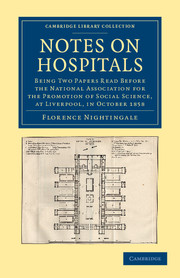
Returning from the Crimea, Florence Nightingale (1820–1910) used her experience of army medicine to ameliorate civilian nursing care. She was appalled by the conditions she found, affirming that the first requirement of a hospital was that 'it should do the sick no harm'. Problems such as overcrowding and damp, in addition to lack of ventilation and proper sanitation, contributed to high mortality rates. Nightingale's belief that such suffering was preventable was seen as revolutionary. In 1859 she published her two most influential works, Notes on Nursing (also reissued in this series) and Notes on Hospitals. This collection contains the two papers she presented to the National Association for the Promotion of Social Science in 1858. Also included, from 1857, is her evidence to the royal commission on the British army's sanitary conditions. Three illustrated articles on hospital design, published in The Builder in 1858, form an appendix to the work.
A painstaking compiler of catalogues and indexes, the biblical scholar and bibliographer Thomas Hartwell Horne (1780–1862) first published his most famous work in 1818, having begun his research for it many years earlier in 1801. Reissued here in five parts is the expanded four-volume tenth edition of 1856, which includes revisions by the scholars Samuel Davidson (c.1806–98) and Samuel Prideaux Tregelles (1813–75). This monumental and influential work of nineteenth-century biblical scholarship remains a valuable resource for modern researchers, reflecting the methods and perspectives of its era. Volume 3 contains a summary of biblical geography and antiquities, including the historical geography of the Holy Land, with discussion of its physical and agricultural features, as well as an account of the political and judicial systems of the Jews and Romans, a study of the existence and location of sacred artefacts, and a survey of Jewish customs mentioned in the scriptures.
Having served on expeditions under John Franklin, the British naval officer Sir George Back (1796–1878) had already gained first-hand experience of Arctic peril and survival by the time he was appointed in 1836 to command HMS Terror. His mission was to survey uncharted coastline in the Canadian Arctic, yet Back's ship became trapped in ice near Frozen Strait and was unable to escape for ten months. In this account, first published in 1838, Back lucidly documents the developing crisis, noting the numerous preparations to abandon ship, the deaths of three of his men from scurvy, and the further damage caused by an iceberg after the Terror was freed. Against the odds, the ship managed to reach Ireland in 1837. Naturally, Back gives much credit to the durability of the Terror - originally a bomb vessel from the War of 1812, it had been further strengthened for Arctic service.
As a younger woman, Anna Maria 'Marie' Tussaud (1761–1850) rubbed shoulders with many of the key figures of the French Revolution, sculpting in wax the likes of Louis XVI, Marie Antoinette, Marat and Robespierre. After moving to Britain, she made her living by exhibiting her sculptures in numerous towns and cities. In 1835 she settled in London and opened her museum, which became one of the city's most popular attractions. Initially reluctant about releasing her memoirs, Madame Tussaud was convinced by her editor Francis Hervé (1781–1850) that her unique position - of seeing first-hand the events and characters that drove the Revolution, while maintaining a generally non-partisan view of them - would make the book of real interest to the public. First published in 1838, it offers evocative eyewitness insights into one of the defining periods in modern European history.
The astronomer John Lee (1783–66) inherited Hartwell House in Buckinghamshire in 1827. During its colourful history, the mansion had notably been occupied between 1809 and 1814 by the exiled court of Louis XVIII. Lee turned the house into something of a museum for his antiquarian and scientific interests, constructing an observatory to the design of the his close friend William Henry Smyth (1788–1865), after whom Lee named a lunar sea. A naval officer, Smyth had helped to found the Royal Geographical Society in 1830. His Sidereal Chromatics (1864) and The Sailor's Word-Book (1867) are also reissued in this series. This charming history and description of Hartwell, its grounds, buildings and contents, appeared in two volumes between 1851 and 1864, illuminating especially the practice of contemporary astronomy. Illustrated throughout, the second volume (1864) serves as a supplement, recording Smyth's researches in the years since the first volume went to press.
A pioneering Egyptologist, Sir William Matthew Flinders Petrie (1853–1942) excavated over fifty sites and trained a generation of archaeologists. In this concise 1912 publication, aimed at non-specialists, Petrie discusses the key aspects of ancient Egyptian religion and the philosophies that underpinned it. Beginning with an explanation of the ancient conception of deities, the text explores the various types of god in the Egyptian pantheon and the ancient theory of the afterlife. It also gives due attention to such structures of belief as ritual, priesthood and scripture. The book ends with an examination of the ways in which ancient Egyptian religion spread through the ancient world and how Egyptian ideas were reused and transformed by later religions, including Christianity. Petrie wrote prolifically throughout his long career, and a great many of his other publications - for both specialists and non-specialists - are also reissued in this series.