A collection of out-of-copyright and rare books from the Cambridge University Library and other world-class institutions that have been digitally scanned, made available online, and reprinted in paperback.
To save content items to your account,
please confirm that you agree to abide by our usage policies.
If this is the first time you use this feature, you will be asked to authorise Cambridge Core to connect with your account.
Find out more about saving content to .
To save content items to your Kindle, first ensure no-reply@cambridge.org
is added to your Approved Personal Document E-mail List under your Personal Document Settings
on the Manage Your Content and Devices page of your Amazon account. Then enter the ‘name’ part
of your Kindle email address below.
Find out more about saving to your Kindle.
Note you can select to save to either the @free.kindle.com or @kindle.com variations.
‘@free.kindle.com’ emails are free but can only be saved to your device when it is connected to wi-fi.
‘@kindle.com’ emails can be delivered even when you are not connected to wi-fi, but note that service fees apply.
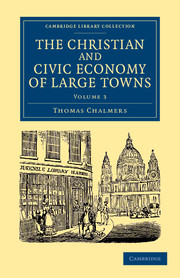
This three-volume study by the Scottish churchman and social reformer Thomas Chalmers (1780–1847) is a revealing work of Christian morality as applied to urban economic theory. Having moved to Glasgow in 1815, Chalmers was given a free hand in 1819 for an experiment in urban ministry at the new parish of St John's in the poorest district of the city. His reforms improved education and reduced the need for institutional poor relief by dividing the area into manageable 'proportions' that were closely looked after by parish elders and deacons, reviving a traditional community spirit and promoting self-help. Volume 3, published in 1826, was written after Chalmers left St John's to become Chair of Moral Philosophy at St Andrew's. It focuses on the relationship between labour, wages and poor relief, discussing how labouring classes should not depend upon welfare and wages to relieve want, but rather practise self-help to reform their condition from below.
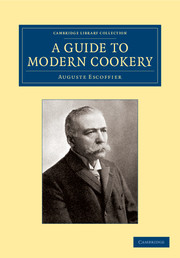
The late nineteenth and early twentieth centuries witnessed a revolution in the eating habits of European households with disposable incomes. Central to the culinary history of the period is the innovative French chef Georges Auguste Escoffier (1846–1935). His cooking methods, combined with a modern approach to managing professional kitchen staff, contributed to the development of a fashionable culture of dining out, notably at London's Savoy and Carlton hotels. Escoffier's influence was such that he was urged to publish his methods and recipes. Reissued here in its English translation of 1907, this textbook on haute cuisine was first published in French in 1903. Beginning with the fundamental elements of cooking, Escoffier gives nearly 3,000 descriptions and recipes, ranging from sauces and marinades to jams and jellies. Intended for the instruction of aspiring chefs, this monumental work remains a core text at cookery schools to this day.
A pioneering Egyptologist, Sir William Matthew Flinders Petrie (1853–1942) excavated over fifty sites and trained a generation of archaeologists. The two excavation reports now reissued here together were written in collaboration with other experts. The first, published in 1907, describes digs at Giza and Rifeh, including the discovery of the Tomb of the Two Brothers, a well-preserved Middle Kingdom burial. The second report, co-authored with Ernest Mackay (1880–1943) and published in 1915, covers work at Heliopolis, Kafr Ammar and Shurafa. Petrie and his collaborators describe how they came to make their discoveries, shedding light on developing archaeological practices used in the early twentieth century. Each report includes a section of valuable illustrative material, such as photographs and drawings of artefacts. Petrie wrote prolifically throughout his long career, and a great many of his other publications - for both specialists and non-specialists - are also reissued in this series.
The son of a shopkeeper, Joseph Lancaster (1778–1838) received little formal education himself. In 1798 he set up a school in Southwark, waiving fees for poor children. Originally published in 1803, this work sets out in detail the philosophy and practice of Lancaster's system of education, which relied on peer tutoring. He was always concerned with the education of the underprivileged in industrial cities, lamenting that 'poor children be deprived of even an initiatory share of education, and of almost any attention to their morals'. The early decades of the nineteenth century saw the peak of the popularity of Lancaster's system as his ideas spread and inspired the establishment of schools around the world. His book is still significant in the history of educational methods. This reissue of the revised third edition of 1805 incorporates a brief 1840 biography of Lancaster.
Famed for his masterful oratory and fearless criticism of parliamentary opponents, William Pitt the Elder (1708–78) distinguished himself through the strong leadership he provided during Britain's struggle against France in the Seven Years' War. Edited by his great-grandsons and first published between 1838 and 1840, this four-volume collection presents nearly forty years' worth of letters to and from the great statesman. Each volume also contains a useful list of the principal officers of state for the period covered, along with facsimile plates of letters and signatures by some of Pitt's eminent correspondents. Volume 3 (1839) covers the period from 1766 through to November 1770. Following Rockingham's resignation in July 1766, Pitt accepted a peerage and became the Earl of Chatham, forming a new ministry that lasted until 1768. As prime minister, he was constantly troubled by longstanding health problems.
A landmark in female historiography, this work first appeared in eight volumes between 1763 and 1783. Notable for her radical politics and her influence on American revolutionary ideology, Catharine Macaulay (1731–91) drew diligently on untapped seventeenth-century sources to craft her skilful yet inevitably biased narrative. Seen as a Whig response to David Hume's Tory perspective on English history, the early volumes made Macaulay a literary sensation in the 1760s. Later instalments were less rapturously received by those critics who took exception to her republican views. Both the product and a portrait of tumultuous ages, the work maintains throughout a strong focus on the fortunes of political liberty. Volume 6 (1781) covers the reign of Charles II up to the end of the Third Anglo-Dutch War in 1674.
Throughout his professional life, the poet Thomas Moore (1779–1852) was variously celebrated and vilified for both his verse and his politics. Born in Dublin, he remained an ardent Irish patriot until his death. This eight-volume collection of Moore's memoirs, diaries and letters, edited by his friend Lord John Russell (1792–1878) and first published between 1853 and 1856, provides rare insights into a man whose genius was applauded by the Morning Chronicle as 'embracing almost all sides of imaginative literature, of criticism and philosophy'. Volume 1 contains Moore's incomplete memoir, described by the Manchester Times as 'a readable and gossiping article', as well as an account of his infamous abortive duel with the critic Francis Jeffrey, and his personal correspondence from the period 1793–1813.
Hermann Osthoff (1847–1909) and Karl Brugmann (1849–1919) were central figures in the circle of German scholars who rejected a doctrinal approach to the study of linguistics. They came to be known as the Neogrammarian school. At the core of their work was the theory that European languages, together with a subset of languages found in central and southern Asia, have a common origin in a single prehistoric language. They called this ancestor Indo-Germanic (known today as Indo-European) and claimed that its descendants are all related to one another by varying degrees of closeness. This six-volume elaboration of this thesis was published between 1878 and 1910. Volume 4 (1881) is devoted entirely to Osthoff's study of vowel gradation in Indo-European languages. He makes it clear that his recent research on vowels has led him to revise his earlier views.
Published in four volumes between 1892 and 1899, this collection contains assorted papers and correspondence between Spain and Spanish dignitaries in England from the accession of Elizabeth I in 1558 through to her death in 1603. Revealing the changing relationship between Spain and England, the documents offer detailed insights into Elizabeth's reign from a continental and Catholic perspective. Derived in large part from the archives at Simancas, they have been carefully edited and translated into English by Martin Andrew Sharp Hume (1843–1910), a respected historian of Spain and a scrupulous archival researcher. Each volume is arranged chronologically, contains an introduction that provides helpful historical context and closes with an index that includes both letter writers and recipients. Volume 2 (1894) covers the period 1568–79 and shows how Elizabeth asserted her authority as a Protestant monarch.
Born in Scotland, James Fergusson (1808–86) spent ten years as an indigo planter in India before embarking upon a second career as an architectural historian. Although he had no formal training, he became one of the most respected researchers in the field and an expert on India's cave temples. His History of Indian and Eastern Architecture was first published in 1876 and became a standard work. It was revised in this two-volume edition of 1910 by James Burgess (1832–1916), former Director of the Archaeological Survey of India, and Richard Spiers (1838–1916), a noted architect and historian of architecture. Volume 1 covers Buddhist and Himalayan architecture, the Dravidian style of southern India, and the later Chalukyan style from southern and central India in the early medieval period. Illustrated with 280 maps, plans and drawings, this work of impressive scope remains relevant to students of Indian architecture and history.
One of the foremost scholars of his day, the German classicist August Böckh (1785–1867) was chosen by the Berlin Academy of Sciences as the first editor of the monumental Corpus inscriptionum graecarum. Before that he had published this groundbreaking edition of the extant works of the Greek poet Pindar (c.522–c.443 BCE) in two volumes, the second being split into two parts. The first volume, published in 1811, contains the only complete surviving works of Pindar, the victory odes (Epinikia). The first part of the second volume, published in 1819, contained the ancient Greek scholia. This final part, published in 1821, contains the editor's own Latin translations of Pindar's poems, with a Latin preface and extensive critical commentary. Pindarian fragments in Greek are also included, accompanied by further Latin translations and notes. The volume concludes with thorough indexes.
Following participation in the Arctic search for Sir John Franklin, the mariner and author William Parker Snow (1817–95) volunteered in 1854 to command the schooner Allen Gardiner, named after the man whose work for the South American Missionary Society was to be resumed. Although conceived as 'merely a simple narrative of daily life in the Southern Seas', this illustrated two-volume work becomes simultaneously a first-hand account of a sailor's experiences and observations, and a self-justification against those by whom he felt disappointed, frustrated and deceived. Volume 2 includes an account of meeting 'Jemmy Button', the Fuegian who had been taken to Britain on the Beagle. It also charts the series of difficulties Snow faced as captain, which culminated in his dismissal and abandonment on the Falklands. First published in 1857, the narrative met with some success. Snow, however, wasted the proceeds on a fruitless action against his former employers.
A seminal figure in nineteenth-century biblical textual criticism, Samuel Prideaux Tregelles (1813–75) did much to formalise the emerging discipline. He published this account of his work on the Greek New Testament in 1854. Reflecting on previous editions of the New Testament, he gives a detailed account of its numerous versions since Erasmus and provides an excellent overview of biblical scholarship to that date. As well as discussing Tischendorf's pioneering work in using manuscripts previously neglected by Western scholarship, Tregelles reports the findings of other textual critics, such as Lachmann, Griesbach and Scrivener. He proceeds to describe his own critical methods and collations, bringing clarity to the developing field, and also presents notes on particular passages in the Gospels. This work still informs modern scholarship and serves to complement Tregelles's remarkable seven-volume Greek New Testament (also reissued in this series).
Of German birth, Sir August Friedrich Manns (1825–1907) secured for himself a central place in nineteenth-century British musical life. Appointed by George Grove in 1855 to conduct the orchestra at the relocated Crystal Palace in Sydenham, ande held the post for more than four decades, establishing a high reputation for the Saturday Concerts and attracting internationally recognised soloists. Manns was involved in every aspect, from developing the repertoire to taking rehearsals. Under his baton, many of the great works of Brahms, Schubert and Berlioz received their first British performances, alongside world premieres of pieces by British composers such as Sullivan and Macfarren. Secretary of the Guildhall School of Music, Henry Saxe Wyndham (1867–1940) published in 1909 this engaging portrait of a musician greatly esteemed by players and audiences alike.
A successful journalist, naturalist and author, James Drummond (1869–1940) began his biography of Richard John Seddon (1845–1906), New Zealand's prime minister, while his subject was still alive and in office. Originally intended as a collaborative effort, the work had to be completed without further assistance following Seddon's sudden death on a voyage from Australia to Auckland in June 1906. It was published in 1907, along lines 'that Mr Seddon approved of', and with an introduction by the prime minister at the time, Sir Joseph Ward. A popular figure, Seddon led his party to victory at five successive general elections. The book traces his life from his English childhood, through his emigration and entry into politics, to his last days, charting the achievements, personality and beliefs of New Zealand's longest-serving prime minister to date, and shedding light on the history of the Liberal Party.
A friend of Wilberforce and Bentham, Sir Samuel Romilly (1757–1818) combined considerable legal expertise with commitment to progressive political causes such as the abolition of the slave trade. During his time in Parliament - he was Solicitor General in Lord Grenville's 'Ministry of All the Talents' - he sought to lessen the archaic severity of English criminal law regarding corporal and capital punishment. Though he met with resistance, his efforts raised awareness and influenced later reforms. Compiled by his sons and published in 1840, this three-volume collection of autobiographical writings and varied correspondence illuminates the development of his outlook and the principles which guided him. Volume 3 contains the concluding part of Romilly's diary of his parliamentary life, covering the years 1812–18. Also included are private memoranda which Romilly described as observations on his 'situation in life and future prospects'.
The German mathematician Karl Weierstrass (1815–97) is generally considered to be the father of modern analysis. His clear eye for what was important is demonstrated by the publication, late in life, of his polynomial approximation theorem; suitably generalised as the Stone–Weierstrass theorem, it became a central tool for twentieth-century analysis. Furthermore, the Weierstrass nowhere-differentiable function is the seed from which springs the entire modern theory of mathematical finance. The best students in Europe came to Berlin to attend his lectures, and his rigorous style still dominates the first analysis course at any university. His seven-volume collected works in the original German contain not only published treatises but also records of many of his famous lecture courses. Edited by Johannes Knoblauch (1855–1915), Volume 3 was published in 1903.
William Dwight Whitney (1827–94) was the foremost American philologist and Sanskrit scholar of the nineteenth century. After studying in Germany, then at the forefront of linguistic scholarship, he assumed the chair of Sanskrit at Yale in 1854, with comparative philology added to his professorship in 1869. As well as teaching modern languages, Whitney published over 300 scholarly papers and books, acted as chief editor of the ten-volume Century Dictionary, and co-founded the American Philological Association. In this important 1875 work, the influence of evolutionary theory on other branches of nineteenth-century scholarship, not merely biology, is clear in the discussion of the development of language. Whitney's survey is wide-ranging, beginning with an examination of language acquisition and how language shapes or limits our thought processes. Stressing the scientific basis of historical linguistics, he further looks at how different languages have changed over time, in terms of grammatical form, pronunciation and meaning.
Beautifully illustrated throughout, this English translation of Désiré Charnay's record of his travels among the ancient cities of Mexico and Central America was first published in 1887. Born in France, Charnay (1828–1915) travelled extensively through commissions from the French government and with private patronage. He made several visits to the region between 1857 and 1886, producing in his work both a journal of his adventures and an archaeological examination of past civilisations. Beginning in Mexico, Charnay notably examines the ancient city of Tula and also the history of Yucatán, discussing aspects of Toltec and Mayan culture. He explores the ruins of Chichen Itza, Kabah and Yaxchilan (which Charnay dubbed 'Lorillard Town' after a benefactor), among many other settlements. Surveying art, pyramid architecture, ancient customs and history based on extant sources, this account was a major contribution in its field and remains of interest to scholars of Latin American archaeology.
A Scottish doctor and botanist, George Watt (1851–1930) had studied the flora of India for more than a decade before he took on the task of compiling this monumental work. Assisted by numerous contributors, he set about organising vast amounts of information on India's commercial plants and produce, including scientific and vernacular names, properties, domestic and medical uses, trade statistics, and published sources. Watt hoped that the dictionary, 'though not a strictly scientific publication', would be found 'sufficiently accurate in its scientific details for all practical and commercial purposes'. First published in six volumes between 1889 and 1893, with an index volume completed in 1896, the whole work is now reissued in nine separate parts. Volume 6, Part 4 (1893) contains entries from Tectona grandis (the common teak tree) to Zygophillum simplex (a flowering plant found in Sindh and the Punjab). The index to the entire work is included as an appendix.