A collection of out-of-copyright and rare books from the Cambridge University Library and other world-class institutions that have been digitally scanned, made available online, and reprinted in paperback.
To save content items to your account,
please confirm that you agree to abide by our usage policies.
If this is the first time you use this feature, you will be asked to authorise Cambridge Core to connect with your account.
Find out more about saving content to .
To save content items to your Kindle, first ensure no-reply@cambridge.org
is added to your Approved Personal Document E-mail List under your Personal Document Settings
on the Manage Your Content and Devices page of your Amazon account. Then enter the ‘name’ part
of your Kindle email address below.
Find out more about saving to your Kindle.
Note you can select to save to either the @free.kindle.com or @kindle.com variations.
‘@free.kindle.com’ emails are free but can only be saved to your device when it is connected to wi-fi.
‘@kindle.com’ emails can be delivered even when you are not connected to wi-fi, but note that service fees apply.
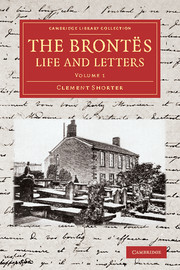
First published in 1908, this two-volume collection was prepared by journalist, critic and Brontë enthusiast Clement King Shorter (1857–1926), following the appearance of Charlotte Brontë and her Circle (1896) and Charlotte Brontë and her Sisters (1905). Building on the research of Elizabeth Gaskell, the volumes document through correspondence the remarkable lives and literary careers of Charlotte (1816–55), Emily (1818–48) and Anne (1820–49). The use of previously unpublished manuscripts and letters served to broaden significantly the scope of the work. Volume 1 covers the family's background, the sisters' experiences at Cowan Bridge and Howarth, and the development of their literary talents. The volume concludes with the death of Branwell Brontë in 1848. Presenting a wealth of source material, this collection remains a treasure trove for those seeking to understand how classics of English literature came to be shaped by the world their authors inhabited.
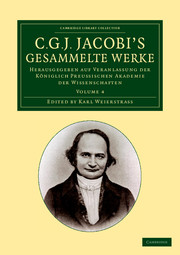
One of the greatest mathematicians of the nineteenth century, Carl Gustav Jacob Jacobi (1804–51) burst into the limelight with his redevelopment, together with Niels Henrik Abel (1802–29), of the theory of elliptic functions. His pioneering work was characterised by the variety of problems tackled and the power of the tools used to tackle them. His lasting influence on rational mechanics, number theory, partial differential equations, complex variable theory and computation is marked by the number of fundamental concepts that bear his name (the Jacobian, the Jacobi sum and the Jacobi symbol, among others). His collected works, comprising treatises, letters and papers written in German, Latin and French, were published in eight volumes between 1881 and 1891. Edited by fellow German mathematician Karl Weierstrass (1815–97), Volume 4 appeared in 1886.
A masterpiece of rhetoric and an impassioned defence of faith in the face of persecution, this work represents a key work in the Latin patristic canon. Addressing the magistrates of the Roman court, Tertullian submits 'the real facts in the case of the Christians', defending the legitimacy of the new faith while charging its detractors with hypocrisy and worse. Scathing, eloquent and defiant, the Apology demonstrates the importance of classical rhetoric to the identity of the controversial religion and its recent converts. This edition (1917), accompanied by a complete commentary by J. E. B. Mayor and translation by Alexander Souter, has been called 'by the far the best commentary ever published' on the work. Published posthumously from Mayor's extensive Cambridge lecture notes, the commentary is a starting point for anyone seeking a full understanding of the text's critical history. Souter's English translation makes it accessible to experts and non-experts alike.
The novelist and essayist Elizabeth Hamilton (1756?–1816) wrote with especial distinction on the subject of education. Inspired by her older brother, the orientalist Charles Hamilton, she pursued her literary ambitions, informing her work with a knowledge of history, philosophy and politics. Her ability to present complex ideas in an accessible manner did much to secure her an appreciative readership. Establishing her reputation with a satirical attack on radical thought, Memoirs of Modern Philosophers (1800), she enjoyed her greatest literary success with The Cottagers of Glenburnie (1808), a tale of moral reformation. Her Letters on the Elementary Principles of Education (1801) is also reissued in this series. The present work was first published in two volumes in 1818 by her friend and fellow novelist Elizabeth Benger (1775–1827). Volume 2 contains selected letters and Hamilton's previously unpublished critique of the Book of Revelation.
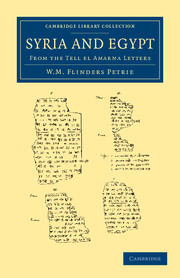
A pioneering Egyptologist, Sir William Matthew Flinders Petrie (1853–1942) excavated over fifty sites and trained a generation of archaeologists. In the early 1890s, he carried out significant work at Tell el-Amarna, the site of the ancient capital of Akhetaten. The illustrated 1894 excavation report that he co-authored has also been reissued in this series, along with many of his other publications. Petrie played a notable part in the preservation of a number of cuneiform tablets that became known collectively as the Tell el-Amarna letters. In this 1898 work, he presents summaries of the most important documents. They offer insights into war, peace and diplomacy in the Near East during the reigns of Amenhotep III and Akhenaten in the fourteenth century BCE. Informative notes on individuals and places mentioned in the letters help set them in context, while the methods used to interpret them are also elucidated.
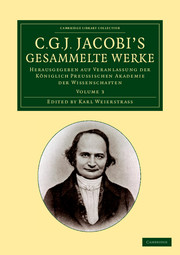
One of the greatest mathematicians of the nineteenth century, Carl Gustav Jacob Jacobi (1804–51) burst into the limelight with his redevelopment, together with Niels Henrik Abel (1802–29), of the theory of elliptic functions. His pioneering work was characterised by the variety of problems tackled and the power of the tools used to tackle them. His lasting influence on rational mechanics, number theory, partial differential equations, complex variable theory and computation is marked by the number of fundamental concepts that bear his name (the Jacobian, the Jacobi sum and the Jacobi symbol, among others). His collected works, comprising treatises, letters and papers written in German, Latin and French, were published in eight volumes between 1881 and 1891. Edited by fellow German mathematician Karl Weierstrass (1815–97), Volume 3 appeared in 1884.
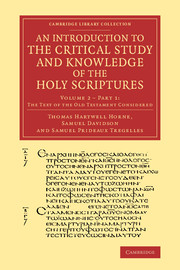
A painstaking compiler of catalogues and indexes, the biblical scholar and bibliographer Thomas Hartwell Horne (1780–1862) first published his most famous work in 1818, having begun his research for it many years earlier in 1801. Reissued here is the expanded four-volume tenth edition of 1856, which includes revisions by the scholars Samuel Davidson (c.1806–98) and Samuel Prideaux Tregelles (1813–75). This monumental and influential work of nineteenth-century biblical scholarship remains a valuable resource for modern researchers. Volume 2, the work of Davidson, addresses the Old Testament and has been split into two parts for this reissue. Influenced by contemporary German scholarship, Davidson's contribution caused controversy, particularly around prophetic authorship and the role of divine inspiration, resulting in his resignation from Lancashire Independent College. Indeed, Horne distanced himself from this volume. Part 1 includes discussion of scriptural Hebrew, of Greek, Arabic, Latin and Syriac translations, and of textual history and interpretation.
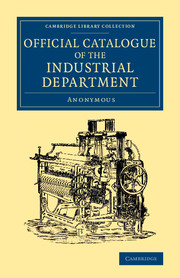
This official catalogue, reissued here in its updated third edition, appeared in 1862 to accompany London's International Exhibition of that year. Held from May to November in South Kensington, on a site now occupied by the Natural History Museum and the Science Museum, the exhibition served to showcase the progress that had been made in a diverse range of crafts, trades and industries since the Great Exhibition of 1851. Over 6 million visitors came to view the wares of more than 28,000 exhibitors from Britain, her empire and beyond. The catalogue contains brief entries for participants, giving details of their name, location and products. The coverage includes mining, engineering, textiles, ceramics, metals, printing, photography, musical instruments, and pharmaceuticals. Containing a ground plan of the exhibition space as well as many contemporary advertisements, this publication remains an instructive resource for social and economic historians.
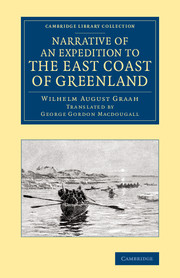
In 1828 a Danish expedition was sent out from Copenhagen under the command of the naval officer and explorer Wilhelm August Graah (1793–1863). Its goal was to locate lost Norse settlements on the coast of Greenland, which had existed in certain places from around the turn of the millennium until their collapse some centuries later. The Danes did not find any settlement where they searched on the eastern coast, and the men endured harrowing conditions and near starvation during three winters. First published in Danish in 1832 and reissued here in its 1837 English translation, Graah's work opens with a brief history of the exploration and colonisation of Greenland before recounting his own expedition. Observations on the Greenlandic Inuit are incorporated as well. Addressing what was known about the Norse settlements at that time, the appendix also contains the expedition's scientific observations.
A fellow Devonian, James Northcote (1746–1831) was an admirer and pupil of Sir Joshua Reynolds, whose two-volume biography he published in 1813–15. Reissued here is the 'revised and augmented' second edition of 1818. Northcote is self-deprecating as to his fitness for the task, but claims that a worthy biography of a great artist can be written only by another artist, and his close personal knowledge of his subject and the circle in which Reynolds moved gives him insights, as well as providing anecdotes, which would not be available to a more 'professional' author. Volume 2 covers the remainder of Reynolds' life, including a description of his elaborate funeral and various assessments of his work, as well as details of the sale of his paintings, and a short account of the life of William Gandy, an obscure seventeenth-century painter whom Reynolds greatly admired.
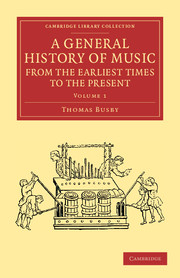
The writer, composer and organist Thomas Busby (1754–1838) is best remembered for his highly entertaining Concert Room and Orchestra Anecdotes (1825), which paints a vivid picture of musical life at the time. The son of a coach painter, Busby was originally articled to the composer Jonathan Battishill, but found the experience unrewarding. His compositions (many now lost) include songs, theatre music and oratorios. His literary output included journal articles and monographs, among them A Grammar of Music (also reissued in this series) and A General History of Music. First published in 1819, this two-volume work proved controversial as it was alleged that Busby had plagiarised the great histories of Burney and Hawkins (also available in the Cambridge Library Collection). However, acknowledging his indebtedness to them, Busby provided a popular interpretation of their work for the general reader. Volume 1 covers the period from the ancient Greeks and Romans to the Renaissance and the invention of printing.
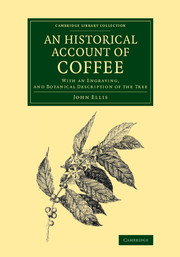
This tract, which first appeared in 1774, considers the characteristics, cultivation and uses of the coffee plant. Its author, John Ellis (c.1710–76), was a botanist and zoologist who from 1770 to 1776 served as a London agent for the government of Dominica. Published in order to promote the prosperity of the island, the work reflects the difficulties faced by the coffee growers. Ellis begins by describing the flower and fruit of the coffee plant. He then presents his historical survey, drawing on contemporaneous travel writing to illuminate coffee-related practices around the globe. The narrative takes in the plant's early uses in Arabia, its cultivation in the colonies, and the growth of coffee houses in Europe. This reissue also contains a 1770 work by Ellis which gives instructions on transporting plants overseas. Reissued elsewhere in this series is The Early History of Coffee Houses in England (1893).
One of the world's leading electrical engineers and involved in projects across the globe, Sir Philip Dawson (1866–1938) was at the forefront of the new technology of electric locomotion. Published in 1897, less than twenty years after the first successful demonstration of an electric passenger locomotive and just seven years after the opening of London's first electrified underground line, this handbook covers all aspects of the building and running of a successful electric railway, ranging from the construction of the permanent way and different means of delivering current through to financial accounting, staff organisation and discipline. Impressed by the speed of American progress, Dawson is keen to impress upon his reader the need for Europe to keep up. With some 500 illustrations, this work offers a uniquely revealing picture of the earliest days of a technology that is now taken for granted.
The architect Charles Robert Cockerell (1788–1863) was encouraged to travel at a young age, so that he might draw inspiration from the great works of European architecture. However, when the Napoleonic Wars made parts of the continent inaccessible to Englishmen, his eye was turned towards southern Europe and the Ottoman Empire. This version of the Grand Tour took up seven years, during which he recorded the events in his journals. There his observations would have remained had it not been for the editorial labours of his son, Samuel Pepys Cockerell (1844–1921), who published the present work in 1903. The narrative takes in such cities as Constantinople, Athens, Florence and Rome. Touching also on friendships made with such figures as Byron, the text gives a sense of what continental travel was like at that time and how the architecture of the past continued to captivate designers in the modern age.
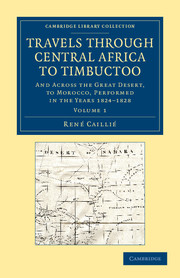
French explorer Réné Caillié (1799–1838) was the first European to document a successful expedition to Timbuktu, Africa's elusive 'city of gold'. Europeans were not welcome there, and until Caillié's expedition no explorer had returned alive. Encouraged by the 10,000 francs offered by the Société de Géographie to the first non-Muslim to bring back information on the city, he set out in 1824 from Senegal and eventually reached Timbuktu in 1828, remaining there for a fortnight before returning to France. His travels are recounted here in this two-volume work, first published in English in 1830. Volume 1 covers his outward journey, with detailed accounts of his travels through Saint-Louis, Kankan and other exotic waypoints, and the people, customs and commerce he encountered in the course of his trip. Vividly written, Caillié's work remains a landmark in the history of African exploration and adventure.
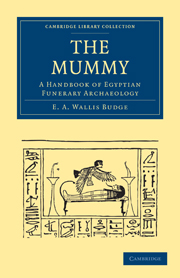
Sir Ernest Alfred Thompson Wallis Budge (1857–1934) was a prominent English Egyptologist who was Keeper of the Department of Egyptian and Assyrian Antiquities in the British Museum between 1893 and 1924. He was knighted in 1920 for his contributions to Egyptology. First published in 1893, this book contains a detailed discussion of the funerary rituals and objects which were used in Egyptian religion to allow the deceased to live again in the Duat (the afterlife). Budge provides detailed descriptions of common religious texts, religious rites and the major deities involved in these. He also includes interpretations for other artefacts which commonly accompanied a burial, including shabiti statues and amulets. His comprehensive study represents the state of Egyptian funerary archaeology before major archaeological finds of the twentieth century challenged its interpretations. The text reissued here is taken from the expanded and revised second edition, published in 1925.
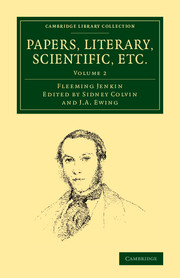
An electrical engineer, university teacher and wide-ranging writer, Fleeming Jenkin (1833–85) filed thirty-five British patents in the course of his career. Edited by Sidney Colvin (1845–1927) and J. A. Ewing (1855–1935) and first published in 1887, this two-volume work brings together a selection of Jenkin's varied and engaging papers. The collection ranges from notes on his voyages as a marine telegraph engineer, to a critical review of Darwin's On the Origin of Species, essays on literature, and thoughts on technical education. A memoir written by Robert Louis Stevenson, his former student, provides biographical context and attests to Jenkin's many interests and talents across the arts and sciences. Volume 2 includes Jenkin's papers on political economy, scientific education, and applied science, notably marine telegraphy. Abstracts of his scientific papers, along with a list of his patents, form an appendix to the volume.
In additamento hoc idem argumentum aliter tractatur simulque ostenditur quemadmodum motus lunae cum omnibus inaequalitatibus innumeris aliis modis repraesentari atque ad calculum revocari possit
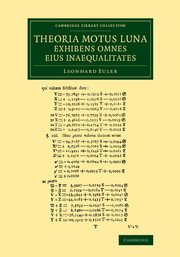
The problem of the moon's orbit was one that Leonhard Euler (1707–83) returned to repeatedly throughout his life. It provided a testing ground for Newton's theory of gravitation. Could the motion of the moon be entirely accounted for by Newton's theory? Or, as Euler initially suspected, did other forces need to be invoked? For practical purposes, if the moon's orbit could be accurately predicted, its motion would provide the universal timekeeper required to solve the longitude problem. In addition to the mathematical 'three-body problem', a topic still under investigation today, Euler was faced with the statistical problem of reconciling observations rendered inconsistent by experimental error. The present work, published in Latin in 1753, is Euler's triumphant solution. It may not be the last word on a subject which has occupied mathematicians and astronomers for over three centuries, but it showed that Newton's laws were sufficient to explain lunar motion.
One of the great algebraists of the nineteenth century, Marie Ennemond Camille Jordan (1838–1922) became known for his work on matrices, Galois theory and group theory. However, his most profound effect on how we see mathematics came through his Cours d'analyse, which appeared in three editions. Reissued here is the first edition, which was published in three volumes between 1882 and 1887. While highly influential in its time, it now appears to us a transitional work between the partially rigorous 'epsilon delta' calculus of Cauchy and his successors, and the new 'real number' analysis of Weierstrass and Cantor. The first two volumes follow the old tradition while the third volume incorporates a substantial amount of the new analysis. Ten years later, the even more influential second edition followed the new point of view from its start. Volume 1 (1882) covers differential calculus.
The German polymath Carl Stumpf (1848–1936) influenced one of the most significant philosophical developments of the early twentieth century: his student, Edmund Husserl, founded modern phenomenology. In a distinguished academic career spanning more than five decades, Stumpf also contributed to the growth of Gestalt psychology and ethnomusicology. An accomplished amateur musician, he used experimental methods to further the scientific study of music theory. His best-known work, first published in two volumes between 1883 and 1890, rigorously investigates the psychology of tone and music, ranging in coverage from physiology to acoustics. Its aim is to elucidate the effect that sounds have on various psychological functions. In Volume 2, Stumpf focuses on describing how the mind responds to listening to different sounds at the same time. He addresses the fusion of different sounds as well as distinguishing between sound and noise.