A collection of out-of-copyright and rare books from the Cambridge University Library and other world-class institutions that have been digitally scanned, made available online, and reprinted in paperback.
To save content items to your account,
please confirm that you agree to abide by our usage policies.
If this is the first time you use this feature, you will be asked to authorise Cambridge Core to connect with your account.
Find out more about saving content to .
To save content items to your Kindle, first ensure no-reply@cambridge.org
is added to your Approved Personal Document E-mail List under your Personal Document Settings
on the Manage Your Content and Devices page of your Amazon account. Then enter the ‘name’ part
of your Kindle email address below.
Find out more about saving to your Kindle.
Note you can select to save to either the @free.kindle.com or @kindle.com variations.
‘@free.kindle.com’ emails are free but can only be saved to your device when it is connected to wi-fi.
‘@kindle.com’ emails can be delivered even when you are not connected to wi-fi, but note that service fees apply.
A physician and medical reformer enthused by the scientific and cultural progress of the Enlightenment as it took hold in Britain, Thomas Percival (1740–1804) wrote on many topics, including public health and demography. His influential publication on medical ethics is considered the first modern formulation. In 1807, his son Edward published this four-volume collection of his father's diverse work. Some of the items here had never been published before, including a selection of Percival's private correspondence and a biographical account written by Edward. Volume 2 contains essays on moral and literary subjects, notably a Socratic discourse on truth as well as miscellaneous observations on the influence of habit and association. Also included are a memoir of the philanthropist Thomas Butterworth Bayley and the text of Percival's Medical Ethics (1803), which has been reissued separately in this series along with his Essays Medical and Experimental (revised edition, 1772–3).
This translation of an Arabic commentary by Jephet ibn Ali (fl. late tenth century) was first published in 1889. Based on ten manuscripts, the text was carefully edited and rendered into English by David Samuel Margoliouth (1858–1940), Laudian Professor of Arabic at Oxford. Jephet was a leading Karaite scholar who wrote a number of biblical commentaries in his native Arabic. This was one of his mature works and perhaps the best example of his critical and exegetical powers. Based on the historical allusions in the commentary, Margoliouth estimated that it was composed between 990 and 1010. The work includes the Arabic text, with critical apparatus and a useful glossary of key words. Fiercely polemical against Islam, Christianity and Rabbinic Judaism, the commentary has greatly contributed to our understanding of tenth-century religious controversies. It remains an important work of Karaite literature.
Originally published in 1773 in two volumes, and now reissued here together in one, this work by the writer Hester Chapone (1727–1801), a renowned proponent of female education, contains advice delivered in the form of letters to her niece. The first volume deals primarily with matters of religion and morality, while the second volume addresses questions of behaviour and schooling. Unusually for self-improvement books of this era, Chapone recommends that a young woman should have a rigorous education in a wide variety of subjects, including ancient history and geography, as well as instruction in ladylike deportment and mastery of household matters. She exhorts young ladies to avoid vanity and other vices through devoted study of scripture, and writes of the importance of choosing worthy and sensible friends who can be trusted to offer good advice. Chapone's posthumously published works, in two volumes, are also reissued in this series.
Thomas Chatterton (1752–70) was only seventeen when he died of arsenic poisoning. Among his family and friends he was known as a versifier with a fascination for medieval manuscripts, but none suspected the true scope of his work. At eleven, he was already writing poetry, and by the end of his life his love poems, eclogues and forged medieval pieces numbered in the hundreds. Chatterton is best known for the Rowley poems, which he claimed were transcribed from the work of a fifteenth-century monk. Although the precocious skill of his forgeries, once exposed, often went unrecognised by critics, Chatterton's legacy influenced the Romantics for decades after his death. This three-volume collection of his work, edited by Joseph Cottle and Robert Southey, first appeared in 1803. Volume 3 includes Chatterton's prose works, selected letters, some contemporary discussion of his work, and Cottle's account of the Rowley manuscripts.
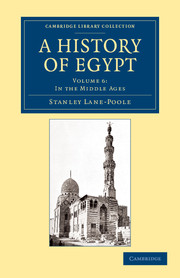
Published in six volumes between 1894 and 1905, this collection served as a valuable reference work for students and scholars of Egyptology at a time when ongoing archaeological excavations were adding significantly to the understanding of one of the world's oldest civilisations. At the forefront of this research was Sir William Matthew Flinders Petrie (1853–1942), whose pioneering methods made Near Eastern archaeology a much more systematic and scientific discipline. Many of his other publications are also reissued in this series. Britain's first professor of Egyptology from 1892, Petrie was conscious of the fact that there was no textbook he could recommend to his students. The work of Weidemann was in German and out of date, so Petrie and his collaborators incorporated the latest theories and discoveries in this English-language resource. Volume 6 (1901), written by Stanley Lane-Poole (1854–1931), covers Arabic Egypt from 639 to 1517.
The architect and designer Augustus Welby Pugin (1812–52), whose early commissions included furniture for George IV at Windsor, assured his place in history through his work with Sir Charles Barry on the Palace of Westminster following the 1834 fire. A pivotal figure in Britain's Gothic Revival, he became a Roman Catholic in 1835, combining his religion with his devotion to the medieval in building projects such as Nottingham Cathedral, St George's Cathedral in Southwark, and Mount St Bernard Abbey in Leicestershire. Benjamin Ferrey (1810–80) studied architectural draughtsmanship under Augustus Charles Pugin (1762–1832). Boarding with the Pugins for seven years, he gained first-hand knowledge of father and son. This 1861 work is a lasting achievement in architectural biography. It includes a substantial appendix by Edmund Sheridan Purcell, a family friend whose own Catholicism equipped him to discuss the religious aspects of the younger Pugin's character and work.
One of the most celebrated and prolific authors of the Victorian era, Anthony Trollope (1815–82) was also an enthusiastic traveller. This two-volume work recounts his two-year journey across Britain's colonies in the Antipodes. First published in 1873, it celebrates the success of British colonisation, but also considers with pragmatic foresight the inevitable unification of the Australian territories and their desire for greater independence. Volume 1 covers Trollope's travels through Queensland, New South Wales and Victoria. Each section addresses the history and governance of the relevant state, assessing also the current condition of the region's institutions, people and resources. In the process, Trollope informs his reader about everything from the temperament of Aboriginal Australians to the troubles of travelling by steamboat. North America (1862), his account of the continent during the American Civil War, and his An Autobiography (1883) are also reissued in this series.
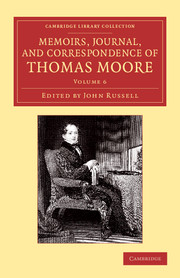
Throughout his professional life, the poet Thomas Moore (1779–1852) was variously celebrated and vilified for both his verse and his politics. Born in Dublin, he remained an ardent Irish patriot until his death. This eight-volume collection of Moore's memoirs, diaries and letters, edited by his friend Lord John Russell (1792–1878) and first published between 1853 and 1856, provides rare insights into a man whose genius was applauded by the Morning Chronicle as 'embracing almost all sides of imaginative literature, of criticism and philosophy'. Volume 6 contains Moore's diary for the period 1829–33, during which time he finally published Letters and Journals of Lord Byron (1830) and the book that won him respect as a leading Irish patriot, The Life and Death of Lord Edward Fitzgerald (1831).
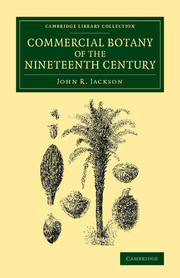
The nineteenth century witnessed great advances in technology which made transporting natural resources overseas significantly easier. At the centre of a global empire, Britain felt the full economic benefits of introducing and cultivating a range of commercial plants both domestically and in her colonies abroad. First published in 1890, this succinct work by the English botanist John Reader Jackson (1837–1920) surveys these plants. The concise descriptions are enhanced by instructive drawings of significant species. The introduction also contains a chronological table of the century's most important developments in commercial botany. This is followed by chapters organised according to the applications of plants, notably in food, drink, medicine, and the building trade. Jackson points out the species which revolutionised these industries, identifying those at the heart of rapidly growing markets. The coverage includes many commodities which remain commercially significant, such as palm oil, sugar cane, and cotton.
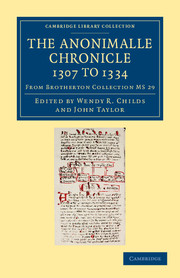
This 1991 publication contains the first printed edition of a short continuation of the Anglo-Norman prose Brut found in the Anonimalle Chronicle. This fourteenth-century chronicle of British history was written at St Mary's Abbey, York, which was a prominent religious centre at the time. Notable for being the most complete example of the text to be found, the continuation here is a valuable source for the wars and political crises of the reign of Edward II and the early reign of Edward III. The manuscript, its contents and value are all discussed in a thorough introduction, while the text is presented with a facing-page translation into English. The work was edited by Wendy Childs, Emeritus Professor of Later Medieval History at Leeds, and John Taylor (1925–2009), former Reader in Medieval History at Leeds.
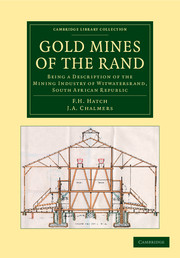
The mining engineer and petrologist Frederick Henry Hatch (1864–1932) left the Geological Survey of Great Britain in 1892, relocating to South Africa. He worked for De Beers and with John Hays Hammond for Cecil Rhodes, finding important new gold fields in Matabeleland and Mashonaland. Control of the gold mines was a significant factor in the tension between Dutch and English settlers that would result in the Second Boer War in 1899. Prior to this, Rhodes and Hammond were behind the abortive Jameson Raid, but Hatch had returned to England briefly and was not implicated. This 1895 work, written with South African mining engineer J. A. Chalmers, reveals the extent of gold reserves in the Transvaal, and the engineering skills needed to exploit them. It deals with geological, economic and legal aspects of the mining industry, remaining of interest to historians of South Africa and the British Empire.
The geologist Sir Henry Thomas De la Beche (1796–1855) made important contributions as both a surveyor and a theorist. Elected to the Royal Society in 1823, he mapped geological strata in Devon during the 1830s and became the founding director of the British Geological Survey, the world's first national geological survey. In 1847, he was elected president of the Geological Society of London. Reflecting the scope of his scientific knowledge, the present work covers a wide range of topics, including the density of planets, the mineralisation of organic remains, and what could be inferred from the fossils thus created. The book was first published in 1834, the year he became embroiled in an argument with his contemporary Roderick Murchison. Lasting several years, the dispute became known as the 'The Great Devonian Controversy'. De la Beche's Geological Manual (third edition, 1833) has also been reissued in this series.
Following his stint as the naturalist aboard the Endeavour on James Cook's pioneering voyage, Sir Joseph Banks (1743–1820) became a pre-eminent member of the scientific community in London. President of the Royal Society from 1778, and a friend and adviser to George III, Banks significantly strengthened the bonds between the practitioners and patrons of science. Between 1796 and 1800, the Swedish botanist and librarian Jonas Dryander (1748–1810) published this five-volume work recording the contents of Banks' extensive library. The catalogue was praised by many, including the distinguished botanist Sir James Edward Smith, who wrote that 'a work so ingenious in design and so perfect in execution can scarcely be produced in any science'. Volume 5 (1800) contains a list of works from the first four volumes indexed by author, as well as a supplementary list of those items that were acquired after the publication of the previous volumes.
A major philosophical mind in his day, William Paley (1743–1805) wrote in a lucid style that made complex ideas more accessible to a wide readership. This work, first published in 1785, was based on the lectures he gave on moral philosophy at Christ's College, Cambridge. Cited in parliamentary debates and remaining on the syllabus at Cambridge into the twentieth century, it stands as one of the most influential texts to emerge from the Enlightenment period in Britain. An orthodox theologian, grounding his utilitarian ethics in strong religious faith, Paley held notably progressive views on issues of toleration and the slave trade. His perspicuity prompted one contemporary to remark that the book 'presents a subject which has always been considered as harsh and difficult, in the most agreeable and intelligible form … we sit down to be informed of our duty, and are surprised to meet with amusement'.
Coffee houses played an important role in the cultural and intellectual history of the seventeenth century. Functioning as venues where people could meet, catch up with news, transact business and discuss issues of mutual concern, they provided a valuable alternative to public houses: the absence of alcohol allowed for more serious conversation. First published in 1893, this illustrated study by Edward Forbes Robinson (fl.1890) explores the history of the English coffee house and its role in seventeenth-century social and political life. Beginning with a history of coffee itself, Robinson examines the religious traditions surrounding the beverage, moving on to discuss its medical uses and the clientele who frequented the establishments that served it. The role of the coffee house as a temperance institution is also considered. With an appendix containing a selection of contemporary texts and descriptions of coffee house tokens, this lively study remains significant to social historians.
This two-volume account of the life and friendships of the publisher John Murray (1778–1843), told largely through his voluminous correspondence, was published in 1891 by Samuel Smiles (1812–1904), whose Lives of the Engineers, Self-Help, and other works are also reissued in the Cambridge Library Collection. Murray was only fifteen when his father, the founder of the famous firm, died, but after a period of apprenticeship he took sole control of the business, becoming the friend as well as the publisher of a range of the most important writers of the first half of the nineteenth century, in both literature and science. Perhaps his most famous author was Lord Byron, whose memoir of his own life, considered unpublishable, was burned in the fireplace at Murray's office in Albemarle Street, London. Volume 1 commences with the beginnings of the firm in Scotland, and takes the story up to 1818.
The Swiss mathematician Jakob Steiner (1796–1863) came from a poor background with an incomplete education, yet such was his mathematical talent that eventually the Prussian university system adapted itself to him rather than he to it. A geometer in an age dominated by analysts, he pursued his own interests in his own way. The elegant results which bear his name - including Steiner circles, systems and symmetrisation - are known to most mathematicians today. Considered by many to be the greatest geometer since Apollonius of Perga, Steiner did important work on systemising geometry, laying the foundation for much later work on projective geometry. Edited by the eminent mathematician Karl Weierstrass (1815–97), this two-volume edition of Steiner's collected works offers scholars access to his influential writings in the original German. Volume 1 was published in 1881.
Successors such as Wordsworth and Coleridge admired yet overshadowed William Cowper (1731–1800). Troubled by mental instability, he retreated from both the legal profession and the woman he had hoped to marry, seeking out a quiet existence in the country. In spite of his struggles, he made a translation of Homer's Iliad, produced a considerable body of poetry, and maintained many epistolary contacts. This four-volume biography, compiled by his friend and fellow poet William Hayley (1745–1820), appeared between 1803 and 1806, bringing together selected letters and unpublished poems to illuminate Cowper's personal and literary life. Featuring a frontispiece portrait engraved by William Blake, Volume 1 (1803) contains Hayley's narrative of Cowper's life, interspersed with his letters. Warm-hearted and engaging, the letters also reflect the debilitating changes of his mood and the beginnings of his troubled faith. They date from 1765, just after his first nervous collapse, to 1791.
Founded in 1666, the French Académie des Sciences was a prominent and prestigious organisation behind numerous scientific advances in Europe in the seventeenth and eighteenth centuries. In 1817, commissioned by the Académie, Louis de Freycinet (1779–1841) embarked on a three-year expedition with the main purpose of investigating terrestrial magnetism and taking a series of pendulum measurements. In the course of this voyage around the world, the scientists aboard the Uranie also collected an abundance of samples and made significant observations in the fields of geography, ethnology, astronomy, hydrography and meteorology. The progress of this journey was detailed by Jacques Arago (1790–1855), draughtsman on the expedition, in the form of letters to a friend. This illustrated narrative is prefaced by a report to the Académie which summarises the mission's findings. Translated into English and published in 1823, this work is an informative and often witty account, reflecting contemporary ambitions in science and exploration.
A prolific philologist of both the German and classical languages, Moriz Haupt (1808–74) enjoyed a successful academic career at the universities of Leipzig and Berlin. As well as founding the Zeitschrift für deutsches Altertum, which is still published, he was a painstaking yet somewhat bold editor of many classical texts. In the years immediately following his death, his shorter works were gathered together in this three-volume collection, edited by fellow philologist Ulrich von Wilamowitz-Moellendorff (1848–1931). Volume 1 (1875) contains essays by Haupt in both Latin and German on a variety of classical subjects. Included here are his Quaestiones Catullianae (1837), an analysis of a fragment of a Pindaric dithyramb, and a commentary on the bucolic poems of Calpurnius and Nemesianus. This work remains of value to researchers interested in the history of classical scholarship, particularly the significant contributions made by German scholars in the nineteenth century.