A collection of out-of-copyright and rare books from the Cambridge University Library and other world-class institutions that have been digitally scanned, made available online, and reprinted in paperback.
To save content items to your account,
please confirm that you agree to abide by our usage policies.
If this is the first time you use this feature, you will be asked to authorise Cambridge Core to connect with your account.
Find out more about saving content to .
To save content items to your Kindle, first ensure no-reply@cambridge.org
is added to your Approved Personal Document E-mail List under your Personal Document Settings
on the Manage Your Content and Devices page of your Amazon account. Then enter the ‘name’ part
of your Kindle email address below.
Find out more about saving to your Kindle.
Note you can select to save to either the @free.kindle.com or @kindle.com variations.
‘@free.kindle.com’ emails are free but can only be saved to your device when it is connected to wi-fi.
‘@kindle.com’ emails can be delivered even when you are not connected to wi-fi, but note that service fees apply.
A pioneering Egyptologist, Sir William Matthew Flinders Petrie (1853–1942) excavated over fifty sites and trained a generation of archaeologists. In 1880 he began the first ever systematic survey of the Giza Plateau, with perhaps his most important work being on the Great Pyramid. Theories abounded as to how the Great Pyramid had been constructed, yet few were based on close examination of the structure itself. Petrie's findings, still used as a reference today, enabled him to disprove prominent theories, such as the belief of Charles Piazzi Smyth that the Great Pyramid was a product of divine revelation and therefore flawless. This first edition of 1883 was not reprinted, and subsequent editions summarised some of the material. Petrie wrote prolifically throughout his long career, and many of his other publications are also reissued in this series.
For this 1897 publication, the American philosopher William James (1842–1910) brought together ten essays, some of which were originally talks given to Ivy League societies. Accessible to a broader audience, these non-technical essays illustrate the author's pragmatic approach to belief and morality, arguing for faith and action in spite of uncertainty. James thought his audiences suffered 'paralysis of their native capacity for faith' while awaiting scientific grounds for belief. His response consisted in an attitude of 'radical empiricism', which deals practically rather than ideologically with real-world phenomena. When facing a 'momentous' decision about belief, he says, we both can and must choose the best hypothesis. The first four essays apply this principle to religious faith, and the rest explore the pragmatic approach to such topics as determinism, ethics and individual achievement. James developed his ideas further in The Varieties of Religious Experience (1902) and Pragmatism (1907), both of which are reissued in this series.
Although without formal scientific training, Henry John Elwes (1846–1922) devoted his life to natural history. He had studied birds, butterflies and moths, but later turned his attention to collecting and growing plants. Embarking on his most ambitious project in 1903, he recruited the Irish dendrologist Augustine Henry (1857–1930) to collaborate with him on this well-illustrated work. Privately printed in seven volumes between 1906 and 1913, it covers the varieties, distribution, history and cultivation of tree species in the British Isles. The strictly botanical parts were written by Henry, while Elwes drew on his extensive knowledge of native and non-native species to give details of where remarkable examples could be found. Each volume contains photographic plates as well as drawings of leaves and buds to aid identification. The species covered in Volume 4 (1909) include fir, chestnut, ash and birch.
John Evelyn (1620–1706), a founder member of the Royal Society, was a horticulturalist and author, best remembered for his diaries. Throughout his prolific writings he exhibits a strong distaste for the corruption of life at court. The beautiful and pious Margaret Godolphin (1652–78), a courtier more than thirty years Evelyn's junior, with whom he struck up an intense friendship in 1672, was maid of honour in the household of Queen Catherine, wife of King Charles II. To Evelyn she represented the antithesis of the corruption he despised. Written as 'a record of her perfections' following her death in childbirth, this hagiographic biography reflects the extent of Evelyn's devotion. Left among his unrevised manuscripts, it was not published until 1847, nearly two centuries after its composition. Edited by the bishop and orator Samuel Wilberforce (1805–73), the work includes helpful notes and genealogical tables that elucidate the text.
First published in 1840, this two-volume treatise by Cambridge polymath William Whewell (1794–1886) remains significant in the philosophy of science. The work was intended as the 'moral' to his three-volume History of the Inductive Sciences (1837), which is also reissued in this series. Building on philosophical foundations laid by Immanuel Kant and Francis Bacon, Whewell opens with the aphorism 'Man is the Interpreter of Nature, Science the right interpretation'. Volume 2 contains the final sections of Part 1, addressing namely the philosophy of biology and palaetiology. Part 2, 'Of Knowledge', includes a selective review of opinions on the nature of knowledge and the means of seeking it, beginning with Plato. Whewell's work upholds throughout his belief that the mind was active and not merely a passive receiver of knowledge from the world. A key text in Victorian epistemological debates, notably challenged by John Stuart Mill and his System of Logic, Whewell's treatise merits continued study and discussion in the present day.
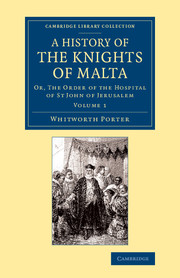
At the close of the Napoleonic Wars, Malta officially became part of the British Empire in 1814. As the British presence there increased, so too did public interest in the island's history, particularly the military religious order of the Knights Hospitaller. In 1858, the army officer Whitworth Porter (1827–92) published this two-volume work, tracing the fortunes of the order since its establishment following the First Crusade. Incorporating details of the knights' social habits and customs into his narrative, Porter also provides supplementary material such as royal and papal documents in translation. Volume 1 focuses on the centuries of warfare between the order and the forces of Islam, from its beginnings in the Holy Land through to the second siege of Rhodes in 1522, when the knights were outnumbered and ultimately defeated by the attacking Ottoman armies.
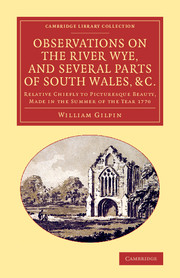
Clergyman, schoolmaster and writer on aesthetics, William Gilpin (1724–1804) is best known for his works on the picturesque. In his Essay on Prints, published in 1768 and reissued in this series, he defined picturesque as 'a term expressive of that peculiar kind of beauty, which is agreeable in a picture'. First published in 1782, the present work was the first in a series which recorded his reflections on the picturesque across British landscapes. It traces the journey he made, equipped with notebook and sketching materials, along the River Wye and into South Wales, visiting such notable sites as Tintern Abbey. As well as describing his route and its highlights, Gilpin includes several reproductions of his pen-and-wash drawings. Further developing and exploring the concept of the picturesque, his later volumes of Observations on various parts of Britain are also reissued in the Cambridge Library Collection.
In April 1855, Bernard Whittingham (fl.1850), a captain of the Royal Engineers, set off from Hong Kong aboard H.M.S. Sibylle. He had volunteered to join an Allied squadron attempting 'to discover the progress of Russian aggrandisement in North-eastern Asia, and to ascertain how far the reports of her successful encroachment on the sea frontiers of China and Japan were true'. In the context of the Crimean War's Pacific theatre, he was also keen to see avenged the Royal Navy's defeat by the Russians at Petropavlovsk the previous year. Whittingham's notes, published in 1856, give a personal and uniquely British account of an understudied time and place with far-reaching influence on later events. The book is also a rich source of anecdotes, not least that relating to the capture of crew members of the ill-fated Russian frigate Diana.
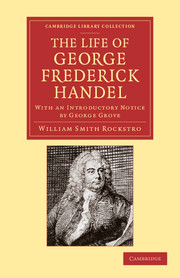
Beloved not only in Britain, George Frideric Handel (1685–1759) is admired as a composer the world over. His inventive and sensitive melodic genius and his exuberant brilliance in depicting the spectacular are best displayed in his Messiah and Zadok the Priest. Larger than life, Handel impressed all who met him and was adept at promoting his works, arranging for their publication and even selling them from his home in London's Brook Street. His dogged determination to triumph over the many reverses of his career and the fickle enthusiasms of the Georgian public is the stuff of three-volume novels. This sympathetic and highly readable biography by the composer and author William Smith Rockstro (1823–95) was first published in 1883. Wherever possible, autograph manuscripts have been consulted and the book contains the first detailed catalogue of Handel's output. Among other works, Rockstro's biography of Mendelssohn is also reissued in this series.
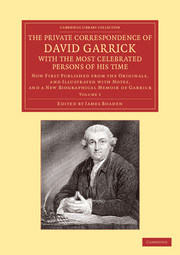
David Garrick (1717–79) is synonymous with the golden age of English theatre. Widely acclaimed as an actor, he went on to become a shrewd theatre manager at Drury Lane. His years in charge of the Theatre Royal ensured its dramatic ascendancy and burnished his own considerable celebrity. These letters, first published in 1831, reveal Garrick's gregarious nature and shed light on his many friendships with leading ladies, fellow actors, contemporary playwrights, and members of high society. His love of Shakespeare's work is also evident, highlighting Garrick's pivotal role in ensuring the plays became established in the national consciousness. This two-volume collection was edited by James Boaden (1762–1839), who published several theatrical biographies (also reissued in this series). Containing correspondence for the period 1736–74, Volume 1 also includes a biographical account that traces the progress of Garrick's theatrical career.
To the naturalist John Woodward (c.1665–1728), fossils were 'much neglected, and left wholly to the Care and Treatment of Miners and meer Mechanicks'. He had built up a large personal collection of these samples of the Earth's petrified remains and spent much of his life developing a system for their classification, the results of which were published in this important illustrated work of 1728. A distinguished physician and a fellow of the Royal Society, Woodward wrote extensively on scientific topics, and had developed a theory that fossils were creatures destroyed in the flood described in the Bible. These ideas attracted critics and supporters in equal measure, but his contribution to techniques of fossil collection and classification were influential. In the present work, he devotes the early chapters to questions of description and classification, while the later sections contain some of his letters to his scientific contemporaries, including Isaac Newton.
Successors such as Wordsworth and Coleridge admired yet overshadowed William Cowper (1731–1800). Troubled by mental instability, he retreated from both the legal profession and the woman he had hoped to marry, seeking out a quiet existence in the country. In spite of his struggles, he made a translation of Homer's Iliad, produced a considerable body of poetry, and maintained many epistolary contacts. This four-volume biography, compiled by his friend and fellow poet William Hayley (1745–1820), appeared between 1803 and 1806, bringing together selected letters and unpublished poems to illuminate Cowper's personal and literary life. Volume 2 (1803) contains personal letters from the period 1791–4, accompanied by Hayley's biographical remarks. Also included are appendices of some of Cowper's original poems and translations from Latin and Greek, notably sections from Horace and Virgil.
As son-in-law and literary executor to Sir Walter Scott (1771–1832), John Gibson Lockhart (1794–1854) was uniquely placed to produce a definitive biography of the great poet and novelist. First published in 1837–8, shortly after Scott's death, this celebrated seven-volume work is based on personal memories, correspondence, and Scott's own autobiographical sketches. Wide-ranging in his purview, Lockhart is also detailed in his descriptions: the Aberdeen Journal of the day observed that the volumes trace Scott's life and literary efforts with 'the most minute distinctness'. In volume 5, Lockhart examines Scott's personal and professional life during the years 1820–5. After introducing readers to the hospitality that Scott bestowed on his guests at Abbotsford, the author then turns the reader's attention to Scott's literary achievements with the publication of The Abbot (1820) and the commencement of St Ronan's Well (1823).
A pioneering Egyptologist, Sir William Matthew Flinders Petrie (1853–1942) excavated over fifty sites and trained a generation of archaeologists. This single-volume reissue brings together three well-illustrated reports of his excavations over three seasons at Memphis and Meidum on the west bank of the Nile, first published in 1909–10. Work at Memphis in 1908 and 1909 notably focused on the west hall of the temple of Ptah and the royal palace of Apries. Chapters on the inscriptions are provided by James Herbert Walker (d.1914). The excavations at Meidum continued those begun in 1891 and recorded in the 1892 report that is also reissued in this series. Petrie was assisted by Ernest Mackay (1880–1943) and Gerald Averay Wainwright (1879–1964) in working on the pyramid, built for the fourth-dynasty pharaoh Sneferu, and the mastaba of Nefermaat, one of the largest private tombs of the Old Kingdom.
William Dwight Whitney (1827–94) was the foremost American philologist and Sanskrit scholar of the nineteenth century. After studying in Germany, then at the forefront of linguistic scholarship, he assumed the chair of Sanskrit at Yale in 1854, with comparative philology added to his professorship in 1869. As well as teaching modern languages, Whitney published over 300 scholarly papers and books, acted as chief editor of the ten-volume Century Dictionary, and co-founded the American Philological Association. This 1867 work is an expanded version of lectures he had given at the Smithsonian Institution and in Boston, rewritten for a wider audience and emphasising the importance of recent German philological scholarship. The first five lectures concentrate mostly on the English language and the study of languages in general, including discussion of regional dialects and American English. The lectures then go on to look at the Indo-European language family as well as methods of linguistic research.
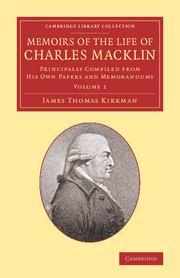
Drawing on his own papers and first published in 1799, this two-volume account traces the colourful life of the actor and playwright Charles Macklin (c.1699–1797). His long career serves as the focal point in a history of the eighteenth-century theatre and its most celebrated performers. Hailed for his enduring interpretation of Shakespeare's Shylock, a role he played for some fifty years, Macklin has been credited with the theatre's move towards realism. His life was just as dramatic offstage, marked as it was by a series of controversies and fierce rivalries. In 1735 he was convicted of the manslaughter of a fellow actor in a quarrel over a wig, and in 1775 he successfully pressed charges of conspiracy against theatregoers who had rioted during his performances. Volume 1 covers Macklin's childhood and early career, including his trial for the killing of Thomas Hallam.
One of the foremost scholars of his day, the German classicist August Böckh (1785–1867) was chosen by the Berlin Academy of Sciences as the first editor of the monumental Corpus inscriptionum graecarum. Before that he had published this groundbreaking edition of the extant works of the Greek poet Pindar (c.522–c.443 BCE) in two volumes, the second being split into two parts. This first volume, published in 1811, contains the only complete surviving works of Pindar, the victory odes (Epinikia), written to celebrate athletic successes at the Olympic and other games. In addition to the editor's Latin preface and critical notes, this volume also contains his important treatise on Pindarian metrics, De metris Pindari, in which he establishes a close connection between Greek music and verse, elucidating the Greeks' own statements about rhythm and providing a systematic basis for the study of Greek verse.
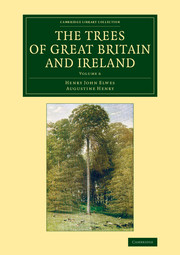
Although without formal scientific training, Henry John Elwes (1846–1922) devoted his life to natural history. He had studied birds, butterflies and moths, but later turned his attention to collecting and growing plants. Embarking on his most ambitious project in 1903, he recruited the Irish dendrologist Augustine Henry (1857–1930) to collaborate with him on this well-illustrated work. Privately printed in seven volumes between 1906 and 1913, it covers the varieties, distribution, history and cultivation of tree species in the British Isles. The strictly botanical parts were written by Henry, while Elwes drew on his extensive knowledge of native and non-native species to give details of where remarkable examples could be found. Each volume contains photographic plates as well as drawings of leaves and buds to aid identification. The species covered in Volume 6 (1912) include spruce, juniper, laburnum, cherry, mulberry and gum trees.
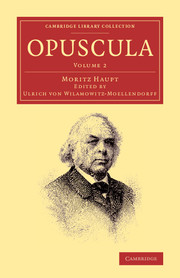
A prolific philologist of both the German and classical languages, Moriz Haupt (1808–74) enjoyed a successful academic career at the universities of Leipzig and Berlin. As well as founding the Zeitschrift für deutsches Altertum, which is still published, he was a painstaking yet somewhat bold editor of many classical texts. In the years immediately following his death, his shorter works were gathered together in this three-volume collection, edited by fellow philologist Ulrich von Wilamowitz-Moellendorff (1848–1931). Volume 2 (1876) contains the Latin text of forty-two lectures delivered by Haupt twice a year at the University of Berlin between 1854 and 1874. The lectures cover a variety of topics concerning classical texts, philology and literature, including an exposition of the forgeries by Simeon Bosius of the texts of Catullus. This work remains of value to researchers interested in nineteenth-century German classical scholarship.
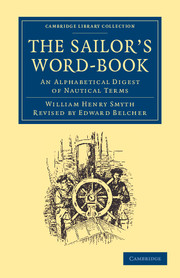
Admiral William Henry Smyth (1780–1865) went to sea at an early age, becoming a sailor and surveyor with the East India Company, and later moving to Mediterranean waters. A founding member of the Royal Geographical Society in 1830, he spent much of his free time engaged in scientific pursuits. One of his final projects was this 'word-book' of nautical terminology, which he had been compiling throughout his career, and whose publication was eagerly anticipated by his fellow naval officers. Although Smyth died before it was published in 1867, his notes were edited by his family and revised by Sir Edward Belcher (1799–1877). Ranging from technical terminology to sailors' slang, Smyth's glossary contains more than 700 pages of definitions, arranged alphabetically, making it an indispensable source on nineteenth-century nautical vocabulary for both maritime historians and sailing aficionados.