A collection of out-of-copyright and rare books from the Cambridge University Library and other world-class institutions that have been digitally scanned, made available online, and reprinted in paperback.
To save content items to your account,
please confirm that you agree to abide by our usage policies.
If this is the first time you use this feature, you will be asked to authorise Cambridge Core to connect with your account.
Find out more about saving content to .
To save content items to your Kindle, first ensure no-reply@cambridge.org
is added to your Approved Personal Document E-mail List under your Personal Document Settings
on the Manage Your Content and Devices page of your Amazon account. Then enter the ‘name’ part
of your Kindle email address below.
Find out more about saving to your Kindle.
Note you can select to save to either the @free.kindle.com or @kindle.com variations.
‘@free.kindle.com’ emails are free but can only be saved to your device when it is connected to wi-fi.
‘@kindle.com’ emails can be delivered even when you are not connected to wi-fi, but note that service fees apply.
The German mathematician Karl Weierstrass (1815–97) is generally considered to be the father of modern analysis. His clear eye for what was important is demonstrated by the publication, late in life, of his polynomial approximation theorem; suitably generalised as the Stone–Weierstrass theorem, it became a central tool for twentieth-century analysis. Furthermore, the Weierstrass nowhere-differentiable function is the seed from which springs the entire modern theory of mathematical finance. The best students in Europe came to Berlin to attend his lectures, and his rigorous style still dominates the first analysis course at any university. His seven-volume collected works in the original German contain not only published treatises but also records of many of his famous lecture courses. Edited by Johannes Knoblauch (1885–1915) and Georg Hettner (1854–1914), Volume 4 was published in 1902.
Among the most influential figures of the Gothic Revival in nineteenth-century Britain, Augustus Welby Northmore Pugin (1812–52) distinguished himself as an architect, author and interior designer. His illustrated lectures on ecclesiastical design were first published in 1841 and are reissued here with An Apology for the Revival of Christian Architecture in England (1843). Reflecting the influence of the author's conversion to Catholicism, the works discuss a range of architectural features, their functions and where they should be implemented. Pugin also outlines, with some amusement, the dangers of executing designs that do not follow his principles. The highly detailed illustrations are drawn with an architect's precision, showing both realised and unrealised designs. Contrasts (revised second edition, 1841), Pugin's most famous work, is also reissued in this series. Together, these publications remain essential reading for those seeking to understand the growth of the Gothic Revival.
The literary career of Anna Seward (1742–1809) had many frustrations. Erasmus Darwin once printed her poetry under his own name. Horace Walpole accused her of having 'no imagination'. And despite her evident talents, she was unable to find a patron willing to support a woman. Yet her letters reveal the breadth of her interests and the strength of her literary criticism. In addition to writing to newspapers and magazines, she counted many eminent figures among her correspondents, including James Boswell (who begged for a lock of her hair) and the young Walter Scott. This six-volume selection of her letters, edited by the publisher Archibald Constable (1774–1827), first appeared in 1811. Volume 2 covers the years 1788–90. It incorporates some of her staunchest defences of the older poets, such as Milton and Gray, against the onslaught of the new criticism, but also opens a touching window into her personal life away from the literary world.
John Conolly (1794–1866) was a physician and alienist (psychiatrist) who worked with the mentally ill at the Hanwell County Asylum in Middlesex, where he introduced the principle of non-restraint. This action was at first controversial and met with strong opposition, but it served to further the cause of humane treatment, securing Conolly's reputation. Published in 1869, this biography was the last major work of Sir James Clark (1788–1870), a supporter of Conolly's enlightened methods. Clark himself had enjoyed a distinguished medical career, becoming a trusted physician and friend to Queen Victoria. Also reissued in this series are his Medical Notes on Climate, Diseases, Hospitals, and Medical Schools in France, Italy, and Switzerland (1820), The Influence of Climate in the Prevention and Cure of Chronic Diseases (1829) and A Treatise on Pulmonary Consumption (1835).
As a surgeon and naturalist for the New Zealand Company, Ernst Dieffenbach (1811–55) travelled widely in the North Island between 1839 and 1841. He was the first European to successfully scale Mount Egmont (or Taranaki), and he also visited the natural wonders of the Pink and White Terraces at Lake Rotomahana, which were later destroyed in a volcanic eruption. First published in 1843, this two-volume work describes the landscapes, flora and fauna in a highly readable style. Volume 2 focuses on the Maori inhabitants of the island, for whom Dieffenbach had a respect and admiration that was unusual for the time. He writes about their customs, such as hunting techniques, burial practices and the tradition of facial tattooing. He also provides examples of Maori language, including songs and simple phrases. The final section of the work comprises a short grammar and dictionary.
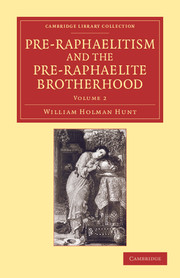
William Holman Hunt (1827–1910) chronicled the Pre-Raphaelite Brotherhood in this well-illustrated two-volume memoir of 1905, controversially presenting himself as the movement's founding father. Popular when first published, it illuminates the search for authenticity of treatment and depth of meaning in his own work and that of Millais, Rossetti and their circle. Stressing the contributions of himself and Millais, Hunt sets out to defend the Brotherhood's ideals, from which he never departed. After his success with The Light of the World, he survived exotic and dangerous travels to create some of the most memorable paintings of the age, such as The Scapegoat (mostly painted by the Dead Sea with a gun at hand) and The Lady of Shalott. Volume 2 covers his further visits to the Holy Land, unconventional remarriage and such later masterpieces as The Triumph of the Innocents. It culminates in a polemical 'Retrospect', linking art to nature, morality and national character.
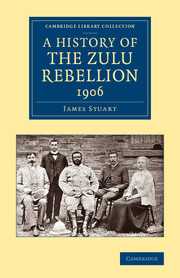
After many years of relatively peaceful coexistence, a dispute over taxation in 1906 stirred thousands of Zulus into bloody revolt against the British in Natal. Following the rebellion's defeat, James Stuart (1868–1942), an expert on Zulu customs and history, was commissioned to write the official history of military operations. It later became a private project of much broader scope. Providing a thoroughly researched account of the rebellion, Stuart wrote using the full breadth of his knowledge of Africa, drawing on the contacts and materials that became available to him during his time as an intelligence officer in the Natal Field Artillery. First published in 1913, the work also covers the administration of the Zulu territories and goes on to investigate the aftermath of the rebellion, including the arrest and imprisonment of the Zulu king, Dinuzulu.
An Irish-born adventurer in Russian service, Peter Dobell (1772–1852) embarked in 1812 on a long journey from Kamchatka across Siberia to Tomsk. This two-volume work, first published in 1830, contains a detailed and idiosyncratic account of his journey, painting an affectionate picture of the region and its people. The narrative includes ethnographic observations, descriptions of nights spent with local families, notes on the wildlife encountered, and discussion of the problems caused by the weather. Dobell also lived in China for many years, and his remarks on the experience are incorporated into the work. He gives opinionated observations on topics such as Chinese society, traditions, trade and medicine. Again, this narrative reflects Dobell's instinctive curiosity and enthusiasm. Volume 2 covers the concluding part of Dobell's Siberian travels, from Yakutsk to Tomsk. It also contains all of the chapters on China.
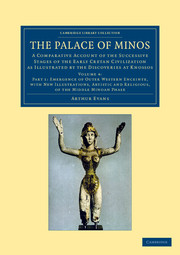
Inspired by Schliemann's discoveries at Mycenae and Troy, Sir Arthur John Evans (1851–1941), keeper of Oxford's Ashmolean Museum from 1884 to 1908, trustee of the British Museum and fellow of the Royal Society, used his inherited wealth to purchase land in Crete at Knossos. From 1900 he commenced excavations there in co-operation with the British School at Athens. Work continued for eight full seasons, uncovering a Bronze Age palace and bringing to light further architectural and artefactual remains of Minoan civilisation, including numerous texts in Linear A and Linear B. Evans' speculative reconstruction of the site in reinforced concrete remains controversial, and some of his interpretations are disputed, but his pioneering work is painstakingly detailed in this highly illustrated multi-volume work, published between 1921 and 1935, with an index volume appearing in 1936. Part 1 of Volume 4 first appeared in 1935.
After the death of the younger Carl Linnaeus in 1783, the entirety of the Linnean collections, including the letters received by the elder Linnaeus from naturalists all over Europe, was purchased by the English botanist James Edward Smith (1759–1828), later co-founder and first president of the Linnean Society of London. In 1821, Smith published this two-volume selection of the letters exchanged by Linnaeus père et fils and many of the leading figures in the study of natural history, revealing some of the close ties of shared knowledge and affection that bound the European scientific community at that time. Where necessary, Smith translates the letters into English, with the exception of those written in French, which are presented in the original. Volume 1 illuminates the epistolary relationships of Linnaeus senior with Peter Collinson, John Ellis and Alexander Garden, providing a very brief biography of each. Garden's letters to Ellis also feature prominently.
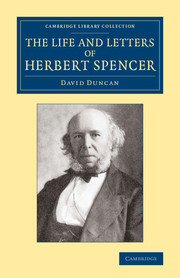
One of the most famous intellectuals of the second half of the nineteenth century, Herbert Spencer (1820–1903) wrote across an impressive range of scientific and philosophical subjects. Although at the time his work was successful and influential, especially in America, it has since been subjected to criticism and reassessment. Principally remembered for his evolutionary theory and for coining the term 'survival of the fittest', Spencer came to be regarded as a Social Darwinist and proponent of unrestricted capitalism. In the field of sociology, he advocated the application of scientific examination to social phenomena, and his individualist philosophy provided inspiration for later libertarian thinkers. Published in 1908 by David Duncan (1839–1923), this substantial biography closely tracks Spencer's developing interests, closing with an assessment of his character and significance. It contains an abundance of extracts from letters to such figures as Charles Darwin, John Stuart Mill and T. H. Huxley.
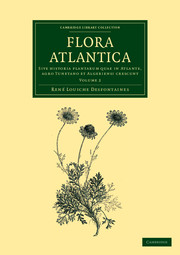
A member, and later president, of the Académie des Sciences, French botanist and doctor René Louiche Desfontaines (1750–1833) spent the years 1783–5 on an expedition to North Africa. During his time in Tunisia and Algeria, he collected over a thousand plant specimens: more than three hundred genera were new to European naturalists at this time. Having succeeded Le Monnier in the chair of botany at the Jardin du Roi in 1786, Desfontaines helped found the Institut de France following the Revolution and published his two-volume Flora atlantica in Latin in 1798–9. A lavishly illustrated second edition appeared in four volumes in 1800. Combining its two volumes of plates into one, this reissue will give modern researchers an insight into the promulgation of pioneering plant science. Volume 2 contains classes 14 to 24 in the Linnaean system of plant taxonomy, from Didynamia to Cryptogamia.
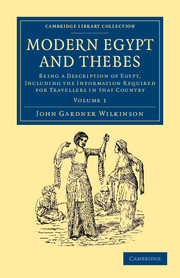
A pioneer of British Egyptology, Sir John Gardner Wilkinson (1797–1875) first travelled to Egypt in 1821, the year before Champollion published his breakthrough work on the Rosetta Stone. As public interest in Egypt grew, Wilkinson studied and sketched the country's major archaeological sites, most notably the tombs of Thebes. His celebrated Topography of Thebes and General View of Egypt (1835) and Manners and Customs of the Ancient Egyptians (1837) are also reissued in this series. A remodelled and enlarged version of the former work, this two-volume guide of 1843 not only gives practical advice for the contemporary traveller, but also provides modern readers with a vivid snapshot of Egypt in the middle of the nineteenth century. Volume 1 includes a host of recommendations, such as which ships to take and which hotels to stay in, as well as a long list of useful items, including fez caps and Turkish slippers.
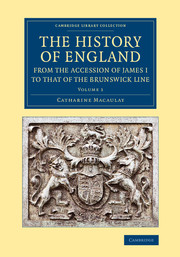
A landmark in female historiography, this work first appeared in eight volumes between 1763 and 1783. Notable for her radical politics and her influence on American revolutionary ideology, Catharine Macaulay (1731–91) drew diligently on untapped seventeenth-century sources to craft her skilful yet inevitably biased narrative. Seen as a Whig response to David Hume's Tory perspective on English history, the early volumes made Macaulay a literary sensation in the 1760s. Later instalments were less rapturously received by those critics who took exception to her republican views. Both the product and a portrait of tumultuous ages, the work maintains throughout a strong focus on the fortunes of political liberty. Volume 1 (1763) begins with the founding of the Stuart dynasty in 1603 and takes the narrative through to the reign of Charles I and the passing of the Petition of Right in 1628.
The Belgian polymath Lambert Adolphe Jacques Quetelet (1796–1874) was regarded by John Maynard Keynes as a 'parent of modern statistical method'. Applying his training in mathematics to the physical and psychological dimensions of individuals, his Treatise on Man (also reissued in this series) identified the 'average man' in statistical terms. Reissued here is the 1839 English translation of his 1828 work, which appeared at a time when the application of probability was moving away from gaming tables towards more useful areas of life. Quetelet believed that probability had more influence on human affairs than had been accepted, and this work marked his move from a focus on mathematics and the natural sciences to the study of statistics and, eventually, the investigation of social phenomena. Written as a summary of lectures given in Brussels, the work was translated from French by the engineer Richard Beamish (1798–1873).
Sir Arthur John Evans (1851–1941), the pioneer of ancient Cretan archaeology, most famously excavated the ruins of Knossos and uncovered the remains of its Bronze Age Minoan civilisation (as detailed in The Palace of Minos at Knossos, also reissued in this series). In this highly illustrated work, first published in 1901, Evans surveys the recent archaeological evidence from his dig at Knossos as well as from other locations around the Mediterranean. He describes a variety of religious objects and symbols, especially those concerned with sacred stones, pillars and trees, which Evans argues are characteristic of religious worship in the Mycenaean period. He considers in particular the importance of the Cretan double-axe symbol, the labrys, its close link with depictions of bulls and its association with the labyrinth of Knossos. Elsewhere he examines the symbolism of the Lion Gate at Mycenae and finds parallels with similar artefacts found in Crete and Egypt.
A member, and later president, of the Académie des Sciences, French botanist and doctor René Louiche Desfontaines (1750–1833) spent the years 1783–5 on an expedition to North Africa. During his time in Tunisia and Algeria, he collected over a thousand plant specimens: more than three hundred genera were new to European naturalists at this time. Having succeeded Le Monnier in the chair of botany at the Jardin du Roi in 1786, Desfontaines helped found the Institut de France following the Revolution and published his two-volume Flora atlantica in Latin in 1798–9. A lavishly illustrated second edition appeared in four volumes in 1800. Combining its two volumes of plates into one, this reissue will give modern researchers an insight into the promulgation of pioneering plant science. Volume 3 brings together all 261 line engravings from the volumes that accompanied the botanical catalogue.
Taking the view that medicine is as much the art of avoiding ill health as it is the cure of disease, physician William Buchan (1729–1805) published this home health guide in 1769. The first part is devoted to preventing ailments through proper diet and exercise, while the second part helps families diagnose and treat maladies ranging from coughs and hiccups to jaundice and gout. Buchan showed particular concern for the health of women and children, whom he believed were often misunderstood and neglected. He condemned corsets and restrictive infant swaddling, discouraged 'high living' and indolence, and blamed the high child-mortality rate on upper-class ignorance of child-rearing wisdom. His book became the most popular health guide prior to the twentieth century, with over a hundred editions by 1871. This reissue is of the first edition. Its diagnoses of physical (and cultural) ailments will illuminate eighteenth-century concerns for modern readers.
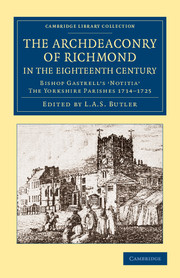
Francis Gastrell (1662–1725) served as Bishop of Chester from 1714 until his death. During this time, he compiled historical notes on his diocese from a range of medieval and contemporary sources. His survey contains detailed information on parishes, including their sizes, populations and economies. The notes also provide invaluable data on administrative matters such as the development of the towns within the diocese, notably including records of acts of charity and records of the grammar schools and their governors, finances and statutes. This 1990 publication, prepared by L. A. S. Butler, is the first printed edition of the notes relating to the Yorkshire parishes that had been transferred within the archdeaconry of Richmond to the bishopric of Chester. With full editorial apparatus, and thorough indexes of persons, clergy and places, this work stands as an important resource for church, social and local historians.
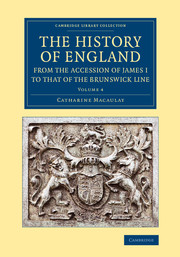
A landmark in female historiography, this work first appeared in eight volumes between 1763 and 1783. Notable for her radical politics and her influence on American revolutionary ideology, Catharine Macaulay (1731–91) drew diligently on untapped seventeenth-century sources to craft her skilful yet inevitably biased narrative. Seen as a Whig response to David Hume's Tory perspective on English history, the early volumes made Macaulay a literary sensation in the 1760s. Later instalments were less rapturously received by those critics who took exception to her republican views. Both the product and a portrait of tumultuous ages, the work maintains throughout a strong focus on the fortunes of political liberty. Volume 4 (1768) follows the course of the English Civil War from the Siege of Gloucester in 1643 through to the trial and execution of Charles I.