A collection of out-of-copyright and rare books from the Cambridge University Library and other world-class institutions that have been digitally scanned, made available online, and reprinted in paperback.
To save content items to your account,
please confirm that you agree to abide by our usage policies.
If this is the first time you use this feature, you will be asked to authorise Cambridge Core to connect with your account.
Find out more about saving content to .
To save content items to your Kindle, first ensure no-reply@cambridge.org
is added to your Approved Personal Document E-mail List under your Personal Document Settings
on the Manage Your Content and Devices page of your Amazon account. Then enter the ‘name’ part
of your Kindle email address below.
Find out more about saving to your Kindle.
Note you can select to save to either the @free.kindle.com or @kindle.com variations.
‘@free.kindle.com’ emails are free but can only be saved to your device when it is connected to wi-fi.
‘@kindle.com’ emails can be delivered even when you are not connected to wi-fi, but note that service fees apply.
Jane Haldimand Marcet (1769–1858) wrote across a range of topics, from natural philosophy to political economy. Her educational books were especially intended for female students, to combat the prevalent idea that science and economics were unsuitable for women, but they found broader popularity: Michael Faraday, as a young bookbinder's apprentice, credited Marcet with introducing him to electrochemistry. This two-volume work, first published in 1829, is a beginner's guide to botany. Since the chief aim was accessibility, Marcet does not dwell on the often burdensome process of plant classification, but focuses on plant forms and botany's practical applications. She presents the facts in the form of simple conversations between two students and their teacher. Based on the lectures of the Swiss botanist Candolle, Volume 2 considers agriculture and plant diseases, the cultivation of trees and culinary vegetables, and the effects of humans on flora.
An Irish-born adventurer in Russian service, Peter Dobell (1772–1852) embarked in 1812 on a long journey from Kamchatka across Siberia to Tomsk. This two-volume work, first published in 1830, contains a detailed and idiosyncratic account of his journey, painting an affectionate picture of the region and its people. The narrative includes ethnographic observations, descriptions of nights spent with local families, notes on the wildlife encountered, and discussion of the problems caused by the weather. Dobell also lived in China for many years, and his remarks on the experience are incorporated into the work. He gives opinionated observations on topics such as Chinese society, traditions, trade and medicine. Again, this narrative reflects Dobell's instinctive curiosity and enthusiasm. Volume 1 covers the first half of the journey, starting in Kamchatka and ending in Yakutsk.
Joseph Mainzer (1801–51), priest, music teacher and composer, had an important influence on the development of the choral movement in the first half of the nineteenth century. Forced to flee his native Germany in 1833 because of his political views, he arrived in London in 1839 via Brussels and Paris, where his singing classes for labourers were immensely successful. Although his musical compositions are largely forgotten, his mission to bring singing to the masses is not: he published a number of works on the subject and established Mainzer's Musical Times, which later became The Musical Times. First published in 1841, this short singing textbook for an English audience is a classic resource in music education, presenting the basics of the fixed sol-fa system together with a generous quantity of musical examples. Mainzer's 1848 work, Music and Education, has also been reissued in this series.
Born into the theatre, though originally intended for Catholic holy orders, John Philip Kemble (1757–1823) made as great a name for himself on the English stage as his gifted older sister, Sarah Siddons. Known for his mastery of tragic Shakespearian roles, among which Coriolanus was deemed his finest, Kemble also distinguished himself as acting manager at Drury Lane under Sheridan. Described by Sir Walter Scott as 'grave, critical, full and laudably accurate', this extensive two-volume biography was the work of James Boaden (1762–1839), an author well acquainted with the foremost theatrical personalities of his day. Boaden's biographies of Sarah Siddons, Elizabeth Inchbald and Dorothy Jordan have also been reissued in this series, along with his edition of David Garrick's correspondence. Volume 1 of the present work covers Kemble's career through to his first season in charge at Drury Lane in 1788–9.
Orphaned by the age of four, George Chaworth Musters (1841–79) joined the Royal Navy at thirteen, served with distinction during the Crimean War, and reached the rank of commander. Having been stationed on the coast of South America, during which time he read up on Darwin's voyage in the Beagle, he pursued in 1869 his aim of travelling through the south of the continent. In this 1871 publication, which earned him the nickname 'the king of Patagonia', Musters records the year he spent among native Patagonians, covering almost 1,400 miles. He gives a detailed account of their customs and daily life, particularly the manners, dress, hunting practices and methods of battle of the Tehuelche people. Featuring a number of vivid engravings, the book did much to reveal this land to Europeans. It remains an instructive text in the history of South American exploration and anthropology.
One of the greatest mathematicians of the nineteenth century, Carl Gustav Jacob Jacobi (1804–51) burst into the limelight with his redevelopment, together with Niels Henrik Abel (1802–29), of the theory of elliptic functions. His pioneering work was characterised by the variety of problems tackled and the power of the tools used to tackle them. His lasting influence on rational mechanics, number theory, partial differential equations, complex variable theory and computation is marked by the number of fundamental concepts that bear his name (the Jacobian, the Jacobi sum and the Jacobi symbol, among others). His collected works, comprising treatises, letters and papers written in German, Latin and French, were published in eight volumes between 1881 and 1891, edited chiefly by Karl Weierstrass (1815–97). Published in 1884, this supplementary volume contains Jacobi's 1842–3 lectures on dynamics as compiled by Alfred Clebsch (1833–72) in the revised second edition by Eduard Lottner (1826–87).
A cavalry officer in the US Army, with training in law and medicine, Frederick Schwatka (1849–92) became interested in the lost expedition of Sir John Franklin following the search attempts led by the American explorer Charles Francis Hall. Supported by the American Geographical Society, Schwatka sailed in 1878 with five others in search of written records, believed to be deposited in cairns. A soldier turned journalist, William Henry Gilder (1838–1900) accompanied Schwatka and published this illustrated account in 1882. Their sledge journey with a party of twelve Inuit was at that time the longest on record. No documents were found, but the expedition did discover artefacts and graves of Franklin's men. Schwatka concluded that no scientific results from Franklin existed. In his adoption of Inuit techniques for safe travel in the Arctic, he preceded Vilhjalmur Stefansson by many decades.
The classical scholar J. P. Mahaffy (1839–1919) is known equally for his work on Greek texts and Egyptian papyri (his edition of The Flinders Petrie Papyri is reissued in the Cambridge Library Collection). He graduated from Trinity College, Dublin and spent the rest of his working life there, as a fellow, and ultimately as provost from 1914 until his death. This work, in which Mahaffy records his impressions of his first visit to Greece, was published in 1876. Though it is not uncritical ('Nothing is more melancholy and more disappointing than the first view of the Athenian museums'), his account of the famous Greek sites of Attica, Thebes, Delphi and the Peloponnese is lively and observant, and his preface strongly argues that Greece, at a time of turmoil in Europe, was deserving of greater support from the western powers. The book will be of interest to scholars and travellers alike.
Officer and author Basil Hall (1788–1844) joined the Royal Navy at the age of thirteen and saw service during the Peninsular War. His subsequent career involved extended journeys to the East Indies, the Far East and South America. During these postings - encompassing elements of exploration, diplomacy and scientific observation - he kept a journal, and from his notes he published successful accounts of his voyages. This two-volume work, first published in 1823 and reissued here in its revised 1824 third edition, recounts his travels and first-hand observations during his final commission to South America and Mexico in command of the Conway. Sensitive to both physical and human geography, Hall's travelogue gives readers a sense of the continent's natural and cultural diversity as well as its contemporary political turbulence. Darwin notably had the book with him aboard the Beagle. In Volume 2, Hall traces his journey from Peru to Ecuador, Panama and Mexico.
Regarded as a founder of modern conservatism, Edmund Burke (1729–97) proved an influential yet controversial writer and politician. Although sympathetic towards American colonists in their grievances against British rule, he was later appalled as the French Revolution unfolded. Published in 1790, when the Revolution was still young, this is Burke's most well-known work and remains a classic of Western political thought and rhetoric. He predicts the excesses that will follow the destruction of the institutions of civil society, and the inevitable rise of a corrupt and violent government rather than a protector of citizens. When she read the famous passage describing her flight from Versailles, Marie Antoinette was apparently moved to tears. Sparking a flurry of responses in defence of the Revolution and its ideals, including Thomas Paine's Rights of Man (also reissued in this series), Burke's polemic remains a crucial text in the history of modern political philosophy.
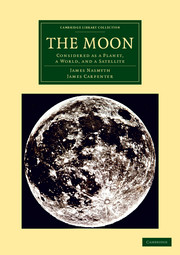
The movement of the moon in space had been well documented by the second half of the nineteenth century. In this monograph, which first appeared in 1874, James Nasmyth (1808–90) and James Carpenter (1840–99) pay closer attention to the lunar surface, notably illustrating their work with photographs of accurate plaster models. At this time, many questions about the moon's properties were still open. Could the moon support life? Did it have an atmosphere? How had its craters been formed? Marshalling the latest available evidence, Nasmyth and Carpenter provide their answers in a text accompanied by explanatory diagrams. Also included are theories on planetary formation, a discussion of lunar volcanism, and a vivid imagining of a day on the moon's surface, describing everything from low lunar gravity to the sudden, monthly sunrise. The work remains an instructive resource, reflecting the state of contemporary astronomical knowledge.
In 1794, Uvedale Price (1747–1829) published his seminal essay on the application of techniques found in landscape painting to the art of landscape gardening. Considered by many to be the successor to Capability Brown, whose approach to landscape design was rejected in no uncertain terms by Price and his followers, Humphry Repton (1752–1818) wrote a letter to Price, with whom he had previously enjoyed good relations, in which he contested certain points in the essay - in particular the necessity of adhering so closely to the principles of landscape painting in the creation of a garden. This reissue is of the 1798 second edition of Price's reply to Repton's criticisms, and forms a supplement to Price's essay of 1794 (also reissued in this series). Repton's original letter is included at the beginning of the text.
Perhaps the first celebrity chef, Alexis Soyer (1810–58) was a flamboyant, larger-than-life character who nonetheless took his profession very seriously. As the chef of the Reform Club, he modernised its kitchens, installing refrigerators and gas cookers. In 1851, during the Great Exhibition, he prepared spectacular (but financially ruinous) culinary extravaganzas at his restaurant, the Gastronomic Symposium of All Nations. In stark contrast, he organised soup kitchens during the Great Famine in Ireland and volunteered his services in the Crimea in 1855 to improve military catering. He was also a prolific inventor of kitchen gadgets, notably promoting the Magic Stove, used for cooking food at the table. First published in 1938, this biography by Helen Soutar Morris (1909–95) is based on François Volant and James Warren's anecdotal account of 1859 (also reissued in this series), and it faithfully conveys the adulation that Soyer engendered in his lifetime.
An author of educational works intended especially for young women, Jane Haldimand Marcet (1769–1858) sought to combat the notion that technical topics were unsuitable for female students. Inspired by conversations with the famous scientists she entertained, she wrote textbooks in the lively form of discussions between a teacher and her two female pupils. Published anonymously at first, they found broad popularity: Michael Faraday, as a young bookbinder's apprentice, credited Marcet with introducing him to electrochemistry. The present work, an introduction to physics, astronomy and the properties of matter, sound and light, was Marcet's first, though it remained unpublished until 1819. Her other works include Conversations on Chemistry (1805), Conversations on Political Economy (1816) and Conversations on Vegetable Physiology (1829), all of which are reissued in this series. Never professing to be original, Marcet's work is noted nonetheless for its thoroughness and clear presentation of concepts.
The American social historian and antiquarian Alice Morse Earle (1851–1911) published this lavishly illustrated book, among the last of her works, in 1902. By this time she had developed a distinctive style of historical writing which made innovative use of material evidence in its focus on the details of everyday life. She was particularly interested in family and society in colonial America, and her views about the importance of ancestry were reflected in her membership of the National Society of the Daughters of the American Revolution. Her fascination for beautiful things found lively expression in this learned and charming exploration of two 'garden delights'. Drawing readily on folklore, literature and anecdote, Earle brings to life her history of sundials and roses in Europe and America, touching on practical, aesthetic and symbolic aspects.
The library of the literary scholar Richard Farmer (1735–97) was first and foremost a working reference collection, the books acquired not as treasures, but to be read and appreciated. Farmer's library included all four Shakespeare folios and was remarkable for its Elizabethan literature and black letter, which provided the source material for his scholarly work. Notable acquaintances such as Samuel Johnson, George Steevens, Edmond Malone and Isaac Reed all benefitted from Farmer's knowledge, and Thomas Percy's Reliques of Ancient English Poetry drew directly on the library itself. In 1798, Farmer's books were sold at an auction attended by many of the next generation's greatest book collectors. Reissued here is a copy of the catalogue featuring handwritten annotations by an anonymous attendee who recorded the prices paid and the names of many buyers, uniquely capturing the dispersal of one of the eighteenth century's great libraries.
The novelist and mystic William Sharp (1855–1905) wrote or edited around fifty books, both in his own name and under the pseudonym of Fiona MacLeod. An introduction to Dante Gabriel Rossetti in 1881 led to his publishing a study of the poet and artist in the following year. Appointed as London art critic of the Glasgow Herald in 1883, he went on to make many more distinguished acquaintances. Originally published in 1892, this work concerns another keeper of illustrious contacts: Joseph Severn (1793–1879), painter and British consul at Rome, who is best remembered for his close friendship with John Keats. As biographer, Sharp utilises Severn's vast though occasionally inconsistent correspondence, tracing his life from his youth, through his years of intimacy with Keats, to his death and eventual burial at the great poet's side.
The radical writer and poet Helen Maria Williams (1759–1827) is best remembered for her eight-volume Letters from France (1790–6), charting the progress of the French Revolution. Having published poetry and a novel, Julia (1790), she travelled to France, where her salon welcomed the likes of Mary Wollstonecraft, Thomas Paine and leading Girondists. Forced to flee the country in 1794, she went into exile in Switzerland for six months, travelling with the printer and political reformer John Hurford Stone (1763–1818). This two-volume account of the journeys she made during her time there, first published in 1798, documents what she sees as the failure of Swiss democracy. Highlighting the shortcomings of the Swiss government and the suffering of much of Swiss society through exploitation, Williams anticipates revolutionary activity in the cantons. In Volume 2, she describes her excursion in the Alps, presenting also observations on Zurich, Fribourg and Berne.
Best remembered for his contribution to the study of Greek music and metre, the German classical philologist Rudolf Westphal (1826─92) had originally studied theology at the University of Marburg before turning his attention to comparative linguistics. He learnt Sanskrit and Arabic and took a keen interest in the Indo-Germanic (Indo-European) languages as well as Semitic grammar. In the late 1850s and early 1860s he joined his friend and fellow classical philologist August Rossbach (1823–98) at the University of Breslau (Wrocław) and later taught at Moscow's Imperial Lyceum. In this work, first published in 1873, Westphal provides the reader with an overview of the Indo-European languages and their sounds. He then gives an extensive account of Indo-European verbs by focusing on the roots derived from Latin and Sanskrit.
Rudolf Westphal (1826─92) originally studied theology at the University of Marburg before turning to classical philology and comparative linguistics. He learnt Sanskrit and Arabic and took a keen interest in Indo-European languages and Semitic grammar. In the late 1850s and early 1860s he joined his friend and fellow philologist August Rossbach (1823–98) at the University of Breslau (Wrocław). This multi-volume work on ancient Greek metre and music resulted from their collaboration. Reissued here is the revised third edition published in four parts between 1885 and 1889. Volume 1 (1885) is given over to Westphal's study of Greek rhythm, noting the contributions made by both ancient and modern thinkers. As in his 1883 Musik des griechischen Alterthumes (also reissued in this series), he pays particular attention to the fourth-century philosopher Aristoxenus, presenting the latter's theories on rhythm.