A collection of out-of-copyright and rare books from the Cambridge University Library and other world-class institutions that have been digitally scanned, made available online, and reprinted in paperback.
To save content items to your account,
please confirm that you agree to abide by our usage policies.
If this is the first time you use this feature, you will be asked to authorise Cambridge Core to connect with your account.
Find out more about saving content to .
To save content items to your Kindle, first ensure no-reply@cambridge.org
is added to your Approved Personal Document E-mail List under your Personal Document Settings
on the Manage Your Content and Devices page of your Amazon account. Then enter the ‘name’ part
of your Kindle email address below.
Find out more about saving to your Kindle.
Note you can select to save to either the @free.kindle.com or @kindle.com variations.
‘@free.kindle.com’ emails are free but can only be saved to your device when it is connected to wi-fi.
‘@kindle.com’ emails can be delivered even when you are not connected to wi-fi, but note that service fees apply.
Published in 1897, this two-volume work by Robert Seymour Conway (1864–1933), classical scholar and comparative philologist, later Hulme Professor of Latin at the University of Manchester, aims to shed light on the origins of the Latin language and Roman institutions by careful examination of the dialects and customs of Rome's neighbours. The second volume provides an outline of the grammar of the Italic dialects, the surviving remains of which were collected in the first volume. There are six dialect alphabets given, followed by a sketch of their accidence and syntax. The first appendix discusses the Oscan measures of the mensa ponderaria at Pompeii; a second gives alien, doubtful or spurious inscriptions. The bulk of the volume consists of indexes of geographical and personal names, a glossary of the dialect words, and an index of Latin words used in the work.
A painstaking compiler of catalogues and indexes, the biblical scholar and bibliographer Thomas Hartwell Horne (1780–1862) first published his most famous work in 1818, having begun his research for it many years earlier in 1801. Reissued here in five parts is the expanded four-volume tenth edition of 1856, which includes revisions by the scholars Samuel Davidson (c.1806–98) and Samuel Prideaux Tregelles (1813–75). A standard text in scriptural teaching for generations of Anglicans, this monumental and influential work of nineteenth-century biblical scholarship remains a valuable resource for modern researchers, reflecting the methods and perspectives of its era. Volume 1 addresses the authenticity and authority of the Old and New Testaments. Horne discusses the role of miracles and prophesy, and argues for the superiority of Christianity over other religions.
The American artist George Catlin (1796–1872) was fascinated by the indigenous people of his homeland and spent many years living among them, painting them, and collecting their artefacts. In 1839 he took his vast collection to Europe to exhibit it, and he also toured with groups of visiting Native Americans. This illustrated two-volume account of his experiences was published in 1848. In Volume 2, Catlin discusses his travels with visiting Native Americans to Dublin, and later Paris, where he staged another exhibition and met King Louis Philippe. The final chapter recounts Catlin's attempt to sell his entire collection to the United States government to preserve 'all the records of this dying race'. His earlier account, Letters and Notes on the Manners, Customs, and Condition of the North American Indians (1841), is also reissued in this series, along with two later books for children about life among various tribes.
An influential German classical scholar and textual critic, Johann Carl Otto Ribbeck (1827–98) published several important works on Roman poetry, notably Geschichte der römischen Dichtung. His two volumes of Virgil's works (second edition, 1894–5) are reissued in this series. First published in 1875, the present work provides a detailed account of the emergence and development of Roman tragedy during the Republic. The book begins with an introduction that discusses how Greek tragedy served as a model for Roman writers. Ribbeck then goes on to outline the most important authors and their works. Among these are Livius Andronicus, celebrated as the father of Latin literature, and Quintus Ennius, regarded as the mediator between Greek and Roman poetry. The final sections of the book deal with the art form of Roman tragedy and its performance on stage.
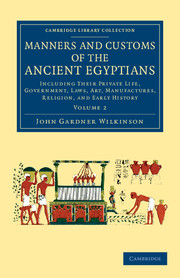
A pioneer of British Egyptology, Sir John Gardner Wilkinson (1797–1875) first travelled to Egypt in 1821, the year before Champollion published his breakthrough work on the Rosetta Stone. As public interest in Egypt grew, Wilkinson studied and sketched the country's major archaeological sites, most notably the tombs of Thebes. His Topography of Thebes and General View of Egypt (1835) and Modern Egypt and Thebes (1843) are also reissued in this series. This well-illustrated three-volume work, first published in 1837, remained for over a century a key text on the lives of ancient Egyptians. Writing in a popular genre that was normally focused on contemporary societies, Wilkinson covers areas ranging from daily life to funerary beliefs. His imaginative approach underpinned the book's considerable success. Volume 2 provides discussion of Egyptian justice, architecture, diet, music, crafts, and the furnishing of homes.
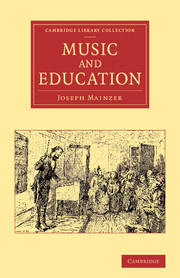
Published in 1848, this short work by Joseph Mainzer (1801–51) argues for the considerable value of music as part of general education. A German priest, teacher and composer, Mainzer had an important influence on the development of amateur music and the choral movement in the first half of the nineteenth century. Attracting large numbers of adult labourers, he gave free singing classes, using his own highly influential teaching system. Music, Mainzer argues here, not only brings direct moral and social benefits, but also takes the place of potentially harmful habits and leisure activities, such as the drinking of alcohol. The work defines music in relation to its educational value and potential, exploring the origins, development and moral influence of music since the ancient Greeks. Mainzer also discusses the ways in which music is taught at all levels.
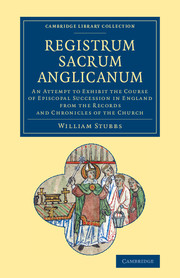
This 1858 work was the first major publication of William Stubbs (1825–1901), who later became bishop of both Chester and Oxford. Stubbs also published highly respected and influential works on the constitutional history of England and was considered an authority on ecclesiastical history. The present work consists of a thorough chronology of the succession of the bishops of England, beginning with the consecration of Augustine of Canterbury in 597 and continuing up to 1857. Each bishop's entry includes their see, their consecrators and the sources from which this information was drawn. Wherever possible, Stubbs endeavoured to consult the original sources, and as such he was able to present more accurate dates of consecration than were previously available. The appendices include a well-annotated list of suffragan, Manx and Welsh bishops, as well as an index of each bishop, ordered by see.
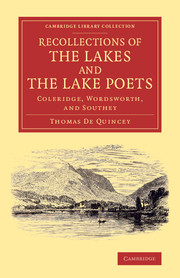
Thomas De Quincey (1785–1859) described his adolescent discovery of the Lyrical Ballads of Wordsworth and Coleridge as 'an absolute revelation of untrodden worlds, teeming with power and beauty'. The admiring letter he sent to Wordsworth led to friendships with him, Coleridge and Robert Southey. Relations soured over time, though, as De Quincey's opium addiction and debts increased. Following Coleridge's death in 1834, De Quincey began writing his 'Lake Reminiscences', published serially in Tait's Magazine up to 1840. Candid, occasionally bitter, and highlighting flaws such as Coleridge's plagiarism, the recollections offended the surviving poets and their families, yet these vivid portraits attract continued scholarly interest for both the light shed on the subjects and on the author himself. The collected essays, reissued in this 1863 printing of the 1862 first edition, certainly served to confirm the Lake Poets as leading figures of English Romanticism.
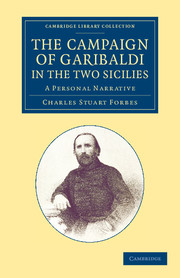
A lieutenant in the Royal Navy who served in South America, the Crimea and China, Charles Stuart Forbes (1829–76) was one of the many Englishmen who volunteered to support Giuseppe Garibaldi during the Risorgimento. Garibaldi (1807–82) was an immensely popular figure in England, often being identified with English heroes of the past. Streets, food and clothing were named in his honour, while Queen Victoria commented that he was 'honest, disinterested and brave'. Published in 1861, Forbes' work tells, mostly through letters, of the progress of the last territorial conquest before the creation of the Kingdom of Italy. From Forbes we learn something of the messianic character attributed to Garibaldi: 'I have many times been told, in all sincerity by the peasants, that he is the brother of the Redeemer.' This remains a valuable first-hand account of some of the most important events in the founding of modern Italy.
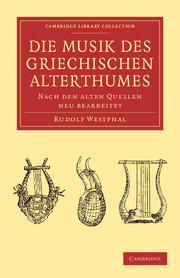
The German classical philologist Rudolf Westphal (1826─92) had originally studied theology at the University of Marburg before turning his attention to comparative linguistics. He learnt Sanskrit and Arabic and took a keen interest in Indo-European languages and Semitic grammar. In the late 1850s and early 1860s he joined his friend and fellow philologist August Rossbach (1823–98) at the University of Breslau (Wrocław) and later taught at Moscow's Imperial Lyceum. In this 1883 work, he gives an extensive account of melody and rhythm in ancient Greek music. Westphal is full of admiration for the philosopher Aristoxenus (born c.370 BCE), whom he hails as 'the founder of musicology'. Following Aristoxenus' distinction between melody (quality of tone) and rhythm (quantity of tone), Westphal divides his work into two parts that describe and exemplify these components in detail. His multi-volume Theorie der musischen Künste der Hellenen is also reissued in this series.
One of the great algebraists of the nineteenth century, Marie Ennemond Camille Jordan (1838–1922) became known for his work on matrices, Galois theory and group theory. However, his most profound effect on how we see mathematics came through his Cours d'analyse, which appeared in three editions. Reissued here is the first edition, which was published in three volumes between 1882 and 1887. While highly influential in its time, it now appears to us a transitional work between the partially rigorous 'epsilon delta' calculus of Cauchy and his successors, and the new 'real number' analysis of Weierstrass and Cantor. The first two volumes follow the old tradition while the third volume incorporates a substantial amount of the new analysis. Ten years later, the even more influential second edition followed the new point of view from its start. Volume 2 (1883) covers the theory of integrals.
One of the most celebrated and prolific authors of the Victorian era, Anthony Trollope (1815–82) requested that his autobiography be published posthumously. The two-volume work, first published in 1883 and reissued here in the second edition of that year, recounts his childhood, successful career at the Post Office, and multiple achievements as a writer. Well received by the critics of the time, the work reveals the incredible discipline that enabled Trollope to write forty-seven novels in the course of his career. Of particular interest to literary scholars, the reflections on his early life show how his unhappy childhood and his father's financial problems influenced his fiction. Volume 1 covers Trollope's education and early Post Office career, before discussing his first authorial efforts. Two of Trollope's non-fiction works, North America (1862) and Australia and New Zealand (1873), have also been reissued in the Cambridge Library Collection.
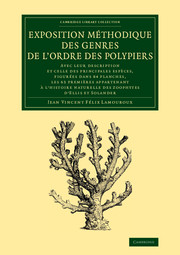
Avec leur description et celle des principales espèces, figurées dans 84 planches, les 63 premières appartenant à l'histoire naturelle des zoophytes d'Ellis et Solander
A professor of natural history at Caen and a member of the Académie des Sciences, Jean Vincent Félix Lamouroux (1779–1825) made significant contributions to the field of marine biology. Following the appearance in 1816 of his Histoire des polypiers corralligènes flexibles, he published in 1821 the present work, drawing upon John Ellis and Daniel Solander's seminal Natural History of Many Curious and Uncommon Zoophytes (1786). It divides more than 130 genera known at the time into twenty groupings. Taxonomy has progressed considerably since Lamouroux's day, yet this work, complete with eighty-four exquisitely drawn plates, serves to illuminate the contemporary understanding and classification of some remarkable marine organisms, principally those which take the form of polyps, such as corals. Moreover, a copy of this work is known to have been consulted by Charles Darwin aboard the Beagle on his famous voyage of discovery the following decade.
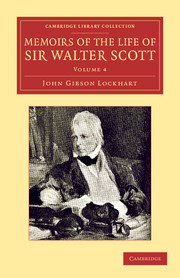
As son-in-law and literary executor to Sir Walter Scott (1771–1832), John Gibson Lockhart (1794–1854) was uniquely placed to produce a definitive biography of the great poet and novelist. First published in 1837–8, shortly after Scott's death, this celebrated seven-volume work is based on personal memories, correspondence, and Scott's own autobiographical sketches. Wide-ranging in his purview, Lockhart is also detailed in his descriptions: the Aberdeen Journal of the day observed that the volumes trace Scott's life and literary efforts with 'the most minute distinctness'. Volume 4 leads readers through the productive years of 1816–20, covering the publication of the first Tales of My Landlord (1816), The Heart of Midlothian (1818), and the preparation of the manuscript of Ivanhoe (1820). Using Scott's private correspondence, Lockhart reveals much about the writer's agreements and disputes with distinguished men of politics and letters.
Officer and author Basil Hall (1788–1844) joined the Royal Navy at the age of thirteen and saw service during the Peninsular War. His subsequent career involved extended journeys to the East Indies, the Far East and South America. During these postings - encompassing elements of exploration, diplomacy and scientific observation - he kept a journal, and from his notes he published successful accounts of his voyages. This two-volume work, first published in 1823 and reissued here in its revised 1824 third edition, recounts his travels and first-hand observations during his final commission to South America and Mexico in command of the Conway. Sensitive to both physical and human geography, Hall's travelogue gives readers a sense of the continent's natural and cultural diversity as well as its contemporary political turbulence. Darwin notably had the book with him aboard the Beagle. Volume 1 covers Hall's travels along the coasts of Chile and Peru.
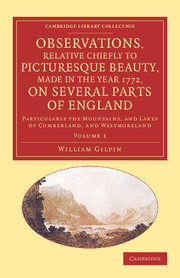
Clergyman, schoolmaster and writer on aesthetics, William Gilpin (1724–1804) is best known for his works on the picturesque. In his Essay on Prints, published in 1768 and reissued in this series, he defined picturesque as 'a term expressive of that peculiar kind of beauty, which is agreeable in a picture'. First published in 1786, this two-volume work formed part of a successful series which recorded his reflections on the picturesque across British landscapes. It traces the journey he made in 1772, equipped with notebook and sketching materials, in the Lake District. Describing his route from southern England, noting highlights along the way, Volume 1 includes discussion of Furness, Windermere and Keswick. The volume also features several reproductions of Gilpin's pen-and-wash drawings. Further exploring the concept of the picturesque, his volumes of Observations on other parts of Britain are also reissued in the Cambridge Library Collection.
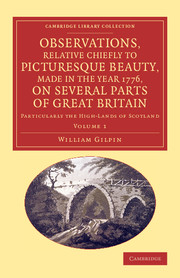
Clergyman, schoolmaster and writer on aesthetics, William Gilpin (1724–1804) is best known for his works on the picturesque. In his Essay on Prints, published in 1768 and reissued in this series, he defined picturesque as 'a term expressive of that peculiar kind of beauty, which is agreeable in a picture'. First published in 1789, this two-volume work forms part of a series which records his reflections on the picturesque across British landscapes. It traces the journey he made in 1776, equipped with notebook and sketching materials, exploring the landscape of the Scottish Highlands via northern England, Edinburgh and Glasgow. Reproductions of his pen-and-wash drawings are included. The companion volumes of Gilpin's Observations on other parts of Britain are also reissued in the Cambridge Library Collection. Volume 1 of the present work takes in such notable sites as Holyrood Palace, Stirling Castle, the Grampian Mountains and Glencoe.
A physician and medical reformer enthused by the scientific and cultural progress of the Enlightenment as it took hold in Britain, Thomas Percival (1740–1804) wrote on many topics, including public health and demography. His influential publication on medical ethics is considered the first modern formulation. In 1807, his son Edward published this four-volume collection of his father's diverse work. Some of the items here had never been published before, including a selection of Percival's private correspondence and a biographical account written by Edward. Volume 3 contains the first two parts of Essays Medical and Experimental, the revised edition of which has been reissued separately in this series in one volume in addition to his Medical Ethics (1803). The essays reflect Percival's wide range of interests, such as the application of philosophical methods to medical questions, the importance of accurate record keeping, and the risks of inoculating very young children against smallpox.
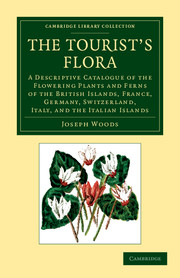
By the middle of the nineteenth century, botany was a popular amateur pursuit as well as a rapidly developing science. First published in 1850, this catalogue covers the flora of Britain, France, Germany, Switzerland and Italy - the most popular tourist destinations of the period. It was compiled over several years by Joseph Woods (1776–1864), who was an architect by profession but also an avid botanist and contributor to the Transactions of the Linnean Society. Taking care to clearly define his terms in the still-developing botanical lexicon, Woods includes hundreds of entries and technical descriptions. A testament to the contemporary market for scholarly amateur guides, this rigorous publication is the product of the author's lifelong interest and a retirement devoted to painstaking study. It remains an instructive resource for those interested in the history and dissemination of plant science.
Among the leading Egyptologists of his day, Sir William Matthew Flinders Petrie (1853–1942) excavated over fifty sites and trained a generation of archaeologists. Pioneering in his rigorous recording of evidence, Petrie wrote prolifically throughout his long career and is credited with bringing his subject to a wider audience. A great many of his other publications are also reissued in this series. First published in 1892 and intended for non-specialists, this highly readable book summarises Petrie's recent work in Egypt, including his surveying of the pyramids of Giza and his discovery of the city of Naukratis in the Nile Delta. Illustrated throughout with detailed line drawings, this work sheds much light on Petrie's influential approach as well as the technological and artistic achievements of ancient Egyptian civilisation. It will appeal to those who wish to learn about the birth of modern Egyptology and the methods of its founding father.