A collection of out-of-copyright and rare books from the Cambridge University Library and other world-class institutions that have been digitally scanned, made available online, and reprinted in paperback.
To save content items to your account,
please confirm that you agree to abide by our usage policies.
If this is the first time you use this feature, you will be asked to authorise Cambridge Core to connect with your account.
Find out more about saving content to .
To save content items to your Kindle, first ensure no-reply@cambridge.org
is added to your Approved Personal Document E-mail List under your Personal Document Settings
on the Manage Your Content and Devices page of your Amazon account. Then enter the ‘name’ part
of your Kindle email address below.
Find out more about saving to your Kindle.
Note you can select to save to either the @free.kindle.com or @kindle.com variations.
‘@free.kindle.com’ emails are free but can only be saved to your device when it is connected to wi-fi.
‘@kindle.com’ emails can be delivered even when you are not connected to wi-fi, but note that service fees apply.
Published in 1879, this Latin dissertation was the first substantial work on Archimedes by the Danish philologist and historian Johan Ludvig Heiberg (1854–1928), who the following year embarked on editing the three-volume Archimedis Opera Omnia (also reissued in this series). Much later, in 1906, he discovered a palimpsest containing previously unknown works by the Greek mathematician. The Quaestiones includes chapters on the life of the famous scientist of Syracuse, a discussion of his works and explanations of his mathematical and scientific ideas, as well as a survey of the extant codices known to the author. It also contains the Greek text, edited and annotated by Heiberg, of Archimedes' Psammites (The Sand Reckoner), a mathematical enquiry into how many grains of sand would fit in the universe. This includes mention of a heliocentric solar system, speculation about the size of the Earth, and Archimedes' other views on astronomy.
Among the ablest anatomical teachers of his day, Robert Knox (1791–1862) also busied himself with the study of zoology and ethnology. Prepared by his pupil and colleague Henry Lonsdale (1816–76), this 1870 biography explores the scope of Knox's scientific research and the nature of his character. It describes how Knox developed at Edinburgh one of the most significant anatomical schools in Britain, playing a dominant role in expanding the comparative anatomy collection held by the city's Royal College of Surgeons. Despite his eminence and popularity as a lecturer, his reputation was deeply tarnished by his association with the notorious murderers Hare and Burke, who had provided Knox with bodies for dissection. Drawing on surviving correspondence and information gathered from friends and colleagues, Lonsdale's work stands as a robust defence and sympathetic portrait of a prominent yet controversial figure in the history of nineteenth-century medicine.
One of the greatest mathematicians of the nineteenth century, Carl Gustav Jacob Jacobi (1804–51) burst into the limelight with his redevelopment, together with Niels Henrik Abel (1802–29), of the theory of elliptic functions. His pioneering work was characterised by the variety of problems tackled and the power of the tools used to tackle them. His lasting influence on rational mechanics, number theory, partial differential equations, complex variable theory and computation is marked by the number of fundamental concepts that bear his name (the Jacobian, the Jacobi sum and the Jacobi symbol, among others). His collected works, comprising treatises, letters and papers written in German, Latin and French, were published in eight volumes between 1881 and 1891. Edited by fellow German mathematician Carl Wilhelm Borchardt (1817–80), Volume 1 appeared in 1881.
One of the most celebrated and prolific authors of the Victorian era, Anthony Trollope (1815–82) requested that his autobiography be published posthumously. The two-volume work, first published in 1883 and reissued here in the second edition of that year, recounts his childhood, successful career at the Post Office, and multiple achievements as a writer. Well received by the critics of the time, the work reveals the incredible discipline that enabled Trollope to write forty-seven novels in the course of his career. Of particular interest to literary scholars, the reflections on his early life show how his unhappy childhood and his father's financial problems influenced his fiction. Volume 2 goes into greater detail on Trollope's writing technique, and includes his thoughts on fellow writers and literary criticism. Two of Trollope's non-fiction works, North America (1862) and Australia and New Zealand (1873), have also been reissued in the Cambridge Library Collection.
First published in 1749 and reissued here in its 1765 printing, this novel by Sarah Fielding (1710–68) attempts to encourage young women to lives of virtue and benevolence through the story of nine girls living with their governess, Mrs Teachum, in a school in the north of England. The girls, aged between eleven and fourteen years old, learn the feminine graces and manners from various lessons and field trips organised by their teacher, as well as through the tales they tell each other. Skilled in conveying moral messages in this educational context, Fielding, whose brother was the novelist Henry Fielding, had also published anonymously The Adventures of David Simple (1744). The present work is particularly notable for being the first novel written in English expressly for children. An important text in eighteenth-century literature, it will appeal especially to readers interested in the history of women's education.
George Hogarth (1783–1870), music critic and journalist, is also remembered as a friend of Sir Walter Scott and the father-in-law of Charles Dickens. His lengthy writing career included posts as music critic with The Harmonicon, the Morning Chronicle (where he first met Dickens), the Evening Chronicle (which he co-edited), and the Daily News. He also served as music critic for The Illustrated London News and was secretary to the Philharmonic Society between 1850 and 1864. His account of the first fifty years of the Society has also been reissued in this series. The present work, first published in 1835, is his lively history of music from ancient to modern times, aimed squarely at the general reader. It is couched in 'simple and perspicuous language, avoiding technical phraseology and abstruse discussions'. The final chapter presents an invaluable first-hand account of contemporary music and musical life in England.
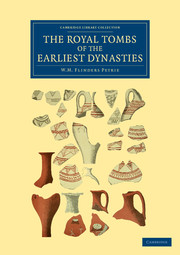
A pioneering Egyptologist, Sir William Matthew Flinders Petrie (1853–1942) excavated over fifty sites and trained a generation of archaeologists. His meticulous recording of artefacts and his sequence dating of pottery types found in Egypt and Palestine made Near Eastern archaeology a more rigorous and scientific discipline. This fully illustrated follow-up report of 1901 on the royal tombs at Abydos, capital of Upper Egypt, covers the early dynastic period (c.3100–c.2700 BCE). Petrie gives detailed descriptions of eight tombs and the associated finds. A chapter on the inscriptions is provided by Francis Llewellyn Griffith (1862–1934). Petrie wrote prolifically throughout his long career for both specialists and non-specialists. His preliminary report, The Royal Tombs of the First Dynasty (1900), and the three-part Abydos (1902–4) are among those works also reissued in this series.
In the early nineteenth century, live plant cuttings were commonly transported between continents in wooden boxes exposed to the elements on the decks of ships; unsurprisingly, it was rare for them to arrive in good health. The glass cases devised by Nathaniel Bagshaw Ward (1791–1868) were a revolutionary step forward in preserving botanical specimens. In this monograph, first published in 1842, Ward explores some of the most common causes of plant deaths in cities and aboard ships, including air quality and temperature. Most importantly, he emphasises the need for light. Although photosynthesis would not be chemically understood until later that century, Ward recognised that a glass case was infinitely preferable to an opaque one. His rapidly adopted invention would have far-reaching effects, allowing for the safe transportation of tea from China to the Himalayas, rubber from the Amazon and medicinal species from the Andes to India.
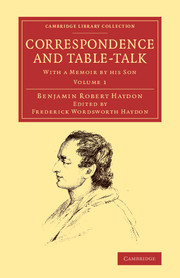
Artist, diarist, and devotee of the Elgin Marbles, Benjamin Robert Haydon (1786–1846) is best known for his large-scale paintings, such as Christ's Entry into Jerusalem and The Raising of Lazarus. After he entered the Royal Academy in 1805 as a student of Henry Fuseli, his forthright views and combative manner fuelled a feud with the institution and perceived enemies. His unshakeable belief in his own genius and his unwillingness to compromise his artistic standards drew him ever further into debt, which ultimately contributed to his suicide. As a writer, Haydon's acute eye for the humorous is demonstrated throughout his correspondence and diary. In this two-volume work, first published in 1876, his son Frederick Wordsworth Haydon (1827–86) brings together letters and extracts from his father's journals. Volume 1 opens with Frederick's biography of his father, followed by general correspondence to and from many eminent figures of the age.
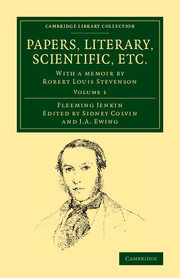
An electrical engineer, university teacher and wide-ranging writer, Fleeming Jenkin (1833–85) filed thirty-five British patents in the course of his career. Edited by Sidney Colvin (1845–1927) and J. A. Ewing (1855–1935) and first published in 1887, this two-volume work brings together a selection of Jenkin's varied and engaging papers. The collection ranges from notes on his voyages as a marine telegraph engineer, to a critical review of Darwin's On the Origin of Species, essays on literature, and thoughts on technical education. A memoir written by Robert Louis Stevenson, his former student, provides biographical context and attests to Jenkin's many interests and talents across the arts and sciences. Volume 1 begins with Stevenson's memoir, incorporating Jenkin's records of his voyages. This is followed by writings on literature and drama. Three pieces on scientific subjects, including the review of Darwin, conclude the volume.
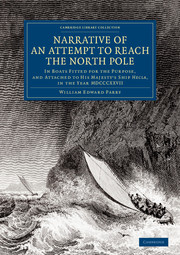
One of the leading Arctic navigators of his age, William Edward Parry (1790–1855) led three expeditions in search of the North-West Passage (accounts of which are also reissued in this series). Parry's early career had been spent protecting the whaling fleet of Spitsbergen and this experience led him in 1826 to propose to the Admiralty an expedition to the North Pole. In order to reach further north than earlier attempts, Parry used sledge-boats that could be towed over the ice on runners, and then take to any open sea that the crew encountered. In 1827 the expedition attained a record latitude that stood for nearly fifty years. This illustrated account, published in 1828, was described by the Quarterly Review as a record of 'the patient, persevering, energetic, and undaunted conduct which British seamen are capable of displaying, in the most difficult, discouraging, and dangerous circumstances'.
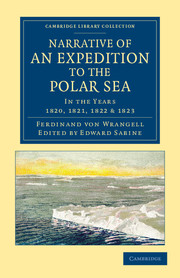
The explorer, soldier and geophysicist Sir Edward Sabine (1788–1883) served as astronomer on John Ross's 1818 expedition in search of the North-West Passage. His return to the Arctic, under William Parry in 1819–20, compounded a keen interest in geomagnetism and his publications earned him the Copley Medal of the Royal Society (whose presidency he would later hold). His experience and expertise made him a natural editor, therefore, of this Arctic narrative, translated into English from German by his wife, Elizabeth Juliana Leeves (1807–79), and published in 1840. It is the account by Ferdinand von Wrangell (1797–1870), a Russian explorer of Baltic German ancestry, regarding his expedition to survey Siberia's north-eastern coastline. Compiled from the notes of the scientists on board, this work offers a valuable and wide-ranging insight into an inaccessible and little-known portion of the globe.
A Scottish doctor and botanist, George Watt (1851–1930) had studied the flora of India for more than a decade before he took on the task of compiling this monumental work. Assisted by numerous contributors, he set about organising vast amounts of information on India's commercial plants and produce, including scientific and vernacular names, properties, domestic and medical uses, trade statistics, and published sources. Watt hoped that the dictionary, 'though not a strictly scientific publication', would be found 'sufficiently accurate in its scientific details for all practical and commercial purposes'. First published in six volumes between 1889 and 1893, with an index volume completed in 1896, the whole work is now reissued in nine separate parts. Volume 4 (1890) contains entries from Gossypium (the cotton genus) to Linociera intermedia (a species of small tree, used for timber).
The orphaned son of an Anglican clergyman, David Hartley (1705–57) was originally destined for holy orders. Declining to subscribe to the Thirty-Nine Articles, he turned to medicine and science yet remained a religious believer. This, his most significant work, provides a rigorous analysis of human nature, blending philosophy, psychology and theology. First published in two volumes in 1749, Observations on Man is notable for being based on the doctrine of the association of ideas. It greatly influenced scientists, theologians, social reformers and poets: Samuel Taylor Coleridge, who named his eldest son after Hartley, had his portrait painted while holding a copy. Volume 2 is particularly concerned with human morality and the duty and expectations of mankind. Here the author is keen to show that scientific observation is not necessarily in conflict with religious conviction.
A landmark in female historiography, this work first appeared in eight volumes between 1763 and 1783. Notable for her radical politics and her influence on American revolutionary ideology, Catharine Macaulay (1731–91) drew diligently on untapped seventeenth-century sources to craft her skilful yet inevitably biased narrative. Seen as a Whig response to David Hume's Tory perspective on English history, the early volumes made Macaulay a literary sensation in the 1760s. Later instalments were less rapturously received by those critics who took exception to her republican views. Both the product and a portrait of tumultuous ages, the work maintains throughout a strong focus on the fortunes of political liberty. Volume 5 (1771) covers the momentous period following the execution of Charles I in 1649 through to the restoration of the monarchy in 1660.
Abandoning a military career, Richard Beamish (1798–1873) decided to become a civil engineer. His suitability as a biographer of Sir Marc Isambard Brunel (1769–1849) stems from the period he spent working closely with the Brunels on the Thames Tunnel. Published in 1862, this memoir recounts the elder Brunel's eventful life and work, including his youth in France, his flight to America in the aftermath of the French Revolution, his lesser-known ventures in the early nineteenth century, and the tunnelling project which would consume much of the second half of his life. An informed portrait of a figure who has since been outshone by his more famous son, this book includes first-hand accounts of the ill-fated early attempt to build the Thames Tunnel, which was abandoned in 1828 due to flooding and lack of funds, and of Brunel's vindication upon its eventual completion in 1843.
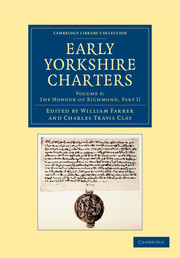
This thirteen-volume series, which first appeared between 1914 and 1965, is an extensive collection of the pre-thirteenth-century charters and related records of Yorkshire, which had previously remained largely unpublished. The first three volumes were edited by William Farrer (1861–1924), after whose death Charles Travis Clay (1885–1978) took up the task. The series was well respected for the quality of Farrer's editing, which was surpassed only by that of Clay in the later volumes. Volume 5 (1936) is the second of two devoted to the honour of Richmond. This volume is given over to charters relating to the fees of the tenants. Each Latin document is amply annotated in English and accompanied by a discussion of its content and points of interest. The volume also contains facsimile plates of select documents as well as detailed indexes.
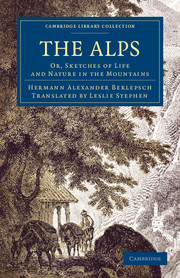
Following the precedent and standards set by the Baedeker guides, travel literature enjoyed great popularity during the later nineteenth century. This guidebook to the Alps, written by Hermann Alexander Berlepsch (1814?–83) and translated from German by the renowned author and mountaineer Leslie Stephen (1832–1904), was first published in English in 1861. This was during the golden age of alpinism, when many major peaks were ascended for the first time. While later mountaineers concentrated on climbing as a sport, earlier expeditions were of a more scientific nature; this guidebook, which provides detailed information pertaining to the geology, flora and fauna of the Alps, is a reflection of this ambition. Also containing descriptions of village life and Alpine customs, it enjoyed a significant readership in its day and was also translated into French. It remains an instructive work in the history of alpinism and travel writing.
In the middle of the nineteenth century, British Arctic exploration became defined by the search for the missing expedition of Sir John Franklin, who had in fact perished in desperate circumstances in 1847. As a newly qualified naval officer, William Hulme Hooper (1827–54) took part in one of the many expeditions which sought to find Franklin. Embarking in 1848, the crew of HMS Plover spent three winters in the Arctic, with tragic consequences for Hooper's health. On his return, perhaps realising time was short, he wrote this illustrated account of his travels, and saw it published the year before he died at the age of only twenty-seven. The work is of particular interest because of its detailed descriptions of the Bering Sea region, Alaska and the Canadian Arctic. Especially noteworthy are the observations on the way of life of the indigenous Chukchi people, whom Hooper called 'Tuski'.
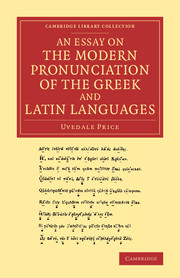
Sir Uvedale Price (1747–1829) most notably concerned himself with questions of the preservation of natural beauty and harmony in landscape gardening. His Essay on the Picturesque (1794) and Letter to H. Repton (second edition, 1798) are also reissued in this series. He took on a completely different subject in the present work, published in 1827. Arguing that modern mispronunciation of ancient Greek and Latin damages 'quantity, metre, rhythm, variety, connexion, euphony, articulation and expression', Price proposes a complete reform. Stresses in particular should be applied along the lines followed by the ancients themselves, thereby preserving the appropriate emphases. He recommends that the young be given proper instruction to correct mistakes and to restore texts to their full effect. Praised by Wordsworth as 'most ingenious', this work will be of value to scholars with an interest in classical phonetics.