A collection of out-of-copyright and rare books from the Cambridge University Library and other world-class institutions that have been digitally scanned, made available online, and reprinted in paperback.
To save content items to your account,
please confirm that you agree to abide by our usage policies.
If this is the first time you use this feature, you will be asked to authorise Cambridge Core to connect with your account.
Find out more about saving content to .
To save content items to your Kindle, first ensure no-reply@cambridge.org
is added to your Approved Personal Document E-mail List under your Personal Document Settings
on the Manage Your Content and Devices page of your Amazon account. Then enter the ‘name’ part
of your Kindle email address below.
Find out more about saving to your Kindle.
Note you can select to save to either the @free.kindle.com or @kindle.com variations.
‘@free.kindle.com’ emails are free but can only be saved to your device when it is connected to wi-fi.
‘@kindle.com’ emails can be delivered even when you are not connected to wi-fi, but note that service fees apply.
Although astronomical guides were available in the early nineteenth century, they tended to come from continental presses and were rarely in English. This two-volume work by the clergyman and astronomer William Pearson (1767–1847) aimed, with brilliant success, to compile data from extant sources into one of the first English practical guides to astronomy. Most of the tables were updated and improved versions, and some were wholly reconstructed to streamline the calculation processes. Sir John Herschel dubbed it 'one of the most important and extensive works on that subject which has ever issued from the press', and for his efforts Pearson was awarded the gold medal of the Astronomical Society. First published in 1824, Volume 1 chiefly comprises extensive tables to facilitate the reduction of a range of astronomical observations, including solar and sidereal movements, alongside thorough instructions. In the history of science, Pearson's work reflects the contemporary challenges of celestial study.
At the close of the Napoleonic Wars, Malta officially became part of the British Empire in 1814. As the British presence there increased, so too did public interest in the island's history, particularly the military religious order of the Knights Hospitaller. In 1858, the army officer Whitworth Porter (1827–92) published this two-volume work, tracing the fortunes of the order since its establishment following the First Crusade. Incorporating details of the knights' social habits and customs into his narrative, Porter also provides supplementary material such as royal and papal documents in translation. Volume 2 opens in 1522 with the surrender of Rhodes, followed by the order's eventual relocation to Malta, which the Ottomans besieged without success in 1565. The coverage extends to the blockade of Valletta, then under French control, at the end of the eighteenth century.
Published in 1880–1, this three-volume edition of the extant works of the Greek mathematician Archimedes of Syracuse (c.287–c.212 BCE) was edited by the Danish philologist and historian Johan Ludvig Heiberg (1854–1928), whose Quaestiones Archimedeae (1879) is also reissued in this series. He later discovered a medieval palimpsest containing lost works by Archimedes, which significantly expanded the canon, but the present collection was produced long before this and therefore contains the works known at the time of publication. Heiberg consulted a Florentine codex, which he painstakingly compared with other sources to produce his edition. This third volume contains the editor's Latin prolegomena - his own extended essay on the works of Archimedes - followed by the commentaries on Archimedes by Eutocius of Ascalon (c.480–c.540) and indexes. The texts are given in the original Greek with parallel Latin translation, notes and introductory material.
First published in 1855 and reissued here in the second edition of that year, this two-volume work celebrates the life of the author, wit and clergyman Sydney Smith (1771–1845). A founder of the second Edinburgh Review, Smith is best remembered for his entertaining observations and witticisms. The work comprises a memoir, written by Smith's daughter Saba Holland (1802–66), and a selection of letters, edited by Sarah Austin (1793–1867). Together, the volumes offer private insights into a man who lived much of his life in the public eye. Volume 2 includes Smith's letters to his friends and contemporaries. Forward-thinking on issues such as women's rights and child labour, he shows himself in these letters to be a wit, critic and 'champion of truth and freedom'.
The Caxton Celebration of 1877 commemorated the 400th anniversary of William Caxton's production of the first book printed in England. It centred on an exhibition in the South Kensington Museum (later the Victoria and Albert Museum) of Caxton's and other incunabula, together with significant artefacts in the later history of typography, printing and binding. The organisation of the celebration involved many of the great and good of Britain, Europe and the United States, from librarians and bibliographers to writers, musicians and statesmen. A leading light was William Blades (1824–90), whose two-volume biography of Caxton is also reissued in this series, and this catalogue was compiled by the librarian George Bullen (1816?–94). It is arranged in sections, from the start of printing in Britain to the most recent technological innovations, including stereotyping, electrotyping and photography, and provides a fascinating survey of the development of the art of printing.
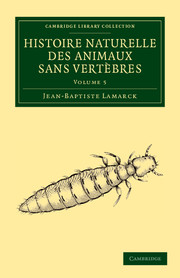
Best known for his ideas relating to evolution, French naturalist Jean-Baptiste Lamarck (1744–1829) first built his reputation as a botanist and was elected to the prestigious Académie des Sciences in 1779. His career took a new turn in 1793 when he was made professor of 'insects, worms and microscopic animals' at the Muséum National d'Histoire Naturelle, although he lacked prior knowledge of the subject area. Undaunted, Lamarck set out to classify organisms which few naturalists had considered worthy of study since Linnaeus. He was the first to distinguish vertebrates from 'invertebrates' - a term he coined - by the presence of a vertebral column. In this groundbreaking seven-volume work, published between 1815 and 1822, he arranges invertebrates into twelve classes, laying the foundations for the modern study of these organisms. Volume 5, first published in 1818, covers arachnids, crustaceans, annelids, cirripedes and conchifera.
Best known for his 1906 discovery of lost texts in the Archimedes Palimpsest, Danish scholar Johan Ludvig Heiberg (1854–1928), professor of classical philology at Copenhagen, published numerous editions of ancient mathematicians, including Archimedes and Apollonius of Perga (also reissued in this series). Between 1898 and 1907, he published in three parts the extant astronomical works of Ptolemy, active in second-century Alexandria. The Ptolemaic system, his geocentric model of the universe, prevailed in the Islamic world and in medieval Europe until the time of Copernicus. This first part of Volume 1, published in 1898, contains a brief Latin preface and the Greek text of Books 1-6 of Ptolemy's major astronomical treatise, known as the Almagest. It demonstrates how to use astronomical observations to construct cosmological models and includes tables that make it possible for celestial phenomena to be calculated for arbitrary dates.
Famed for his exploration of the Pacific and Australasia, James Cook (1728–79) was also an excellent surveyor and a meticulous keeper of records. The journal entries presented here cover Cook's first voyage around the world aboard the Endeavour, during which he mapped New Zealand and claimed the eastern coastline of Australia for George III, having made landfall at Botany Bay. Cook's journal is an invaluable first-hand account containing nautical details of his voyage around the Pacific as well as geographical observations, descriptions of flora and fauna, and notes on the peoples, cultures and languages encountered. Critical of the 1773 Hawkesworth edition (also reissued in this series), the naval officer William James Lloyd Wharton (1843–1905) published this annotated transcription of Cook's journal in 1893. A number of illustrations, maps and facsimiles of some entries are spread throughout the text. The work also contains a sketch of Cook's life.
This thirteen-volume series, which first appeared between 1914 and 1965, is an extensive collection of the pre-thirteenth-century charters and related records of Yorkshire, which had previously remained largely unpublished. The first three volumes were edited by William Farrer (1861–1924), after whose death Charles Travis Clay (1885–1978) took up the task. The series was well respected for the quality of Farrer's editing, which was surpassed only by that of Clay in the later volumes. Volume 10 (1955) is devoted to the Trussebut fee, but also contains texts related to the Ros fee. As he has done elsewhere, Clay has expanded the scope of this corpus to include some early thirteenth-century documents. The Latin texts presented here are accompanied by English notes and discussion of points of interest. The volume also contains facsimile plates of select documents as well as detailed indexes.
Being Practical Directions for the Cultivation of Flowering and Foliage Plants in Windows and Glazed Cases, and the Arrangement of Plants and Flowers for the Embellishment of the Household
The later nineteenth century saw a dramatic increase in the popularity of domestic gardening and the cultivation of plants and flowers in the home. Largely a middle-class pursuit, it caught the attention of writers and publishers who recognised and nurtured the growing demand for advice. This detailed guide first appeared in 1877 and was written for those living in towns and cities who, without substantial gardens, cultivated plants mainly in their windows. The author, John R. Mollison, intended for it to be 'understood by all', and advises on matters ranging from suitable vases, window boxes, hanging baskets and soil, to watering methods, insect prevention and the labelling of specimens, while also discussing the health-related pros and cons of keeping plants in the home. Complete with an alphabetical list of suitable species, and illustrated with a host of wood engravings, this attractive resource will interest both gardening enthusiasts and social historians.
A pioneering Egyptologist, Sir William Matthew Flinders Petrie (1853–1942) excavated over fifty sites and trained a generation of archaeologists. A great many of his publications have been reissued in this series. In the 1890s, the Irish scholar Sir John Pentland Mahaffy (1839–1919) took the lead on the considerable task of cataloguing, transcribing and commenting on the Greek papyri found by Petrie in mummy cartonnage on recent digs in Egypt. This three-volume collection is the result of his labours. The texts, comprising private correspondence, legal records, petitions and many other types of document, reveal a great deal about life in Egypt in the third century BCE. Volume 2, first published in 1893, contains eighteen autotype reproductions of key examples, as well as an introduction on the deciphering of the papyri.
A member, and later president, of the Académie des Sciences, French botanist and doctor René Louiche Desfontaines (1750–1833) spent the years 1783–5 on an expedition to North Africa. During his time in Tunisia and Algeria, he collected over a thousand plant specimens: more than three hundred genera were new to European naturalists at this time. Having succeeded Le Monnier in the chair of botany at the Jardin du Roi in 1786, Desfontaines helped found the Institut de France following the Revolution and published his two-volume Flora atlantica in Latin in 1798–9. A lavishly illustrated second edition appeared in four volumes in 1800. Combining its two volumes of plates into one, this reissue will give modern researchers an insight into the promulgation of pioneering plant science. Volume 1 contains the first thirteen classes of plants in the Linnaean system of taxonomy, from Monandria to Polyandria.
This is the third volume in a seven-volume collection - published in nine parts between 1864 and 1890 - comprising Venetian and other northern Italian state papers relating to England. Translator and editor Rawdon Lubbock Brown (1806–83) lived for many years in Venice, had unrivalled access to the Venetian archives and travelled widely to find documents in other Italian libraries and archives. He had previously published two volumes of Sebastian Giustinian's dispatches to Venice from Henry VIII's court (also reissued in this series). This third volume contains documents from the years 1520–26, a time when Henry VIII was a powerful figure in European politics: his meeting with the king of France at the Field of the Cloth of Gold is recounted here. The editor's preface puts the various documents into historical context, and there is also an appendix of miscellaneous items, including papal letters.
William Holman Hunt (1827–1910) chronicled the Pre-Raphaelite Brotherhood in this well-illustrated two-volume memoir of 1905, controversially presenting himself as the movement's founding father. Popular when first published, it illuminates the search for authenticity of treatment and depth of meaning in his own work and that of Millais, Rossetti and their circle. Stressing the contributions of himself and Millais, Hunt sets out to defend the Brotherhood's ideals, from which he never departed. After his success with The Light of the World, he survived exotic and dangerous travels to create some of the most memorable paintings of the age, such as The Scapegoat (mostly painted by the Dead Sea with a gun at hand) and The Lady of Shalott. Volume 1 shows him overcoming family objections and early criticism to pursue his artistic goals, finding common ground in the Brotherhood, winning Ruskin's backing and wider recognition, and making his first trip to the Holy Land.
Thomas Chatterton (1752–70) was only seventeen when he died of arsenic poisoning. Among his family and friends he was known as a versifier with a fascination for medieval manuscripts, but none suspected the true scope of his work. At eleven, he was already writing poetry, and by the end of his life his love poems, eclogues and forged medieval pieces numbered in the hundreds. Chatterton is best known for the Rowley poems, which he claimed were transcribed from the work of a fifteenth-century monk. Although the precocious skill of his forgeries, once exposed, often went unrecognised by critics, Chatterton's legacy influenced the Romantics for decades after his death. This three-volume collection of his work, edited by Joseph Cottle and Robert Southey, first appeared in 1803. Volume 1 includes his earliest poetry, and a biography by George Gregory (also reissued separately in this series).
Although Gustav Theodor Fechner (1801–87) had studied medicine at the University of Leipzig, he never practised as a doctor. In the 1820s he published satirical evaluations of the medical science of the day under the pseudonym 'Dr Mises' and supplemented his income by translating chemistry and physics texts. Increasingly he focused his studies on mathematics and physics, and the physical and physiological became recurrent themes in his work. With the publication of his Elemente der Psychophysik (1860), Fechner not only established the foundations of psychophysics as a field of research, but also pioneered much experimental psychology. This two-volume second edition of his 1876 work on the principles of aesthetics was published in 1897–8. In Volume 1, Fechner identifies new experimental methods while advocating the inductive study of 'aesthetics from below'.
Following participation in the Arctic search for Sir John Franklin, the mariner and author William Parker Snow (1817–95) volunteered in 1854 to command the schooner Allen Gardiner, named after the man whose work for the South American Missionary Society was to be resumed. Although conceived as 'merely a simple narrative of daily life in the Southern Seas', this illustrated two-volume work becomes simultaneously a first-hand account of a sailor's experiences and observations, and a self-justification against those by whom he felt disappointed, frustrated and deceived. Volume 1 recounts the history of the Falkland Islands and the circumstances of this mission, covering the voyage to Patagonia, the establishment of a station on Keppel Island and the first friendly meetings with 'dreaded savages'. First published in 1857, the book met with some success. Snow, however, wasted the proceeds on a fruitless action against his former employers.
The American music critic and lecturer William James Henderson (1855–1937) wrote for The New York Times and The New York Sun, provided the libretto for Walter Damrosch's opera Cyrano (1913) and authored fiction, poetry, sea stories and a textbook on navigation. He also taught at the New York College of Music and the Institute of Musical Art. Taking up the cause of Wagner with considerable understanding, he published this substantial work in 1902, barely twenty years after the composer's death. It is an illuminating account of Wagner's life and artistic aims, complemented by an insightful analysis of each of his music dramas from Rienzi to Parsifal. Its purpose, states Henderson, 'is to supply Wagner lovers with a single work which shall meet all their needs'. With Ernest Newman's Study of Wagner (1899), also reissued in this series, it reflects the composer's contemporary popularity.
The German mathematician Karl Weierstrass (1815–97) is generally considered to be the father of modern analysis. His clear eye for what was important is demonstrated by the publication, late in life, of his polynomial approximation theorem; suitably generalised as the Stone–Weierstrass theorem, it became a central tool for twentieth-century analysis. Furthermore, the Weierstrass nowhere-differentiable function is the seed from which springs the entire modern theory of mathematical finance. The best students in Europe came to Berlin to attend his lectures, and his rigorous style still dominates the first analysis course at any university. His seven-volume collected works in the original German contain not only published treatises but also records of many of his famous lecture courses. Volume 2 was published in 1895.
During his last voyage back to England, the ship of Sir Thomas Stamford Raffles (1781–1826) caught fire, consuming many of the papers from which future biographers might have worked. When he died two years later, the task of sifting through the surviving materials and recording his life and career fell to his widow Sophia (1786–1858). Her substantial biography, first published in 1830, remains an essential source of information about one of the key figures of British colonialism in the East Indies. At the centre of the book, interspersed with many of her husband's letters, is Raffles' struggle against his Dutch opponents, with whom he clashed on ideological grounds - he noted with distaste their mistreatment of the local population and their advocacy of slavery. It was this rivalry which convinced Raffles to found Singapore as a trading post. His two-volume History of Java (1817) is also reissued in this series.