A collection of out-of-copyright and rare books from the Cambridge University Library and other world-class institutions that have been digitally scanned, made available online, and reprinted in paperback.
To save content items to your account,
please confirm that you agree to abide by our usage policies.
If this is the first time you use this feature, you will be asked to authorise Cambridge Core to connect with your account.
Find out more about saving content to .
To save content items to your Kindle, first ensure no-reply@cambridge.org
is added to your Approved Personal Document E-mail List under your Personal Document Settings
on the Manage Your Content and Devices page of your Amazon account. Then enter the ‘name’ part
of your Kindle email address below.
Find out more about saving to your Kindle.
Note you can select to save to either the @free.kindle.com or @kindle.com variations.
‘@free.kindle.com’ emails are free but can only be saved to your device when it is connected to wi-fi.
‘@kindle.com’ emails can be delivered even when you are not connected to wi-fi, but note that service fees apply.
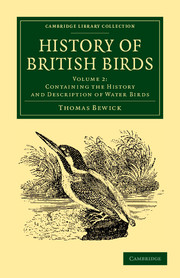
Thomas Bewick (1753–1828) is synonymous with finely crafted wood engravings of the natural world, and his instantly recognisable style influenced book illustration well into the nineteenth century. During his childhood in the Tyne valley, his two obsessions were art and nature. At fourteen, he was apprenticed to the engraver and businessman Ralph Beilby (1743–1817) with whom he later published A General History of Quadrupeds (also reissued in this series). The present work, with its text compiled from various sources, was the first practical field guide for the amateur ornithologist, inspiring also artists and writers. Each of the two volumes contains hundreds of illustrations of breathtaking beauty and precision: one for each species, neatly capturing its character in exquisite detail, interspersed with charming vignettes of country life. Volume 2, first published in 1804, covers water birds, including sandpipers, terns, grebes and guillemots.
Having trained in Edinburgh as a surgeon and served aboard Royal Navy vessels, Sir James Clark (1788–1870) developed a particular interest in the spread of the tuberculosis pandemic in Europe. A licentiate of the Royal College of Physicians from 1826, and elected to the Royal Society in 1832, he became a trusted physician and friend to Queen Victoria and Prince Albert. This early work of 1820 was based on his first-hand knowledge of the treatment of tuberculosis in southern Europe as well as the effects of climate on the disease. Among his tubercular patients in Italy around this time was the poet John Keats (who would succumb in 1821). Also reissued in this series are Clark's Treatise on Pulmonary Consumption (1835), his Memoir of John Conolly (1869), and The Influence of Climate in the Prevention and Cure of Chronic Diseases (1829), a development of aspects of the present work.
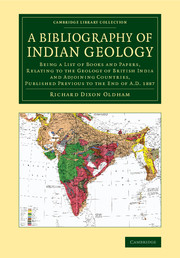
Geologist and seismologist Richard Dixon Oldham (1858–1936) is best known for making two fundamental discoveries: in 1900 he identified primary, secondary and tertiary seismic waves, and in 1906 he presented evidence for the existence of the Earth's core. A fellow of the Royal Geographical Society, the Geological Society of London and the Royal Society, Oldham spent a large part of his career in Asia. Involved in the Geological Survey of India for twenty-five years, he played a key role in the development of geological research in the region (his revised Manual of the Geology in India is also reissued in this series). Originally published in 1888, the present work was the first bibliography of its kind and remains a valuable reference tool in earth sciences. Notably, Oldham chose to broaden the scope of the work by also listing papers on Indian mineralogy, geography, archaeology and botany.
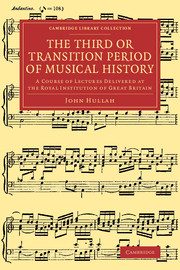
The music teacher and composer John Pyke Hullah (1812–84) is best remembered for his 'singing school for schoolmasters'. Through his dedicated efforts music was embedded into the school curriculum, and his inspiration influenced the rapid growth of amateur choral societies in Britain. Professor of vocal music at King's College, London, from 1844 to 1874, Hullah was elected to the committee of management of the Royal Academy of Music in 1869 and in 1872 became the first government inspector of music in teacher training colleges. The work reissued here is the second edition, published in 1876, of lectures given at the Royal Institution in 1865 on the topic of Italian, French, German and English music from the Renaissance to Handel. It expands on part of his overarching 1861 course of lectures, The History of Modern Music, which is also reissued in this series.
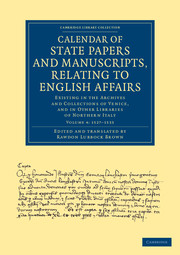
This is the fourth volume in a seven-volume collection - published in nine parts between 1864 and 1890 - comprising Venetian and other northern Italian state papers relating to England. Translator and editor Rawdon Lubbock Brown (1806–83) lived for many years in Venice, had unrivalled access to the Venetian archives and travelled widely to find documents in other Italian libraries and archives. He had previously published two volumes of Sebastian Giustinian's dispatches to Venice from Henry VIII's court (also reissued in this series). This fourth volume contains documents from the years 1527–33, including the important diaries of Marin Sanuto, which chronicle the momentous period when Henry was seeking a divorce from Catherine of Aragon and when Cardinal Wolsey's failure to have the marriage annulled led to his downfall. The editor's preface puts the various documents into historical context, and an appendix of miscellaneous items is also included.
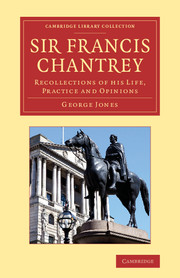
A painter, army officer and eminent Royal Academician, George Jones (1786–1869) enjoyed a close friendship with the sculptor Sir Francis Chantrey (1781–1841). Britain's portrait sculptor of choice at the peak of his career, Chantrey is most celebrated for works such as his busts of Sir Walter Scott and John Horne Tooke, his statue of James Watt, the equestrian bronze of Sir Thomas Munro in India, and The Sleeping Children in Lichfield Cathedral. Originally published in 1849, this book is an affectionate tribute to the man and his work, featuring also a selection of his letters to Jones, the engraver Charles Turner, and other correspondents. Whereas Jones's patriotism led him to enlist, Chantrey's was reflected in his enthusiasm for the advancement and promotion of his country's art: his generous bequest to the Royal Academy allowed for the purchase of numerous works of British art, now held by the Tate.
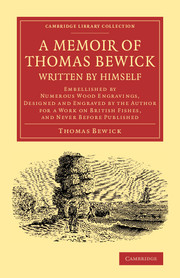
Synonymous with finely crafted wood engravings of the natural world, Thomas Bewick (1753–1828) perfected an instantly recognisable style which was to influence book illustration well into the nineteenth century. Begun in November 1822, at the behest of his daughter Jane, and completed in 1828, Bewick's autobiography was first published in 1862. The opening chapters recall vividly his early life on Tyneside, his interest in the natural world, his passion for drawing, and his apprenticeship with engraver Ralph Beilby in Newcastle, where he would learn his trade and then work in fruitful partnership for twenty years. Later passages in the work reveal Bewick's strongly held views on religion, politics and nature. The work also features illustrations for a proposed work on British fish. Bewick's General History of Quadrupeds (1790) and History of British Birds (1797–1804), the works which secured his high reputation, are also reissued in this series.
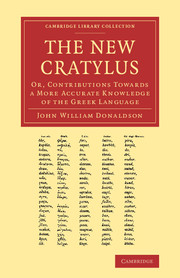
The philologist and biblical critic John William Donaldson (1811–61) published this pioneering work in 1839. It is an attempt to apply the principles of comparative philology to ancient Greek, elucidating the grammar and syntax of the language by comparing it with actual or conjectural cognate languages. As well as producing a great deal of original research on the subject, Donaldson was the first British philologist to bring the work of continental scholars to the attention of English readers. In the book's first section, he gives a history of philology, surveys its present state and expounds a philosophy of language. Here he sets Greek in the context of other Indo-European languages, and outlines a theory of the Greek alphabet and its origins. In the second section, he examines pronouns, numerals, prepositions and particles before considering the noun in the third section, and finally the various tenses and moods of the verb in the fourth section.
Employed early on in his career by Sir Joseph Banks, the botanist John Lindley (1799–1865) went on to conduct important research on the orchid family and also recommended that Kew Gardens should become a national botanical institution. This pioneering three-volume work of palaeobotany, first published between 1831 and 1837, catalogues almost 300 species of fossil plants from the Pleistocene to the Carboniferous period. The geologist and palaeontologist William Hutton (1797–1860), with whom Lindley collaborated, was responsible for collecting the fossil specimens from which the 230 plates were drawn. The first serious attempt at organising and interpreting the evidence of Britain's primeval plant life, this resource is notable also for its prefatory discussion of topics such as coal seams and prehistoric climate. Volume 1 opens with a context-setting introduction and list of genera, followed by the descriptions of plates 1-79.
Cornwall has one of the oldest mining histories in Europe. At one time, the county was a leading producer of tin, with over 2,000 mines in operation, but competition from overseas saw the boom years of the mid-nineteenth century give way to steady decline. Brenton Symons (1832–c.1908), an experienced mining engineer and metallurgist, firmly believed that the mineral wealth of Cornwall was far from exhausted and that careful application of financial investment and skilled personnel could boost the county's prosperity. This illustrated monograph, published in 1884, is his account of Cornwall's geological characteristics, giving details of the formation, location and economic use of various mineral deposits, and describing the extraction techniques of the key mining districts. Accessible and authoritative, this book remains relevant to readers interested in mineralogy, mining and the economic history of Cornwall.
The eminent British botanist Sir William Jackson Hooker (1785–1865) expanded and developed the Royal Botanic Gardens at Kew into a world-leading centre of research and conservation. Appointed its first full-time director in 1841, Hooker came to Kew following a highly successful period in the chair of botany at Glasgow University. He quickly began to extend the gardens, arranging for the building of the now famous Palm House and establishing the Museum of Economic Botany. This volume reissues Hooker's popular guides to the gardens (sixteenth edition) and to the museum (third edition), both published in 1858. Illustrated throughout, these documents reveal the areas and specimens accessible to a receptive Victorian public. Hooker's ten volumes of Icones Plantarum (1837–54) have also been reissued in this series, along with many works by his son and equally accomplished successor, Sir Joseph Dalton Hooker (1817–1911).
Remembered for devising the measure of wind speed that bears his name, the naval officer and hydrographer Sir Francis Beaufort (1774–1857) also had a hand in the production of more than a thousand nautical charts over the course of his career. In 1810 he had been appointed to command the frigate Frederikssteen by the Lords Commissioners of the Admiralty. His mission was to explore 'Karamania', a contemporary European term for the shores of southern Turkey. For two years Beaufort charted the coastline and investigated its classical ruins before his work was brought to an end in 1812 by a Turkish attack which left him wounded. Returning to England, Beaufort set about drawing up the charts of his survey and documenting his findings, publishing this work in 1817, complete with engraved maps and plates. Experts and laypeople received the book favourably, as it shed much light on an underexplored region.
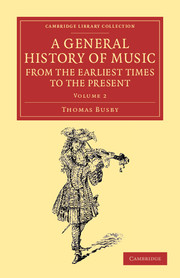
The writer, composer and organist Thomas Busby (1754–1838) is best remembered for his highly entertaining Concert Room and Orchestra Anecdotes (1825), which paints a vivid picture of musical life at the time. The son of a coach painter, Busby was originally articled to the composer Jonathan Battishill, but found the experience unrewarding. His compositions (many now lost) include songs, theatre music and oratorios. His literary output included journal articles and monographs, among them A Grammar of Music (also reissued in this series) and A General History of Music. First published in 1819, this two-volume work proved controversial as it was alleged that Busby had plagiarised the great histories of Burney and Hawkins (also available in the Cambridge Library Collection). However, acknowledging his indebtedness to them, Busby provided a popular interpretation of their work for the general reader. Volume 2 covers the period from the sixteenth century to Busby's own time, with a particular emphasis on England.
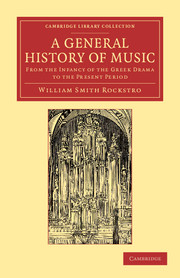
A friend and pupil of Mendelssohn, the composer and author William Smith Rockstro (1823–95) was regarded as an expert on early music. He contributed articles on the subject to Sir George Grove's Dictionary of Music and Musicians as well as teaching counterpoint and plainsong at the Royal College of Music. His published output includes biographies of Handel (1883), Mendelssohn (1884) and the opera singer Jenny Lind (1891), all of which are reissued in this series. The present work was first published in 1886. In its narrative of musical history since the Greeks, it gives due weight to the development of music in England and includes, naturally, a chapter on Handel that reflects his enduring influence on national taste. The final section of the book discusses the contemporary musical scene and considers the importance of the recently deceased Wagner for the music of the future.
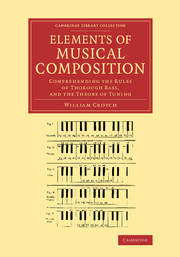
An exceptional child prodigy at the keyboard, the organist and composer William Crotch (1775–1847) attracted the attention of both George III and Charles Burney, going on to become one of the most eminent musical figures of his day. Following a period of study in Cambridge, at the age of fifteen he was appointed organist at Christ Church, Oxford. At twenty-one he assumed the university's chair of music, a post he retained until his death. The first principal of the Royal Academy of Music between 1822 and 1832, Crotch is remembered today for his oratorio Palestine. The present work, first published in 1812, made his expertise available to a wider audience. A clearly written primer on music theory, composition and figured bass, it includes an abundance of musical examples. Crotch's Substance of Several Courses of Lectures on Music (1831) is also reissued in this series.
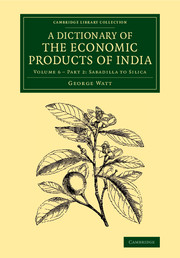
A Scottish doctor and botanist, George Watt (1851–1930) had studied the flora of India for more than a decade before he took on the task of compiling this monumental work. Assisted by numerous contributors, he set about organising vast amounts of information on India's commercial plants and produce, including scientific and vernacular names, properties, domestic and medical uses, trade statistics, and published sources. Watt hoped that the dictionary, 'though not a strictly scientific publication', would be found 'sufficiently accurate in its scientific details for all practical and commercial purposes'. First published in six volumes between 1889 and 1893, with an index volume completed in 1896, the whole work is now reissued in nine separate parts. Volume 6, Part 2 (1893) contains entries from Sabadilla (an imported plant, the seeds of which produce a neurotoxin) to silica (used in the production of glass).
The tragic lives of the Brontë sisters hold a romantic fascination as great as that of the stories into which they poured their rich imaginations and experiences. Following their first appearance in 1847 and the deaths of Emily (1818–48) and Anne (1820–49), these two classics of English literature - one an impassioned tale of doomed love, the other a quietly intense portrait of the governess in Victorian society - were published together with poems and a biographical notice in this revised 1851 edition. It was prepared by the authors' sister and fellow novelist, Charlotte (1816–55). Wuthering Heights was Emily's only novel, and although it received mixed reviews upon first publication because of its stark depiction of mental and physical cruelty, it has since become an icon of its genre. Agnes Grey, Anne's debut novel, astutely shows the governess to be an often invisible and abused member of the household.
William Michael Rossetti (1829–1919) made himself the diarist, chronicler and champion of one of the most creative Victorian families. This two-volume memoir of 1906 provides an unparalleled glimpse into the dynamics of the Rossettis, covering his own childhood and that of his siblings, the genesis of the Pre-Raphaelite Brotherhood, and friendships with such outstanding figures as Morris, Burne-Jones, Swinburne and the Brownings. In fact, many of the members of the Victorian art and literary world make an appearance at some point in these volumes. But what is so engaging about the work is the way in which William Michael treats these personalities straightforwardly and unpretentiously. Especially fascinating are the observations that deal with intimate family details, his thoughts about brother Dante Gabriel and his attitude to sister Christina as her work developed. Though what he says is not always completely candid, his remarks remain uniquely informed, subtle and telling.
Trained by his father, a market gardener, Philip Miller (1691–1771) rose to become Britain's most eminent horticulturalist in the eighteenth century. Following a period as a nurseryman in Southwark, he was appointed the head gardener of the Chelsea Physic Garden by the Society of Apothecaries in 1722, upon the recommendation of Sir Hans Sloane. Under Miller's supervision, the diversity of plants at Chelsea outstripped that of all other European botanic gardens. His talent was equally reflected in his writings. Miller's most famous work, The Gardener's Dictionary, ran to eight editions during his lifetime, as did his celebrated abridgement, reissued here in its 1771 sixth edition. Ranging widely in coverage from agriculture to winemaking, as well as incorporating traditional gardening topics, the work reflects the progress of contemporary plant science and the breadth of knowledge acquired by one of its foremost practitioners.
A miller's son, George Green (1793–1841) received little formal schooling yet managed to acquire significant knowledge of modern mathematics, especially French work. In 1828 he published his Essay on the Application of Mathematical Analysis to the Theories of Electricity and Magnetism, the work for which he is now celebrated. Admitted to Cambridge in 1833 as a mature student, Green went on to become a fellow of Gonville and Caius College. His early death, however, cut short a promising career as a mathematical physicist. While English contemporaries saw what he might have achieved, they did not understand what he had actually achieved. Only when William Thomson (later Lord Kelvin) rediscovered Green's first publication and shared it with the French mathematical elite was his greatness truly appreciated. Edited by the Cambridge mathematician Norman Macleod Ferrers (1829–1903) and published in 1871, this collection comprises Green's influential essay and nine further papers.