A collection of out-of-copyright and rare books from the Cambridge University Library and other world-class institutions that have been digitally scanned, made available online, and reprinted in paperback.
To save content items to your account,
please confirm that you agree to abide by our usage policies.
If this is the first time you use this feature, you will be asked to authorise Cambridge Core to connect with your account.
Find out more about saving content to .
To save content items to your Kindle, first ensure no-reply@cambridge.org
is added to your Approved Personal Document E-mail List under your Personal Document Settings
on the Manage Your Content and Devices page of your Amazon account. Then enter the ‘name’ part
of your Kindle email address below.
Find out more about saving to your Kindle.
Note you can select to save to either the @free.kindle.com or @kindle.com variations.
‘@free.kindle.com’ emails are free but can only be saved to your device when it is connected to wi-fi.
‘@kindle.com’ emails can be delivered even when you are not connected to wi-fi, but note that service fees apply.
The pharmacist Jacob Bell (1810–59) spent much of his career working to raise the standards and reputation of his profession. A founder in 1841 of the Pharmaceutical Society of Great Britain, he sought to improve scientific education for practitioners as well as protect the profession through legislation. Although he served briefly in Parliament, Bell exerted his greatest influence through editing the Pharmaceutical Journal. An extended piece that he produced for the journal in 1842 forms the first part of the present work. He traces the development of pharmaceutical practice and legislation from the sixteenth century to the birth of the Pharmaceutical Society. At the behest of the society's council, Theophilus Redwood (1806–92) continued the narrative after Bell's death, concluding with the 1868 Pharmacy Act. Published in 1880, the book provides a thorough account of the gradual establishment of British pharmacy as a separate and respected profession.
The influential music theorist and composer Adolf Bernhard Marx (1795–1866) spent much of his career as a professor of music in Berlin and was a friend and mentor of Mendelssohn. He believed music should be part of everyone's general education and lobbied the Prussian government for a comprehensive national scheme for musical education. His compositions included many songs and choral works now largely forgotten, with the exception of the 1841 oratorio Mose. Among his publications is Gluck und die Oper (1863) which is reissued in this series in both the German original and English translation. His most famous and influential work, Die Lehre von der musikalischen Komposition, was intended for the students of the University of Berlin, setting out in simple terms the principles of music theory and composition for the untrained. This English translation, of only the first volume of the fourth edition, was published in 1852.
Julius Wellhausen (1844–1918) first published this work in German in 1878. Reissued here is the 1885 English translation of a revised 1883 version. Intended as a multi-volume work, this first book now stands as a self-contained work. A biblical scholar and orientalist, Wellhausen was professor of theology at Greifswald (until resigning for reasons of conscience) and then professor at Halle, Marburg and Göttingen. An early exponent of scientific philology, he placed the Pentateuch in a historical-social context, setting aside theological traditions. In this work, he sets out his method and argues that the Pentateuch is a synthesis of four independent narratives. He then examines the history of worship, sacrifice, sacred feasts, priests, and the law in ancient Israel. Wellhausen is a central figure in modern biblical studies, his theory dominated scholarship for a century, and his pioneering work remains of great interest in the field.
Inspired by Schliemann's discoveries at Mycenae and Troy, Sir Arthur John Evans (1851–1941), keeper of Oxford's Ashmolean Museum from 1884 to 1908, trustee of the British Museum and fellow of the Royal Society, used his inherited wealth to purchase land in Crete at Knossos. From 1900 he commenced excavations there in co-operation with the British School at Athens. Work continued for eight full seasons, uncovering a Bronze Age palace and bringing to light further architectural and artefactual remains of Minoan civilisation, including numerous texts in Linear A and Linear B. Evans' speculative reconstruction of the site in reinforced concrete remains controversial, and some of his interpretations are disputed, but his pioneering work is painstakingly detailed in this highly illustrated multi-volume work, published between 1921 and 1935, with an index volume appearing in 1936. Part 2 of Volume 2 first appeared in 1928.
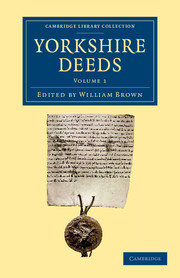
Published between 1909 and 1955, this ten-volume collection contains deeds relating to all of Yorkshire, from the twelfth to the seventeenth century. The deeds are of local historical interest, and provide topographical, philological and genealogical information, as well as insights into daily life. The majority of the records here are presented as abstracts, while documents in the vernacular that are of greater interest or importance are printed in full. Where possible, the documents are dated. Thorough background information and discussion of the deeds is included, as are notable physical descriptions, in particular of the seals. Each volume concludes with an index of people and places. Edited by William Brown (1854–1924) and published in 1909, Volume 1 contains 613 documents arranged alphabetically according to place name. Facsimile plates along with full transcriptions of several notable documents are found in the appendix.
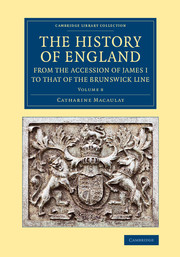
A landmark in female historiography, this work first appeared in eight volumes between 1763 and 1783. Notable for her radical politics and her influence on American revolutionary ideology, Catharine Macaulay (1731–91) drew diligently on untapped seventeenth-century sources to craft her skilful yet inevitably biased narrative. Seen as a Whig response to David Hume's Tory perspective on English history, the early volumes made Macaulay a literary sensation in the 1760s. Later instalments were less rapturously received by those critics who took exception to her republican views. Both the product and a portrait of tumultuous ages, the work maintains throughout a strong focus on the fortunes of political liberty. Volume 8 (1783) covers the final years of the reign of Charles II and the ill-fated reign of James II, concluding with a full account of the Glorious Revolution.
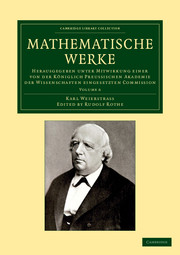
The German mathematician Karl Weierstrass (1815–97) is generally considered to be the father of modern analysis. His clear eye for what was important is demonstrated by the publication, late in life, of his polynomial approximation theorem; suitably generalised as the Stone–Weierstrass theorem, it became a central tool for twentieth-century analysis. Furthermore, the Weierstrass nowhere-differentiable function is the seed from which springs the entire modern theory of mathematical finance. The best students in Europe came to Berlin to attend his lectures, and his rigorous style still dominates the first analysis course at any university. His seven-volume collected works in the original German contain not only published treatises but also records of many of his famous lecture courses. Edited by Rudolf Rothe (1873–1942), Volume 6 was published in 1915.
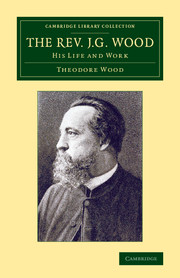
An Oxford-educated clergyman and prolific writer on natural history topics ranging from seashore wildlife to microscopy, John George Wood (1827–89) wrote and lectured for a receptive Victorian audience. His books were not rigorously scientific, but they made their subjects accessible to laypeople and were said to have inspired many future naturalists in their youth. His Nature's Teachings (1877) has also been reissued in this series. Theodore Wood (1862–1923) published this biography of his father in 1890. The account covers Wood's childhood and education, his clerical work and his desire to share his enthusiasm for the natural world with the public. His lecturing engagements, including a tour of America, and his home life are also discussed. An affectionate portrait of a significant figure in the history of popular science, this work sheds light on the intellectual interests of its subject and his readership.
The poet and forger Thomas Chatterton (1752–70) is known today to have been the author of the Rowley poems, a series of compositions in medieval English. Chatterton claimed to have transcribed them from manuscripts written by a fifteenth-century monk, Thomas Rowley. After Chatterton's tragic early death, however, debate raged about the provenance of the poems. This biography, published in 1789, engages powerfully in that debate. Scholar and cleric George Gregory (1754–1808) makes every effort to defend Chatterton against the accusations of forgery, tackling each objection point by point, not least the question of why eighteenth-century syntax appears in the Rowley poems. Paired with Cottle and Southey's three-volume collection of Chatterton's work (also reissued in this series), this book attests to the growth of his influence and remains relevant to students and scholars of English literature.
Before abandoning archaeology for politics, Sir Austen Henry Layard (1817–94) carried out major excavations in Mesopotamia between 1845 and 1851, uncovering important evidence of ancient Assyrian civilisation. Although he originally believed that Nimrud was Nineveh, he later confirmed that Kuyunjik was the location of the ancient city. First published in 1849, this two-volume work is a mixture of excavation report, ancient history, anthropology and travel writing. Layard's excitement at the extent and importance of the finds as soon as digging commenced is clearly conveyed, and he places Mesopotamian history in the context of the more familiar biblical and classical worlds. His Discoveries in the Ruins of Nineveh and Babylon (1853) is also reissued in this series. Illustrated with reproductions of monumental sculptures, smaller finds and excavation plans, Volume 2 follows the progress of digs at a number of sites. The volume's latter part covers the history, culture and customs of the ancient Assyrians.
Thomas Grahame Bailey (1872–1942) had the components of this work printed in individual parts in India between 1902 and 1906. The Royal Asiatic Society in London decided to collect and publish them in 1908 in its monograph series, incorporating a preface by Bailey. The pagination is not continuous as already printed sheets of the earlier studies were reused. Twenty-six dialects from the hill regions of the northern and north-western Himalayas are covered in some detail, including grammar, vocabulary, their relationship to each other, and some songs. Bailey's work was pioneering: he had travelled among the hill peoples, being initiated into tribal rites and secret vocabularies, often of a criminal nature. There had been no previous publications on the grammar or philology of these dialects, merely some translated Christian texts. Bailey subsequently published a number of works on languages of the Indian subcontinent, including a history of Urdu literature.
A Revised Selection of Correspondence from the Illyrian Provinces of Bosnia, Herzegovina, Montenegro, Albania, Dalmatia, Croatia and Slavonia, Addressed to the Manchester Guardian during 1877
Although remembered today chiefly for his archaeological discoveries in Crete, Sir Arthur John Evans (1851–1941) became Britain's leading expert on Balkan affairs after publishing his account of travelling through Bosnia in 1875 (also reissued in this series). In 1877 he returned to the region as a correspondent for the Manchester Guardian, reporting on the continuing insurrection against Ottoman rule. Evans is at pains to point out that he does not regard himself as a war correspondent, but wishes to introduce 'in a tolerably peaceful fashion the insurgents and their little mountain territory to the English public'. Published in 1878, these letters offer historical, social and religious background to the insurrection. In so doing, they provide a valuable insight into the genesis of more recent conflicts in a region that has always been a melting pot of peoples and cultures.
A Huguenot exile in England, the French mathematician Abraham de Moivre (1667–1754) formed friendships with such luminaries as Edmond Halley and Isaac Newton. Making his living from private tuition, he became a fellow of the Royal Society in 1697 and published papers on a range of topics. Probability theory had been pioneered by Pascal, Fermat and Huygens, with further development by the Bernoullis. Originally published in 1718, The Doctrine of Chances was the first English textbook on the new science and so influential that for a time the whole subject was known by the title of the work. Reissued here is the revised and expanded 1738 second edition which contains the remarkable discovery that when a coin is tossed many times, the binomial distribution may be approximated by the normal distribution. This version of the central limit theorem stands as one of de Moivre's most significant contributions to mathematics.
Published in four volumes between 1892 and 1899, this collection contains assorted papers and correspondence between Spain and Spanish dignitaries in England from the accession of Elizabeth I in 1558 through to her death in 1603. Revealing the changing relationship between Spain and England, the documents offer detailed insights into Elizabeth's reign from a continental and Catholic perspective. They have been carefully edited and translated into English by Martin Andrew Sharp Hume (1843–1910), a respected historian of Spain and a scrupulous archival researcher. Each volume is arranged chronologically, contains an introduction that provides helpful historical context and closes with an index that includes both letter writers and recipients. Volume 4 (1899) covers the final years of Elizabeth's reign (1587–1603). Though lacking the completeness of the correspondence in previous volumes - due to the diplomatic breakdown between Spain and England - this volume nevertheless contains much valuable and previously untapped material.
A landmark in female historiography, this work first appeared in eight volumes between 1763 and 1783. Notable for her radical politics and her influence on American revolutionary ideology, Catharine Macaulay (1731–91) drew diligently on untapped seventeenth-century sources to craft her skilful yet inevitably biased narrative. Seen as a Whig response to David Hume's Tory perspective on English history, the early volumes made Macaulay a literary sensation in the 1760s. Later instalments were less rapturously received by those critics who took exception to her republican views. Both the product and a portrait of tumultuous ages, the work maintains throughout a strong focus on the fortunes of political liberty. Volume 3 (1767) covers the outbreak of the English Civil War, closing with Prince Rupert's taking of Bristol in the summer of 1643.
This two-volume life of Sir Joshua Reynolds (1723–92) was begun by the Royal Academician Charles Leslie (1794–1859), who had previously published a life of John Constable, also reissued in this series. On Leslie's death, the journalist and dramatist Tom Taylor (1817–80) completed the work, published in 1865. Leslie's motive was that he felt that Reynolds had been unfairly treated by an earlier biography. He aimed to show that Reynolds was 'the genial centre of a most various and brilliant society, as well as the transmitter of its chief figures to our time by his potent art'. One of the greatest artists of the eighteenth century, especially famous for his portraits, Reynolds was also instrumental in founding the Royal Academy, and was its first president. Volume 2 begins in 1773, and ends with Reynolds' death. Leslie also provides an assessment of his status as an artist.
Rudolf Westphal (1826–92) originally studied theology at the University of Marburg before turning to classical philology and comparative linguistics. He learnt Sanskrit and Arabic and took a keen interest in Indo-European languages and Semitic grammar. In the late 1850s and early 1860s he joined his friend and fellow philologist August Rossbach (1823–98) at the University of Breslau (Wrocław). This multi-volume work on ancient Greek metre and music resulted from their collaboration. Reissued here is the revised third edition published in four parts between 1885 and 1889. Volume 2 (1886) is devoted to Westphal's thorough account of melody and harmony in Greek music. He provides a general introduction to the development of Greek melody through history as well as an account of Aristoxenus' theory on intervals. The latter part of the volume focuses on the scholarship relating to harmonies and scales.
A landmark in female historiography, this work first appeared in eight volumes between 1763 and 1783. Notable for her radical politics and her influence on American revolutionary ideology, Catharine Macaulay (1731–91) drew diligently on untapped seventeenth-century sources to craft her skilful yet inevitably biased narrative. Seen as a Whig response to David Hume's Tory perspective on English history, the early volumes made Macaulay a literary sensation in the 1760s. Later instalments were less rapturously received by those critics who took exception to her republican views. Both the product and a portrait of tumultuous ages, the work maintains throughout a strong focus on the fortunes of political liberty. Volume 2 (1765) opens in 1628 with the abortive English attempts to relieve the siege of La Rochelle. The volume concludes with the execution of the Earl of Strafford in 1641.
Originally published in two volumes in 1816 and 1820, this collection of biographical information and anecdotes tracing the career of the artist Benjamin West (1738–1820) is reissued here in one volume. Prepared by the Scottish novelist John Galt (1779–1839), it is based on the personal recollections of West himself, yet it is acknowledged to include some embellishment. Born in Pennsylvania and largely self-taught, West was the first American artist to travel through Italy to improve his skill by studying antique sculptures and old master paintings. After he came to London in 1763, his strength as a history painter was recognised, not least by George III, and he became a leader of the neoclassical movement. Instrumental in establishing the Royal Academy of Arts, West became its second president in 1792. Galt's narrative emphasises the importance of West in the history of art in Britain.
A pioneering Egyptologist, Sir William Matthew Flinders Petrie (1853–1942) excavated over fifty sites and trained a generation of archaeologists. His meticulous recording of artefacts and his sequence dating of pottery types found in Egypt and Palestine made Near Eastern archaeology a more rigorous and scientific discipline. This fully illustrated report of 1900 on the royal tombs at Abydos, capital of Upper Egypt, covers the first dynasty (c.3100–c.2900 BCE). Although Petrie acknowledges that it is only a preliminary report of ongoing work, he gives detailed descriptions of six tombs and the associated finds. A chapter on the inscriptions is provided by Francis Llewellyn Griffith (1862–1934). Petrie wrote prolifically throughout his long career for both specialists and non-specialists. His follow-up report, The Royal Tombs of the Earliest Dynasties (1901), and the three-part Abydos (1902–4) are among those works also reissued in this series.