A collection of out-of-copyright and rare books from the Cambridge University Library and other world-class institutions that have been digitally scanned, made available online, and reprinted in paperback.
To save content items to your account,
please confirm that you agree to abide by our usage policies.
If this is the first time you use this feature, you will be asked to authorise Cambridge Core to connect with your account.
Find out more about saving content to .
To save content items to your Kindle, first ensure no-reply@cambridge.org
is added to your Approved Personal Document E-mail List under your Personal Document Settings
on the Manage Your Content and Devices page of your Amazon account. Then enter the ‘name’ part
of your Kindle email address below.
Find out more about saving to your Kindle.
Note you can select to save to either the @free.kindle.com or @kindle.com variations.
‘@free.kindle.com’ emails are free but can only be saved to your device when it is connected to wi-fi.
‘@kindle.com’ emails can be delivered even when you are not connected to wi-fi, but note that service fees apply.
First published in 1834, this work was an important early contribution to the emerging field of Egyptology in Britain. It united the twin passions of its author, the noted surgeon and antiquarian Thomas Joseph Pettigrew (1791–1865), who made a name for himself by unrolling and autopsying mummies: his London home was the scene of well-attended parties during which he would impress his guests with such displays. In the present work, Pettigrew delves into the history, technique and ritual of mummification in a depth that had never been attempted before, notably extending the coverage beyond ancient Egypt to other societies and eras. Describing the beliefs that informed these practices, the work also addresses the Egyptians' worship and embalming of animals such as bulls, dogs and hawks. Based on numerous examinations and years of study, this work stood as a landmark in the scientific and historical understanding of these funerary rites.
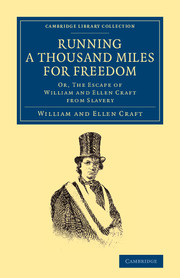
In this short work of 1860, William Craft (c.1825–1900), assisted by his wife Ellen (c.1825–91), recounts the remarkable story of how they escaped from slavery in America. Having married as slaves in Georgia, yet unwilling to raise a family in servitude, the couple came up with a plan to disguise the light-skinned Ellen as a man, with William acting as her slave, and to travel to the north in late 1848. This compelling narrative traces their successful journey to Philadelphia and their subsequent move to Boston, where they became involved in abolitionist activities. Later, the couple sought greater safety in England, where they lived for a number of years and had five children. A success upon its first appearance, the book touches on the themes of race, gender and class in mid-nineteenth-century America, offering modern readers a first-hand account of how barriers to freedom could be overcome.
Trained as a gardener in his native Scotland, William Aiton (1731–93) had worked in the Chelsea Physic Garden prior to coming to Kew in 1759. He met Joseph Banks in 1764, and the pair worked together to develop the scientific and horticultural status of the gardens. Aiton had become superintendent of the entire Kew estate by 1783. This important three-volume work, first published in 1789, took as its starting point the plant catalogue begun in 1773. In its compilation, Aiton was greatly assisted with the identification and scientific description of species, according to the Linnaean system, by the botanists Daniel Solander and Jonas Dryander (the latter contributed most of the third volume). Aiton added dates of introduction and horticultural information. An important historical resource, it covers some 5,600 species and features a selection of engravings. Volume 2 continues to catalogue the plants, covering Octandria to Monadelphia.
The German biblical scholar Constantin von Tischendorf (1815–74) published his monumental eighth edition of the Greek New Testament between 1869 and 1872. Influenced by the pioneering scholarship of Karl Lachmann (1793–1851), who had first moved away from relying on the Textus Receptus, Tischendorf placed key emphasis on the witness of older uncial manuscripts, most notably the Codex Sinaiticus (which he rediscovered) and the Codex Vaticanus. His painstaking work laid the foundations for the creation of modern critical texts, and the vast amount of manuscript evidence he collated has ensured that this edition remains a standard work of reference for biblical scholars and textual critics. Following Tischendorf's death, the work's Latin prolegomena was issued in separate parts by Caspar René Gregory (1846–1917), assisted by Ezra Abbott (1819–84). The present volume amalgamates the parts published in 1884 and 1890, comprising sections I-VIII and including detailed codicological information.
A painstaking compiler of catalogues and indexes, the biblical scholar and bibliographer Thomas Hartwell Horne (1780–1862) first published his most famous work in 1818, having begun his research for it many years earlier in 1801. Reissued here is the expanded four-volume tenth edition of 1856, which includes revisions by the scholars Samuel Davidson (c.1806–98) and Samuel Prideaux Tregelles (1813–75). This monumental and influential work of nineteenth-century biblical scholarship remains a valuable resource for modern researchers. Volume 2, the work of Davidson, addresses the Old Testament and has been split into two parts for this reissue. Influenced by contemporary German scholarship, Davidson's contribution caused controversy, particularly around prophetic authorship and the role of divine inspiration, resulting in his resignation from Lancashire Independent College. Part 2, Davidson's exegetical 'Brief Introduction to the Old Testament and Apocrypha', includes extensive references to contemporary scholarship as well as research on sources and interpretation of meaning.
One of the great American pragmatic philosophers alongside Peirce and Dewey, William James (1842–1910) delivered these eight lectures in Boston and New York in the winter of 1906–7. Though he credits Peirce with coining the term 'pragmatism', James highlights in his subtitle that this 'new name' describes a philosophical temperament as old as Socrates. The pragmatic approach, he says, takes a middle way between rationalism's airy principles and empiricism's hard facts. James' pragmatism is both a method of interpreting ideas by their practical consequences and an epistemology which identifies truths according to their useful outcomes. Furnished with many examples, the lectures illustrate pragmatism's response to classic problems such as the question of free will versus determinism. Published in 1907, this work further develops James's approach to religion and morality, introduced in The Will to Believe (1897) and The Varieties of Religious Experience (1902), both reissued in this series.
When this highly illustrated work first appeared in 1900, the day-to-day business of an astronomer was prone to misapprehension; the reality tended to be clouded by the temptation to imagine observatories as preoccupied with making awe-inspiring discoveries and glimpsing distant worlds. Describing himself as a hybrid between an engineer and an accountant, astronomer Edward Walter Maunder (1851–1928) explodes the romantic myths and takes the reader on an entertaining tour of the history and real purposes of the Royal Observatory at Greenwich. Founded with the sole aim of advancing navigation at sea, the observatory originally confined its activities to the accurate compilation of celestial charts. In exploring the observatory's various departments and the lives of its Astronomers Royal, Maunder shows how its remit slowly expanded into heliography, meteorology, spectroscopy and the study of magnetism, which transformed it from a tool of the Navy to a major institution in contemporary astronomy.
Although Gustav Theodor Fechner (1801–87) had studied medicine at the University of Leipzig, he never practised as a doctor. In the 1820s he published satirical evaluations of the medical science of the day under the pseudonym 'Dr Mises' and supplemented his income by translating chemistry and physics texts. Increasingly he focused his studies on mathematics and physics, and the physical and physiological became recurrent themes in his work. With the publication of his Elemente der Psychophysik (1860), Fechner not only established the foundations of psychophysics as a field of research, but also pioneered much experimental psychology. This two-volume second edition of his 1876 work on the principles of aesthetics was published in 1897–8. In Volume 2, Fechner uses the principles that he established in Volume 1 and applies these in the analysis of different works of art.
This is the last of three parts of the sixth volume in a seven-volume collection - published between 1864 and 1890 - comprising Venetian and other northern Italian state papers relating to England. Translator and editor Rawdon Lubbock Brown (1806–83) lived for many years in Venice, had unrivalled access to the Venetian archives and travelled widely to find documents in other Italian libraries and archives. He had previously published Sebastian Giustinian's dispatches to Venice from Henry VIII's court (also reissued in this series). This third part of the sixth volume contains documents from the years 1557–8, the last years of Mary I's reign - when her husband Philip II was absent for much of the time - up to her death and the accession of Elizabeth I. Also included is an appendix of documents concerning the House of Este and its relations with the English dynasties from the Plantagenets to the Tudors.
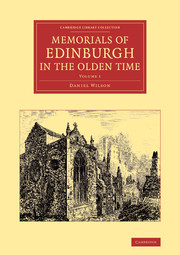
Born in Edinburgh, Daniel Wilson (1816–92) initially pursued an artistic career and spent time in Turner's studio. However, in 1846 he became a fellow of the Society of Antiquaries of Scotland and devoted the rest of his life to archaeology, anthropology and university administration. He was active in the Society's attempts to save historic buildings in Edinburgh, and the city's built environment was the subject of this two-volume 1848 work, which is illustrated with engravings after his own drawings. In Volume 1, Wilson begins by tracing the city's history from earliest times. The latter part of the volume covers local antiquities and traditions, with each chapter looking at a different area of the Old Town. The historical detail, with references, is immense, and Wilson's enthusiasm for his city is evident throughout. His second major work, the landmark Prehistoric Annals of Scotland (second edition, 1863), is also reissued in this series.
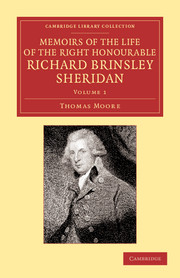
Best known for The Rivals and The School for Scandal, Richard Brinsley Sheridan (1751–1816) was already a celebrated comic playwright when he entered Parliament in 1780. Turning his wit and talent as a writer to political oratory, he won acclaim for his speeches in the House of Commons. As an independent-minded Whig, he had to reconcile his distrust of monarchical power with his role as friend and confidant to the future George IV. Sheridan's was ultimately a turbulent life, rocked by affairs, heavy drinking and constant debt. This successful and influential two-volume biography, first published in 1825, was written by the poet Thomas Moore (1779–1852), who went on to chart the life of Lord Byron. Volume 1 covers Sheridan's early life and career as a writer, including extensive extracts from unfinished plays.
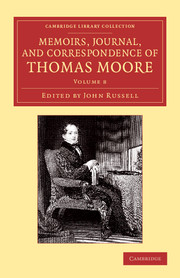
Throughout his professional life, the poet Thomas Moore (1779–1852) was variously celebrated and vilified for both his verse and his politics. Born in Dublin, he remained an ardent Irish patriot until his death. This eight-volume collection of Moore's memoirs, diaries and letters, edited by his friend Lord John Russell (1792–1878) and first published between 1853 and 1856, provides rare insights into a man whose genius was applauded by the Morning Chronicle as 'embracing almost all sides of imaginative literature, of criticism and philosophy'. Volume 8 opens with a portrait of Moore in later life and a view of the valley where he died. This final volume contains Moore's diary for the period 1845–7, prior to his descent into dementia. A selection of correspondence from 1799 to 1847, Russell's postscript and an index to the eight volumes complete the work.
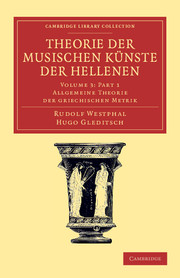
Rudolf Westphal (1826–92) originally studied theology at the University of Marburg before turning to classical philology and comparative linguistics. He learnt Sanskrit and Arabic and took a keen interest in Indo-European languages and Semitic grammar. In the late 1850s and early 1860s he joined his friend and fellow philologist August Rossbach (1823–98) at the University of Breslau (Wrocław). This multi-volume work on ancient Greek metre and music resulted from their collaboration. Reissued here is the revised third edition published in four parts between 1885 and 1889. Part 1 of Volume 3 (1887), which features the input of classical scholar Hugo Gleditsch (1837–1913), discusses the distinction drawn by Aristoxenus between singing and speaking. The volume also focuses on prosody and different types of verse feet.
Born in Franconia, the son of a rabbi, Joseph Wolff (1795–1862) was baptised in 1812, moved to England in 1819, and became a Christian missionary. He travelled widely in the Near East, Middle East and Central Asia, enduring shipwreck, robbery and disease. His Researches and Missionary Labours among the Jews, Mohammedans, and Other Sects (1835) and the miscellaneous Travels and Adventures (1861) are also reissued in this series. First published in 1845 and reissued here in the revised second edition of that year, this work records Wolff's journey to the Emirate of Bukhara (in present-day Uzbekistan) to investigate the disappearance of two British officers. Volume 1 begins with chapters covering Wolff's background and previous travels, before focusing on his mission to find the missing men, his initial investigations in Persia, and his arrival in Bukhara, noting details of the people and culture.
Initially faced with popular mistrust, Prince Albert (1819–61) fought hard to establish his own role both in public and in his marriage to Queen Victoria. Before he died, he came to be recognised as an influential figure in a kind of dual monarchy, acting as an intermediary with prime ministers and orchestrating the hugely complicated but ultimately successful Great Exhibition of 1851. This collection of speeches, edited by Sir Arthur Helps (1813–75) and published in 1862, was compiled at the request of the widowed Victoria. The speeches reflect the Prince's standing in public life and his unusual position as a consort who was afforded wide-ranging responsibilities. Clerk of the Privy Council, Helps had known Albert personally and his introduction provides an overwhelmingly positive character sketch. Official biographer Theodore Martin's five-volume Life of His Royal Highness the Prince Consort (1875–80) is also reissued in the Cambridge Library Collection.
Or, Memoirs of the Lives and Writings of the Most Eminent Musical Composers and Writers, Who Have Flourished in the Different Countries of Europe during the Last Three Centuries
A naturalist and Church of England clergyman, William Bingley (1774–1823) wrote widely on botany, topography and zoology. Works such as his Tour of North Wales (1800), Animal Biography (1802) and Memoirs of British Quadrupeds (1809) enjoyed great popularity. He served as curate of the priory in Christchurch, Hampshire, and from 1816 to 1823 as minister of Fitzroy Chapel in Charlotte Street, London. This two-volume publication, which first appeared in 1814, is one of his many works of compilation. Bingley takes as his principal sources the great music histories of Hawkins and Burney (also reissued in this series), to which he acknowledges his debt. The work comprises vignettes of chiefly Italian, German and British composers of the sixteenth, seventeenth and eighteenth centuries, touching also on French and Spanish musicians. Volume 2 focuses on the eighteenth century, including a chapter devoted to Handel which reflects the composer's considerable standing.