A collection of out-of-copyright and rare books from the Cambridge University Library and other world-class institutions that have been digitally scanned, made available online, and reprinted in paperback.
To save content items to your account,
please confirm that you agree to abide by our usage policies.
If this is the first time you use this feature, you will be asked to authorise Cambridge Core to connect with your account.
Find out more about saving content to .
To save content items to your Kindle, first ensure no-reply@cambridge.org
is added to your Approved Personal Document E-mail List under your Personal Document Settings
on the Manage Your Content and Devices page of your Amazon account. Then enter the ‘name’ part
of your Kindle email address below.
Find out more about saving to your Kindle.
Note you can select to save to either the @free.kindle.com or @kindle.com variations.
‘@free.kindle.com’ emails are free but can only be saved to your device when it is connected to wi-fi.
‘@kindle.com’ emails can be delivered even when you are not connected to wi-fi, but note that service fees apply.
The German linguist Hugo Schuchardt (1842–1927) made significant contributions to the study of the Basque and Romance languages, publishing also on pidgins and creoles. A critic of the Neogrammarian hypothesis of sound laws, he subscribed to the 'wave model' of language change. His Über die Lautgesetze: Gegen die Junggrammatiker (1885) has been reissued in this series in a volume with Die Verwantschaftsverhältnisse der indogermanischen Sprachen (1872) by Johannes Schmidt (1843–1901). Based on Schuchardt's doctoral dissertation and the painstaking study of extant sources, the present three-volume work appeared between 1866 and 1868. He explores here the development and characteristics of Vulgar Latin, the language of the general population, as opposed to the classical, literary variety. The work focuses on the distinctive vowel changes that took place in Romance vernaculars over many centuries. Volume 3 (1868) is a supplement to the first two volumes and includes corrections.
First published in two volumes between 1907 and 1908, this major work by the Scottish biblical scholar and geographer Sir George Adam Smith (1856–1942) is organised into three books. Volume 1 contains the first two books. Book 1 covers the topography, geology and climate of ancient Jerusalem, while Book 2 focuses on the economic and political development of the city. Best known for his celebrated Historical Geography of the Holy Land (1894), Smith provides here a more detailed and specialist analysis, based on first-hand knowledge derived from the visits he made to the region over the years. Spanning more than fourteen centuries of Jerusalem's history from 1400 BCE to 70 CE, these well-illustrated volumes remain a standard work of scholarship, expertly elucidating the changing shape of the city.
A keen collector and sketcher of plant specimens from an early age, the author, educator and clergyman Charles Alexander Johns (1811–74) gained recognition for his popular books on British plants, trees, birds and countryside walks. The Forest Trees of Britain (1847–9), one of several works originally published by the Society for Promoting Christian Knowledge, is also reissued in this series. First published by the Society in 1851, Johns' best-known work is this two-volume botanical guide to common British flowering plants. Following the Linnaean system of classification, Johns describes the various plant families, providing the common and Latin names for each species. The work is especially noteworthy for its delicate and meticulous line drawings, based on watercolours by the botanical artist Emily Stackhouse and the author's sisters Julia and Emily. Volume 1 includes an introduction to the Linnaean system and the botanical terms used in the text.
An anthropologist and archaeologist working for much of his life at the British Museum, Thomas Athol Joyce (1878–1942) succeeded in making American archaeology more accessible to non-specialists. Through careful analysis and presentation of the available evidence from South and Central America, he secured his reputation as an authority in this field, especially with regard to Mayan civilisation. Drawing on his wide reading of the published literature, he produced three pioneering and highly illustrated textbooks. The present work appeared in 1914 and focuses on Mexican and Mayan culture. The topics discussed include social structure and daily life, warfare, trade and architecture, as well as religious observance and mythology. Particular attention is paid to the calendar, with appendices providing the names of days and months along with a provisional dating scheme. Joyce's South American Archaeology (1912) and Central American and West Indian Archaeology (1916) are also reissued in this series.
First published in 1892, this work by the architect Reginald Theodore Blomfield (1856–1942), illustrated by Francis Inigo Thomas (1865–1950), uses historical evidence to vindicate a classical approach to garden design, in which a house and its surroundings are kept in harmony. It is a response to the work of the gardener and journalist William Robinson (1838–1935), who had written vehemently in favour of romantic, naturalistic gardens. Closely linked to the burgeoning Arts and Crafts movement as secretary to the Art-Workers' Guild under William Morris' presidency, Blomfield had developed a theory of garden design which held that it should be a reflection of architectural order: honest, vernacular simplicity as opposed to the 'wild garden'. Illustrative of the contemporary debate between architects and plantsmen, this instructive text, reissued in its second edition of 1892, captures a moment in this developing relationship in the years before Edwin Lutyens and Gertrude Jekyll gave it new harmony.
Alexander Morris (1826–89) served as lieutenant-governor of Manitoba and the Northwest Territories, not long after Canada purchased the latter from the Hudson's Bay Company in 1869. This colossal land transfer was a source of unrest for the indigenous peoples, who were displeased about the arrival of missionaries and other settlers. Morris was involved in negotiating treaties over issues such as land rights, publishing this account in 1880. He provides some historical context to the many negotiations in which he participated as well as some of his thoughts on how the agreements could best be implemented. The work, which also includes the full texts of these treaties, remains a valuable source on the history of the relationship between Europeans and indigenous peoples during the settlement of the outer reaches of Canada.
Published in four volumes between 1892 and 1899, this collection contains assorted papers and correspondence between Spain and Spanish dignitaries in England from the accession of Elizabeth I in 1558 through to her death in 1603. Revealing the changing relationship between Spain and England, the documents offer detailed insights into Elizabeth's reign from a continental and Catholic perspective. Derived in large part from the archives at Simancas, they have been carefully edited and translated into English by Martin Andrew Sharp Hume (1843–1910), a respected historian of Spain and a scrupulous archival researcher. Each volume is arranged chronologically, contains an introduction that provides helpful historical context and closes with an index that includes both letter writers and recipients. Volume 1 (1892) covers the first nine years of Elizabeth's reign and highlights the religious tensions that characterised this period.
Hermann Osthoff (1847–1909) and Karl Brugmann (1849–1919) were central figures in the circle of German scholars who rejected a doctrinal approach to the study of linguistics. They came to be known as the Neogrammarian school. At the core of their work was the theory that European languages, together with a subset of languages found in central and southern Asia, have a common origin in a single prehistoric language. They called this ancestor Indo-Germanic (known today as Indo-European) and claimed that its descendants are all related to one another by varying degrees of closeness. This six-volume elaboration of this thesis was published between 1878 and 1910. Volume 5 (1890) comprises various essays, including an account of how the numbers 10 and 100 are formed within Indo-European languages and an excursus detailing the forming of the nominative and accusative cases.
The American artist George Catlin (1796–1872) was fascinated by the indigenous people of his homeland and spent many years living among them, painting them, and collecting their artefacts. In 1839 he took his vast collection to Europe to exhibit it, and he also toured with groups of visiting Native Americans. This illustrated two-volume account of his experiences was published in 1848. Volume 1 begins with Catlin's voyage to England across the Atlantic, for which he embarked with eight tons of freight. He goes on to discuss such events as introducing a group of Native Americans to Queen Victoria. He also includes, in the appendices, press reviews of the exhibition and a catalogue of his collection. Catlin's earlier account, Letters and Notes on the Manners, Customs, and Condition of the North American Indians (1841), is also reissued in this series, along with two later books for children about life among various tribes.
Indefatigable as a writer and reformer on rural and political questions in his native Britain, William Cobbett (1763–1835) wrote the present work during the period he spent as a farmer in the United States. Intended for young people and especially 'soldiers, sailors, apprentices, and plough-boys' (Cobbett had himself been one of the latter), it provides concise and practical explanations of grammatical terms, touching on aspects of orthography, prosody, etymology and syntax. First published in December 1818 and used in English schools into the twentieth century, it is reissued here in the version printed in London in 1819. Cobbett demonstrates in a series of letters to his son the fundamental importance of good grammar and clarity of expression. To emphasise this point, he includes 'specimens of false grammar' in the writings of Samuel Johnson as well as 'errors and nonsense' in a speech given by George III.
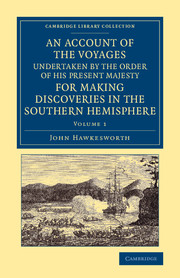
A bestseller in its day, this three-volume work vividly recounts significant voyages made by Britain's leading navigators. A prominent figure in London cultural life, John Hawkesworth (c.1720–73) was commissioned by the Admiralty to compile, from the captains' journals, the official record of voyages which included James Cook's first journey to the South Pacific. Reissued here is the Dublin edition based on the first printing of 1773; a second edition appeared later in the year. Critical opinion was fierce, however, with Hawkesworth accused of impiety, manipulating the original texts and promoting the sexual freedoms of Pacific islanders. Devastated by these attacks, he died the same year. Later taken aboard the Beagle with Darwin, the work still speaks to scholars and students of nautical exploration. Volume 1 includes accounts of voyages by John Byron, Philip Carteret and Samuel Wallis - notably the latter's discovery of Tahiti.
As a surgeon and naturalist for the New Zealand Company, Ernst Dieffenbach (1811–55) travelled widely in the North Island between 1839 and 1841. He was the first European to successfully scale Mount Egmont (or Taranaki), and he also visited the natural wonders of the Pink and White Terraces at Lake Rotomahana, which were later destroyed in a volcanic eruption. First published in 1843, this two-volume work describes the landscapes, flora and fauna in a highly readable style. In Volume 1, Dieffenbach recounts his sea journeys through Cook Strait and Queen Charlotte Sound, along with his excursions deep into the North Island. There is also a thorough account of his ambitious climb to the snowy summit of Mount Egmont. His passages relating to the people he encountered also give an insight into the lives of the native islanders. This volume includes illustrations of Lake Taupo, Mount Egmont and Mount Ruapehu.
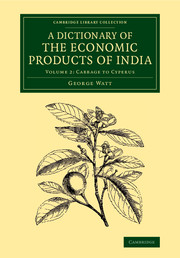
A Scottish doctor and botanist, George Watt (1851–1930) had studied the flora of India for more than a decade before he took on the task of compiling this monumental work. Assisted by numerous contributors, he set about organising vast amounts of information on India's commercial plants and produce, including scientific and vernacular names, properties, domestic and medical uses, trade statistics, and published sources. Watt hoped that the dictionary, 'though not a strictly scientific publication', would be found 'sufficiently accurate in its scientific details for all practical and commercial purposes'. First published in six volumes between 1889 and 1893, with an index volume completed in 1896, the whole work is now reissued in nine separate parts. Volume 2 (1889) contains entries from cabbage (introduced to India by Europeans) to Cyperus (a genus of grass-like flowering plants).
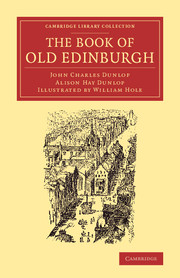
And Hand-Book to the ‘Old Edinburgh Street' Designed by Sydney Mitchell, Architect, for the International Exhibition of Industry, Science, and Art, Edinburgh, 1886
This work was first published in 1886 to accompany one of the more eccentric displays at the Edinburgh International Exhibition of the same year. Historically accurate reconstructions of noteworthy but long-demolished Edinburgh buildings were built side by side to create a fictional street. This guide provided visitors with key historical information relating to the recreated buildings and monuments ranging from the medieval market cross to the historic tolbooth. Fact is combined with anecdote, situating the buildings in the wider context of Edinburgh's rich history. The text was written by John Charles Dunlop and Alison Hay Dunlop, antiquarian siblings little known beyond their Edinburgh circles. Of particular interest are the illustrations by William Fergusson Brassey Hole (1846–1917), who later painted the murals in the entrance hall of the Scottish National Portrait Gallery.
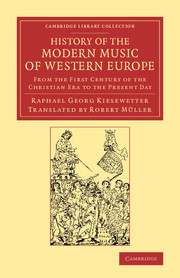
A high-ranking official in the Imperial War Office in Vienna, Raphael Georg Kiesewetter (1773–1850) is better known for his musicological activities. An accomplished amateur musician, he studied with Albrechtsberger, hosted private concerts of early music, and was closely involved in the affairs of Vienna's Society of the Friends of Music. His important collection of scores is now in the Austrian National Library. He also wrote a number of books and articles, including a pioneering study of Arabic music which was the first to use original sources, owing to the assistance of orientalist Joseph von Hammer-Purgstall. Originally published in German in 1834 and reissued here in its 1848 English translation, the present work is considered Kiesewetter's most significant and remains accessible to the general reader. Based on an evolutionary approach influenced by the Enlightenment, the book presents seventeen epochs which are named after their most characteristic composers.
Being a Description of the Rivers Witham and Welland and their Estuary, and an Account of the Reclamation, Drainage, and Enclosure of the Fens Adjacent Thereto
A respected hydraulic engineer, William Henry Wheeler (1832–1915) established himself as an authority in the fields of low-lying land reclamation and drainage, embanking, and the improvement of tidal rivers and harbours. First published in 1868, Wheeler's historical work on the Fens of South Lincolnshire is reissued here in its much expanded second edition of 1896. It discusses in detail the reclamation of the fenland in the late eighteenth and early nineteenth centuries. The coverage includes a history of each of the districts, the Acts of Parliament involved, the pumping machinery used, the management of the highways and waterways, the agriculture and geology of the area, and the costs associated with the whole reclamation project. Another of Wheeler's works, The Drainage of Fens and Low Lands (1888), is also reissued in this series. The books remain a rich source of information for local historians and civil engineers.
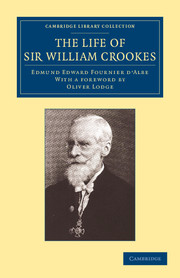
In 1870, Sir William Crookes (1832–1919) travelled to Gibraltar to observe the solar eclipse. He kept a diary and produced beautiful accounts of the expedition - alongside altogether more specific observations, including the 656 steps down a local cliff face, and every item in his luggage. It is with the same meticulous approach and cheerful prose that he records, in letters, journal articles and reports, the successes and failures of the vast range of projects in which he was involved. Although initially trained as a chemist, Crookes worked across the spectrum of the sciences, from consulting on preventative measures against cattle plague through to investigating spiritualism. Opening with a foreword by the physicist Sir Oliver Lodge, this biography by Edmund Edward Fournier d'Albe (1868–1933), first published in 1923, explores a remarkable life of enquiry through a host of first-hand sources.
The French author and traveller Constantin-François de Chasseboeuf (1757–1820) adopted the pen name Volney, which combined the name of Voltaire and Ferney, where the great philosopher lived. A friend of Thomas Jefferson and other Enlightenment figures, Volney used an inheritance to further his education by travelling to Ottoman Egypt and the historical region of Syria, visiting areas of present-day Lebanon and Israel. He chose these lands as he believed he would gain political and philosophical insights from their ancient heritage. Very little had been written in the West about these areas before he published this two-volume account in 1787. It enjoyed great popularity and even accompanied Darwin aboard the Beagle on his own voyage of discovery decades later. Reissued here is the revised and corrected French second edition, which also appeared in 1787. Volume 1 delves into the geography, ethnic divisions, religious beliefs, commerce and politics of Egypt and Syria.
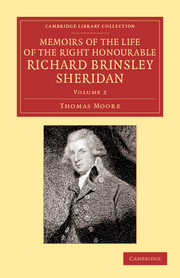
Best known for The Rivals and The School for Scandal, Richard Brinsley Sheridan (1751–1816) was already a celebrated comic playwright when he entered Parliament in 1780. Turning his wit and talent as a writer to political oratory, he won acclaim for his speeches in the House of Commons. As an independent-minded Whig, he had to reconcile his distrust of monarchical power with his role as friend and confidant to the future George IV. Sheridan's was ultimately a turbulent life, rocked by affairs, heavy drinking and constant debt. This successful and influential two-volume biography, first published in 1825, was written by the poet Thomas Moore (1779–1852), who went on to chart the life of Lord Byron. Volume 2 covers Sheridan's political career, his speeches in Parliament and his final years, closing with reflections on his life.
Grace Ellison (d.1935) was a journalist with an enthusiasm for Turkish culture. She had previously published works on life in a liberal Turkish family, and on the experiences of two modern Turkish women in Europe, which have also been reissued in the Cambridge Library Collection. In this 1923 book, she recounts what she found on revisiting Turkey in the aftermath of the First World War and the war between Turkey and Greece which had arisen after the dismemberment of the Ottoman empire. Passionately pro-Turk, Ellison was dismayed at the peace treaties' punitive effect on Turkey. This work describes a journey via Athens (filled with destitute refugees) and devastated Smyrna to Angora (Ankara), the small town which was the new capital of the Turkish Republic, where she had several meetings with Mustafa Kemal, the reforming president. This is a partisan but fascinating view of the birth of modern Turkey.