A collection of out-of-copyright and rare books from the Cambridge University Library and other world-class institutions that have been digitally scanned, made available online, and reprinted in paperback.
To save content items to your account,
please confirm that you agree to abide by our usage policies.
If this is the first time you use this feature, you will be asked to authorise Cambridge Core to connect with your account.
Find out more about saving content to .
To save content items to your Kindle, first ensure no-reply@cambridge.org
is added to your Approved Personal Document E-mail List under your Personal Document Settings
on the Manage Your Content and Devices page of your Amazon account. Then enter the ‘name’ part
of your Kindle email address below.
Find out more about saving to your Kindle.
Note you can select to save to either the @free.kindle.com or @kindle.com variations.
‘@free.kindle.com’ emails are free but can only be saved to your device when it is connected to wi-fi.
‘@kindle.com’ emails can be delivered even when you are not connected to wi-fi, but note that service fees apply.
Born in Germany and trained in Greek, Latin and Sanskrit, Friedrich Max Müller (1823–1900) settled at Oxford, where he would become the university's first professor of comparative philology. Best known for his work on the Rig Veda, he brought the comparative study of language, mythology and religion to a wider audience in Victorian Britain. His lectures at the Royal Institution, published in two volumes between 1861 and 1864, were reprinted fifteen times before the end of the century. Volume 2 contains the twelve 1863 lectures, in which Max Müller argues for the inseparability of the science of language from the science of the mind. He explores 'the body or the outside of language, the sounds in which language is clothed' as well as 'the soul or the inside' and its relation to mythology. Hugely successful at the time - George Eliot was particularly enthused - the lectures remain instructive reading in the history of linguistics.
A lecturer and writer on spiritualism, Emma Hardinge Britten (1823–99) acted as a medium in both England and America. Allegedly written by an enigmatic nobleman, 'Chevalier Louis de B.', Ghost Land was prepared for publication by Britten in 1876. The author's real identity is unknown, and scholars have attributed the work to various personalities, including Ernest de Bunsen, Britten's husband William, and Britten herself. The book is divided into two parts, 'The Neophyte' and 'The Adept'. Each part includes a series of sketches from the life of the author, who was initiated into the ancient mysteries of the occult. The book also describes the spiritual encounters of an Englishman referred to as 'John Cavendish Dudley'. Britten claimed to have translated the French parts of the manuscript and edited the English sections. Of enduring interest in the history of spiritualism, the work reflects a strong theosophical influence.
The German mathematician Karl Weierstrass (1815–97) is generally considered to be the father of modern analysis. His clear eye for what was important is demonstrated by the publication, late in life, of his polynomial approximation theorem; suitably generalised as the Stone–Weierstrass theorem, it became a central tool for twentieth-century analysis. Furthermore, the Weierstrass nowhere-differentiable function is the seed from which springs the entire modern theory of mathematical finance. The best students in Europe came to Berlin to attend his lectures, and his rigorous style still dominates the first analysis course at any university. His seven-volume collected works in the original German contain not only published treatises but also records of many of his famous lecture courses. Volume 1 was published in 1894.
The sculptor Joseph Nollekens (1737–1823) was famed for his portrait busts of leading figures of his day. While working in Italy in the 1760s, he established contacts among a group of aristocratic British patrons, going on to become London's most fashionable sculptor upon his return to England in 1771. The draughtsman and antiquary John Thomas Smith (1766–1833) had been at one time a pupil of Nollekens. It is believed that this anecdotal two-volume biography, first published in 1828, was written as an act of revenge. Having been promised a considerable legacy in the sculptor's will, Smith was disappointed to receive only an executor's fee. The work contains little analysis concerning the sculptor's art, relating instead much gossip and anecdotes of a personal nature. Nonetheless, it presents a vivid picture of the London art world at that time. Volume 2 covers the infamous will and provides biographical sketches of Nollekens' contemporaries.
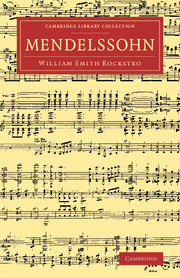
The composer, virtuoso pianist and conductor Felix Mendelssohn (1809–47) was lionised by the music-loving public during his lifetime, and his music is still greatly admired today. A versatile child prodigy, he wrote music for A Midsummer Night's Dream while he was still a teenager. Masterpieces such as the octet for strings, the 'Italian' symphony, the violin concerto and his great oratorio Elijah followed. His extraordinary ability was such that he was made an honorary member of the Philharmonic Society in 1829 at the age of only twenty during the first of his ten visits to Britain. A great advocate of Johann Sebastian Bach, Mendelssohn did much to reawaken interest in his music. This eminently readable short biography by the composer William Smith Rockstro (1823–95) was first published in 1884 as part of Francis Hueffer's 'Great Musicians' series. A list of Mendelssohn's works is included as an appendix.
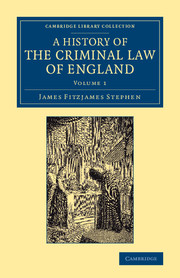
Sir James Fitzjames Stephen (1829–94) published this three-volume account of the English criminal law's historical development in 1883, four years after his appointment as a judge of the High Court. It is a revision and expansion of the second chapter in Stephen's 1863 General View (also reissued in this series). At first sight, it is ironic that the author of this classic of legal historical scholarship was himself a Benthamite who favoured and promoted the codification of the common law and worked on codes of criminal law and procedure for India and for England. Volume 1 contains a short preliminary account of Roman criminal law and pre-Conquest English criminal law; a survey of courts exercising criminal jurisdiction; a historical account of the development of the main elements of criminal procedure; a history of criminal punishments; and a general comparative view of the differences between English and French criminal procedure.
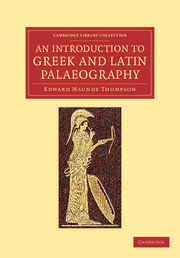
Principal librarian of the British Museum and eminent palaeographer, Sir Edward Maunde Thompson (1840–1929) had originally produced a handbook on the history and development of Greek and Latin handwriting in 1893. He extensively revised and expanded it for this 1912 edition, incorporating numerous facsimile plates. Thompson begins his treatment with an introduction to the Greek and Latin alphabets, then surveys ancient writing materials and implements, and describes the use and development of scrolls and codices. Later chapters, accompanied by valuable illustrations, examine the different forms of first Greek then Latin handwritten texts, from the earliest surviving examples (fourth century BCE) to the end of the fifteenth century. Punctuation, accents and abbreviations are considered, and the various scripts - cursive, uncial, majuscule and miniscule - are all illustrated and examined. Tables of Greek and Latin literary and cursive alphabets are also provided.
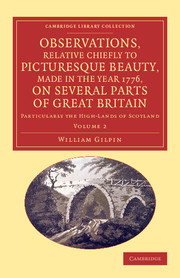
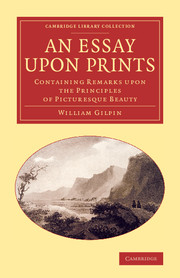
Clergyman, schoolmaster and writer on aesthetics, William Gilpin (1724–1804) is best known for his works on the picturesque. In his Essay on Prints, published in 1768 and reissued in this series, he defined picturesque as 'a term expressive of that peculiar kind of beauty, which is agreeable in a picture'. First published in 1789, this two-volume work forms part of a series which records his reflections on the picturesque across British landscapes. It traces the journey he made in 1776, equipped with notebook and sketching materials, exploring the landscape of the Scottish Highlands via northern England, Edinburgh and Glasgow. Reproductions of his pen-and-wash drawings are included. The companion volumes of Gilpin's Observations on other parts of Britain are also reissued in the Cambridge Library Collection. Volume 2 of the present work covers the journey from Loch Fyne to Keswick, taking in sites such as Loch Lomond and Dumbarton Rock.
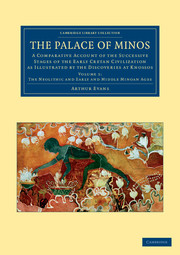
Inspired by Schliemann's discoveries at Mycenae and Troy, Sir Arthur John Evans (1851–1941), keeper of Oxford's Ashmolean Museum from 1884 to 1908, trustee of the British Museum and fellow of the Royal Society, used his inherited wealth to purchase land in Crete at Knossos. From 1900 he commenced excavations there in co-operation with the British School at Athens. Work continued for eight full seasons, uncovering a Bronze Age palace and bringing to light further architectural and artefactual remains of Minoan civilisation, including numerous texts in Linear A and Linear B. Evans' speculative reconstruction of the site in reinforced concrete remains controversial, and some of his interpretations are disputed, but his pioneering work is painstakingly detailed in this highly illustrated multi-volume work, published between 1921 and 1935, with an index volume appearing in 1936. Volume 1 (1921) opens with a sketch of Minoan civilisation and then surveys its early history.
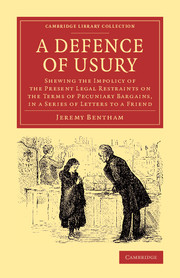
The utilitarian philosopher and jurist Jeremy Bentham (1748–1832) argues in this collection of letters for the cessation of government control of the rate of interest. The work first appeared in 1787 and is reissued here in the version published in Dublin in 1788. The final letter, addressed to Adam Smith, is a response to Smith's Wealth of Nations (1776), arguing against the limits to inventive industry forced by the restriction on rates. Throughout the work is Bentham's emphasis on the value, both ethical and practical, of allowing private citizens to regulate their own financial dealings. Bentham offers a sophisticated philosophical, economic and political analysis of 'usury' and in so doing provides a template for a wider liberal view. Influential at the time of publication, the work still retains its significance in making a case for the proper relationship between the individual and the state.
By the time of his death, William Herschel (1738–1822) had built revolutionary telescopes, identified hundreds of binary stars, and published astronomical papers in over forty volumes of the Royal Society's Philosophical Transactions. This two-volume collection, which originally appeared in 1912, was the first to gather together his scattered publications. It draws also on a wealth of previously unpublished material, from personal letters to numerous papers presented to the Philosophical Society of Bath. Although Herschel is best known for his discovery of Uranus, this collection highlights the true range of his observations and interests. Focusing on his early work, Volume 1 includes notes on the discovery of Uranus, unpublished papers on electricity, and studies of the lunar mountains and the poles of Mars - both of which he believed to be inhabited. It also features a biographical account by the historian of astronomy J. L. E. Dreyer.
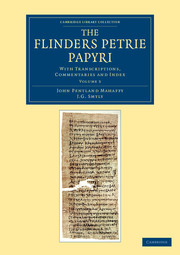
A pioneering Egyptologist, Sir William Matthew Flinders Petrie (1853–1942) excavated over fifty sites and trained a generation of archaeologists. A great many of his publications have been reissued in this series. In the 1890s, the Irish scholar Sir John Pentland Mahaffy (1839–1919) took the lead on the considerable task of cataloguing, transcribing and commenting on the Greek papyri found by Petrie in mummy cartonnage on recent digs in Egypt. This three-volume collection is the result of his labours. The texts, comprising private correspondence, legal records, petitions and many other types of document, reveal a great deal about life in Egypt in the third century BCE. First published in 1905 with significant input from Mahaffy's colleague J. G. Smyly, Volume 3 contains seven autotype reproductions of key examples, as well as a review by Mahaffy of the entire project and its scholarly reception.
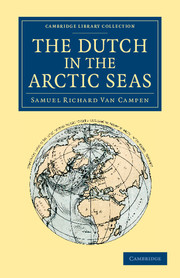
Despite Holland's rich history as a major maritime power, by the time this work first appeared in 1876 the Dutch had long abandoned their exploration of the Arctic Circle. In this detailed study, noting the achievements of Dutch navigators, Samuel Richard van Campen (c.1833–c.1893) makes the case for new expeditions into the north, not only to investigate the possibility of Arctic passages to America and Asia, but also to pursue scientific research. The author delineates potential routes and difficulties, discusses ocean conditions, and examines both historical and contemporary expeditions for flaws and successes. The book also includes as an appendix a chronological table of Arctic expeditions ranging from ninth-century Viking endeavours to Allen Young's 1876 voyage. Reissued here is the second edition of 1877, which does not differ textually from the first. Despite the author's intention to continue the work, a second volume never appeared.
Clergyman, schoolmaster and writer on aesthetics, William Gilpin (1724–1804) is best known for his works on the picturesque. His approach as a teacher was enlightened: during his time as headmaster of Cheam School, his aim was to prepare his pupils for life. Moving in 1777 to become vicar of Boldre, Hampshire, where he remained for the rest of his life, he was able to endow two schools there with income from his successful writings. This knowledgeable appraisal of the print as an art form, and of its foremost practitioners, was first published anonymously in 1768 to positive reviews. It defines picturesque as 'a term expressive of that peculiar kind of beauty, which is agreeable in a picture'. Gilpin further developed and explored the concept in his volumes of Observations on various parts of Britain, which are also reissued in this series.
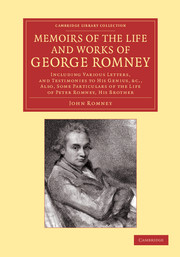
Written by his son John Romney (1757–1832) and published in 1830, nearly three decades after the artist's death, this collection of anecdotes and biographical episodes traces the extraordinary career of George Romney (1734–1802), highlighting his early training as a joiner in the family firm, his artistic education at the hands of the disreputable Christopher Steele, and his eventual fame as a portraitist of fashionable London. Recollections of personal and professional encounters with such influential figures as Laurence Sterne and Richard Payne Knight provide insights into the circumstances that inspired Romney's most famous works. Including an engraving of his self-portrait of c.1784, a section on his brother and fellow painter Peter Romney (1743–77), and a list of the designs and studies which were donated in 1817 to the Fitzwilliam Museum in Cambridge, this work reveals much about the eighteenth-century art world, its patrons and its pitfalls.
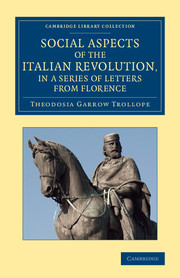
Having married and settled in Florence in the 1840s, the poet and translator Theodosia Trollope (1816–65) found herself well placed to chronicle the events which contributed to the unification of Italy. While another Englishwoman in Italy, Elizabeth Barrett Browning, would become better known for her verse, Trollope nevertheless firmly established herself in the liberal and literary circles of Florentine society, allowing her to witness at first hand, and explore in prose, the effects that the Risorgimento was having on those living through it. Vividly capturing the unfolding situation in Tuscany, twenty-seven letters first appeared in The Athenaeum in 1859–60. They were published together in this work of 1861, along with an update on the months that had elapsed since the last letter was written in April 1860. Championing the cause of unification, Trollope's writing helped to generate enthusiasm in Britain for the progress and personalities of the Risorgimento.
The German classical philologist Friedrich August Wolf (1759–1824) developed a holistic approach which deeply influenced modern classical studies. In this 1795 treatise, he argues that the poems attributed to Homer were composed orally and that, prior to their transcription, they were altered by editors and performers in order to appeal to contemporary audiences, only coming together in their apparent artistic unity once they had been written down. Like many scholars of his day, seeking to reach an international audience, Wolf wrote in Latin here. And although he may have intended to address further questions relating to the Homeric epics, only this volume was ever published. Radical at the time, the arguments presented here now form the foundation of modern Homeric scholarship, shedding light on the composition, performance, transmission and evolution of ancient poetry.
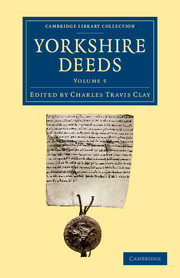
Published between 1909 and 1955, this ten-volume collection contains deeds relating to all of Yorkshire, from the twelfth to the seventeenth century. The deeds are of local historical interest, and provide topographical, philological and genealogical information, as well as insights into daily life. The majority of the records here are presented as abstracts, while documents in the vernacular that are of greater interest or importance are printed in full. Where possible, the documents are dated. Thorough background information and discussion of the deeds is included, as are notable physical descriptions, in particular of the seals. Each volume concludes with an index of people and places. Published in 1926, Volume 5 was edited by Charles Travis Clay (1885–1978). The majority of the documents in this volume relate to the West and North Ridings. The appendix contains an alphabetical list of all the deeds to have appeared thus far in the series.
Born into the theatre, though originally intended for Catholic holy orders, John Philip Kemble (1757–1823) made as great a name for himself on the English stage as his gifted older sister, Sarah Siddons. Known for his mastery of tragic Shakespearian roles, among which Coriolanus was deemed his finest, Kemble also distinguished himself as acting manager at Drury Lane under Sheridan. Described by Sir Walter Scott as 'grave, critical, full and laudably accurate', this extensive two-volume biography was the work of James Boaden (1762–1839), an author well acquainted with the foremost theatrical personalities of his day. Boaden's biographies of Sarah Siddons, Elizabeth Inchbald and Dorothy Jordan have also been reissued in this series, along with his edition of David Garrick's correspondence. Volume 2 of the present work opens with the season of 1789–90 at Drury Lane and closes with the text of Kemble's will.
The eminent French philologist Michel Bréal (1832–1915) made significant contributions to the fields of comparative linguistics, pedagogy and etymology. He became a member of the Académie des Inscriptions et Belles-Lettres in 1875 and a commander of the Légion d'honneur in 1890. This work, first published in 1877, gathers together articles that Bréal mostly wrote before 1869, when he was appointed secretary of the new and prestigious Société de Linguistique de Paris. He argues that language and mythology have a common origin, which accounts for why most abstract nouns are feminine, in remembrance of ancient deities. Bréal also exposes new ways to study languages and their impact in primary and secondary education. Lastly, he lays the foundations of modern semantics, a discipline he intended would reconcile historical linguistics with the philosophy of the Enlightenment.