A collection of out-of-copyright and rare books from the Cambridge University Library and other world-class institutions that have been digitally scanned, made available online, and reprinted in paperback.
To save content items to your account,
please confirm that you agree to abide by our usage policies.
If this is the first time you use this feature, you will be asked to authorise Cambridge Core to connect with your account.
Find out more about saving content to .
To save content items to your Kindle, first ensure no-reply@cambridge.org
is added to your Approved Personal Document E-mail List under your Personal Document Settings
on the Manage Your Content and Devices page of your Amazon account. Then enter the ‘name’ part
of your Kindle email address below.
Find out more about saving to your Kindle.
Note you can select to save to either the @free.kindle.com or @kindle.com variations.
‘@free.kindle.com’ emails are free but can only be saved to your device when it is connected to wi-fi.
‘@kindle.com’ emails can be delivered even when you are not connected to wi-fi, but note that service fees apply.
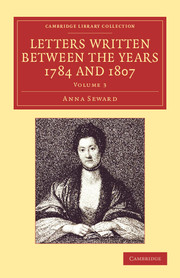
The literary career of Anna Seward (1742–1809) had many frustrations. Erasmus Darwin once printed her poetry under his own name. Horace Walpole accused her of having 'no imagination'. And despite her evident talents, she was unable to find a patron willing to support a woman. Yet her letters reveal the breadth of her interests and the strength of her literary criticism. In addition to writing to newspapers and magazines, she counted many eminent figures among her correspondents, including James Boswell (who begged for a lock of her hair) and the young Walter Scott. This six-volume selection of her letters, edited by the publisher Archibald Constable (1774–1827), first appeared in 1811. Volume 3 covers the years 1791–4. Ranging from simple but meticulous acknowledgements of praise for her poetry through to her wary opinions of the recent French Revolution, her letters show an unwavering devotion to both her literary criticism and the people closest to her.
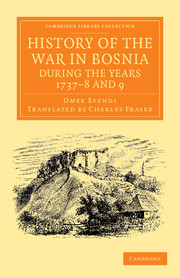
Serving as a judge in his native Bosnia in 1737 when war broke out between the Austrians and the Turks, Omer Efendi (about whose life little else is known) produced this vivid account of the conflict from an Ottoman perspective. Important for what it reveals about the region's social history, the work was revised and published by Ibrahim Müteferrika (c.1672–1745), the founder of Turkish printing. It was first published in English in 1830 after being translated by Charles Fraser, a professor at Edinburgh's Naval and Military Academy. Fraser also added an introduction to the work that gives both a brief history of Bosnia and an overview of the text. The narrative begins with a description of the army of the invading Austrians, who are described throughout as 'infidels'. An account is then given of the operations of the war, through to the signing of the Belgrade treaty in 1739.
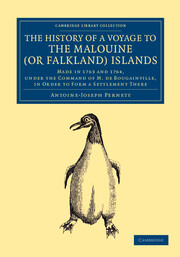
After the French and Indian War, in which France and England had fought over the control of North America, the French government decided to send an expedition to the Falkland Islands, or Isles Malouines, with a view to founding a colony where the Acadians expelled from Canada could settle. Under the command of Louis-Antoine de Bougainville (1729–1811), the 1763–4 expedition claimed these islands for France and established a base at Port Saint Louis. This work, translated from French and first published in English in 1771, is an illustrated account of this endeavour by Antoine-Joseph Pernety (1716–96), a naturalist and writer who took part in the expedition. Notably, it contains the first description of the geological phenomena of the stone runs on East Falkland. The latter part of the work is a compilation of letters and notes pertaining to subsequent voyages to Patagonia and the Straits of Magellan.
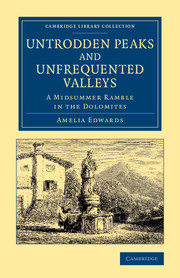
Even in the latter part of the nineteenth century, the Dolomites in the Italian Alps were little known beyond the geological community, and largely unexplored by non-natives. In 1872, the English author Amelia Edwards (1831–92) and her friend travelled through these mountains, riding side-saddle on donkeys. Edwards' account of their journey is presented in this charming work, originally published in 1873. In it, she describes in great detail the people and mishaps met with along the way, including also digressions on the history of the region, the local flora, and geological theories on the origin and development of the mountains. The lively text is accompanied by wood engravings of the settlements and landscapes encountered by the travellers on their route. The result is a highly readable record of a bold journey which helped open up this area to tourism.
'If one would understand the Greek genius fully, it would be a good plan to begin with their geometry.' As early as the sixth century BCE, Thales of Miletus used geometrical principles to calculate distance and height. Within a few hundred years, Euclid had produced his seminal Elements, which was still used as a textbook when this two-volume work was first published in 1921. A distinguished civil servant as well as an expert on ancient Greek mathematics, Sir Thomas Little Heath (1861–1940) includes here sufficient detail for a modern mathematician to grasp ancient methodology, alongside explanatory sections aimed at classicists. This remains a rigorous and essential exposition of a vast topic. Volume 2 focuses on post-Euclidian mathematics, beginning with the work of Aristarchus of Samos and extending to that of Diophantus of Alexandria. Heath had previously published separate studies on these two thinkers (also reissued in this series).
Ascribed to the Egyptian scholar Jalal al-Din al-Suyuti (1445–1505), this medieval Arabic history was translated into English by the orientalist James Reynolds (1805–66). An outstanding Islamic polymath, al-Suyuti produced a large body of work in such fields as grammar, rhetoric, theology, medicine and history. The present work may have been compiled from his earlier General History and Critical History of Traditions. It contains rich descriptions of religious places and buildings in Jerusalem, including the Dome of the Rock and the Mosque of Omar, and offers a historical account of the city. First published in 1836 for the Oriental Translation Fund of the Royal Asiatic Society, the translation was based on the text of two Arabic manuscripts preserved in the British Museum. Including a translator's preface and detailed exegetical notes, this publication remains a rich source for the architectural and topographical history of Jerusalem.
A pioneering Egyptologist, Sir William Matthew Flinders Petrie (1853–1942) excavated over fifty sites and trained a generation of archaeologists. In this short but classic work of 1904, he explains his vision for the young science of archaeology. Petrie outlines his processes and goals for an excavation, offering advice on how to manage workers drawn from the local population as well as guidance on creating a thorough record of a dig, the importance of which had not been fully appreciated by many contemporary archaeologists. His methods were highly influential in their more systematic and scientific approach to archaeology at a time when many of its practitioners were more focused on acquiring attractive artefacts than advancing knowledge. The text is accompanied by 66 illustrations. Petrie wrote prolifically throughout his long career, and a great many of his other publications - for both specialists and non-specialists - are also reissued in this series.
Throughout his professional life, the poet Thomas Moore (1779–1852) was variously celebrated and vilified for both his verse and his politics. Born in Dublin, he remained an ardent Irish patriot until his death. This eight-volume collection of Moore's memoirs, diaries and letters, edited by his friend Lord John Russell (1792–1878) and first published between 1853 and 1856, provides rare insights into a man whose genius was applauded by the Morning Chronicle as 'embracing almost all sides of imaginative literature, of criticism and philosophy'. Opening with a portrait of Moore's most loyal patron in his later years, the Marquis of Lansdowne, Volume 7 contains Moore's diary for the period 1833–44, during which he published Travels of an Irish Gentleman in Search of Religion (1833) and devoted much time to his History of Ireland (1835–46).
A respected hydraulic engineer, William Henry Wheeler (1832–1915) established himself as an authority in the fields of low-lying land reclamation and drainage, embanking, and the improvement of tidal rivers and harbours. Based on articles written for The Engineer in 1887, he published this more substantial work in 1888 to provide a practical point of reference for those working on existing drainage systems or designing and implementing new schemes. Drawing on first-hand knowledge of the low-lying fens of England and the polders of Holland, Wheeler describes the processes of drainage by gravitation and steam power. The book also includes chapters on lifting and draining water using the scoop wheel, the Archimedean screw pump and the centrifugal pump. Providing also a wealth of operational facts relating to pumping stations in England and abroad, this remains a rich source of information for those interested in the history of civil engineering.
Born and educated in Ireland, Max Arthur Macauliffe (1841–1913) joined the Indian Civil Service in 1862. In 1882 he was promoted to the post of deputy commissioner of the Punjab. But it was after he retired from the civil service in 1893 that he gained public attention. Macauliffe developed a close affinity with Sikhism while in the Punjab, eventually converting to the religion. His translation into English of the Guru Granth Sahib, the holy book of Sikhism, is recognised as the most accurate to date. Following this project, he set to work on this six-volume set, covering the history and philosophy of Sikhism, first published in 1909 and still regarded as the definitive work on the subject. Volume 6 covers the lives of the Hindu and Muslim saints whose compositions are included in the Sikh holy book. Translations of these compositions are also provided.
Containing an Account of the Great Distresses Suffered by Himself and his Companions on the Coast of Patagonia, from the Year 1740, till their Arrival in England, 1746
John Byron (1723–86) died a vice-admiral, having earned the nickname 'Foulweather Jack' after much experience on rough seas. In 1741 he was a midshipman aboard HMS Wager in a squadron sent to attack Spanish ships off Chile. Shipwrecked in a storm after rounding Cape Horn, the majority of the survivors turned on their captain and attempted to make their own way home. Byron was among the group who stayed with the commanding officer. In 1768, now a commodore, he published this account of the five harrowing years it took to get back to England, by which time he was one of only four survivors. Although no doubt written to give his side of the story, it appealed to a public eager for tales of dramatic endurance against the odds. Aboard the Beagle on Darwin's voyage, the book also informed the shipwreck in Don Juan by the author's grandson.
The dispersal in 1812 of the library of John Ker, Duke of Roxburghe (1740–1804) was the bibliographical event of the decade and a key moment in 'bibliomania'. The huge collection contained illuminated medieval manuscripts, incunabula, fifteen books printed by Caxton, and all four Shakespeare folios. The sale, orchestrated by the bookseller and auctioneer Robert Harding Evans (1777–1857), attracted the greatest book collectors and dealers of the day, setting new records. For the first time in British auction history a single book fetched more than £1,000, while the Valdarfer Boccaccio, the first edition of the Decameron, sold for £2,260. Reported in The Times, the sale immediately gained mythological status. Reissued together here are the printed catalogue and its supplement, both annotated by an attendee at the auction who recorded the name of every buyer and the price paid for each book. Ed Potten, Head of Rare Books at Cambridge University Library, has provided a new introduction that places the catalogue in its wider context.
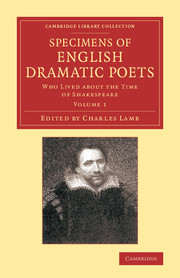
Since its first appearance in 1808, this collection of extracts from Elizabethan and Jacobean drama has been highly acclaimed; the twentieth-century critic Edmund Blunden considered it 'the most striking anthology perhaps ever made from English literature'. In compiling the work, the critic and essayist Charles Lamb (1775–1834) aimed to achieve two goals: to illustrate the greatness of Shakespeare's often forgotten contemporaries, and to explore the way in which sixteenth- and seventeenth-century Englishmen experienced emotion. He includes only those scenes which he judges to show the best poetry and the deepest passion, adding only brief notes to let the texts speak for themselves. This reissue is of the expanded two-volume edition of 1835. Volume 1 focuses on the plays produced at the height of the Elizabethan theatre's popularity. Including extracts from Kyd, Marlowe and Jonson, among others, it remains a rich resource for literature students.
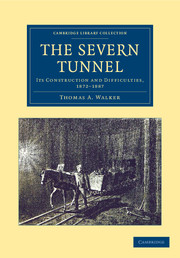
Costing at the time £1.8 million to complete, the Severn Tunnel was a Victorian engineering triumph, and for over a century it remained the longest rail tunnel in Britain. Construction had begun in 1873 but came to a standstill after the workings were inundated by water in 1879. An accomplished civil engineering contractor, Thomas Andrew Walker (1828–89) had worked on railways in Canada, Russia and Africa as well as on London's new underground lines; he was therefore well qualified to complete the Severn Tunnel, which was achieved in 1886. First published in 1888, Walker's first-hand account of the problematic project remains an engaging source for railway and engineering historians, and its detailed account of the ground encountered will also interest geologists. Replete with plans and maps, reissued here is the second edition of 1890, the year following Walker's death, which is likely to have been hastened by overwork.
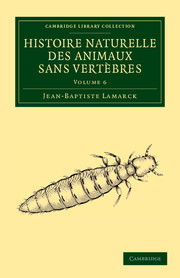
Best known for his ideas relating to evolution, French naturalist Jean-Baptiste Lamarck (1744–1829) first built his reputation as a botanist and was elected to the prestigious Académie des Sciences in 1779. His career took a new turn in 1793 when he was made professor of 'insects, worms and microscopic animals' at the Muséum National d'Histoire Naturelle, although he lacked prior knowledge of the subject area. Undaunted, Lamarck set out to classify organisms which few naturalists had considered worthy of study since Linnaeus. He was the first to distinguish vertebrates from 'invertebrates' - a term he coined - by the presence of a vertebral column. In this groundbreaking seven-volume work, published between 1815 and 1822, he arranges invertebrates into twelve classes, laying the foundations for the modern study of these organisms. Volume 6, published in two parts between 1819 and 1822 (reissued here together), continues with the study of conchifera and covers molluscs.
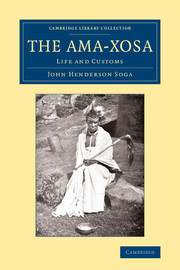
Son of Tiyo Soga, the first black South African to be ordained, John Henderson Soga (1860–1941) was a Xhosa minister and scholar. Like his father, he was one of the first of his people to be educated in Europe and to marry a European woman. His perspective on his people's history and culture is therefore distinctive. Conscious of the effects of modernity on Xhosa traditions, he published this work of social anthropology in 1932 to record their way of life as distinct from other tribal communities in South Africa. Soga traces the historical development of their clan system and laws, while offering uniquely informed insights into their beliefs and practices, such as the function of witch doctors and the customs of circumcision, lobola or 'bride price', and polygamy. The South-Eastern Bantu (1930), Soga's earlier survey of three branches of the Bantu family, is also reissued in this series.
Jane Haldimand Marcet (1769–1858) wrote across a range of topics, from natural philosophy to political economy. Her educational books were especially intended for female students, to combat the prevalent idea that science and economics were unsuitable for women, but they found broader popularity: Michael Faraday, as a young bookbinder's apprentice, credited Marcet with introducing him to electrochemistry. This two-volume work, first published in 1829, is a beginner's guide to botany. Since the chief aim was accessibility, Marcet does not dwell on the often burdensome process of plant classification, but focuses on plant forms and botany's practical applications. She presents the facts in the form of simple conversations between two students and their teacher. Based on the lectures of the Swiss botanist Candolle, Volume 1 introduces roots, leaves, sap, and the effects of different soil and air.
A pioneering Egyptologist, dedicated to careful, methodical and economical research, Sir William Matthew Flinders Petrie (1853–1942) made Near Eastern archaeology a much more rigorous and scientific discipline. This 1906 publication covers Petrie's work in the Sinai Peninsula, investigating the historical and biblical significance of the region, especially as it related to the Exodus. Copiously illustrated with photographs, the book depicts the region's climate, geography and antiquities, recording the logistical and archaeological processes that characterised Petrie's approach. Notable is the material on ancient turquoise mines and a Middle Kingdom temple at Serabit el-Khadim, where inscriptions in the previously unknown Proto-Sinaitic script were discovered. Several chapters by Charles T. Currelly (1876–1957) record additional travels and observations. Petrie wrote prolifically throughout his long career, and a great many of his other publications are also reissued in this series.
Beethoven's symphonies captured the public imagination from the outset and remain compelling today. Revolutionary in their time, these life-enhancing works now sit at the centre of the classical music repertoire, retaining their ability to delight and inspire. The career of Sir George Grove (1820–1900) ranged from civil engineering to biblical scholarship, but he is best known for editing his celebrated Dictionary of Music and Musicians. A driving force at the heart of nineteenth-century British musical life, Grove organised important concerts at the rebuilt Crystal Palace in Sydenham, and he served as the first director of the Royal College of Music from 1883 to 1894. First published in 1896, and reissued here in its swiftly corrected and indexed second edition, this work is a classic of musical analysis, exploring the composition, structure, performance and reception of each symphony in turn. Intended for 'the amateurs of this country', it represents the culmination of a lifetime's research.
By the late eighteenth century, scientists had discovered certain types of gas, such as 'fixed air' (carbon dioxide), but their composition was little understood. Relatively few investigations into gases had taken place, and so the polymath Joseph Priestley (1733–1804) was able to make major breakthroughs in the field using a range of experimental techniques. While living near a brewery, he found that it was possible to outline the shape of the gas above fermenting beer with smoke, and that fire would burn with varying strength depending on the composition of the air. This three-volume collection first appeared between 1774 and 1777. Priestley acknowledges that Volume 3 (1777) would more greatly interest those with technical training in the physical sciences as compared with general scholars. It also highlights some new and important inferences, notably on the function of blood in respiration.