A collection of out-of-copyright and rare books from the Cambridge University Library and other world-class institutions that have been digitally scanned, made available online, and reprinted in paperback.
To save content items to your account,
please confirm that you agree to abide by our usage policies.
If this is the first time you use this feature, you will be asked to authorise Cambridge Core to connect with your account.
Find out more about saving content to .
To save content items to your Kindle, first ensure no-reply@cambridge.org
is added to your Approved Personal Document E-mail List under your Personal Document Settings
on the Manage Your Content and Devices page of your Amazon account. Then enter the ‘name’ part
of your Kindle email address below.
Find out more about saving to your Kindle.
Note you can select to save to either the @free.kindle.com or @kindle.com variations.
‘@free.kindle.com’ emails are free but can only be saved to your device when it is connected to wi-fi.
‘@kindle.com’ emails can be delivered even when you are not connected to wi-fi, but note that service fees apply.
Born Alphonse Louis Constant, French magician Éliphas Lévi (1810–75) wrote prolifically on the occult sciences. His Histoire de la magie was first published in 1860. In it, Lévi recounts the history of the occult in Western thought, encompassing its biblical, Zoroastrian and ancient Greek origins, various magical practices of the medieval and early modern periods - including hermeticism, alchemy and necromancy - and the role of magic in the French Revolution. The last section of the book describes nineteenth-century magical practices and includes details of Lévi's own occult experiences. Prepared by Arthur Edward Waite (1857–1942), this English translation was first published in 1913. An editor and translator of numerous magical texts, Waite includes here a preface comprising an eloquent defense of Lévi and intellectual magic. The original French edition is also reissued in the Cambridge Library Collection.
Diplomat, philosopher and friend of John Donne and Ben Jonson, Edward Herbert (1582?–1648), first Baron Herbert of Cherbury, is best known for his philosophical treatise De veritate, examining the nature of truth. After Oxford and a period at court, he served as ambassador to France from 1619 to 1624. A reluctant Royalist, he surrendered the family seat, Montgomery Castle, to Parliament in 1644. His lively and amusing account of his adventures up to 1624 was first published by Horace Walpole in 1764 in an edition of only 200 copies. From the narrative we learn of Herbert's social triumphs in France and of his duels, affairs of the heart, views on education, and herbal remedies. Reissued here is the 1886 limited edition of 1,000 copies that was edited by the literary scholar Sidney Lee (1859–1926). Lee has completed Herbert's life story and offers an insightful introduction to the whole.
A leading figure of the Scottish Enlightenment, George Campbell (1719–96) began to write what was to become his most famous work, The Philosophy of Rhetoric, soon after his ordination as a minister in 1748. Later, as a founder of the Aberdeen Philosophical Society, he was able to present his theories, and these discourses were eventually published in 1776. In the spirit of the Enlightenment, Campbell combined classical rhetorical theory with the latest thinking in the social, behavioural and natural sciences. A proponent of 'common sense' philosophy, he was particularly interested in the effect of successful rhetoric upon the mind. Published in two volumes, the work is divided into three books. Volume 2 contains the concluding part of Book 2 and all of Book 3, which shows the author at his most intricate, expanding upon the correct selection, number and arrangement of words required for successful argument.
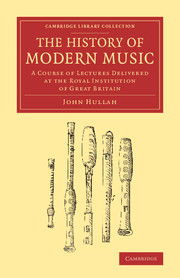
The music teacher and composer John Pyke Hullah (1812–84) is best remembered for his 'singing school for schoolmasters'. Through his dedicated efforts music was embedded into the school curriculum, and his inspiration influenced the rapid growth of amateur choral societies in Britain. Professor of vocal music at King's College, London, from 1844 to 1874, Hullah was elected to the committee of management of the Royal Academy of Music in 1869 and in 1872 became the first government inspector of music in teacher training colleges. Published in 1862, this accessible history of music from plainsong to the mid-nineteenth century, which Hullah divided into four periods, was first given as a course of six lectures at the Royal Institution in 1861. A further series of lectures, The Third or Transition Period of Musical History, is also reissued in this series in its 1876 second edition.
Thomas Bewick (1753–1828) began his career as an apprentice to the engraver and businessman Ralph Beilby (1743–1817). Having entered into a partnership and illustrated more than eighty small books for children, they decided to work together on this natural history, with Beilby drafting the descriptions and Bewick providing wood engravings and textual revisions. It was first published in 1790, cementing Bewick's reputation as an engraver of the natural world. Although by the end of 1797 the partnership had foundered, the book ran to seven editions and sold some 14,000 copies. Its aim was to describe and depict the domestic animals that 'so materially contribute to the strength, the wealth, and the happiness of this kingdom', and also provide entries on more exotic species, such as monkeys and big cats. Beginning with horses and cattle, this reissue of the first edition also includes an index of animals.
First published in 1824, this is a two-volume English translation of part of the account by German naturalists Johann Baptist von Spix (1781–1826) and Carl Friedrich Philipp von Martius (1794–1868) of their Brazilian expedition, one of the nineteenth century's great scientific enterprises. Despite debilitating conditions (which would contribute to Spix's premature death), they accumulated a spectacular collection of specimens, including dozens of live animals and over 10,000 other examples of flora and fauna. Although no further volumes appeared, this wide-ranging work formed part of the library aboard the Beagle during Darwin's famous voyage. Volume 2 covers the expedition's progress from São Paulo, through the state of Minas Gerais, to Villa Rica (now Ouro Preto) up to May 1818. One of the illustrations depicts the two indigenous children, Juri and Miranha, who were taken back to Munich. Several popular songs in Portuguese form an appendix.
Actor and baritone Eduard Devrient (1801–77) first met Felix Mendelssohn (1809–47) in 1822, and they remained close friends thereafter. During his lifetime, Mendelssohn achieved celebrity status as a composer, virtuoso pianist and conductor, and it was Devrient who secured in 1829 the famous performance in Berlin, under Mendelssohn's direction, of the St Matthew Passion, which began the Bach revival. First published in German in 1869, this work is reissued here in the English translation of the same year by Natalia Macfarren (1827–1913), singer and wife of the composer Sir George Macfarren. Her work as a translator included the first English versions of Wagner's Lohengrin and Verdi's Rigoletto. Although Devrient does not always exactly reproduce the correspondence, particularly where Mendelssohn is critical of others, the letters and commentary here serve to illuminate the development of a great composer.
Having trained as a civil engineer and surveyor, the ornithologist William Eagle Clarke (1853–1938) established himself in his field by preparing reports on bird migration for the British Association. Focusing on the species passing through the British Isles, Clarke spent many months in various lighthouses and on remote islands. He brought all his research together in this two-volume work, first published in 1912 and illustrated with maps and weather charts. In Volume 2, Clarke describes key examples of his investigations. Photographs of the sites he visited accompany the text. The locations range from the Flannan Isles, in the Outer Hebrides, to the island of Ushant, off the coast of Brittany. Clarke's expedition to the latter location ended abruptly when he and his colleague were mistaken for spies and forced to leave. Extensive coverage is also given to Fair Isle, between Shetland and Orkney.
Active in fields spanning medicine, ornithology, zoology and even watercolour painting, Frederick Dawtrey Drewitt (1848–1942) was a prominent fellow of the Royal College of Physicians, exhibited at the Royal Academy, and was involved in governing the National Trust. His particular interest in birds led him to study the work of the physician and naturalist Edward Jenner (1749–1823), who contributed to the field of ornithology through his observations of the cuckoo's behaviour. Jenner is better known, however, as the 'father of immunology' for pioneering the smallpox vaccination - the word 'vaccine' comes from the Latin vacca (cow) as Jenner used the cowpox virus to inoculate against smallpox infection in humans. Drewitt had general readers in mind when he wrote about Jenner's extraordinary life and growing worldwide recognition. The first edition of this biography was published in 1931, and this enlarged second edition appeared in 1933.
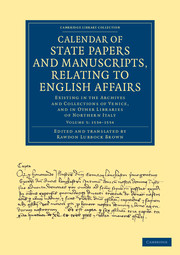
This is the fifth volume in a seven-volume collection - published in nine parts between 1864 and 1890 - comprising Venetian and other northern Italian state papers relating to England. Translator and editor Rawdon Lubbock Brown (1806–83) lived for many years in Venice, had unrivalled access to the Venetian archives and travelled widely to find documents in other Italian libraries and archives. He had previously published two volumes of Sebastian Giustinian's dispatches to Venice from Henry VIII's court (also reissued in this series). This fifth volume contains documents from the years 1534–54, which chronicle Henry's final years, Edward VI's short reign and the brief rule of Lady Jane Grey, followed by Mary's coronation - Ambassador Soranzo's official report of 1554 summarises all these matters. The editor's preface puts the various documents into historical context, and the appendix includes Acts of the Venetian Senate (in Latin) and miscellaneous documents (in English translation).
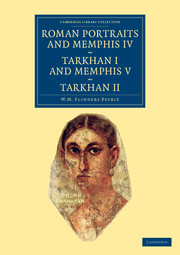
A pioneering Egyptologist, Sir William Matthew Flinders Petrie (1853–1942) excavated over fifty sites and trained a generation of archaeologists. The diversity of his work is revealed in these three excavation reports, reissued here together but originally published separately in 1911, 1913 and 1914. The first, an important resource on mummy portraits, records significant discoveries made during renewed work on the Roman necropolis at Hawara. Continued excavations at Memphis are also described. Petrie's work at Tarkhan, where he excavated numerous tombs, is written up in the second and third reports. Each report features a valuable section of illustrations, including photographs and drawings of the various sites and finds, most notably the lifelike mummy portraits. Petrie wrote prolifically throughout his long career, and a great many of his other publications - including earlier reports from both Hawara and Memphis - are also reissued in this series.
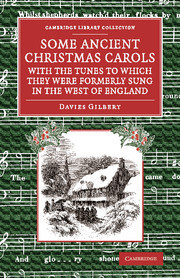
A significant figure in the scientific community of his day, and a mentor to the chemist Sir Humphry Davy and his successor as president of the Royal Society, Davies Gilbert (1767–1839) also represented his native Cornwall in Parliament for almost thirty years. His love of his county and his concern to preserve its customs led him to publish in 1822 this collection of eight Christmas folk carols, the first of its kind, drawing on Cornwall's rich oral tradition. In his preface, Davies paints a heartwarming picture of the Christmas Eves of his childhood when, 'in the evening, cakes were drawn hot from the oven; cyder or beer exhilarated the spirits in every house; and the singing of Carols was continued late into the night'. From 'The Lord at first did Adam make' to 'Let all that are to mirth inclined', these simple ballads reflect the West of England's festive heritage.
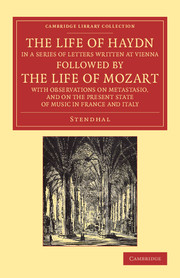
Marie-Henri Beyle (1783–1842), better known by his pen name Stendhal, is remembered today for such novels as Le Rouge et le Noir. In his lifetime, he wrote in a variety of literary genres and under a multitude of names. Louis-Alexandre-César Bombet was his choice of pseudonym for these early works, originally published in French in 1814. His lives of Haydn and Mozart were substantially derived from works by Giuseppe Carpani and Théophile Winckler respectively. Despite this audacious plagiarism, Stendhal's passion for music is evident, especially for Mozart, whose Clemenza di Tito he had enjoyed in Königsberg during the winter of 1812 whilst serving in Napoleon's army. Of especial interest to the modern reader are Stendhal's frequent digressions expressing his forthright opinions on the issues and figures of his day. This reissue is of Robert Brewin's English translation of 1817, with additional notes by the composer William Gardiner.
The German polymath Carl Stumpf (1848–1936) influenced one of the most significant philosophical developments of the early twentieth century: his student, Edmund Husserl, founded modern phenomenology. In a distinguished academic career spanning more than five decades, Stumpf also contributed to the growth of Gestalt psychology and ethnomusicology. An accomplished amateur musician, he used experimental methods to further the scientific study of music theory. His best-known work, first published in two volumes between 1883 and 1890, rigorously investigates the psychology of tone and music, ranging in coverage from physiology to acoustics. Its aim is to elucidate the effect that sounds have on various psychological functions. Volume 1 is divided into two sections. In the first, Stumpf describes the types of decision made by the human mind. In the second, he attempts to explain the connection between specific sounds and the decision-making process.
The orphaned son of an Anglican clergyman, David Hartley (1705–57) was originally destined for holy orders. Declining to subscribe to the Thirty-Nine Articles, he turned to medicine and science yet remained a religious believer. This, his most significant work, provides a rigorous analysis of human nature, blending philosophy, psychology and theology. First published in two volumes in 1749, Observations on Man is notable for being based on the doctrine of the association of ideas. It greatly influenced scientists, theologians, social reformers and poets: Samuel Taylor Coleridge, who named his eldest son after Hartley, had his portrait painted while holding a copy. In Volume 1, Hartley utilises Newtonian science in his observations. He presents a theory of 'vibrations', explaining how the elements of the nerves and brain interact as a result of stimulation, creating 'associations' and emotions.
Though professionally a banker and politician, John Lubbock (1834–1913) is best remembered for his scientific writings. As a boy, he was tutored by his father's friend, Charles Darwin, in natural history. He went on to make contributions to archaeology, anthropology and entomology. In this illustrated anthropological treatise, Lubbock applies evolutionary theory to the development of human civilisations, outlining the progression from ancient forms of art, relationships, religion, ethics, language and law to their counterparts in the present day. He argues that the social structures of ancient cultures can be interpreted through interaction with contemporary primitive cultures. Published in book form in 1870, the material for this work was first delivered as a lecture series at the Royal Institution. Lubbock's Pre-historic Times as Illustrated by Ancient Remains, and the Manners and Customs of Modern Savages (1865), in which he coined the terms Palaeolithic and Neolithic, is also reissued in this series.
Published in 1897, this two-volume work by Robert Seymour Conway (1864–1933), classical scholar and comparative philologist, later Hulme Professor of Latin at the University of Manchester, aims to shed light on the origins of the Latin language and Roman institutions by careful examination of the dialects and customs of Rome's neighbours. The work is laid out in geographical order, beginning with Southern Oscan in Sicily and moving north through Volscian and Latinian to conclude with Umbrian and Picenum, so that the influence of one dialect on its neighbours can be traced. This first volume collects all the surviving remains of these minor Italic dialects, gleaned primarily from epigraphic sources (such as Oscan inscriptions at Pompeii and elsewhere), but also from the evidence of coins, glosses and other references in later writers, and geographical and proper names from the dialect areas.
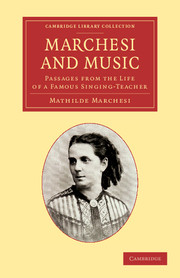
The German mezzo-soprano and celebrated singing teacher Mathilde Marchesi (1821–1913) presents an illuminating account of her life in these memoirs. First published in 1897, the book reflects the significant role that Marchesi played in vocal education during the nineteenth and early twentieth centuries. Having begun her career as a performer, from 1854 she devoted herself to teaching at the Vienna Conservatory and also in Paris and Cologne. She instructed many of the pre-eminent female singers of the age, including Nellie Melba, Mary Garden and Emma Calvé. Also renowned for bringing the Italian bel canto vocal technique into the twentieth century, Marchesi occupied a prominent position in musical history. Featuring musical excerpts and a number of other illustrations, these memoirs record her outstanding achievements and strong opinions. The work also includes a brief introduction by the French composer Jules Massenet.
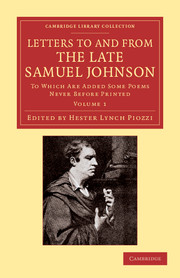
One of the most celebrated individuals of English literature, Samuel Johnson (1709–84) was a defining figure of his age. In addition to his celebrated labours as a lexicographer, Johnson distinguished himself as a poet, essayist, critic, biographer and editor. The writer and society hostess Hester Lynch Piozzi (1741–1821) was an unconventional woman of great intellectual vivacity. She became a close friend of Johnson, whom she met through her first husband, the brewer Henry Thrale, whose ailing business Johnson did much to support. As well as writing essays, poetry, memoirs and travel diaries, she was one of the first women to produce works on philology and history. First published in 1788 - two years after her groundbreaking Anecdotes of the Late Samuel Johnson, which anticipated Boswell's biography - these letters offer a captivating glimpse into their daily lives and concerns. Volume 1 covers the period 1765 to 1777.
Successors such as Wordsworth and Coleridge admired yet overshadowed William Cowper (1731–1800). Troubled by mental instability, he retreated from both the legal profession and the woman he had hoped to marry, seeking out a quiet existence in the country. In spite of his struggles, he made a translation of Homer's Iliad, produced a considerable body of poetry, and maintained many epistolary contacts. This four-volume biography, compiled by his friend and fellow poet William Hayley (1745–1820), appeared between 1803 and 1806, bringing together selected letters and unpublished poems to illuminate Cowper's personal and literary life. Opening with an essay, 'Desultory remarks on the letters of eminent persons, particularly those of Pope and Cowper', Volume 3 (1804) includes letters in which Cowper gives his frank opinions of contemporary literary figures, notably Samuel Johnson, interspersed with his characteristic flights of whimsy and enthusiastic remarks on gardening.