A collection of out-of-copyright and rare books from the Cambridge University Library and other world-class institutions that have been digitally scanned, made available online, and reprinted in paperback.
To save content items to your account,
please confirm that you agree to abide by our usage policies.
If this is the first time you use this feature, you will be asked to authorise Cambridge Core to connect with your account.
Find out more about saving content to .
To save content items to your Kindle, first ensure no-reply@cambridge.org
is added to your Approved Personal Document E-mail List under your Personal Document Settings
on the Manage Your Content and Devices page of your Amazon account. Then enter the ‘name’ part
of your Kindle email address below.
Find out more about saving to your Kindle.
Note you can select to save to either the @free.kindle.com or @kindle.com variations.
‘@free.kindle.com’ emails are free but can only be saved to your device when it is connected to wi-fi.
‘@kindle.com’ emails can be delivered even when you are not connected to wi-fi, but note that service fees apply.
The later works of the radical and visionary Romantic poet Percy Bysshe Shelley (1792–1822) include some of his boldest productions, such as the large-scale verse dramas Prometheus Unbound and The Cenci, the miniatures 'Ode to a Skylark' and 'Ode to the West Wind', and the sonnet 'Ozymandias'. All have taken their place among the classics of English literature. This one-volume collection contains four editions which were originally published during the poet's lifetime and which feature his prefaces. These are Prometheus Unbound with Other Poems (1820); Hellas: A Lyrical Drama (1822), which also includes 'Lines Written on Hearing the News of the Death of Napoleon'; The Cenci: A Tragedy in Five Acts (second edition, 1821); and Rosalind and Helen: A Modern Eclogue with Other Poems (1819). The fifth and final component is Posthumous Poems (1824), with a preface by Mary Shelley, the poet's second wife.
First published in 1824, this is a two-volume English translation of part of the account by German naturalists Johann Baptist von Spix (1781–1826) and Carl Friedrich Philipp von Martius (1794–1868) of their Brazilian expedition, one of the nineteenth century's great scientific enterprises. Despite debilitating conditions (which would contribute to Spix's premature death), they accumulated a spectacular collection of specimens, including dozens of live animals and over 10,000 other examples of flora and fauna. Although no further volumes appeared, this wide-ranging work formed part of the library aboard the Beagle during Darwin's famous voyage. Volume 1 recounts the early stages of the expedition, covering the voyage from Trieste to Rio de Janeiro. It contains studies of the flora and fauna of Malta, Gibraltar and Madeira. The volume concludes with the arrival at São Paulo on 31 December 1817.
Scholar and composer Emil Naumann (1827–88) studied with Mendelssohn, and his compositions reflect the style of his teacher. He published several works on musical aesthetics and history, of which Illustrierte Musikgeschichte, written between 1880 and 1885, is his best known. It went through many editions and this English translation, first published in 1888, was prepared by the composer, pianist and writer Ferdinand Praeger (1815–91). To rectify the work's marked neglect of English music, chapters were added by its editor, the eminent Victorian musician Sir Frederick Gore Ouseley (1825–89), Professor of Music at Oxford. Lavishly illustrated and with musical examples throughout, this two-volume history was intended to 'aid in fostering ever-increasing interest in the most emotional and cherished of all the arts'. Volume 1 covers the music of ancient civilisations through to the eighteenth century.
Scholar and composer Emil Naumann (1827–88) studied with Mendelssohn, and his compositions reflect the style of his teacher. He published several works on musical aesthetics and history, of which Illustrierte Musikgeschichte, written between 1880 and 1885, is his best known. It went through many editions and this English translation, first published in 1888, was prepared by the composer, pianist and writer Ferdinand Praeger (1815–91). To rectify the work's marked neglect of English music, chapters were added by its editor, the eminent Victorian musician Sir Frederick Gore Ouseley (1825–89), Professor of Music at Oxford. Lavishly illustrated and with musical examples throughout, this two-volume history was intended to 'aid in fostering ever-increasing interest in the most emotional and cherished of all the arts'. Volume 2 covers the eighteenth and nineteenth centuries, and includes an index.
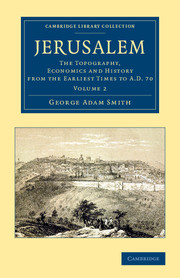
First published in two volumes between 1907 and 1908, this major work by the Scottish biblical scholar and geographer Sir George Adam Smith (1856–1942) is organised into three books. Volume 2 contains the third book and consists of a historical narrative that clarifies political and religious developments in ancient Jerusalem. It contains a number of useful maps, plans and photographs. Best known for his celebrated Historical Geography of the Holy Land (1894), Smith provides here a more detailed and specialist analysis, based on first-hand knowledge derived from the visits he made to the region over the years. Spanning more than fourteen centuries of Jerusalem's history from 1400 BCE to 70 CE, these well-illustrated volumes remain a standard work of scholarship, expertly elucidating the changing shape of the city.
Akbar the Great (1542–1605) is often regarded as the Mughal Empire's most accomplished ruler. This document on the workings of his empire was produced by Akbar's vizier, Abu'l-Fazl ibn Mubarak (1551–1602). Between 1783 and 1786, the scholar Francis Gladwin (1744/5–1812) produced an English translation from the original Persian. Reissued here is the two-volume edition that appeared in 1800. As the work's dedicatee and Governor-General of Bengal, Warren Hastings had seen the translation as illuminating the Mughal Empire's 'original constitution' and believed it would educate and inform Britain's colonial administrators. Gladwin's text would not be superseded for many decades, and it testifies to the quality of his scholarship and the contemporary concerns of the East India Company. Volume 1 explains the workings of the royal household and military offices, including details of the mint, treasury and harem, as well as building regulations.
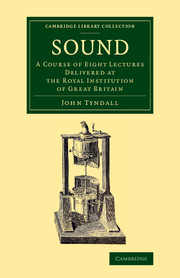
Professor of natural philosophy at the Royal Institution between 1853 and 1887, the British physicist and mountaineer John Tyndall (1820–93) passionately sought to share scientific understanding with the Victorian public. A lucid and highly regarded communicator, he lectured on such topics as heat, light, magnetism and electricity. In this collection of eight lectures, first published in 1867, Tyndall explains numerous acoustic phenomena for a non-specialist audience. Emphasising the practical nature of scientific enquiry, he describes experiments throughout and includes many illustrations of laboratory equipment. The lectures discuss the general properties of sound, how it travels, how noise and music differ, how gas flames can produce musical notes, and much more. Several of Tyndall's other publications, from his work on radiant heat to his exploration of alpine glaciers, are also reissued in this series.
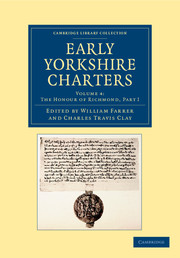
This thirteen-volume series, which first appeared between 1914 and 1965, is an extensive collection of the pre-thirteenth-century charters and related records of Yorkshire, which had previously remained largely unpublished. The first three volumes were edited by William Farrer (1861–1924), after whose death Charles Travis Clay (1885–1978) took up the task. The series was well respected for the quality of Farrer's editing, which was surpassed only by that of Clay in the later volumes. Volume 4 (1935) is the first of two devoted to the honour of Richmond. This volume includes the charters of the lords of the honour as well as texts concerned with land in Yorkshire. Each Latin document is amply annotated in English and accompanied by a discussion of its content and points of interest. The volume also contains facsimile plates of select documents as well as detailed indexes.
In terms of musical composition, all but the first five of his thirty-five years were astoundingly productive for Wolfgang Amadeus Mozart (1756–91). A stream of glorious symphonies, piano concertos, chamber music, operas and the sublime but unfinished Requiem poured from his pen. German philologist and archaeologist Otto Jahn (1813–69) was inspired to write a scholarly biography of Mozart following a conversation at Mendelssohn's funeral in 1847. He immersed himself in intensive research on the composer and his music, publishing the first edition of this landmark work in four volumes between 1856 and 1859. A second edition followed in 1867, incorporating new material and making use of Köchel's 1862 catalogue of Mozart's works. It is from this edition that Pauline D. Townsend made her three-volume English translation, first published in 1882. Volume 3 discusses the Mozart–Da Ponte operas and the Requiem, and also includes a list of his works.
Born in Scotland, James Fergusson (1808–86) spent ten years as an indigo planter in India before embarking upon a second career as an architectural historian. Although he had no formal training, he became one of the most respected researchers in the field and an expert on India's cave temples. His History of Indian and Eastern Architecture was first published in 1876 and became a standard work. It was revised in this two-volume edition of 1910 by James Burgess (1832–1916), former Director of the Archaeological Survey of India, and Richard Spiers (1838–1916), a noted architect and historian of architecture. Volume 2 covers Jain and Indo-Aryan architecture, Islamic architecture in India, and the buildings of Burma, Cambodia, Thailand and Java. The final chapter looks at Chinese and Japanese temples. Illustrated with nearly 300 maps, plans and drawings, this work of impressive scope remains relevant to students of Indian and Asian architecture and history.
As early as the seventeenth century, scientists realised that a pendulum swings more slowly at the equator than it would at the North Pole. Newton predicted that gravity increased with latitude, and that the Earth could not be perfectly spherical. Although various experiments were undertaken to determine the exact degree of this ellipticity, none proved successful until physicist Edward Sabine (1788–1883) embarked on a series of expeditions across the world. Based on pendulum measurements from a wide range of latitudes, from Jamaica to Spitsbergen, his results were very different to mathematical predictions, and far more accurate; Charles Babbage would even complain that they were too good to be true. In this account, which first appeared in 1825, Sabine explains his methodology and presents his findings. His book opens a fascinating window into nineteenth-century geodesy for students in the history of science.
A bestseller in its day, this three-volume work vividly recounts significant voyages made by Britain's leading navigators. A prominent figure in London cultural life, John Hawkesworth (c.1720–73) was commissioned by the Admiralty to compile, from the captains' journals, the official record of voyages which included James Cook's first journey to the South Pacific. Reissued here is the Dublin edition based on the first printing of 1773; a second edition appeared later in the year. Critical opinion was fierce, however, with Hawkesworth accused of impiety, manipulating the original texts and promoting the sexual freedoms of Pacific islanders. Devastated by these attacks, he died the same year. Later taken aboard the Beagle with Darwin, the work still speaks to scholars and students of nautical exploration. Volume 2 presents the first part of Cook's account of his first voyage, including fascinating descriptions of Tahiti and his mapping of New Zealand.
Perhaps the first celebrity chef, Alexis Soyer (1810–58) was a flamboyant, larger-than-life character who nonetheless took his profession very seriously. As the chef of London's Reform Club, he modernised its kitchens, installing refrigerators and gas cookers. They became something of a showpiece, even opening for tours. In contrast, Soyer also organised soup kitchens during the Great Famine in Ireland and volunteered his services in the Crimea in 1855 to improve military catering. He was also a prolific inventor of kitchen gadgets, notably promoting the Magic Stove, used for cooking food at the table. This work, first published in 1849, was aimed at the middle classes. Conceived as a dialogue between two housewives, it contains hundreds of recipes and tips, giving modern readers a rich insight into household management of the time. Also reissued in this series are Soyer's Gastronomic Regenerator (1846) and Culinary Campaign (1857).
Daughter of a Unitarian minister and schoolmaster, the penal reformer and educationist Mary Carpenter (1807–77) grew up in a pious family with a strong sense of obligation to those who were less fortunate. Moved by the appalling circumstances of destitute children in Bristol, she established her first ragged school in 1846. In her bid to improve the difficult lives of juvenile delinquents, her enlightened philosophy was one of rehabilitation rather than retribution, emphasising the importance of giving children a sense of self-worth. These views form the basis of this landmark work, first published in 1851. Marshalling a range of evidence in support of her argument, Carpenter highlights the need for radical change in the treatment of young offenders. Her lobbying bore fruit in England with the passage of the Youthful Offenders Act (1854), described as 'the Magna Carta of the neglected child'.
Inspired by Schliemann's discoveries at Mycenae and Troy, Sir Arthur John Evans (1851–1941), keeper of Oxford's Ashmolean Museum from 1884 to 1908, trustee of the British Museum and fellow of the Royal Society, used his inherited wealth to purchase land in Crete at Knossos. From 1900 he commenced excavations there in co-operation with the British School at Athens. Work continued for eight full seasons, uncovering a Bronze Age palace and bringing to light further architectural and artefactual remains of Minoan civilisation, including numerous texts in Linear A and Linear B. Evans' speculative reconstruction of the site in reinforced concrete remains controversial, and some of his interpretations are disputed, but his pioneering work is painstakingly detailed in this highly illustrated multi-volume work, published between 1921 and 1935, with an index volume appearing in 1936. Part 2 of Volume 4 first appeared in 1935.
One of the greatest mathematicians of the nineteenth century, Carl Gustav Jacob Jacobi (1804–51) burst into the limelight with his redevelopment, together with Niels Henrik Abel (1802–29), of the theory of elliptic functions. His pioneering work was characterised by the variety of problems tackled and the power of the tools used to tackle them. His lasting influence on rational mechanics, number theory, partial differential equations, complex variable theory and computation is marked by the number of fundamental concepts that bear his name (the Jacobian, the Jacobi sum and the Jacobi symbol, among others). His collected works, comprising treatises, letters and papers written in German, Latin and French, were published in eight volumes between 1881 and 1891. Edited by fellow German mathematician Karl Weierstrass (1815–97), Volume 2 appeared in 1882.
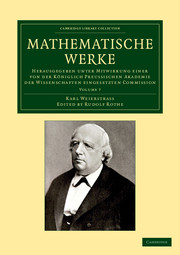
The German mathematician Karl Weierstrass (1815–97) is generally considered to be the father of modern analysis. His clear eye for what was important is demonstrated by the publication, late in life, of his polynomial approximation theorem; suitably generalised as the Stone–Weierstrass theorem, it became a central tool for twentieth-century analysis. Furthermore, the Weierstrass nowhere-differentiable function is the seed from which springs the entire modern theory of mathematical finance. The best students in Europe came to Berlin to attend his lectures, and his rigorous style still dominates the first analysis course at any university. His seven-volume collected works in the original German contain not only published treatises but also records of many of his famous lecture courses. Edited by Rudolf Rothe (1873–1942), Volume 7 was published in 1927.
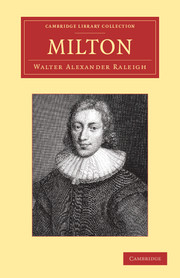
Ranking among the greatest of all English poets, John Milton (1608–74) was an influential thinker during a particularly volatile period in his nation's history. His supreme masterpiece Paradise Lost forms one of the pillars of English literature. The literary scholar and historian Sir Walter Alexander Raleigh (1861–1922) was educated at University College London and King's College, Cambridge. Following posts at Liverpool and Glasgow, he was appointed Professor of English Literature at Oxford University, where he also served as an adviser to the Clarendon Press. This work, first published in 1900, is based upon lectures he gave the previous year as Clark Lecturer in English Literature at Trinity College, Cambridge. Admired by the critic William Empson, it is a penetrating study of the great poet and contains a biographical sketch as well as lucid analyses of Milton's use of language and its significant influence.
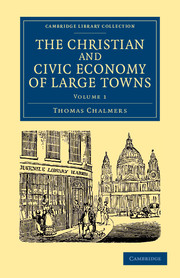
This three-volume study by the Scottish churchman and social reformer Thomas Chalmers (1780–1847) is a revealing work of Christian morality as applied to urban economic theory. Having moved to Glasgow in 1815, Chalmers was given a free hand in 1819 for an experiment in urban ministry at the new parish of St John's in the poorest district of the city. His reforms improved education and reduced the need for institutional poor relief by dividing the area into manageable 'proportions' that were closely looked after by parish elders and deacons, reviving a traditional community spirit and promoting self-help. Although sometimes severe, Chalmers' system and this influential work reflect Enlightenment optimism regarding human nature, suggesting the need for the Church of Scotland to respond actively to problems of urban industrialisation. Volume 1, published in 1821, outlines his theories of locality and the ways in which the Church could support the community.
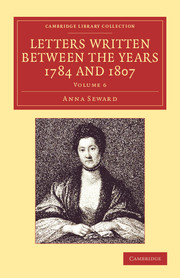
The literary career of Anna Seward (1742–1809) had many frustrations. Erasmus Darwin once printed her poetry under his own name. Horace Walpole accused her of having 'no imagination'. And despite her evident talents, she was unable to find a patron willing to support a woman. Yet her letters reveal the breadth of her interests and the strength of her literary criticism. In addition to writing to newspapers and magazines, she counted many eminent figures among her correspondents, including James Boswell (who begged for a lock of her hair) and the young Walter Scott. This six-volume selection of her letters, edited by the publisher Archibald Constable (1774–1827), first appeared in 1811. A touching record of her final years, Volume 6 covers the period 1802–7. It includes her letters to the young Walter Scott, who visited her at her Lichfield home and prepared an edition of her poems after her death.