A collection of out-of-copyright and rare books from the Cambridge University Library and other world-class institutions that have been digitally scanned, made available online, and reprinted in paperback.
To save content items to your account,
please confirm that you agree to abide by our usage policies.
If this is the first time you use this feature, you will be asked to authorise Cambridge Core to connect with your account.
Find out more about saving content to .
To save content items to your Kindle, first ensure no-reply@cambridge.org
is added to your Approved Personal Document E-mail List under your Personal Document Settings
on the Manage Your Content and Devices page of your Amazon account. Then enter the ‘name’ part
of your Kindle email address below.
Find out more about saving to your Kindle.
Note you can select to save to either the @free.kindle.com or @kindle.com variations.
‘@free.kindle.com’ emails are free but can only be saved to your device when it is connected to wi-fi.
‘@kindle.com’ emails can be delivered even when you are not connected to wi-fi, but note that service fees apply.
The naturalist and traveller Thomas Pennant (1726–98) helped popularise British ornithology by meticulously compiling and arranging existing research. At the age of twelve, Pennant had been given Francis Willughby's Ornithology (1678), to which he credited his lifelong love of natural history. His own writings on ornithology are heavily based on the classification system devised by Willughby and John Ray, which divides birds primarily into land birds and waterfowl. Although Pennant's brief, accessible book brought few original insights to the field, it boosted public interest in the study and classification of birds. The detailed descriptions of the appearance and habits of each bird are enlivened by the author's elegant turns of phrase. This better-known 1781 version of the 1773 original includes fifteen fine engravings. Pennant's other zoological works include Arctic Zoology (1784–5) and his History of Quadrupeds (third edition, 1793), both of which are reissued in this series.
Or, Memoirs of the Lives and Writings of the Most Eminent Musical Composers and Writers, Who Have Flourished in the Different Countries of Europe during the Last Three Centuries
A naturalist and Church of England clergyman, William Bingley (1774–1823) wrote widely on botany, topography and zoology. Works such as his Tour of North Wales (1800), Animal Biography (1802) and Memoirs of British Quadrupeds (1809) enjoyed great popularity. He served as curate of the priory in Christchurch, Hampshire, and from 1816 to 1823 as minister of Fitzroy Chapel in Charlotte Street, London. This two-volume publication, which first appeared in 1814, is one of his many works of compilation. Bingley takes as his principal sources the great music histories of Hawkins and Burney (also reissued in this series), to which he acknowledges his debt. The work comprises vignettes of chiefly Italian, German and British composers of the sixteenth, seventeenth and eighteenth centuries, touching also on French and Spanish musicians. Volume 1 covers the sixteenth and seventeenth centuries. The introduction gives a brief account of early church music.
Commissioned by the enterprising actor-manager John Rich, Covent Garden's Theatre Royal first opened its doors in December 1732. Principally a playhouse during its first century, the venue has had an eventful history involving two disastrous fires and riots over ticket prices. Most notably, it hosted Handel's incomparable operas and oratorios, and was where he presented regular seasons from 1735 until his death in 1759. Not until 1847, under Michael Costa, did the theatre dedicate itself to opera, and in 1892 it received the name by which it is known today: the Royal Opera House. Secretary of the Guildhall School of Music from 1901 to 1935, Henry Saxe Wyndham (1867–1940) published this richly illustrated two-volume account in 1906, celebrating the venue's legendary personalities and productions. Volume 2 covers the period 1819 to 1897 and includes appendices which list principal events and managers.
The English polymath Joseph Priestley (1733–1804) wrote on a wide range of scientific, theological and pedagogical subjects. In 1761, he produced the influential textbook Rudiments of English Grammar (also reissued in this series). The following year, having taken up a teaching position at Warrington Academy, he released this outline of nineteen lectures on a variety of linguistic topics. Although it was not published, it was distributed to other dissenting academies. Intended to give teachers a starting point when discussing 'the art of language' in its diverse forms, the lectures range from articulation and the alphabet to comparative linguistics, syntax, metre and the evolution of language. Along with its companion work, it established Priestley as one of the leading grammarians and educators of his time. Modern readers will gain a deeper understanding of his drive to increase and share knowledge of how and why speech and writing served their purpose.
The Swiss mathematician Jakob Steiner (1796–1863) came from a poor background with an incomplete education, yet such was his mathematical talent that eventually the Prussian university system adapted itself to him rather than he to it. A geometer in an age dominated by analysts, he pursued his own interests in his own way. The elegant results which bear his name - including Steiner circles, systems and symmetrisation - are known to most mathematicians today. Considered by many to be the greatest geometer since Apollonius of Perga, Steiner did important work on systemising geometry, laying the foundation for much later work on projective geometry. Edited by the eminent mathematician Karl Weierstrass (1815–97), this two-volume edition of Steiner's collected works offers scholars access to his influential writings in the original German. Volume 2 was published in 1882.
The daughter of a Scottish soldier and a Jamaican herbalist, Mary Seacole (1805–81) gained recognition for her provision of care to British troops during the Crimean War. She had travelled widely in the Caribbean and Panama before venturing to England to volunteer as an army nurse in the Crimea. Although rebuffed by officials, an undeterred Seacole funded her own expedition, establishing the British Hotel near Balaclava to provide a refuge for wounded officers. Known affectionately as 'Mother Seacole' among the men, yet returning to England bankrupt at the end of hostilities, she had her plight highlighted in the press. First published in 1857, and reissued here in its 1858 printing, her autobiography was intended to share her story and restore to her some financial security. Probably dictated to her editor, who then polished the text for publication, this was the first autobiography by a black woman in Britain.
Early in the twentieth century, public interest in Jane Austen (1775–1817) was considerable. Although the popularity of her work had remained modest in her lifetime, she was sufficiently well known by the centenary of her death to have provoked toxic reviews from Henry James and Mark Twain along with the reserved support of E. M. Forster. Previous biographies had been riddled with inaccuracies: she was called 'narrow', was said to have disliked children and animals, and to have led a quiet, almost monastic life. Many of these mistakes could be traced back to the unashamedly idealised biography written by her nephew, but while contrary accounts emerged later in the form of her letters, the old misapprehensions endured. In this neglected addition to Austen literature, first published in 1920, Mary Augusta Austen-Leigh (1838–1922) corrects many of these errors, advocating a closer critical reading of her great aunt's novels.
Edited by the eminent anthropologist and linguist Franz Boas (1858–1942), this work was first published in two huge volumes between 1911 and 1922. Comprising detailed studies of several Native American languages, Volume 1 has been split into two parts for this reissue. Part 1 contains chapters on the Athapascan (Hupa), Tlingit, Haida, Tsimshian and Kwak'wala languages. Each chapter contains a discussion of the speakers of the language, its geographical distribution, the phonetic system, and an analysis of the grammar and vocabulary. The work built upon the foundations laid by J. W. Powell (1834–1902) in his Introduction to the Study of Indian Languages (1877). Boas, a pioneer in the field of cultural anthropology, used his introduction to the present work to promote his culturally relativist approach to ethnographic study. Overall, the project ranks as a landmark in entrenching scientific principles for the study of North America's indigenous peoples and languages.
From humble origins, and trained by the London Missionary Society in theology, printing and rudimentary medicine, William Ellis (1794–1872) sailed for the Society Islands in 1816. He found himself at the cusp of major cultural change as Western influences affected the indigenous Polynesians. During his time there, Ellis became a skilled linguist and able chronicler of the traditional yet rapidly shifting way of life. He succeeded in capturing vivid stories of a leisured people who, without written language, had developed a rich oral tradition, social structure and belief system. Published in 1829, this two-volume collection proved to be an important reference work, notably for its natural history; it soon accompanied Darwin aboard the Beagle. In Volume 2, Ellis moves between Huahine and Raiatea, giving further background on the existing customs and polytheistic rituals, contrasted with the introduction of Western religion, dress, schools, housing, medicine and law.
Frances Sheridan (1724–66) won acclaim in her day as both a playwright and novelist. Her most famous work, the sentimental novel Memoirs of Miss Sidney Bidulph (1761), found favour with Samuel Johnson, while her comedy The Discovery (1763) was staged by David Garrick at Drury Lane. Her fame was later eclipsed by that of her son, the playwright and politician Richard Brinsley Sheridan (1751–1816). Written by Alicia Lefanu (1791–c.1844), her granddaughter, this 1824 publication reaffirms the significance of Frances Sheridan's own work as a writer. Recounting her successes and incorporating her own recollections, the book reveals a woman admired both for her literary output and for her character. This work also includes reflections on the life of her son, whose early writing was influenced by that of his mother. Thomas Moore's two-volume biography of Richard Brinsley Sheridan has also been reissued in this series.
This is the last volume in a seven-volume collection - published in nine parts between 1864 and 1890 - comprising Venetian and other northern Italian state papers relating to England. Translator and editor Rawdon Lubbock Brown (1806–83) lived for many years in Venice, had unrivalled access to the Venetian archives and travelled widely to find documents in other Italian libraries and archives. After his death, the work was completed by George Cavendish Bentinck (1821–91), who was a trustee of the British Museum and provides a preface to the documents assembled by his predecessor. Brown had previously published two volumes of Sebastian Giustinian's dispatches to Venice from Henry VIII's court (also reissued in this series). This seventh volume documents Venetian relations with England during the period 1558–80, the early part of Elizabeth I's reign. An index and a brief appendix of miscellaneous documents are also included.
By the late eighteenth century, scientists had discovered certain types of gas, such as 'fixed air' (carbon dioxide), but their composition was little understood. Relatively few investigations into gases had taken place, and so the polymath Joseph Priestley (1733–1804) was able to make major breakthroughs in the field using a range of experimental techniques. While living near a brewery, he found that it was possible to outline the shape of the gas above fermenting beer with smoke, and that fire would burn with varying strength depending on the composition of the air. This three-volume collection first appeared between 1774 and 1777. Primarily an account of Priestley's early experiments, with details of apparatus including candles and live mice, Volume 1 is reissued here in its corrected 1775 second edition and also incorporates a brief history of the field of inquiry.
One of the leading exponents of the nineteenth century's Gothic Revival, the architect Sir George Gilbert Scott (1811–78) most famously designed the Albert Memorial in Kensington Gardens and the Midland Grand Hotel at St Pancras. In the design and restoration of churches and cathedrals, his work was distinguished by its care, skill and sheer volume: most medieval cathedrals in England and Wales, including Westminster Abbey, benefited from Scott's expertise in some form. Written between 1864 and his death, then edited by his son and fellow architect George Gilbert Scott (1839–97), this 1879 autobiography was among the first of its kind, recording the background, career and opinions of a prolific professional architect. Moreover, the work includes a defence of Scott's principles against what he saw as the 'anti-restoration movement', led by John Ruskin and others. Altogether, these lucid memoirs confirm Scott's place at the centre of Victorian design.
First published in 1790, this collection of letters presents the mature views of Catharine Macaulay (1731–91) on education and related topics. Famed as an impassioned writer on history and politics, she defied eighteenth-century preconceptions of what it was possible and appropriate for women to achieve. Ranging across a broad spectrum of subjects, from diet and reading to pastimes, religion and discipline, this work reflects her enlightened thinking. She compares the educational situation in England to the contemporary French and American systems, and even those of ancient Rome and Sparta. Championing equality in education regardless of gender, Macaulay argues for the instruction of girls within a co-educational system, seeing this as the only way to improve female standing in society. Also reissued in this series is her eight-volume History of England (1763–83), which traces the upheavals of the seventeenth century.
Joseph Yelloly Watson (1817–88) produced this short work for private circulation in 1843. For many years a mining agent with the London firm of Watson and Cuell, he became a fellow of the Geological Society and wrote on mining and historical subjects. Drawing chiefly on data from Cornwall, the present work gives details of mining processes, the layout of mines, the working conditions of miners (including figures for wages and working hours), and the typical management structure of a mine, with information on shareholders, profits and accounting. The work includes coverage of individual mining districts, including Gwennap, Camborne, Illogan, St Just, St Ives and Marazion in Cornwall, along with discussion of mines in Devon, Cumberland and elsewhere. Concluding with notes on the history of metal mining, followed by a useful glossary of mining terms, this remains a concise and instructive resource on a significant economic sector in the nineteenth century.
The nineteenth century saw an influx of British travellers to Iceland, drawn by growing interest in its saga literature or by the potential for scientific discovery offered by its volcanic and glacial landscapes. Charles Stuart Forbes (1829–76), an officer in the Royal Navy, was one of these adventurers. In this work, first published in 1860, he gives a vivid and detailed account of his journeys across the island, conveying his wonder at its natural phenomena and sharing his observations on its history, culture and way of life. A fervent supporter of Garibaldi, Forbes went on to publish in 1861 The Campaign of Garibaldi in the Two Sicilies (also reissued in this series). While making little reference here to the growing movement for independence from Denmark, the present work, written with colour and wit, remains an engaging source of information on Iceland.
In 1793, the Caribbean island of Dominica fell victim to the deadly yellow fever virus. The British physician James Clark (c.1737–1819), who practised on the island for many years, witnessed the outbreak at first hand. He published this descriptive account in 1797, using the work to discuss his methods of attempting to treat the disease, which was considered among the most lethal tropical ailments of the time. Long before the link between mosquitoes and disease transmission was made, Clark explains his hypothesis about the origins of the outbreak and discusses the symptoms of its sufferers as well as possible methods of prevention. He also includes chapters addressing other ailments, including typhus, dysentery, cholera and tetanus. This remains an enlightening resource in the history of the understanding and treatment of disease in tropical climates.
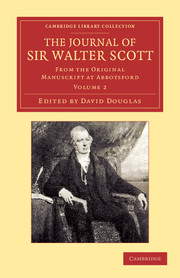
By the close of the nineteenth century, the works of Sir Walter Scott (1771–1832) could be found on the bookshelves of every respectable Victorian. Public interest was such that, nearly sixty years after his death, there remained considerable demand for new insights into the man and his milieu. First published in 1890, his two-volume journal for the period 1825–32 immediately attracted press attention. One review observed that 'it shows us the man in prosperity and in adversity, now delightfully humorous … now saddened by the financial troubles which came upon his later years'. Notwithstanding his money worries, Scott's final decade was not without literary achievement. Volume 2 comprises entries from July 1827 to April 1832, during which time Scott published The Fair Maid of Perth (1828) and Letters on Demonology and Witchcraft (1830).
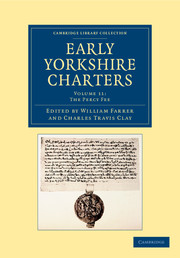
This thirteen-volume series, which first appeared between 1914 and 1965, is an extensive collection of the pre-thirteenth-century charters and related records of Yorkshire, which had previously remained largely unpublished. The first three volumes were edited by William Farrer (1861–1924), after whose death Charles Travis Clay (1885–1978) took up the task. The series was well respected for the quality of Farrer's editing, which was surpassed only by that of Clay in the later volumes. Volume 11 (1963) is devoted to the Percy fee and aims to be a survey of the land which constituted the knights' fees held by William de Percy II in 1166. The Latin texts presented here are accompanied by English notes and discussion of points of interest. The volume also contains facsimile plates of select documents as well as detailed indexes.
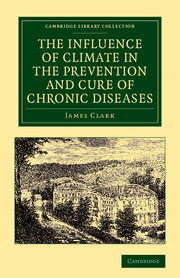
Published in 1829, this important work raised awareness of a poorly understood topic, running to a third edition by 1841. Sir James Clark (1788–1870) had trained as a surgeon in Edinburgh and gained experience in the Royal Navy during the Napoleonic Wars. During subsequent European travels, he studied the effects of climate on disease, particularly tuberculosis, and this publication represents an expanded version of his Medical Notes on Climate, Diseases, Hospitals, and Medical Schools in France, Italy, and Switzerland (1820), which is also reissued in this series. A licentiate of the Royal College of Physicians from 1826, and elected to the Royal Society in 1832, Clark became a trusted physician and friend to Queen Victoria and Prince Albert. Also reissued in the Cambridge Library Collection are his Treatise on Pulmonary Consumption (1835) and Memoir of John Conolly (1869).