A collection of out-of-copyright and rare books from the Cambridge University Library and other world-class institutions that have been digitally scanned, made available online, and reprinted in paperback.
To save content items to your account,
please confirm that you agree to abide by our usage policies.
If this is the first time you use this feature, you will be asked to authorise Cambridge Core to connect with your account.
Find out more about saving content to .
To save content items to your Kindle, first ensure no-reply@cambridge.org
is added to your Approved Personal Document E-mail List under your Personal Document Settings
on the Manage Your Content and Devices page of your Amazon account. Then enter the ‘name’ part
of your Kindle email address below.
Find out more about saving to your Kindle.
Note you can select to save to either the @free.kindle.com or @kindle.com variations.
‘@free.kindle.com’ emails are free but can only be saved to your device when it is connected to wi-fi.
‘@kindle.com’ emails can be delivered even when you are not connected to wi-fi, but note that service fees apply.
One of the most widely studied texts of ancient philosophy and politics, Plato's Laws is his last and most substantial dialogue, debating crucial questions on the subject of law-giving and education. This two-volume edition of 1921 was prepared by the classicist Edwin Bourdieu England (1847–1936), who describes the dialogue as 'the treasury of pregnant truths which Plato in extreme old age left … as his last legacy to humanity'. Generally held to have been written after Plato's failed attempt to influence Syracusan politics, it concerns the just city and its constitution, including discussions of divine revelation, the role of intelligence in the creation of laws, and natural law itself. This edition comprises a short introduction, England's helpful analyses, the Greek text of the dialogue, and extensive notes. Volume 1 is devoted to Books 1–6.
Best known for his ideas relating to evolution, French naturalist Jean-Baptiste Lamarck (1744–1829) first built his reputation as a botanist and was elected to the prestigious Académie des Sciences in 1779. His career took a new turn in 1793 when he was made professor of 'insects, worms and microscopic animals' at the Muséum National d'Histoire Naturelle, although he lacked prior knowledge of the subject area. Undaunted, Lamarck set out to classify organisms which few naturalists had considered worthy of study since Linnaeus. He was the first to distinguish vertebrates from 'invertebrates' - a term he coined - by the presence of a vertebral column. In this groundbreaking seven-volume work, published between 1815 and 1822, he arranges invertebrates into twelve classes, laying the foundations for the modern study of these organisms. Volume 4, first published in 1817, continues to classify insects.
Jean-Baptiste-Barthélemy de Lesseps (1766–1834), a French diplomat, served as an interpreter on La Pérouse's voyage around the world, which sailed from Brest in 1785. In 1787, on the eastern coast of the Kamchatka peninsula, he was tasked with an overland mission to get reports back to France as La Pérouse proceeded to Australia. This two-volume work, reissued here in its English translation of 1790, is a compelling account of the one-year journey from Russia to France, and a tale of endurance and resourcefulness in the face of forbidding conditions. More than a mere journal, it also relates the author's observations on the way of life in Kamchatka, its institutions and trade. Rich in detail, the work will appeal to historians and readers with an interest in transcontinental adventure. Volume 1 covers his journey from Petropavlovsk-Kamchatsky to the north-eastern extremity of the Sea of Okhotsk.
The aftershocks of the devastating Lisbon earthquake of 1755 were not only physical: the scientific investigations undertaken in its wake formed the basis of the science of seismology. Published in 1757, the present work is, in the words of its presumed editor, John Bevis (1695–1771), 'a repertory of all that has been written of earthquakes and their causes', and includes several recent papers published by the Royal Society. At the time, scientists suggested subterranean fires or electrical shocks in the atmosphere as possible causes of earthquakes. This reissue also incorporates a brief 1760 work by John Michell (1724/5–93), which uses Bevis' collection as a source and suggests that earthquakes were caused by seismic waves through the earth: it was one of the first to propose that tsunamis were the result of undersea earthquakes. Both these works rank as important steps in the developing understanding of one of nature's most destructive phenomena.
The library of the chandler John Ratcliffe (1707–76) was amassed before the onset of 'bibliomania', and perfectly illustrates the last days of a period of book collecting when scholars and commoners could hope to compete with wealthy noblemen. The collection contained over a hundred incunabula, including forty-eight Caxtons, and a fine selection of sixteenth-century English books, alongside contemporary literature and Presbyterian tracts. Many of Ratcliffe's incunabula had been purchased from James West, others from Anthony Askew. In turn, his books were acquired by a circle of his contemporaries, including William Herbert, Charles Chauncy and William Hunter. However, the purchase of some of the finest books by the aristocratic Justin MacCarthy Reagh provided a hint of what was to come. Reissued here is James Christie's 1776 sale catalogue, featuring handwritten annotations by an attendee at the auction who recorded the prices paid and the names of buyers.
After training to be a doctor at the London School of Medicine for Women, Flora Murray (1869–1923) became an active member of the Women's Social and Political Union. At the outbreak of the First World War, she and her fellow suffragists laid down their banners and sought to aid the Allied war effort. Working within the newly formed Women's Hospital Corps, Murray and her colleague Louisa Garrett Anderson (1873–1943) overcame initial prejudice and established two military hospitals in France in the period 1914–15. Their success prompted an invitation from the War Office to open the Endell Street Military Hospital in London, staffed entirely by women. First published in 1920, Murray's account, illustrated with numerous photographs, records important steps in furthering the acceptance of women in the medical profession. For female doctors, surgeons and nurses, the war provided not only the 'occasion for service' but also 'great professional opportunities'.
By the close of the nineteenth century, the works of Sir Walter Scott (1771–1832) could be found on the bookshelves of every respectable Victorian. Public interest was such that, nearly sixty years after his death, there remained considerable demand for new insights into the man and his milieu. First published in 1890, his two-volume journal for the period 1825–32 immediately attracted press attention. One review observed that 'it shows us the man in prosperity and in adversity, now delightfully humorous … now saddened by the financial troubles which came upon his later years'. Notwithstanding his money worries, Scott's final decade was not without literary achievement. Volume 1 comprises entries from November 1825 to June 1827, soon after Scott had published Tales of the Crusaders (1825) and during which period he wrote his Letters of Malachi Malagrowther (1826).
Between 1787 and 1798, the agricultural writer and land agent William Marshall (1745–1818) published a number of works on the rural economies of England, covering Norfolk, his native Yorkshire, Gloucestershire, the Midlands and the South. This two-volume study appeared in 1796 and investigated the farming, geography, public works and produce of districts in Devon, Somerset, Dorset and Cornwall. Volume 2 looks in detail at the upland areas of Cornwall and Devon, at Dartmoor, North Devon, the vales of Exeter and Taunton, and West Dorset. The coverage includes aspects of the laws surrounding land ownership, the chemistry of the soil, notes on the dairy industry, and suggested improvements to farming practices. The result is a richly detailed survey of the area in the Georgian period and an important record of rural and agricultural life, so often overlooked by other contemporary chroniclers.
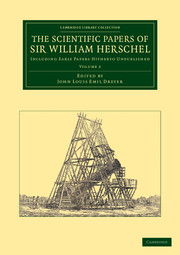
By the time of his death, William Herschel (1738–1822) had built revolutionary telescopes, identified hundreds of binary stars, and published astronomical papers in over forty volumes of the Royal Society's Philosophical Transactions. This two-volume collection, which originally appeared in 1912, was the first to gather together his scattered publications. It draws also on a wealth of previously unpublished material, from personal letters to numerous papers presented to the Philosophical Society of Bath. Although Herschel is best known for his discovery of Uranus, this collection highlights the true range of his observations and interests. Focusing on his later work, Volume 2 includes notes on some of the moons of Uranus, studies of solar heat and the atmosphere of Saturn, and some practical experiments investigating the capabilities of contemporary telescopes. It also features an appendix of work compiled by his son, John Herschel, and sister Caroline.
Among the most influential figures in the development of modern linguistics, the American scholar Edward Sapir (1884–1939) notably promoted the connection between anthropology and the study of language. His name is also associated with that of his student in the Sapir–Whorf principle of linguistic relativity, the hypothesis that the structure of a language affects how its speakers conceptualise the world. In this seminal work, first published in 1921, Sapir lucidly introduces his ideas about language and explores topics that remain fundamental to linguistics today, such as the relationship between language and culture, the elements of speech, grammatical processes and concepts, historical language development, and the question of how languages influence one another. Especially significant in the history of structural linguistics and ethnolinguistics, this clearly written text remains relevant and accessible to students and scholars across the social sciences.
An anthropologist and archaeologist working for much of his life in the British Museum, Thomas Athol Joyce (1878–1942) succeeded in making American archaeology more accessible to non-specialists. Through careful analysis and presentation of the available evidence from South and Central America, he secured his reputation as an authority in this field, especially with regard to Mayan civilisation. Drawing on his wide reading of the published literature, he produced three pioneering and highly illustrated textbooks. The present work appeared in 1912 and confined itself to South America, beginning its coverage with Colombia in the north. Given the better preservation of the material culture, there is a particular focus on Peru and the Incas. The topics discussed range from burials, mummies and shrunken heads to nose ornaments, musical instruments, tattoos and weaving. Joyce's Mexican Archaeology (1914) and Central American and West Indian Archaeology (1916) are also reissued in this series.
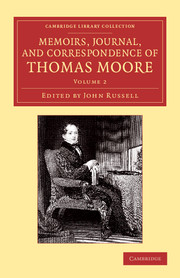
Throughout his professional life, the poet Thomas Moore (1779–1852) was variously celebrated and vilified for both his verse and his politics. Born in Dublin, he remained an ardent Irish patriot until his death. This eight-volume collection of Moore's memoirs, diaries and letters, edited by his friend Lord John Russell (1792–1878) and first published between 1853 and 1856, provides rare insights into a man whose genius was applauded by the Morning Chronicle as 'embracing almost all sides of imaginative literature, of criticism and philosophy'. Volume 2 opens with a portrait of his friend and patron Lord Moira and a view of Bermuda, where Moore spent a brief period in 1803–4. The volume covers the period 1814–18, during which time the poet wrote one of his most profitable publications, Lalla Rookh, and bought his Wiltshire home, Sloperton Cottage, where he would spend his final years.
American-born lawyer and author Lindley Murray (1745–1826) was hailed by his admirers as the 'father of English grammar'. First published in 1795 and reissued here in its 1830 forty-fourth edition, English Grammar became the definitive textbook on the subject in the early nineteenth century. Murray divides the work into four sections: orthography, etymology, syntax and prosody. Treating his subject methodically, he reasons that sound instruction in grammar should begin with the form and sound of letters, continue to the different types of words, include guidelines on the construction of sentences, and provide advice on correct pronunciation. Accordingly, the book commences with the alphabet before moving on to more complex subjects, from verb conjugation through to versification. An appendix gives advice on writing more effectively. The work's huge success, in Britain and the United States, as well as in translation, testifies to its rigorous and unpretentious approach.
Published in four volumes between 1892 and 1899, this collection contains assorted papers and correspondence between Spain and Spanish dignitaries in England from the accession of Elizabeth I in 1558 through to her death in 1603. Revealing the changing relationship between Spain and England, the documents offer detailed insights into Elizabeth's reign from a continental and Catholic perspective. Derived in large part from the archives at Simancas, they have been carefully edited and translated into English by Martin Andrew Sharp Hume (1843–1910), a respected historian of Spain and a scrupulous archival researcher. Each volume is arranged chronologically, contains an introduction that provides helpful historical context and closes with an index that includes both letter writers and recipients. Volume 3 (1896) covers the period 1580–86 and shows both the English and Spanish perspectives on the build-up and beginning of the Anglo-Spanish war.
Having previously embarked on a collecting expedition to the Pyrenees, backed by Sir William Hooker and George Bentham, the botanist Richard Spruce (1817–93) travelled in 1849 to South America, where he carried out unprecedented exploration among the diverse flora across the northern part of the continent. After his death, Spruce's writings on fifteen fruitful years of discovery were edited as a labour of love by fellow naturalist Alfred Russel Wallace (1823–1913), whom Spruce had met in Santarém. This two-volume work, first published in 1908, includes many of the author's exquisite illustrations. Showing the determination to reach plants in almost inaccessible areas, Spruce collected hundreds of species, many with medicinal properties, notably the quinine-yielding cinchona tree, as well as the datura and coca plants. Volume 1 contains Wallace's biographical introduction and a list of Spruce's published works. The narrative includes discussion of Pará, Santarém, and the Negro and Orinoco rivers.
The writings of Ælfric of Eynsham (c.950–c.1010) are among the most important to survive from Anglo-Saxon England. He was shaped by tenth-century monastic reform, and his promotion of Old English was highly influential. His earliest known works, the Sermones Catholici (c.990–5), are adaptations of Latin texts rendered in Old English. The homilies draw on the gospels, saints' lives and other doctrinal themes. They were intended to be delivered over two years. This two-volume collection, first published between 1844 and 1846, contains transcriptions of the Old English texts with facing-page translations by Benjamin Thorpe (1781/2–1870). A well-respected scholar with a strong interest in promoting the study of Old English, Thorpe produced an important edition of the Anglo-Saxon Chronicle for the Rolls Series (also reissued in this series). Volume 2 of the present work contains the sermons for the second year, focusing on doctrine and church history.
Famed for his masterful oratory and fearless criticism of parliamentary opponents, William Pitt the Elder (1708–78) distinguished himself through the strong leadership he provided during Britain's struggle against France in the Seven Years' War. Edited by his great-grandsons and first published between 1838 and 1840, this four-volume collection presents nearly forty years' worth of letters to and from the great statesman. Each volume also contains a useful list of the principal officers of state for the period covered, along with facsimile plates of letters and signatures by some of Pitt's eminent correspondents. Volume 4 (1840) covers the period from November 1770 until Pitt's death in May 1778. Despite his retirement and deteriorating health, he continued to take an active interest in politics, writing to his many correspondents on a wide range of subjects, notably the unfolding American Revolution.
George Anson Byron (1789–1868), cousin of the famous poet, was a naval officer and the seventh Baron Byron. When the king and queen of Hawaii died of measles in July 1824 on a visit to England, Byron was chosen to lead the voyage that returned the bodies to their native land. Prepared by Maria Graham (1785–1842), known later as Lady Callcott, this work was published in 1826 and organised into two parts: the first gives a brief history of the islands, culminating in an account of the fatal visit; the second and larger part is compiled from the journals of those on board HMS Blonde. Engravings made from the drawings of the ship's artist, Robert Dampier, complement observations about the geography of Hawaii, its people and their customs. The remarkable journey home involved the first European sighting of Malden Island and the rescue of survivors from a shipwreck.
One of the most prolific composers of the nineteenth century, Sir George Alexander Macfarren (1813–87) produced operas, symphonies, and instrumental and choral works, and is remembered today for the overture Chevy Chace. Son of the London impresario George Macfarren, he studied composition with Cipriani Potter at the Royal Academy of Music, becoming a professor there in 1837. Despite encroaching blindness, which became total in 1860, he remained at the centre of British musical life, continuing to compose, lecture, write and teach. Following the death of William Sterndale Bennett in 1875, he became professor of music at Cambridge and principal of the Royal Academy of Music. Reissued here is the 1882 third edition of a series of lectures on harmony delivered at the Royal Institution in 1867, intended to enhance the amateur listener's musical appreciation. They are based on Alfred Day's controversial Treatise on Harmony (also reissued in this series).
First published in 1840 as a volume in the Cabinet Cyclopaedia - a series published between 1830 and 1844, intended for the self-educating middle class - this work was written by the naturalist and artist William Swainson (1789–1855). The first part is a treatise on taxidermy, showcasing methods of Victorian science that may appear gruesome to modern readers. It discusses the best ways to collect, preserve and present animals for scientific study. Swainson gives detailed advice, making allowances for naturalists working in different locations and searching for a range of species. The directions for skinning and mounting animals are not for the faint-hearted, but they offer a fascinating insight into the practices of the time. The work's second part is a zoological bibliography, with short biographies of notable authors. Zoological painters and engravers, such as Thomas Bewick (1753–1828), are also featured.