A collection of out-of-copyright and rare books from the Cambridge University Library and other world-class institutions that have been digitally scanned, made available online, and reprinted in paperback.
To save content items to your account,
please confirm that you agree to abide by our usage policies.
If this is the first time you use this feature, you will be asked to authorise Cambridge Core to connect with your account.
Find out more about saving content to .
To save content items to your Kindle, first ensure no-reply@cambridge.org
is added to your Approved Personal Document E-mail List under your Personal Document Settings
on the Manage Your Content and Devices page of your Amazon account. Then enter the ‘name’ part
of your Kindle email address below.
Find out more about saving to your Kindle.
Note you can select to save to either the @free.kindle.com or @kindle.com variations.
‘@free.kindle.com’ emails are free but can only be saved to your device when it is connected to wi-fi.
‘@kindle.com’ emails can be delivered even when you are not connected to wi-fi, but note that service fees apply.
The architect Arthur Ashpitel (1807–69) worked on a wide variety of projects, including churches, houses and schools, and wrote widely on architecture, literature and politics. He became a fellow of the Institute of British Architects in 1841 and the Society of Antiquaries of London in 1847. This 1867 work comprises his compilation and revision of notable tracts on architecture from the Encyclopædia Britannica. It includes entries by William Hosking (1800–61) on classical, Gothic and modern architecture, building and construction; Thomas Tredgold (1788–1829) on joinery and stonemasonry; Thomas Young (1773–1829) on carpentry; and John Robison (1739–1805) on roofs, arches and the strength of materials. Intended to be of practical use to architects, craftsmen and 'the building trade', Ashpitel's synthesis remains a valuable resource for scholars interested in nineteenth-century thought on architectural history, practice and technology.
The library of the physician Anthony Askew (1722–72) was outstanding in both printed books and manuscripts. He may have failed in his ambition to secure a complete collection of every printed edition of the Greek classics, but he did amass a classical library which remained unsurpassed until Spencer. Although he was later accused of plagiarism, virtually every edition of Aeschylus down to the 1850s cited 'Askew's collations'. He also secured Richard Mead's fine collection of Latin and Greek manuscripts, alongside other early classical codices from the Maffei library. The dispersal of Askew's collection in two sales, ten years apart, attracted international interest. Bidders at the 1775 book sale included George III, while the manuscript sale in 1785 led to acquisitions by the British Museum, the Bodleian and Cambridge University Library. Now reissued together, the sale catalogues have been annotated here by auction attendees who recorded prices and some purchaser details.
Remembered chiefly for his archaeological discoveries in Crete, Sir Arthur John Evans (1851–1941) was also highly respected as an expert on the Balkans, an area then little known. Evans describes 'a land and people among the most interesting in Europe', and in 1875 he was visiting for the third time. This trip found him witnessing the outbreak of the revolt that saw Austria-Hungary take control of Bosnia. Here, however, Evans explores Bosnia's rich heritage with detailed ethnographic and anthropological observations, alongside descriptive impressions of its people and natural beauty. He returned in 1877 as a correspondent for the Manchester Guardian, which resulted in his Illyrian Letters (also reissued in this series). First published in 1876 and reprinted the following year, the present work offers background not only to the revolt in that country, but also to the later deadly conflicts that would shake all of Europe.
Edited by the eminent anthropologist and linguist Franz Boas (1858–1942), this work was first published in two huge volumes between 1911 and 1922. Comprising detailed studies of several Native American languages, Volume 1 has been split into two parts for this reissue. Part 2 contains chapters on the Chinook, Maidu, Algonquian, Siouan and Inuit languages. Each chapter contains a discussion of the speakers of the language, its geographical distribution, the phonetic system, and an analysis of the grammar and vocabulary. The work built upon the foundations laid by J. W. Powell (1834–1902) in his Introduction to the Study of Indian Languages (1877). Boas, a pioneer in the field of cultural anthropology, intended the present work to promote his culturally relativist approach to ethnographic study. Overall, the project ranks as a landmark in entrenching scientific principles for the study of North America's indigenous peoples and languages.
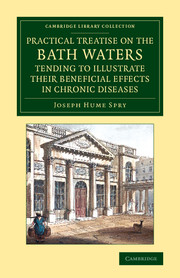
Bath physician Joseph Hume Spry (c.1779–1859) was concerned that the popular practice of 'taking the waters' had fallen out of favour. In 1822 he produced this treatise extolling the healing properties of Bath's waters, supported by his own case notes and the writings of other physicians. He claimed that manifold afflictions, ranging from gout to indigestion, could be eased by drinking or bathing in these mineral-rich waters. In addition to offering careful instructions for treating each ailment, Spry's book includes a chapter on Bath's history, detailed descriptions and a sketch of the Roman baths, and a summary of the authors who had previously described the baths, from Solinus in the third century to Spry's contemporaries. Opening the work with a supplicating dedication to one of Bath's wealthy patrons, Charles Herbert Pierrepont, second Earl Manvers, Spry also used the book to appeal for the much-needed restoration of the Roman baths.
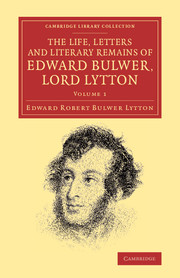
One of the most popular writers of his age, outsold only by Dickens, Edward George Bulwer Lytton (1803–73), first Baron Lytton, is notable for coining the phrases 'the great unwashed' and 'the pen is mightier than the sword', although his work is largely forgotten today. G. K. Chesterton's appraisal was that 'you could not have the Victorian Age without him'. Lytton requested that his son Edward Robert (1831–91), first Earl of Lytton, complete his autobiography. Complemented by letters and previously unpublished material - the better to flesh out the story of a prolific literary life - it appeared in two volumes in 1883. In his preface, Edward Robert writes that his main purpose is 'to illustrate my father's works by his life, and his life by his works'. Volume 1 contains the original autobiography, along with letters and selected writings that provide insights into Lytton's first twenty-two years.
Published between 1880 and 1897 as part of Max Müller's Sacred Books of the East series, this five-volume translation of Pahlavi texts was the work of Edward William West (1824–1905). Largely self-taught, West developed his knowledge of ancient oriental languages in India, where he worked as a civil engineer. After returning to Europe, West focused on the study of sacred Zoroastrian texts and prepared these translations of Pahlavi manuscripts. His writings and editions are still referenced today in Indo-Iranian studies. The Nasks are the focus of Volume 4, wherein West collects, translates and analyses fragments such as names, summaries, digests and stray quotes from other books in order to present all that is known of the twenty-one original treatises containing Sassanid Zoroastrian literature. The treatises were themselves records of what was legendarily lost after Alexander the Great's conquest of Persia in the fourth century BCE.
Hermann Osthoff (1847–1909) and Karl Brugmann (1849–1919) were central figures in the circle of German scholars who rejected a doctrinal approach to the study of linguistics. They came to be known as the Neogrammarian school. At the core of their work was the theory that European languages, together with a subset of languages found in central and southern Asia, have a common origin in a single prehistoric language. They called this ancestor Indo-Germanic (known today as Indo-European) and claimed that its descendants are all related to one another by varying degrees of closeness. This six-volume elaboration of this thesis was published between 1878 and 1910. The preface to Volume 1 (1878) contains the 'Neogrammarian Manifesto' which states categorically that there are no exceptions in the laws of sound change, while new languages are formed only in relation to already existing languages.
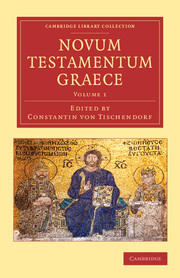
Ad antiquissimos testes denuo recensuit apparatum criticum omni studio perfectum apposuit commentationem isagogicam praetexuit Constantinus Tischendorf
The German biblical scholar Constantin von Tischendorf (1815–74) published his monumental eighth edition of the Greek New Testament between 1869 and 1872. Following his death, the prolegomena was compiled by colleagues and appeared between 1884 and 1894. Influenced by the pioneering scholarship of Karl Lachmann (1793–1851), who had first moved away from relying on the Textus Receptus, Tischendorf placed key emphasis on the witness of older uncial manuscripts, most notably the Codex Sinaiticus (which he rediscovered) and the Codex Vaticanus. His painstaking work laid the foundations for the creation of modern critical texts, and the vast amount of manuscript evidence he collated has ensured that this edition remains a standard work of reference for biblical scholars and textual critics. Volume 1 (1869) contains the text and critical apparatus for the Gospels.
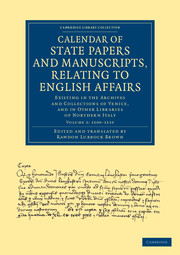
This is the second volume in a seven-volume collection - published in nine parts between 1864 and 1890 - comprising Venetian and other northern Italian state papers relating to England. Translator and editor Rawdon Lubbock Brown (1806–83) lived for many years in Venice, had unrivalled access to the Venetian archives and travelled widely to find documents in other Italian libraries and archives. He had previously published two volumes of Sebastian Giustinian's dispatches to Venice from Henry VIII's court (also reissued in this series). This second volume contains documents from the years 1509–19, beginning with the accession of Henry VIII - a momentous period for the Venetian state, which was then seeking an alliance with England. Giustinian's ambassadorial correspondence is reproduced here. The editor's preface puts the various documents into historical context, and the appendices include a history of Italian cipher.
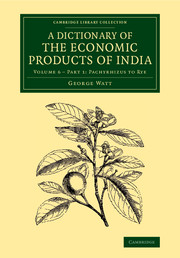
A Scottish doctor and botanist, George Watt (1851–1930) had studied the flora of India for more than a decade before he took on the task of compiling this monumental work. Assisted by numerous contributors, he set about organising vast amounts of information on India's commercial plants and produce, including scientific and vernacular names, properties, domestic and medical uses, trade statistics, and published sources. Watt hoped that the dictionary, 'though not a strictly scientific publication', would be found 'sufficiently accurate in its scientific details for all practical and commercial purposes'. First published in six volumes between 1889 and 1893, with an index volume completed in 1896, the whole work is now reissued in nine separate parts. Volume 6, Part 1 (1892) contains entries from Pachyrhizus angulatus (a large climbing herb) to rye (not indigenous to India).
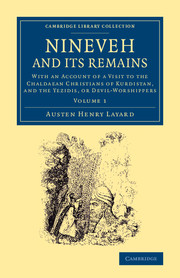
Before abandoning archaeology for politics, Sir Austen Henry Layard (1817–94) carried out major excavations in Mesopotamia between 1845 and 1851, uncovering important evidence of ancient Assyrian civilisation. Although he originally believed that Nimrud was Nineveh, he later confirmed that Kuyunjik was the location of the ancient city. First published in 1849, this two-volume work is a mixture of excavation report, ancient history, anthropology and travel writing. Layard's excitement at the extent and importance of the finds as soon as digging commenced is clearly conveyed, and he places Mesopotamian history in the context of the more familiar biblical and classical worlds. His Discoveries in the Ruins of Nineveh and Babylon (1853) is also reissued in this series. Volume 1 covers the background to the excavations, the first discoveries, and the difficulties with Arab authorities and local workmen. Also included are observations on the inhabitants, culture and history of the region.
Jean-Baptiste-Barthélemy de Lesseps (1766–1834), a French diplomat, served as an interpreter on La Pérouse's voyage around the world, which sailed from Brest in 1785. In 1787, on the eastern coast of the Kamchatka peninsula, he was tasked with an overland mission to get reports back to France as La Pérouse proceeded to Australia. This two-volume work, reissued here in its English translation of 1790, is a compelling account of the one-year journey from Russia to France, and a tale of endurance and resourcefulness in the face of forbidding conditions. More than a mere journal, it also relates the author's observations on the way of life in Kamchatka, its institutions and trade. Rich in detail, the work will appeal to historians and readers with an interest in transcontinental adventure. Volume 2 covers his journey from the north-eastern extremity of the Sea of Okhotsk all the way back to France.
The radical writer and poet Helen Maria Williams (1759–1827) is best remembered for her eight-volume Letters from France (1790–6), charting the progress of the French Revolution. Having published poetry and a novel, Julia (1790), she travelled to France, where her salon welcomed the likes of Mary Wollstonecraft, Thomas Paine and leading Girondists. Forced to flee the country in 1794, she went into exile in Switzerland for six months, travelling with the printer and political reformer John Hurford Stone (1763–1818). This two-volume account of the journeys she made during her time there, first published in 1798, documents what she sees as the failure of Swiss democracy. Highlighting the shortcomings of the Swiss government and the suffering of much of Swiss society through exploitation, Williams anticipates revolutionary activity in the cantons. Volume 1 concentrates primarily on Basel and its canton.
Born in Edinburgh, Daniel Wilson (1816–92) initially pursued an artistic career and spent time in Turner's studio. However, in 1846 he became a fellow of the Society of Antiquaries of Scotland and devoted the rest of his life to archaeology, anthropology and university administration. He was active in the Society's attempts to save historic buildings in Edinburgh, and the city's built environment was the subject of this two-volume 1848 work, which is illustrated with engravings after his own drawings. In Volume 2, Wilson continues to cover local antiquities and traditions, with each chapter looking at a different area of the Old Town. Leith, the New Town, and ecclesiastical buildings are also discussed. The historical detail, with references, is immense, and Wilson's enthusiasm for his city is evident throughout. Wilson's second major work, the landmark Prehistoric Annals of Scotland (second edition, 1863), is also reissued in this series.
Distinguished above all for his zeal for learning, Richard de Bury (1287–1345) was an influential figure during the reign of Edward III, becoming bishop of Durham and serving on several diplomatic missions abroad, during which time he accumulated many rare works. The Philobiblon is his passionate treatise on learning and book collecting. Lodging a complaint in the voice of books themselves, Richard expresses his frank views on the current state of learning and scholarly practice. This translation, the first such into English, was prepared anonymously in 1832 by the scholar and linguist John Bellingham Inglis (1780–1870). Unlike other book collectors, Inglis was noted for actually having read the books he acquired. The present work contains a brief preface discussing previous scholarship and editions of the text, and ends with extensive notes by Inglis on the original text and his editorial decisions.
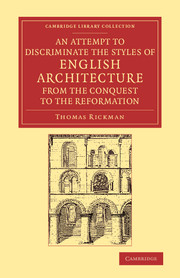
First published in 1817, this highly influential study by Thomas Rickman (1776–1841) provides a classic overview of English medieval architecture. A devotee of the Gothic style, Rickman forged a successful career as an architect of Anglican churches, in the face of criticism from his Quaker brethren. This study is founded on the attention to detail and delight of a true enthusiast, drawing on knowledge of some five hundred buildings across the British Isles. Describing Greek and Roman influences before delineating English architecture since the Norman Conquest, Rickman presents a compelling narrative of architectural styles and precedents. Illustrated with a number of detailed drawings, the work ends with short entries, organised by county, on notable cathedrals, churches and abbeys. Introducing terminology and classifications that are still used today, the book quickly became an essential reference work for architectural students and practitioners. This reissue is of the first edition.
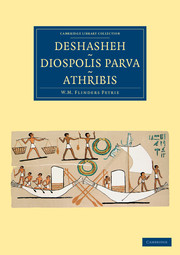
A pioneering Egyptologist, Sir William Matthew Flinders Petrie (1853–1942) excavated over fifty sites and trained a generation of archaeologists. These three illustrated excavation reports, now reissued together, were originally published in 1898, 1901 and 1908 in collaboration with other experts. They focus on the cemeteries at Deshasheh, Abadiyeh and Hu (the latter known also as Diospolis Parva), and Athribis. Light is shed on the major discoveries, such as large quantities of beautifully preserved Neolithic linen, the 'pan graves' of semi-nomadic settlers, and a tomb featuring an early relief of Egyptians besieging a fortified Near Eastern town. Most significantly, these reports reflect Petrie's development of sequence dating, which influenced the use of seriation as a relative dating method in archaeology. Petrie wrote prolifically throughout his long career. Many of his other publications - for both Egyptologists and non-specialists - are also reissued in this series.
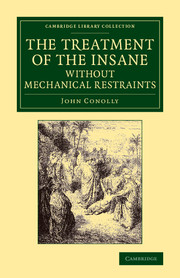
Trained as a physician and alienist (psychiatrist), John Conolly (1794–1866) first published this work in 1856. It describes the abolition of mechanical restraints in the treatment of mentally ill patients at the Hanwell County Asylum in Middlesex, where Conolly worked as resident physician. He argues for a system of non-restraint to be implemented as standard in all asylums, focusing on understanding patients as individuals and treating them with care and compassion. Conolly had introduced at Hanwell an innovative programme for patients that was based around positive activities, personal freedom, privacy, good-quality food, exercise, and, most importantly, the absence of any physical restraint. Though controversial at first, Conolly's enlightened methods and writings helped further the cause of humane treatment. This work remains a key text in the history of asylum reform and changing attitudes to mental illness.
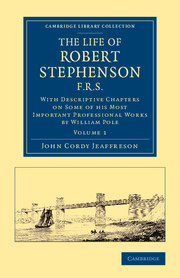
Relying on incremental experiment rather than leaps into the unknown, Robert Stephenson (1803–59) forged an influential career as a highly respected railway and civil engineer. From the steam locomotive Rocket to the London and Birmingham Railway and the Britannia Bridge, his work helped to consolidate the foundations of the modern engineering profession. Based on the first-hand testimony of relatives and contemporaries as well as correspondence and official records, this 1864 biography by John Cordy Jeaffreson (1831–1901), published only five years after Stephenson's death, tells the story of this quiet industrial innovator. Five chapters by engineer William Pole (1814–1900) provide a more technical insight, examining some of Stephenson's most significant railway bridges and his involvement with the atmospheric system. Volume 1 traces Robert's early life, carefully moulded by his father George, and also covers the building of the London and Birmingham Railway.