A collection of out-of-copyright and rare books from the Cambridge University Library and other world-class institutions that have been digitally scanned, made available online, and reprinted in paperback.
To save content items to your account,
please confirm that you agree to abide by our usage policies.
If this is the first time you use this feature, you will be asked to authorise Cambridge Core to connect with your account.
Find out more about saving content to .
To save content items to your Kindle, first ensure no-reply@cambridge.org
is added to your Approved Personal Document E-mail List under your Personal Document Settings
on the Manage Your Content and Devices page of your Amazon account. Then enter the ‘name’ part
of your Kindle email address below.
Find out more about saving to your Kindle.
Note you can select to save to either the @free.kindle.com or @kindle.com variations.
‘@free.kindle.com’ emails are free but can only be saved to your device when it is connected to wi-fi.
‘@kindle.com’ emails can be delivered even when you are not connected to wi-fi, but note that service fees apply.
Paving the way for modern feminist thinking, Mary Wollstonecraft (1759–97) dared to challenge traditional eighteenth-century attitudes towards women. First published in 1787, this book discusses how girls can best be educated to become valuable wives and mothers. It argues that women can offer the most effective contribution to society if they are brought up to display sound morals, character and intellect, rather than superficial social graces. Wollstonecraft later developed her ideas in A Vindication of the Rights of Woman (also reissued in this series), in which she attacked the educational restrictions imposed upon women. Her writings formed a cornerstone of the battle for women's rights in the nineteenth and twentieth centuries. Prompting deeper reflection upon the role and status of women in modern society, the present work remains an instructive and provocative read for those seeking to learn about the roots of feminism in its social and historical context.
The English naturalist Philip Henry Gosse (1810–88) travelled to Jamaica in 1844 and stayed for eighteen months to observe the diverse wildlife there. Upon his return he described his findings in a trilogy of books. The first two examined the island's birds - he has been hailed as the 'father of Jamaican ornithology' - but he used the present work, first published in 1851, to describe all the other forms of life on the island, from beetles to fruit trees. Lamenting that natural history was too often presented as a 'science of dead things', Gosse made his investigations come alive in this work by writing it in a diary form, discussing what he encountered as his journey progressed, and providing a number of illustrations. His lively and engaging style won him a wide audience, and this work remains an important early example of popular natural history.
In terms of musical composition, all but the first five of his thirty-five years were astoundingly productive for Wolfgang Amadeus Mozart (1756–91). A stream of glorious symphonies, piano concertos, chamber music, operas and the sublime but unfinished Requiem poured from his pen. German philologist and archaeologist Otto Jahn (1813–69) was inspired to write a scholarly biography of Mozart following a conversation at Mendelssohn's funeral in 1847. He immersed himself in intensive research on the composer and his music, publishing the first edition of this landmark work in four volumes between 1856 and 1859. A second edition followed in 1867, incorporating new material and making use of Köchel's 1862 catalogue of Mozart's works. It is from this edition that Pauline D. Townsend made her three-volume English translation, first published in 1882. Volume 2 covers Mozart the man, the break with Colloredo, his move to Vienna, marriage, and Freemasonry.
Published in 1888, this work reproduced for the first time in full the letters sent by the English gentlewoman Dorothy Osborne (1627–95) to Sir William Temple (1628–99) during their courtship. Osborne first met Temple on the Isle of Wight in 1648, but both their families opposed the relationship and the couple were not able to marry until 1654. Osborne's letters are highly engaging, especially notable for their political and social commentary as well as for the details they reveal about her daily life and the clandestine courtship. Only one of Temple's letters survives, since Osborne destroyed them as soon as she had read them. While extracts of her letters had appeared in print earlier, the lawyer and author Edward Abbott Parry (1863–1943) was the first person to publish the entire collection of surviving correspondence. His edition is particularly valuable for the explanatory notes that accompany each letter.
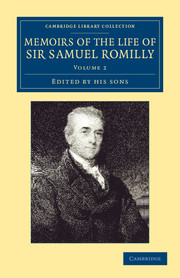
A friend of Wilberforce and Bentham, Sir Samuel Romilly (1757–1818) combined considerable legal expertise with commitment to progressive political causes such as the abolition of the slave trade. During his time in Parliament - he was Solicitor General in Lord Grenville's 'Ministry of All the Talents' - he sought to lessen the archaic severity of English criminal law regarding corporal and capital punishment. Though he met with resistance, his efforts raised awareness and influenced later reforms. Compiled by his sons and published in 1840, this three-volume collection of autobiographical writings and varied correspondence illuminates the development of his outlook and the principles which guided him. Volume 2 comprises selected correspondence for the period 1792–1802, the diary of a visit to Paris in 1802, an unfinished narrative of personal events in 1805, and Romilly's diary of his parliamentary life between 1806 and 1811.
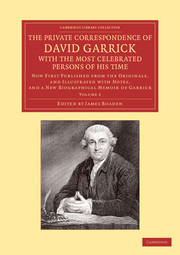
David Garrick (1717–79) is synonymous with the golden age of English theatre. Widely acclaimed as an actor, he went on to become a shrewd theatre manager at Drury Lane. His years in charge of the Theatre Royal ensured its dramatic ascendancy and burnished his own considerable celebrity. These letters, first published in 1831, reveal Garrick's gregarious nature and shed light on his many friendships with leading ladies, fellow actors, contemporary playwrights, and members of high society. His love of Shakespeare's work is also evident, highlighting Garrick's pivotal role in ensuring the plays became established in the national consciousness. This two-volume collection was edited by James Boaden (1762–1839), who published several theatrical biographies (also reissued in this series). Volume 2 contains letters from the final years of Garrick's life, notably his correspondence in French with influential figures in Parisian theatre.
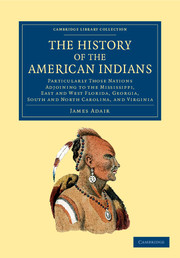
A trader who lived and worked for four decades among Native Americans and became a keen observer of their languages, customs and politics, James Adair (fl.1735–75) studied the Catawba, Cherokee, Muscogee, Chickasaw and Choctaw, compiling extensive ethnographic information. Upon publication in 1775, this work was unique in its treatment of these peoples as well as their interaction with white traders and colonists. The book also propounds a theory, popular at the time, that the ancestors of Native Americans were the lost tribes of Israel; as such it remains a valuable source for the history of this idea. In part autobiographical, the work reflects Adair's involvement in trading, local politics and warfare with the British and French. His observations remain of great interest to scholars of American history and ethnography.
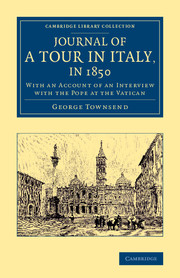
A Church of England clergyman and biblical scholar, George Townsend (1788–1857) gained recognition for preparing chronological arrangements of both the Old and New Testament. First published in 1850, the present work is an intriguing account of his journey to Italy for an audience with Pope Pius IX, whom he intended to convert to Protestantism. Townsend's journal features details of his stay in Paris, where he was received by the city's archbishop, as well as remarks on the churches and clergy he encountered along the way. In Rome and the Vatican, he visited the main sites of interest while commenting on points of doctrinal divergence and the hospitality shown towards him. Warmly received by Pius IX, who chose to interpret the visit as ecumenical, Townsend inevitably failed in his ultimate objective. Tendentious and forthright, his work sheds light on a strain of English anti-Catholicism.
The astronomer John Lee (1783–66) inherited Hartwell House in Buckinghamshire in 1827. During its colourful history, the mansion had notably been occupied between 1809 and 1814 by the exiled court of Louis XVIII. Lee turned the house into something of a museum for his antiquarian and scientific interests, constructing an observatory to the design of the his close friend William Henry Smyth (1788–1865), after whom Lee named a lunar sea. A naval officer, Smyth had helped to found the Royal Geographical Society in 1830. His Sidereal Chromatics (1864) and The Sailor's Word-Book (1867) are also reissued in this series. This charming history and description of Hartwell, its grounds, buildings and contents, appeared in two volumes between 1851 and 1864, illuminating especially the practice of contemporary astronomy. Illustrated throughout, the first volume (1851) includes coverage relating to the locality, the lords of the manor, the collected antiquities and the observatory.
Born a slave, Ignatius Sancho (c.1729–80) became one of the most influential free Africans of his century. Largely self-taught, he was the first black Briton known to have voted in parliamentary elections and to be given an obituary in the British press. He corresponded with many notable figures, including the author Laurence Sterne, whom he urged to write against slavery in the West Indies. The politician Joseph Jekyll (1754–1837) commended Sancho's 'epistolary talent' in a brief biography, praising his 'wild patriotism' and 'universal philanthropy'. This two-volume collection of Sancho's letters was published in 1782 by the hostess Frances Crewe (1748–1818), who upheld Sancho as proof, in an age of dehumanising slavery, that Africans possessed as much natural intelligence as Europeans. Volume 1 contains Jekyll's biography, a list of more than 1,200 subscribers, and letters for the period 1768–78. It includes the famous 1766 letter to Sterne, incorrectly dated 1776.
In the mid-nineteenth century, the northern coastline of North America was of particular interest to the Hudson's Bay Company as it was believed to hold the key to the elusive North-West Passage, a trade route from the Atlantic to the Pacific. Recruited to lead a team to survey part of this forbidding region, the Scottish explorer John Rae (1813–93) undertook his first expedition during 1846–7. It was remarkable not only for its success, but also because Rae's was the first crew to overwinter in the Arctic. Unlike other Victorian explorers, Rae embraced the culture of the Inuit and learnt to live off the land like them, which enabled him to complete his survey. First published in 1850, this journal relates the details of his journey as well as how he and his men survived the extreme conditions. It remains a valuable document in the history of Arctic exploration.
Famed for his masterful oratory and fearless criticism of parliamentary opponents, William Pitt the Elder (1708–78) distinguished himself through the strong leadership he provided during Britain's struggle against France in the Seven Years' War. Edited by his great-grandsons and first published between 1838 and 1840, this four-volume collection presents nearly forty years' worth of letters to and from the great statesman. Each volume also contains a useful list of the principal officers of state for the period covered, along with facsimile plates of letters and signatures by some of Pitt's eminent correspondents. Including six pre-1760 letters, Volume 2 (1838) chiefly covers the period from 1760 through to the end of July 1766. The accession of a hostile George III in October 1760 created difficulties for Pitt, which resulted in his resignation from government a year later. During his time in opposition, the Treaty of Paris concluded Anglo-French hostilities.
Clergyman, schoolmaster and writer on aesthetics, William Gilpin (1724–1804) is best known for his works on the picturesque. In his Essay on Prints, published in 1768 and reissued in this series, he defined picturesque as 'a term expressive of that peculiar kind of beauty, which is agreeable in a picture'. First published in 1786, this two-volume work formed part of a successful series which recorded his reflections on the picturesque across British landscapes. It traces the journey he made in 1772, equipped with notebook and sketching materials, in the Lake District. Continuing to describe his route and its highlights, Volume 2 includes discussion of parts of Yorkshire, Derbyshire, Leicestershire and Northamptonshire as well as the Lakes. The volume also features several reproductions of Gilpin's pen-and-wash drawings. Further exploring the concept of the picturesque, his volumes of Observations on other parts of Britain are also reissued in the Cambridge Library Collection.
Dietrich Heinrich von Bülow (1757–1807) served for sixteen years in the Prussian army, but for the remainder of his life lived a varied existence as a theatrical manager, preacher, writer, businessman, debtor and finally prisoner. It was not until after his death that this work, written in 1799 and reissued here in its 1806 English translation, began to find favour. He advocates the use of mathematical principles in devising swift and decisive tactics, and was one of the first theoreticians to regard tactics and strategy as separate concerns. At a time when Germany and Italy were yet to be unified, he writes that expansion to 'optimum' size would result in a Europe of only twelve states. The book's theories were criticised by Napoleon and Clausewitz, but had a considerable influence on the Prussian and Austrian armies of the late nineteenth century, and it is regarded as one of the founding texts of modern geopolitics.
A fellow Devonian, James Northcote (1746–1831) was an admirer and pupil of Sir Joshua Reynolds, whose two-volume biography he published in 1813–15. Reissued here is the 'revised and augmented' second edition of 1818. Northcote is self-deprecating as to his fitness for the task, but claims that a worthy biography of a great artist can be written only by another artist, and his close personal knowledge of his subject and the circle in which Reynolds moved gives him insights, as well as providing anecdotes, which would not be available to a more 'professional' author. Volume 1 covers the first fifty years of Reynolds' life, and includes accounts of Reynolds' development as an artist, his growing fame, the founding of the Royal Academy and the first six of his Discourses on Art (also reissued in this series), which Northcote defends against claims that they were not written by Reynolds himself.
Having trained as a civil engineer and surveyor, the ornithologist William Eagle Clarke (1853–1938) established himself in his field by preparing reports on bird migration for the British Association. Focusing on the species passing through the British Isles, Clarke spent many months in various lighthouses and on remote islands. He brought all his research together in this two-volume work, first published in 1912 and illustrated with maps, weather charts and photographs of key research locations. In Volume 1, Clarke notes which species arrive in the British Isles during each season. A map shows the routes they take. He also explains how weather conditions affect avian journeys, using charts to indicate temperature changes across Europe and wind conditions over Britain. The annual movements of swallows, skylarks, rooks and other species are then discussed individually. The volume closes with Clarke's account of the month he spent at the Eddystone Lighthouse.
The novelist and essayist Elizabeth Hamilton (1756?–1816) wrote with especial distinction on the subject of education. Inspired by her older brother, the orientalist Charles Hamilton, she pursued her literary ambitions, informing her work with a knowledge of history, philosophy and politics. Her ability to present complex ideas in an accessible manner did much to secure her an appreciative readership. Establishing her reputation with a satirical attack on radical thought, Memoirs of Modern Philosophers (1800), she enjoyed her greatest literary success with The Cottagers of Glenburnie (1808), a tale of moral reformation. Her Letters on the Elementary Principles of Education (1801) is also reissued in this series. The present work was first published in two volumes in 1818 by her friend and fellow novelist Elizabeth Benger (1775–1827). Volume 1 includes a biographical fragment by Hamilton, along with a selection of journal extracts and satirical essays.
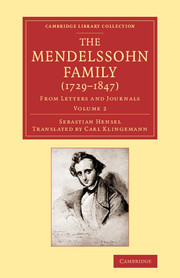
Sebastian Hensel (1830–98), nephew of the composer, virtuoso pianist and conductor Felix Mendelssohn (1809–47), originally intended this work to be 'not only of the family but for the family', drawing on their letters and diaries. Persuaded by friends to publish his narrative in 1879, Hensel in particular provides a first-hand insight into the lives of his uncle, lionized by the music-loving public of his day, and Felix's beloved sister Fanny (1805–47), herself a talented composer and pianist. Translated from the German revised second edition by Felix's close friend, diplomat Carl Klingemann (1798–1862), this 1881 two-volume collection made available for the first time in English a great deal of valuable source material. Covering the period 1836–47, Volume 2 focuses on the final decade of Fanny and Felix's lives, and includes a delightful description by George Grove of Felix's personal appearance.
While a tutor at Warrington Academy, the polymath Joseph Priestley (1733–1804) established himself as a leading grammarian and educational theorist, producing the influential Rudiments of English Grammar (1761) and A Course of Lectures on the Theory of Language and Universal Grammar (1762), both of which are reissued in this series. In 1762 he also delivered these lectures on rhetorical theory, arguing that the purpose of rhetoric is moral formation. Priestley was deeply influenced by associationism, a theory of mind developed by John Locke and David Hartley. This claims that all complex ideas develop from simple ones, which arise purely from sensory impressions. The orator's role, then, is to form the right associations between impressions and ideas in a listener's mind. Informed by this theory, these thirty-five lectures re-evaluate the classical rhetorical components of topic, method and style. First published in 1777, the work is reissued here in its 1781 Dublin printing.
This three-volume study by the Scottish churchman and social reformer Thomas Chalmers (1780–1847) is a revealing work of Christian morality as applied to urban economic theory. Having moved to Glasgow in 1815, Chalmers was given a free hand in 1819 for an experiment in urban ministry at the new parish of St John's in the poorest district of the city. His reforms improved education and reduced the need for institutional poor relief by dividing the area into manageable 'proportions' that were closely looked after by parish elders and deacons, reviving a traditional community spirit and promoting self-help. Although sometimes severe, Chalmers' system and this influential work reflect Enlightenment optimism regarding human nature, suggesting the need for the Church of Scotland to respond actively to problems of urban industrialisation. Volume 2, published in 1823, investigates the nature of pauperism in Scotland and England and the ways in which Parliament and the parish can work towards its abolition.