A collection of out-of-copyright and rare books from the Cambridge University Library and other world-class institutions that have been digitally scanned, made available online, and reprinted in paperback.
To save content items to your account,
please confirm that you agree to abide by our usage policies.
If this is the first time you use this feature, you will be asked to authorise Cambridge Core to connect with your account.
Find out more about saving content to .
To save content items to your Kindle, first ensure no-reply@cambridge.org
is added to your Approved Personal Document E-mail List under your Personal Document Settings
on the Manage Your Content and Devices page of your Amazon account. Then enter the ‘name’ part
of your Kindle email address below.
Find out more about saving to your Kindle.
Note you can select to save to either the @free.kindle.com or @kindle.com variations.
‘@free.kindle.com’ emails are free but can only be saved to your device when it is connected to wi-fi.
‘@kindle.com’ emails can be delivered even when you are not connected to wi-fi, but note that service fees apply.
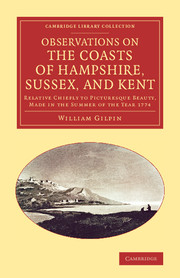
Clergyman, schoolmaster and writer on aesthetics, William Gilpin (1724–1804) is best known for his works on the picturesque. In his Essay on Prints, published in 1768 and reissued in this series, he defined picturesque as 'a term expressive of that peculiar kind of beauty, which is agreeable in a picture'. First published in 1804, the present work is one of a series which records his reflections on the picturesque across British landscapes. It traces the journey he made in 1774, equipped with notebook and sketching materials, along England's south coast from Portsmouth to Dover and Canterbury via Brighton, Rye and Romney Marsh. He describes his impressions of famous landmarks such as the South Downs, Petworth House, Dover Castle and Canterbury Cathedral, and includes several reproductions of his pen-and-wash drawings. The companion volumes of Observations on other parts of Britain are also reissued in the Cambridge Library Collection.
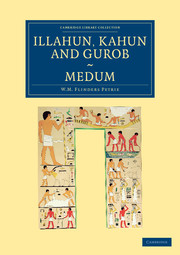
A pioneering Egyptologist, Sir William Matthew Flinders Petrie (1853–1942) excavated over fifty sites and trained a generation of archaeologists. The two excavation reports now reissued here together were first published in 1891 and 1892 respectively, written in collaboration with other experts. They outline significant finds at the pyramids of Lahun and Meidum, and at Gurob and Kahun, notably the latter's cache of Middle Kingdom papyri. Petrie and his collaborators describe in detail how they came to make these discoveries, shedding light on developing archaeological practices used towards the end of the nineteenth century. Petrie's professional method of painstakingly recording every find is well demonstrated here, and each report includes a section of valuable illustrative material. Petrie wrote prolifically throughout his long career, and a great many of his other publications - for both specialists and non-specialists - are also reissued in this series.
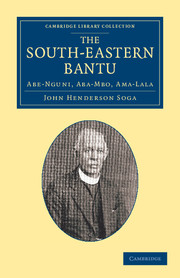
Son of Tiyo Soga, the first black South African to be ordained, John Henderson Soga (1860–1941) was a Xhosa minister and scholar. Like his father, he was one of the first of his people to receive an education in Europe and to marry a European woman. His perspective on his people's history is therefore distinctive. Driven by a desire to record Xhosa traditions before they were lost in a changing world, Soga collected oral histories during his work at mission stations in South Africa, producing this historical survey of three branches of the Bantu family. Including genealogies of the main tribes, and tracing their traditions, beliefs and conflicts, the work first appeared in this English version in 1930, having been translated by the author from his native language. His equally authoritative work of social anthropology, The Ama-Xosa: Life and Customs (1932), is also reissued in this series.
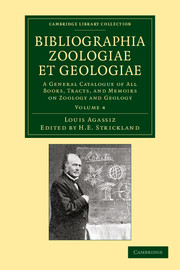
Born in Switzerland, Louis Agassiz (1807–73) distinguished himself as one of the most capable and industrious naturalists of the nineteenth century, working in fields as diverse as ichthyology and glaciology. In the late 1840s, he moved to North America, where he became a professor of zoology at Harvard and established the Museum of Comparative Zoology. His extensive bibliography of all known works relating to zoology and geology, which he had compiled for private use, was revised and substantially expanded by the English naturalist Hugh Edwin Strickland (1811–53) and published by the Ray Society in four volumes between 1848 and 1854. As such, it stands as the fullest record of the existing scientific literature just prior to the publication of Darwin's On the Origin of Species. Volume 4 (1854), completed by Sir William Jardine (1800–74) after the death of Strickland, concludes the list of works, arranged alphabetically by author, ranging here from Naccari to Zwinger.
When this book first appeared in 1793, there had been no significant work on comets published in English since Edmond Halley's death some fifty years before. In Europe the field was dominated by French astronomers such as Pingré and Laplace, but their ornate styles were often difficult to translate. In this concise monograph, Sir Henry Englefield (c.1752–1822) draws both on this continental work and on his own correspondence with William Herschel to produce one of the few accessible manuals in English for the computation of cometary orbits. He includes mathematical examples as new formulae are introduced, along with detailed tables and appendices. Englefield's particular interest was in the development of scientific instruments suitable for travellers - he devised a portable telescope and lent his name to the Englefield mountain barometer - and his passion for efficiency shines through in this work, still valuable to researchers in the history of astronomy and comet science.
Successors such as Wordsworth and Coleridge admired yet overshadowed William Cowper (1731–1800). Troubled by mental instability, he retreated from both the legal profession and the woman he had hoped to marry, seeking out a quiet existence in the country. In spite of his struggles, he made a translation of Homer's Iliad, produced a considerable body of poetry, and maintained many epistolary contacts. This four-volume biography, compiled by his friend and fellow poet William Hayley (1745–1820), appeared between 1803 and 1806, bringing together selected letters and unpublished poems to illuminate Cowper's personal and literary life. Volume 4 (1806) is a collection of supplementary material, namely amendments to the previous volumes, additional letters and an index giving a short description of every letter's content.
The humorously self-styled 'late' Thomas Pennant (1726–98) published this short autobiographical survey in 1793. A prominent Welsh naturalist and antiquary, he was known more for his energy and meticulous methodology than for original scientific genius. Yet he helped popularise natural history with beautifully illustrated works such as his History of Quadrupeds, the third edition of which is also reissued in this series. Moreover, he is credited with preserving thorough records of antiquities that were later damaged or destroyed. Samuel Johnson, who toured Scotland after Pennant, praised him as 'the best traveller I ever read'. More than a mere travelogue, Pennant's Literary Life is full of delightful vignettes - his meeting with the 'wicked wit' Voltaire, his affection for his faithful servant and illustrator Moses Griffith, and his poetic critique of certain hypocritical clergy. The appendices contain several of Pennant's shorter pieces on diverse topics, from anthropology to politics.
An important figure in British business history, the civil engineering contractor Thomas Brassey (1805–70) stood at the forefront of railway construction across the globe in the nineteenth century. He was also instrumental in the development of the Victoria Dock and part of London's sewer system. Originally published in 1872 and reissued here in its 1888 seventh edition, this first biography of Brassey was written by his personal friend, the public servant and author Sir Arthur Helps (1813–75). It describes Brassey's many remarkable achievements as a prolific contractor working in Europe, Asia, Australia and the Americas. A brilliant businessman, representing the best of British skill, leadership and organisation, Brassey employed tens of thousands of men around the world at the peak of his career. Having collaborated with prominent engineers such as Joseph Locke and Robert Stephenson, he secured for himself a long-lasting reputation for integrity and dedication.
The Scottish social anthropologist Sir James Frazer (1854–1941) first published The Golden Bough in 1890. A seminal two-volume work (reissued in the Cambridge Library Collection), it revolutionised the study of ancient religion through comparative analysis of mythology, rituals and superstitions around the world. Following the completion in 1915 of the revised twelve-volume third edition (also available in this series), Frazer found that he had more to say and further evidence to present. Published in 1936, Aftermath was conceived as a supplement to The Golden Bough, offering his additional findings on such topics as magic, royal and priestly taboos, sacrifice, reincarnation, and all manner of supernatural beliefs spanning cultures, continents and millennia. Sealing Frazer's profound contribution to the study of religion and folklore, this work remains an important text for scholars of anthropology and the history of ideas.
Also on Several Parts of North Wales, Relative Chiefly to Picturesque Beauty, in Two Tours, the Former Made in the Year 1769, the Latter in the Year 1773
Clergyman, schoolmaster and writer on aesthetics, William Gilpin (1724–1804) is best known for his works on the picturesque. In his Essay on Prints, published in 1768 and reissued in this series, he defined picturesque as 'a term expressive of that peculiar kind of beauty, which is agreeable in a picture'. First published in 1809, the present work is one of a series which records his reflections on the picturesque across British landscapes. It traces two journeys he made equipped with notebook and sketching materials: the first in 1769 across East Anglia, and the second in 1773 from Anglesey south-east to Shrewsbury. He describes his impression of notable sites such as Cambridge, Houghton Hall and its art collection, Beaumaris Castle and Snowdon, and includes reproductions of his pen-and-wash drawings. The companion volumes of Observations on other parts of Britain are also reissued in the Cambridge Library Collection.
The Austrian scientist Ernst Mach (1838–1916) carried out work of importance in several fields of enquiry, including physics, physiology and psychology. In this short work, first published in German in 1872 and translated here into English in 1911 by Philip E. B. Jourdain (1879–1919) from the 1909 second edition, Mach discusses the formulation of one of science's most fundamental theories. He provides his interpretation of the principle of the conservation of energy, claiming its foundations are not in mechanical physics. Mach's 1868 work on the definition of mass - one of his most significant contributions to mechanics - has been incorporated here. His perspective on the topic as a whole remains relevant to those interested in the history of science and the theory of knowledge. Also reissued in this series in English translation are Mach's The Science of Mechanics (1893) and Popular Scientific Lectures (1895).
Since its first appearance in 1808, this collection of extracts from Elizabethan and Jacobean drama has been highly acclaimed; the twentieth-century critic Edmund Blunden considered it 'the most striking anthology perhaps ever made from English literature'. In compiling the work, the critic and essayist Charles Lamb (1775–1834) aimed to achieve two goals: to illustrate the greatness of Shakespeare's often forgotten contemporaries, and to explore the way in which sixteenth- and seventeenth-century Englishmen experienced emotion. He includes only those scenes which he judges to show the best poetry and the deepest passion, adding only brief notes to let the texts speak for themselves. This reissue is of the expanded two-volume edition of 1835. Volume 2 focuses on plays produced in the seventeenth century. Including extracts from Massinger, Fletcher and Shirley, among others, it remains a rich resource for literature students.
Best known for his 1906 discovery of lost texts in the Archimedes Palimpsest, Danish scholar Johan Ludvig Heiberg (1854–1928), professor of classical philology at Copenhagen, published numerous editions of ancient mathematicians, including Archimedes and Apollonius of Perga (also reissued in this series). Between 1898 and 1907, he published in three parts the extant astronomical works of Ptolemy, active in second-century Alexandria. The Ptolemaic system, his geocentric model of the universe, prevailed in the Islamic world and in medieval Europe until the time of Copernicus. This second part of Volume 1, published in 1903, contains a brief Latin preface and the Greek text of Books 7-13 of Ptolemy's major astronomical treatise, known as the Almagest. It demonstrates how to use astronomical observations to construct cosmological models and includes tables that make it possible for celestial phenomena to be calculated for arbitrary dates.
Thugs, or thuggees, were members of secretive gangs that robbed and sometimes murdered travellers in India; they were also said to worship the Hindu goddess Kali. The British colonial administrator William Henry Sleeman (1788–1856) took a special interest in these gangs and mounted a campaign to eradicate them. Between 1826 and 1840 thousands of Thugs were imprisoned or hanged. The outcome of the operation was due in part to Sleeman's focus on gathering intelligence about the gangs' coded communications. This substantial vocabulary, published in 1836, was compiled from conversations with informers and interrogations of prisoners. It includes words such as adhoreea, which means an intended victim who escaped being murdered, or dhurohurkurna, which is the verb 'to strangle'. The book contains much fascinating data for linguists and historians, and includes an appendix of cases and depositions that constitutes a useful source on crime in colonial India.
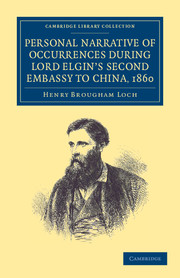
In 1860, James Bruce (1811–63), the eighth Earl of Elgin, embarked upon a second embassy to China which aimed to obtain ratification of the Treaty of Tientsin and finally conclude the Second Opium War on terms favourable to the British. Accompanying Elgin as his private secretary was the enterprising army officer Henry Brougham Loch (1827–1900). Originally published in 1869, Loch's first-hand account of the mission reflects sustained concern over Britain's strained trading relationship with China in the nineteenth century. Notwithstanding his views regarding the need for European influence to shape China's future success in government, his clearly written narrative illuminates contemporary diplomacy and the events surrounding the Convention of Peking in October 1860. Prior to this outcome, Loch had been captured, imprisoned and brutally tortured by Chinese officials. His chapters detailing this experience and his eventual release are especially noteworthy.
A bestseller in its day, this three-volume work vividly recounts significant voyages made by Britain's leading navigators. A prominent figure in London cultural life, John Hawkesworth (c.1720–73) was commissioned by the Admiralty to compile, from the captains' journals, the official record of voyages which included James Cook's first journey to the South Pacific. Reissued here is the Dublin edition based on the first printing of 1773; a second edition appeared later in the year. Critical opinion was fierce, however, with Hawkesworth accused of impiety, manipulating the original texts and promoting the sexual freedoms of Pacific islanders. Devastated by these attacks, he died the same year. Later taken aboard the Beagle with Darwin, the work still speaks to scholars and students of nautical exploration. Volume 3 continues Cook's account of his first voyage, including the first sighting of Australia and his landing at Botany Bay.
A pioneer of British Egyptology, Sir John Gardner Wilkinson (1797–1875) first travelled to Egypt in 1821, the year before Champollion published his breakthrough work on the Rosetta Stone. As public interest in Egypt grew, Wilkinson studied and sketched the country's major archaeological sites, most notably the tombs of Thebes. His Topography of Thebes and General View of Egypt (1835) and Modern Egypt and Thebes (1843) are also reissued in this series. This well-illustrated three-volume work, first published in 1837, remained for over a century a key text on the lives of ancient Egyptians. Writing in a popular genre that was normally focused on contemporary societies, Wilkinson covers areas ranging from daily life to funerary beliefs. His imaginative approach underpinned the book's considerable success. Volume 3 includes discussion of hunting techniques, decorative arts, the making of papyrus, ship construction, and the building and decoration of monuments.
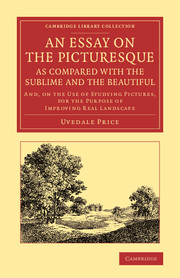
Frustrated by what he saw as the over-grooming prevalent in British landscape gardening and associated with the work of Capability Brown, Uvedale Price (1747–1829) published this essay in 1794. He emphasises here the importance of naturalism and harmony with the surrounding environment. Providing examples of how certain features in a garden may be improved through adherence to picturesque principles, Price seeks to apply the lessons of landscape painting to the practice of landscape gardening. He also stresses the importance of paying attention to changing light and the effect of shadow. The essay appeared in the same year as 'The Landscape', a didactic poem by Richard Payne Knight (1751–1824), which was addressed to Price and is included at the end of this reissue. Price's Letter to H. Repton, Esq., a supplement to his essay, is reissued separately in this series in its 1798 edition.
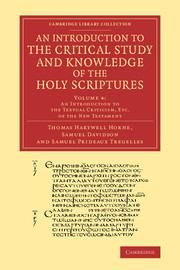
A painstaking compiler of catalogues and indexes, the biblical scholar and bibliographer Thomas Hartwell Horne (1780–1862) first published his most famous work in 1818, having begun his research for it many years earlier in 1801. Reissued here in five parts is the expanded four-volume tenth edition of 1856, which includes revisions by the scholars Samuel Davidson (c.1806–98) and Samuel Prideaux Tregelles (1813–75). This monumental and influential work of nineteenth-century biblical scholarship remains a valuable resource for modern researchers, reflecting the methods and perspectives of its era. Volume 4, rewritten by Tregelles for this edition, addresses textual criticism of the New Testament. Drawing strongly on his previous scholarship, Tregelles covers the history of the text, distinguished readings and important manuscripts, and he provides an introduction to each book of the New Testament.
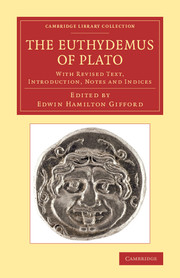
Headmaster of King Edward's School in Birmingham for fourteen years, Edwin Hamilton Gifford (1820–1905) also held a number of ecclesiastical posts, including select preacher at both Cambridge and Oxford. Better known for his biblical and patristic scholarship, he also prepared this edition of the Euthydemus, Plato's most comical dialogue. Thought to be an early work, depicting a discussion between Socrates and two sophists trained in eristic (argument for the sake of conflict), it is among the earliest-known treatises on logic, satirising various fallacies that were subsequently categorised by Aristotle. Published in 1905, a generation after Jowett's standard translation, this edition was intended for university and advanced school students. A thorough introduction is given in English, followed by the Greek text, extensive notes, and indexes of vocabulary and names. As such, this reissue illuminates the educational preoccupations of both early twentieth-century England and classical Athens.