A collection of out-of-copyright and rare books from the Cambridge University Library and other world-class institutions that have been digitally scanned, made available online, and reprinted in paperback.
To save content items to your account,
please confirm that you agree to abide by our usage policies.
If this is the first time you use this feature, you will be asked to authorise Cambridge Core to connect with your account.
Find out more about saving content to .
To save content items to your Kindle, first ensure no-reply@cambridge.org
is added to your Approved Personal Document E-mail List under your Personal Document Settings
on the Manage Your Content and Devices page of your Amazon account. Then enter the ‘name’ part
of your Kindle email address below.
Find out more about saving to your Kindle.
Note you can select to save to either the @free.kindle.com or @kindle.com variations.
‘@free.kindle.com’ emails are free but can only be saved to your device when it is connected to wi-fi.
‘@kindle.com’ emails can be delivered even when you are not connected to wi-fi, but note that service fees apply.
This authoritative biography of Ludwig van Beethoven (1770–1827) was a landmark in its meticulous research and use of source material. For the American author Alexander Wheelock Thayer (1817–97), it represented a lifelong labour of love, yet it remained unfinished at his death. His friend Hermann Deiters (1833–1907) edited and translated Thayer's work into German, publishing three volumes which covered Beethoven's life to 1816. Since Deiters also died before the biography could be completed, musicologist Hugo Riemann (1849–1919) was called upon to conclude the work. The final German volumes appeared in 1907 and 1908. It was the American critic Henry Edward Krehbiel (1854–1923) who prepared the present work, the first and considerably revised English version, published in three volumes in 1921. Volume 3 covers Beethoven's final years, his ninth symphony and late quartets.
Among the leading Egyptologists of his day, Sir William Matthew Flinders Petrie (1853–1942) excavated over fifty sites and trained a generation of archaeologists. As a young man, he demonstrated an aptitude for mathematics and used this skill to measure monuments across the south of England, including Stonehenge. Published in 1877, this work was based in part on these early surveys and provides great insight into the linear measurements used by ancient civilisations. Notably, Petrie establishes that accurate measurement was possible in societies without writing systems. His innovative approach to metrology draws comparisons between units of measurement used by peoples separated by great spans of time and distance, ranging from medieval Ireland to ancient Egypt. Petrie went on to write prolifically throughout his long career, and a great many of his other publications are also reissued in this series.
Edited by the eminent anthropologist and linguist Franz Boas (1858–1942), this work was first published in two huge volumes between 1911 and 1922. Comprising detailed studies of four Native American languages, Volume 2 focuses on the Takelma, Coos, Siuslaw and Chukchi languages. Each chapter contains a discussion of the speakers of the language, its geographical distribution, the phonetic system, and an analysis of the grammar and vocabulary. The work built upon the foundations laid by J. W. Powell (1834–1902) in his Introduction to the Study of Indian Languages (1877). Boas, a pioneer in the field of cultural anthropology, intended the present work to promote his culturally relativist approach to ethnographic study. Overall, the project ranks as a landmark in entrenching scientific principles for the study of North America's indigenous peoples and languages.
Born in Ancoats, a deprived industrial area of Manchester, Charles Rowley (1839–1933) witnessed what he saw as the degeneration of inner-city life in the second half of the nineteenth century. His family's picture-framing business, combined with his love of culture, brought him into contact with the ideas and personalities associated with the Pre-Raphaelite Brotherhood, notably William Morris. As a social reformer, Rowley was suspicious of organised charity and its tendency to patronise those it tried to support. Through a number of progressive initiatives, he laboured to bring art and culture to working people: the Ancoats Brotherhood, which organised lectures and reading groups, was among the many projects he fostered. First published in 1911, these well-illustrated memoirs present a thoughtful portrait of Rowley's experiences and enthusiasms, touching upon his interactions with such artists as Ford Madox Brown, Dante Gabriel Rossetti and William Holman Hunt.
By the late eighteenth century, scientists had discovered certain types of gas, such as 'fixed air' (carbon dioxide), but their composition was little understood. Relatively few investigations into gases had taken place, and so the polymath Joseph Priestley (1733–1804) was able to make major breakthroughs in the field using a range of experimental techniques. While living near a brewery, he found that it was possible to outline the shape of the gas above fermenting beer with smoke, and that fire would burn with varying strength depending on the composition of the air. This three-volume collection first appeared between 1774 and 1777. Following the international interest and new discoveries prompted by the publication of its predecessor, Volume 2 - reissued here in its corrected 1776 second edition - includes accounts of further experiments, Priestley's paper on the conducting power of charcoal, and, most significantly, notes on what he calls 'dephlogisticated air' (oxygen).
Trained as a gardener in his native Scotland, William Aiton (1731–93) had worked in the Chelsea Physic Garden prior to coming to Kew in 1759. He met Joseph Banks in 1764, and the pair worked together to develop the scientific and horticultural status of the gardens. Aiton had become superintendent of the entire Kew estate by 1783. This important three-volume work, first published in 1789, took as its starting point the plant catalogue begun in 1773. In its compilation, Aiton was greatly assisted with the identification and scientific description of species, according to the Linnaean system, by the botanists Daniel Solander and Jonas Dryander (the latter contributed most of the third volume). Aiton added dates of introduction and horticultural information. An important historical resource, it covers some 5,600 species and features a selection of engravings. Volume 3 covers Diadelphia to Cryptogamia, and includes addenda and indexes of generic and English names.
The French author and traveller Constantin-François de Chasseboeuf (1757–1820) adopted the pen name Volney, which combined the name of Voltaire and Ferney, where the great philosopher lived. A friend of Thomas Jefferson and other Enlightenment figures, Volney used an inheritance to further his education by travelling to Ottoman Egypt and the historical region of Syria, visiting areas of present-day Lebanon and Israel. He chose these lands as he believed he would gain political and philosophical insights from their ancient heritage. Very little had been written in the West about these areas before he published this two-volume account in 1787. It enjoyed great popularity and even accompanied Darwin aboard the Beagle on his own voyage of discovery decades later. Reissued here is the revised and corrected French second edition, which also appeared in 1787. Volume 2 is devoted to Syria. It looks in detail at the region's history, justice, trade and customs.
A Scottish doctor and botanist, George Watt (1851–1930) had studied the flora of India for more than a decade before he took on the task of compiling this monumental work. Assisted by numerous contributors, he set about organising vast amounts of information on India's commercial plants and produce, including scientific and vernacular names, properties, domestic and medical uses, trade statistics, and published sources. Watt hoped that the dictionary, 'though not a strictly scientific publication', would be found 'sufficiently accurate in its scientific details for all practical and commercial purposes'. First published in six volumes between 1889 and 1893, with an index volume completed in 1896, the whole work is now reissued in nine separate parts. Volume 6, Part 3 (1893) contains entries from silk to tea, two of India's most important economic products.
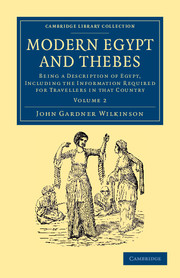
A pioneer of British Egyptology, Sir John Gardner Wilkinson (1797–1875) first travelled to Egypt in 1821, the year before Champollion published his breakthrough work on the Rosetta Stone. As public interest in Egypt grew, Wilkinson studied and sketched the country's major archaeological sites, most notably the tombs of Thebes. His celebrated Topography of Thebes and General View of Egypt (1835) and Manners and Customs of the Ancient Egyptians (1837) are also reissued in this series. A remodelled and enlarged version of the former work, this two-volume guide of 1843 not only gives practical advice for the contemporary traveller, but also provides modern readers with a vivid snapshot of Egypt in the middle of the nineteenth century. Volume 2 includes further information and guidance about places to visit, including Mount Sinai, along with a section on the history of Egypt that focuses on the Islamic period but also incorporates chronological tables of rulers from the pharaohs onward.
Thomas Chatterton (1752–70) was only seventeen when he died of arsenic poisoning. Among his family and friends he was known as a versifier with a fascination for medieval manuscripts, but none suspected the true scope of his work. At eleven, he was already writing poetry, and by the end of his life his love poems, eclogues and forged medieval pieces numbered in the hundreds. They were to influence the Romantics for decades after his death. This three-volume collection of his work, edited by Joseph Cottle and Robert Southey, first appeared in 1803. Volume 2 contains the Rowley poems, for which Chatterton is best known. Ironically, they were never published under his own name in his lifetime: he claimed that the poems were transcripts he had taken from the work of Thomas Rowley, a fifteenth-century monk. The value of these ambitious forgeries is still underappreciated.
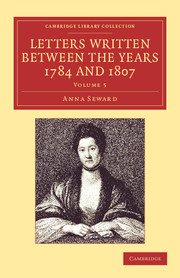
The literary career of Anna Seward (1742–1809) had many frustrations. Erasmus Darwin once printed her poetry under his own name. Horace Walpole accused her of having 'no imagination'. And despite her evident talents, she was unable to find a patron willing to support a woman. Yet her letters reveal the breadth of her interests and the strength of her literary criticism. In addition to writing to newspapers and magazines, she counted many eminent figures among her correspondents, including James Boswell (who begged for a lock of her hair) and the young Walter Scott. This six-volume selection of her letters, edited by the publisher Archibald Constable (1774–1827), first appeared in 1811. Full of Seward's characteristic good humour, Volume 5 covers the years 1797–1801. It features her reflections on slavery, the disinclination of the young toward a religious life, and the troubled state of Ireland, alongside frank accounts of the rheumatism that plagued her middle age.
In terms of musical composition, all but the first five of his thirty-five years were astoundingly productive for Wolfgang Amadeus Mozart (1756–91). A stream of glorious symphonies, piano concertos, chamber music, operas and the sublime but unfinished Requiem poured from his pen. German philologist and archaeologist Otto Jahn (1813–69) was inspired to write a scholarly biography of Mozart following a conversation at Mendelssohn's funeral in 1847. He immersed himself in intensive research on the composer and his music, publishing the first edition of this landmark work in four volumes between 1856 and 1859. A second edition followed in 1867, incorporating new material and making use of Köchel's 1862 catalogue of Mozart's works. It is from this edition that Pauline D. Townsend made her three-volume English translation, first published in 1882. Volume 1 covers Mozart's life to 1778, including tours with his father and employment under Archbishop Colloredo.
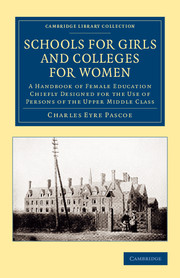
The author of handbooks that reflected the Victorian emphasis on bettering one's prospects, Charles Eyre Pascoe (1842–1912) addressed the topic of female education in this work of 1879, at a time when the Cambridge colleges of Girton and Newnham were in their infancy. 'Chiefly designed for the use of persons of the upper middle class', the guide aims to assist parents in making informed choices about their daughters' education. The coverage extends from kindergarten through to university, before focusing on career options for women in the late nineteenth century, in fields such as teaching, the arts and medicine. Throughout, Pascoe's recommendations are based on consideration of the breadth of the curriculum, the qualifications of the teaching staff and the results achieved in examinations. For higher education, details of entrance examinations are provided, together with information on the subjects and lectures that were open to women at that time.
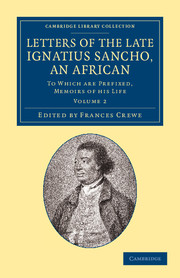
Born a slave, Ignatius Sancho (c.1729–80) became one of the most influential free Africans of his century. Largely self-taught, he was the first black Briton known to have voted in parliamentary elections and to be given an obituary in the British press. He corresponded with many notable figures, including the author Laurence Sterne, whom he urged to write against slavery in the West Indies. The politician Joseph Jekyll (1754–1837) commended Sancho's 'epistolary talent' in a brief biography, praising his 'wild patriotism' and 'universal philanthropy'. This two-volume collection of Sancho's letters was published in 1782 by the hostess Frances Crewe (1748–1818), who upheld Sancho as proof, in an age of dehumanising slavery, that Africans possessed as much natural intelligence as Europeans. Volume 2 contains letters for the period 1778–80. Sancho's last letters, betraying his acute suffering from gout, reveal the same warmth of affection and zeal for justice which characterised his life.
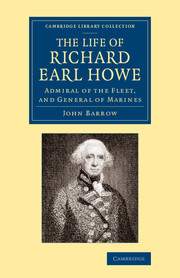
Richard, Earl Howe (1726–99) participated in some of the Royal Navy's most significant conflicts. As captain of the Dunkirk, he fired the first shots of the Seven Years' War off the eastern coast of North America in 1755. After being forced to juggle the demands of the American Revolutionary War with the British government's reluctance to put the ships he needed at his disposal, he resigned his command of the North American Station, but later made a comeback, masterminding the battle against the French on the 'Glorious First of June' in 1794. Prolific author Sir John Barrow (1764–1848) drew on more than 400 of Howe's personal letters in preparing this substantial biography, first published in 1838. Several of Barrow's other works have also been reissued in this series, including his autobiography and accounts of the early years of polar exploration.
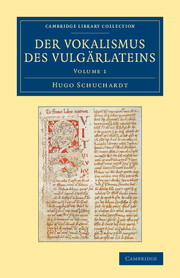
The German linguist Hugo Schuchardt (1842–1927) made significant contributions to the study of the Basque and Romance languages, publishing also on pidgins and creoles. A critic of the Neogrammarian hypothesis of sound laws, he subscribed to the 'wave model' of language change. His Über die Lautgesetze: Gegen die Junggrammatiker (1885) has been reissued in this series in a volume with Die Verwantschaftsverhältnisse der indogermanischen Sprachen (1872) by Johannes Schmidt (1843–1901). Based on Schuchardt's doctoral dissertation and the painstaking study of extant sources, the present three-volume work appeared between 1866 and 1868. He explores here the development and characteristics of Vulgar Latin, the language of the general population, as opposed to the classical, literary variety. The work focuses on the distinctive vowel changes that took place in Romance vernaculars over many centuries. Opening with a thorough introduction and discussion of sources, Volume 1 (1866) examines qualitative vowel changes.
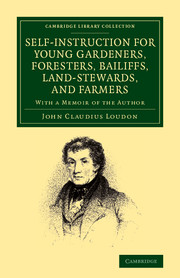
Intended for young men with limited formal education, this manual was the final project of the landscape gardener John Claudius Loudon (1783–1843). Completed by friends, the book appeared posthumously in 1845. The son of a farmer, Loudon was well aware that men who began their careers as gardeners often became the stewards of estates, bailiffs, or tenant farmers later in life, and he provides here some of the mathematical and technical instruction necessary to carry out those roles successfully. Including sections on fractions, geometry, trigonometry, architectural drawing, and the calculation of wages and interest rates, the book traces a remarkable picture for the modern reader of the administrative duties expected of horticultural and agricultural workers in the mid-nineteenth century. Also included are conversion tables, a biography of Loudon, and a short preface by his wife Jane, whose Instructions in Gardening for Ladies (1840) is also reissued in this series.
A pioneering Egyptologist, Sir William Matthew Flinders Petrie (1853–1942) excavated over fifty sites and trained a generation of archaeologists. This reissue brings together two of his well-illustrated excavation reports. The first, originally published in 1891, covers his 1890 dig in Palestine at Tell el-Hesi. Although he identified it incorrectly as the biblical city of Lachish, his work here was significant in Near Eastern archaeology for the stratigraphic method of excavation and use of pottery to establish chronology. The second report, from 1906, records the work carried out at a number of Hyksos and Israelite sites in Egypt, such as Tell el-Yehudiyeh and Tell er-Retabeh. It also includes chapters by John Garrow Duncan (1872–1951) on the cemeteries of Suwa and Goshen. Each report contains a section of photographs and drawings of sites, artefacts and inscriptions. Petrie wrote prolifically throughout his long career, and a great many of his other publications are also reissued in this series.
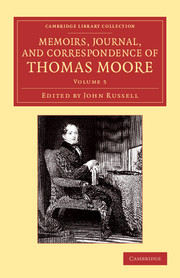
Throughout his professional life, the poet Thomas Moore (1779–1852) was variously celebrated and vilified for both his verse and his politics. Born in Dublin, he remained an ardent Irish patriot until his death. This eight-volume collection of Moore's memoirs, diaries and letters, edited by his friend Lord John Russell (1792–1878) and first published between 1853 and 1856, provides rare insights into a man whose genius was applauded by the Morning Chronicle as 'embracing almost all sides of imaginative literature, of criticism and philosophy'. Opening with a portrait of Lord John Russell and a view of Moore's residence in Paris, Volume 5 contains the poet's diary for the period 1825–8. During these years, Moore embarked on a new career as biographer of the playwright and politician Richard Brinsley Sheridan, and published the political satire Odes upon Cash, Corn, Catholics, and Other Matters (1828).
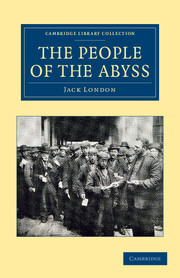
In the summer of 1902, respected American author Jack London (1876–1916), previously known for his descriptions of life during the Klondike Gold Rush, spent two months living 'down by the docks' in London's East End among the city's poorest residents. During this time he often slept in workhouses or on the streets, seeing first-hand how the impoverished struggled daily for adequate food, clothing and shelter while the rest of the city lived in relative prosperity - a prosperity which the author believed was gained at the expense of the poor. One of the earliest eyewitness descriptions of life in the slums of London, this book would influence later socially minded authors such as George Orwell. The text is also illustrated with photographs of the places and people mentioned, offering an important insight into the living conditions of the poor at the dawn of the twentieth century.