A collection of out-of-copyright and rare books from the Cambridge University Library and other world-class institutions that have been digitally scanned, made available online, and reprinted in paperback.
To save content items to your account,
please confirm that you agree to abide by our usage policies.
If this is the first time you use this feature, you will be asked to authorise Cambridge Core to connect with your account.
Find out more about saving content to .
To save content items to your Kindle, first ensure no-reply@cambridge.org
is added to your Approved Personal Document E-mail List under your Personal Document Settings
on the Manage Your Content and Devices page of your Amazon account. Then enter the ‘name’ part
of your Kindle email address below.
Find out more about saving to your Kindle.
Note you can select to save to either the @free.kindle.com or @kindle.com variations.
‘@free.kindle.com’ emails are free but can only be saved to your device when it is connected to wi-fi.
‘@kindle.com’ emails can be delivered even when you are not connected to wi-fi, but note that service fees apply.
Brought up among the extensive grounds of her family home at Didlington Hall in Norfolk, Alicia Amherst (1865–1941) was a keen gardener from an early age. Especially interested in socially beneficial gardening, she sat on the board of the Chelsea Physic Garden from 1900, encouraged the growing of smoke-resistant flowers in poor urban areas, and promoted the greater use of allotments and school gardens during the First World War. The product of four years' research, this learned and engaging work of horticultural history since Roman times was first published to great acclaim in 1895. It notably discusses the manuscript kept at Trinity College, Cambridge, of a fifteenth-century treatise in verse, The Feate of Gardening, which is the earliest existing account in English on the subject. Highly illustrated, Amherst's book also includes her annotated and chronological bibliography of printed works on gardening since 1516.
This is the first volume in a seven-volume collection - published in nine parts between 1864 and 1890 - comprising Venetian and other northern Italian state papers relating to England. Translator and editor Rawdon Lubbock Brown (1806–83) lived for many years in Venice, had unrivalled access to the Venetian archives and travelled widely to find documents in other Italian libraries and archives. He had previously published two volumes of Sebastian Giustinian's dispatches to Venice from Henry VIII's court (also reissued in this series). This first volume contains documents from the years 1202–1509, a large proportion being decrees of the Venetian Senate. Also included is correspondence of the English crown, such as Henry VI's and Edward IV's letters to the Pope. The editor's extensive preface puts the documents into historical context, and the volume also includes chronological tables of documents, ambassadors, consuls and other diplomats featured in the records.
Rudolf Westphal (1826–92) originally studied theology at the University of Marburg before turning to classical philology and comparative linguistics. He learnt Sanskrit and Arabic and took a keen interest in Indo-European languages and Semitic grammar. In the late 1850s and early 1860s he joined his friend and fellow philologist August Rossbach (1823–98) at the University of Breslau (Wrocław). This multi-volume work on ancient Greek metre and music resulted from their collaboration. Reissued here is the revised third edition published in four parts between 1885 and 1889. Part 2 of Volume 3 (1889) considers the historical development of different metres and analyses a number of lyrical and choral compositions in great detail. It also pays attention to the hexameter in drama and the poetry of Nonnus and Theocritus in particular. Also included are accounts of the structure of the Greek choliamb and of the Anacreontea collection.
'To the poet, if to any man, it must be justly conceded to be estimated by what he has written rather than by what he has done, and to be judged by the productions of his genius rather than by the circumstances of his outward life.' At the time of his death, John Keats (1795–1821) was often unfavourably appraised, not only with regard to his poetry, but also his character. In this 1848 collection of his letters, the first of its kind, editor Richard Monckton Milnes (1809–85) sets out to show the poet's true colours through his personal correspondence. Adding insightful commentary and context, he builds up a portrait of an extraordinary young man. Keats' epistolary style is often humorous and salted with miniature flights of fantasy, but he is never far from the monetary concerns that dogged him. Volume 1 charts his early life up to 1819.
Sir James Fitzjames Stephen (1829–94) published this three-volume account of the English criminal law's historical development in 1883, four years after his appointment as a judge of the High Court. It is a revision and expansion of the second chapter in Stephen's 1863 General View (also reissued in this series). At first sight, it is ironic that the author of this classic of legal historical scholarship was himself a Benthamite who favoured and promoted the codification of the common law and worked on codes of criminal law and procedure for India and for England. Volume 2 contains a discussion of the limits on criminal jurisdiction in respect of time, person and place; of the history of criminal responsibility; of the different categories of criminal offence (treason, felony and misdemeanour); of inchoate offences (incitements, attempts and conspiracies); and of the history of the offences against the state (treason, seditious words, libels) and offences against religion.
Composed in the twelfth century by the leading Muslim jurist Burhan al-Din al-Marghinani (1135–97), the original Arabic al-Hidāyah remains a central text of Islamic personal law. This English translation, from a Persian version of the work, was prepared by the orientalist Charles Hamilton (c.1752–92) for the East India Company in 1791. Although since superseded, it remains a fascinating document in the history of colonial jurisprudence. The legal system was central to the entrenchment of British rule in India, providing the framework for active control of civil administration and the courts. Translations of Islamic texts were intended to remove the language barrier for colonial officials, and blurred British and native law for the first time. Volume 2 contains sections on punishments, larceny, the rules of war, foundlings, the absconding of slaves, missing persons, partnerships, sales, bail, the transfer of debts, the duties of judges, and evidence.
Although without formal scientific training, Henry John Elwes (1846–1922) devoted his life to natural history. He had studied birds, butterflies and moths, but later turned his attention to collecting and growing plants. Embarking on his most ambitious project in 1903, he recruited the Irish dendrologist Augustine Henry (1857–1930) to collaborate with him on this well-illustrated work. Privately printed in seven volumes between 1906 and 1913, it covers the varieties, distribution, history and cultivation of tree species in the British Isles. The strictly botanical parts were written by Henry, while Elwes drew on his extensive knowledge of native and non-native species to give details of where remarkable examples could be found. Each volume contains photographic plates as well as drawings of leaves and buds to aid identification. The species covered in Volume 7 (1913) include lime, box, willow, poplar and elm. The work's index appeared separately in 1913 but is now incorporated in this volume.
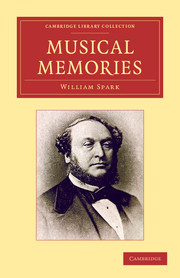
The organist and writer William Spark (1823–97) is best remembered for his active role in the Leeds musical scene, notably his involvement in the People's Concerts and the Leeds Festival. Spark had been articled to the organist and composer Samuel Sebastian Wesley in 1840 and accompanied him when he moved to Leeds two years later. Following several posts as an organist, he worked with Henry Smart on the design of the organ for Leeds town hall in 1858, giving regular recitals on it thereafter. He wrote on a wide variety of musical topics and the present work, first published in 1888, brings together his personal reminiscences and anecdotes. The pen portraits of eminent musicians - including conductor Sir Michael Costa, composer Felix Mendelssohn and soprano Adelina Patti - offer a remarkably informed insight into the development of musical culture in the nineteenth century.
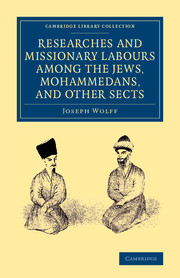
Born in Franconia, the son of a rabbi, Joseph Wolff (1795–1862) was baptised in 1812. Educated in Hebrew, Greek and Latin, he later studied Arabic, Syriac and Aramaic in Vienna, and Christian theology in Rome before being expelled from the city for his heretical views. He came to England, became a member of the Church of England, and then embarked on his missionary work. Though he met with limited evangelical success, the books he went on to publish made him well known at home. Reissued here is his 1835 account of travels in the early 1830s through the Middle East and Asia, during which he experienced robbery and disease, journeyed through the Himalayas, and was hosted by numerous royal courts. This tale, exotic and extraordinary, is a remarkable source for those interested in nineteenth-century orientalism and Christian missionary zeal.
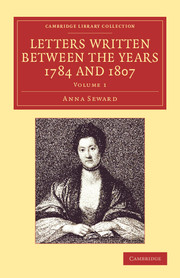
The literary career of Anna Seward (1742–1809) had many frustrations. Erasmus Darwin once printed her poetry under his own name. Horace Walpole accused her of having 'no imagination'. And despite her evident talents, she was unable to find a patron willing to support a woman. Yet her letters reveal the breadth of her interests and the strength of her literary criticism. In addition to writing to newspapers and magazines, she counted many eminent figures among her correspondents, including James Boswell (who begged for a lock of her hair) and the young Walter Scott. This six-volume selection of her letters, edited by the publisher Archibald Constable (1774–1827), first appeared in 1811. Volume 1 covers the period 1784–7. Showing the first signs of her long-lasting acrimony towards Samuel Johnson, whom she saw as a bully, it includes some of her anecdotes of him, alongside her own equally expert criticism.
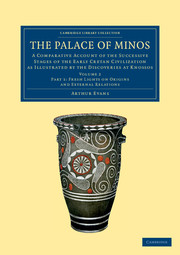
Inspired by Schliemann's discoveries at Mycenae and Troy, Sir Arthur John Evans (1851–1941), keeper of Oxford's Ashmolean Museum from 1884 to 1908, trustee of the British Museum and fellow of the Royal Society, used his inherited wealth to purchase land in Crete at Knossos. From 1900 he commenced excavations there in co-operation with the British School at Athens. Work continued for eight full seasons, uncovering a Bronze Age palace and bringing to light further architectural and artefactual remains of Minoan civilisation, including numerous texts in Linear A and Linear B. Evans' speculative reconstruction of the site in reinforced concrete remains controversial, and some of his interpretations are disputed, but his pioneering work is painstakingly detailed in this highly illustrated multi-volume work, published between 1921 and 1935, with an index volume appearing in 1936. Part 1 of Volume 2 first appeared in 1928.
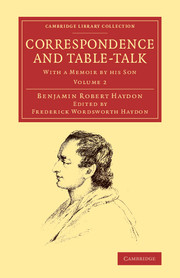
Artist, diarist, and devotee of the Elgin Marbles, Benjamin Robert Haydon (1786–1846) is best known for his large-scale paintings, such as Christ's Entry into Jerusalem and The Raising of Lazarus. After he entered the Royal Academy in 1805 as a student of Henry Fuseli, his forthright views and combative manner fuelled a feud with the institution and perceived enemies. His unshakeable belief in his own genius and his unwillingness to compromise his artistic standards drew him ever further into debt, which ultimately contributed to his suicide. As a writer, Haydon's acute eye for the humorous is demonstrated throughout his correspondence and diary. In this two-volume work, first published in 1876, his son Frederick Wordsworth Haydon (1827–86) brings together letters and extracts from his father's journals. Volume 2 contains selected letters, including those to and from Keats and Wordsworth, along with a host of witty and erudite journal extracts.
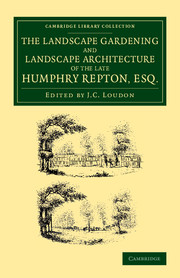
By the beginning of the nineteenth century, landscape gardening had divided into at least two branches. The geometric style promoted strictly ordered gardens, while the natural style, for which the period is known, preserved characteristics of untamed vistas. Edited by a former professional rival, John Claudius Loudon (1783–1843), this one-volume collection of the works of Humphry Repton (1752–1818) first appeared in 1840. Featuring more than 250 engravings, it illuminates the principal styles and contemporary debates of landscape design. Including perspective tricks to disguise differing water levels, and instructions on the use of cattle as a natural measure of scale, Repton's writings reflect the attention to detail that was involved in planning and executing major projects. The collection is prefaced with a biographical notice believed to have been written by the architect John Adey Repton (1775–1860), who collaborated with his father on many schemes.
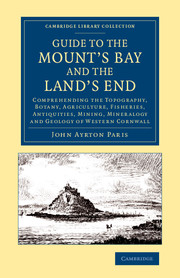
President of the Royal College of Physicians from 1844 until his death, John Ayrton Paris (1785–1856) wrote chiefly on medical topics, yet he also devoted time to the study of science and natural history. He served as physician to the Penzance Dispensary between 1813 and 1817, during which time he helped to establish what became the Royal Geological Society of Cornwall. First published anonymously in 1816, and reissued here in the second edition of 1824, this work explores the landscapes and natural history of the western part of Cornwall. Presented as a series of 'excursions', the guide takes in locations such as St Michael's Mount and the Lizard, also covering the rich mining districts at Redruth and St Just, and discussing local customs, the Cornish language and the health-giving climate. Several of Paris's medical and biographical works are also reissued in this series, including his life of the Cornish chemist Sir Humphry Davy.
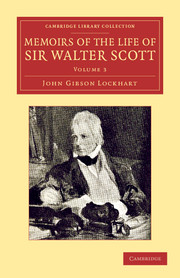
As son-in-law and literary executor to Sir Walter Scott (1771–1832), John Gibson Lockhart (1794–1854) was uniquely placed to produce a definitive biography of the great poet and novelist. First published in 1837–8, shortly after Scott's death, this celebrated seven-volume work is based on personal memories, correspondence, and Scott's own autobiographical sketches. Wide-ranging in his purview, Lockhart is also detailed in his descriptions: the Aberdeen Journal of the day observed that the volumes trace Scott's life and literary efforts with 'the most minute distinctness'. Volume 3 opens in 1812 with an account of 'one of the busiest summers of Scott's busy life', during which he finally moved into his beloved Abbotsford. Incorporating extracts from Scott's correspondence with the English poet George Crabbe, this volume covers the period in which Scott finished Waverley (1814) and published in verse The Field of Waterloo (1815).
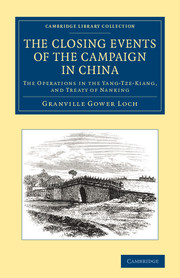
This 1843 work by naval officer Granville Gower Loch (1813–53) is based on his journal of the capture of Chinkiang (Zhenjiang) in July 1842, the last major battle of the First Opium War. Covering not only military and diplomatic activity, the work also contains Loch's colourful descriptions of the region's landscape, architecture, commerce, people and customs. Having been promoted to captain in August 1841, Loch had gone to China as a volunteer and aide-de-camp to General Sir Hugh Gough (1779–1869). Following service in the West Indies, he was killed on a mission in Burma during the Second Anglo-Burmese War. A monument was erected to his memory in St Paul's Cathedral. One of his brothers, Henry Brougham Loch (1827–1900), also later served under Gough and his Personal Narrative of Occurrences during Lord Elgin's Second Embassy to China (1869) has been reissued in this series.
A leading figure of the Scottish Enlightenment, George Campbell (1719–96) began to write what was to become his most famous work, The Philosophy of Rhetoric, soon after his ordination as a minister in 1748. Later, as a founder of the Aberdeen Philosophical Society, he was able to present his theories, and these discourses were eventually published in 1776. In the spirit of the Enlightenment, Campbell combined classical rhetorical theory with the latest thinking in the social, behavioural and natural sciences. A proponent of 'common sense' philosophy, he was particularly interested in the effect of successful rhetoric upon the mind. Published in two volumes, the work is divided into three books. Volume 1 contains Book 1 and part of Book 2. Book 1 emphasises the necessity of acknowledging and adapting to the needs of an audience. In Book 2, Campbell expands on the linguistic tools a successful rhetorician should employ.
The Austrian scientist Ernst Mach (1838–1916) carried out work of importance in many fields of enquiry, including physics, physiology, psychology and philosophy. Published in this English translation of 1906, these essays examine geometry from three different perspectives. Mach argues that, as our ideas about space are created by the senses and how we experience our environment, researchers must not consider the subject from a mathematical standpoint alone. In the first essay, he explains how humans generate spatial concepts. Next, he discusses the psychology of geometry, its empirical origins, and its development. In the final piece, he writes from the viewpoint of a physicist, outlining how various mathematicians, such as Carl Friedrich Gauss and Bernhard Riemann, have contributed to our geometrical understanding. Also reissued in this series in English translation are Mach's The Science of Mechanics (1893) and Popular Scientific Lectures (1895).
Following the French Revolution, the physicist and mathematician Jean Baptiste Joseph Fourier (1768–1830) taught at the École Normale Supérieure and later succeeded Lagrange at the École Polytechnique. He was promoted to administrative positions under Napoleon, but continued to pursue his scientific interests. From 1822 until his death he served as the permanent secretary for mathematical sciences at the Académie des Sciences. These selected works were edited by the mathematician Jean Gaston Darboux (1842–1917) and published in two volumes between 1888 and 1890. Volume 2 contains several extraordinary contributions: the first paper to address the question of why the earth's surface is warm (which we now call the greenhouse effect), the first paper to address the cooling of the earth's interior (still a major research topic) and the first paper on optimisation under linear constraints, along with the results on roots of polynomials which first made Fourier's reputation.
Having joined the Royal Navy at the age of ten, Frederick William Beechey (1796–1856) had risen to the rank of lieutenant when he served under John Franklin on the 1818 British expedition to the Arctic in search of a possible route from the Atlantic to the Pacific. Two ships, the Dorothea and the Trent, were sent to find a route via the seas around Spitsbergen. A little north of 80° their progress was halted by ice. Sailing west to Greenland, the Dorothea was seriously damaged and the expedition aborted. Beechey's account remains the principal source for this voyage as neither Franklin nor the overall commander David Buchan published their journals. Beechey's Arctic service equipped him to later command the Blossom in northern waters: his two-volume Narrative of a Voyage to the Pacific and Beering's Strait (1831) is also reissued in the Cambridge Library Collection.