To save content items to your account,
please confirm that you agree to abide by our usage policies.
If this is the first time you use this feature, you will be asked to authorise Cambridge Core to connect with your account.
Find out more about saving content to .
To save content items to your Kindle, first ensure no-reply@cambridge.org
is added to your Approved Personal Document E-mail List under your Personal Document Settings
on the Manage Your Content and Devices page of your Amazon account. Then enter the ‘name’ part
of your Kindle email address below.
Find out more about saving to your Kindle.
Note you can select to save to either the @free.kindle.com or @kindle.com variations.
‘@free.kindle.com’ emails are free but can only be saved to your device when it is connected to wi-fi.
‘@kindle.com’ emails can be delivered even when you are not connected to wi-fi, but note that service fees apply.
This Element addresses the illiberal challenge facing public administration amidst the rise of authoritarian populism and democratic backsliding. It investigates how populist governments seek to reshape state bureaucracies, often undermining liberal democratic principles such as pluralism, expertise, and constitutional safeguards, and examines how public administration must respond to safeguard democratic integrity. Drawing on global examples, the Element identifies strategies of populist administrative manipulation, patterns of bureaucratic compliance and resistance, and critical gaps in scholarly understanding. It develops a framework for analyzing these dynamics and proposes normative principles to defend active democratic bureaucracy. Through theoretical inquiry and practical recommendations, it advocates for robust, ethically grounded public administration capable of countering illiberal pressures. Its central thesis underscores the need to restore the intellectual foundation of public administration as a social science deeply embedded in and committed to the democratic policy process. This title is also available as Open Access on Cambridge Core.
This volume offers in-depth coverage of varieties of English across the world, outside of the British and North American arenas. It is split into two parts, with Part 1 dedicated to varieties of English across Africa, and Part 2 looking at varieties in Asia, and Australia and the Pacific. There are introductory chapters dealing with the colonial transportation of English overseas, and the generic types of English which resulted, often labelled World Englishes, and examinations of English-lexifier pidgins and creoles. The remaining sections look at different geographic regions. Anglophone Africa divides into three blocks: west, east and south, each with different linguistic ecologies determined by history and demography. Asia, especially South Asia and South-East Asia, is similar in the kinds of English it now shows, with the significance of East Asia for varieties of English increasing in recent years. Varieties of English in Australia and the Pacific are also examined.
Investigates the 2016 installation of Anishinaabemowin (Ojibwe language) toponym signs throughout the White Earth Reservation, reflecting an ongoing tradition of Ojibwe linguistic preservation rooted in environmental knowledge of waters. Drawing on ethnographic interviews with White Earth citizens, descendants, and personnel, this work addresses how these public markers make Anishinaabemowin visible in the world for Ojibwe youth and other White Earth Anishinaabeg, while marking the reservation as an Ojibwe space. These place name signs, along with youth language programs, intervene in the legacy of imposed language loss of Anishinaabemowin on the White Earth Reservation caused by mission, day, and boarding schools. Examines Ojibwe people's intergenerational efforts to document place names, responses to these signs, and how they relate to toponymic authority and spatial belonging. Focuses on historic and contemporary stories of Ojibwe geographic relationships grounded in fishing, hunting, ricing, and gathering within and surrounding Gaa-waabaabiganikaag. This title is also available as open access on Cambridge Core.
This Element maps the relationship between taxation and social policy from a comparative and historical perspective. It critically reviews studies in fiscal sociology, history, political science, and political economy to highlight blind spots in the body of knowledge that future studies could explore. It shows that studying the revenue side of social policy offers compelling answers to central questions tackled in welfare state scholarship and addresses questions such as: What explains the introduction and timing of social programs? How can we understand processes of welfare state expansion and retrenchment? What determines the redistributive capacity of welfare states? What accounts for variations in redistributive capacity between groups and across generations in different countries? While bringing in the financing side of social policy complements prevailing accounts in the welfare state literature, studying financing can also transform how we understand social policy. This title is also available as Open Access on Cambridge Core.
The Messianic Jews of Ethiopia's Gambella region are Evangelical Christian Zionists who adhere to various Jewish practices and understand their faith as authentically emulating the faith of the first followers of Jesus Christ. Drawing on over a year of ethnographic research in this region, Yotam Gidron traces here the rise and evolution of Christian Zionist and Messianic Jewish faiths amongst Nuer communities in the Ethiopia-South Sudan borderlands. This study approaches processes of religious change from the perspective of believers, examining their pursuits of knowledge and transnational connectivity. In doing so, Gidron considers everyday dilemmas concerning spiritual mediation and truth, as they emerged in relation to church genealogies, Christian literacy, modes of prayer and praise, bloodlines, cattle, and the constitution of various human and divine relationships. As a result, he offers timely insights on spiritual and political life at the global margins, and on contemporary African attitudes towards Israel and the Middle East.
Using a welcoming and conversational style, this Student's Guide takes readers on a tour of the laws of thermodynamics, highlighting their importance for a wide range of disciplines. It will be a valuable resource for self-guided learners, students, and instructors working in physics, engineering, chemistry, meteorology, climatology, cosmology, biology, and other scientific fields. The book discusses thermodynamic properties such as temperature, internal energy, and entropy, and develops the laws through primarily observational means without extensive reference to atomic principles. This classical approach allows students to get a handle on thermodynamics as an experimental science and prepares them for more advanced study of statistical mechanics, which is introduced in the final chapter. Detailed practical examples are used to illustrate the theoretical concepts, with a selection of problems included at the end of each chapter to facilitate learning. Solutions to these problems can be found online along with additional supplemental materials.
Solar geoengineering (SG) is a set of highly controversial emerging technologies proposed to address climate change by reflecting sunlight away from the planet to reduce temperatures. SG may reduce climate risks, however it also presents novel risks, uncertainties, and challenges, necessitating broad and inclusive public engagement. This Element presents a briefing book and methods toolkit to build capacity for public engagement on SG. Part I of the Element explains the need to build capacity to enable public engagement on solar geoengineering, and presents three methods for doing so: capacity building workshops, participatory Technology Assessment, and Deliberative Polling. Part II presents a briefing book that provides accessible, balanced, and evidence-based information on critical topics including climate science, climate policy, SG science, SG governance and policy, and SG ethics and justice. This title is also available as open access on Cambridge Core.
Current policing practices directly continue from historical methods. City policing in the Global North emerged as a response to unrest and subsistence crises during the late stage of the Little Ice Age, namely across two capital cities, Dublin and later London. From the mid-1700s, poor harvests and food rioting precipitated a series of policing reforms in the Irish Parliament. In the 1800s, further weather fluxes and unrest, combined with shifts in interpretation of social obligation - all linked to increasing urban population and its mobility – led to a series of new police reforms in Great Britain, soon reaching its former and current dominions. The expanding urban centres from Ireland to Australia, and England to North America, shared founding principles, structures, regulations and personnel. Despite modernisation and innovations in operational policing, law enforcement continues to face similar challenges in an increasingly globalising world, partly due to persistent adherence to historical antecedents.
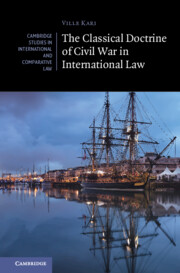
In the classical law of nations there was a doctrine of civil war. This book sets out to recover the forgotten legal tradition that shaped the modern world from 1575-1975. The result is an autonomous reassessment of four hundred years of the law of insurgencies and revolutions, both in state practice and in legal scholarship. Its journey through centuries of rebellion and the rule of law touches some of the most basic questions of international law across ages. What does it mean to stand among the nations of the world? Who should be welcomed among the subjects of international law, who should not, and who should decide? Its findings not only help make the classical doctrine understandable again, but also offer potential new insights for present-day lawyers about the origins, aspirations and vulnerabilities of the legal tradition with which they work today.
Basque is a language of central importance to linguists because it is a 'language isolate,' a rare type of language that is typologically 'alone' and cannot be classified as a part of any language family. Language isolates remain somewhat a mystery, and this book aims to provide an important piece of the puzzle, by both exploring the structure of Basque and shedding new light on its unique place within the languages of the world. It meticulously examines various properties of Basque, including the alignment of intransitive verbs, the introduction of dative arguments, the nature of psych predicates, the causative/inchoative alternation, impersonals, and morphological causatives. By doing so, it presents a comprehensive overview of Basque's intricacies within the realm of argument structure alternations and voice. In its final chapter, it provides an introduction to potential formal analyses of the topics discussed, paving the way for future research in the field. This title is part of the Flip it Open programme and may also be available open access. Check our website Cambridge Core for details.
This volume examines the development of forms of English in North America from the earliest founder populations through to present-day varieties in the United States and Canada. The linguistic analyses of today's forms emphasise language variation and change with a view to determining the trajectories for current linguistic change. The first part on English in the United States also has dedicated chapters on the history of African American English and the English of Spanish-heritage people in the United States. Part II is concerned with English in Canada and contains seven chapters beginning with the anglophone settlement of Canada and continuing with chapters on individual regions of that country including English in Quebec. Part III consists of chapters devoted to the history of English in the Anglophone Caribbean, looking at various creoles in that region, both in the islands and the Rim, with a special chapter on Jamaica and on the connections between the Caribbean and the United States.
China's Green Belt and Road Initiative (GBRI) was launched in 2017 to address key criticisms of the original BRI and to better align China's overseas development strategy with the global climate agenda. This research examines whether the GBRI represents a genuine shift in China or just a symbolic gesture, and explores its underlying domestic and international drivers. Specifically, it interrogates three prevailing interpretations of the GBRI: a greenwashing tactic, a geopolitical strategy, and a global climate cooperation effort. Our analysis reveals a more dynamic and nuanced process behind the GBRI's emergence and evolution in China. On the one hand, the initiative is rooted in Chinese green industrialization and globalization, interacting with external opportunities and constraints. On the other hand, the rise of GBRI has elicited diverse responses: while US-aligned countries have imposed barriers, emerging markets, while selectively, have embraced Chinese green energy investments.
This Element advances an agency-theoretic approach to public administration through comparative analysis of the United States, China, and EU. It examines how principals – such as legislatures, executives, or ruling parties – can align the actions of diverse agents, including civil servants, public agencies, street-level bureaucrats, and contractors, with the public interest. Drawing on an extensive review of 146 key studies and AI-assisted analysis of 8,400 articles from Public Administration Review, Part I outlines fundamental concepts: goal divergence, moral hazard, adverse selection, and information asymmetry and traces its history, debates, and criticisms. These concepts are then applied to key themes in public administration – performance management, federalism/decentralization, contracting, politics-administration, and institutional drift. Part II investigates how these problems manifest and tackled in the US, China, and Europe. Part III concludes with a synthesis of findings, debates, extensions, and future directions for theory and practice.
This Element centers the 'Black Pacific' as a generative site for comparative and intersectional methodologies and transnational frameworks for thinking about racial formations, post-national literary forms, and cultural histories. At the end of the nineteenth century, US overseas expansion into the Pacific brought white supremacy and colonial rule into alignment. It also threw into greater relief the contradictions of US citizenship and national identity as legalized segregation and rising anti-Black violence foreclosed Reconstruction's possibilities. Race accrued dynamic new meanings in the age of new imperialism. Focusing on the earliest of African American literary magazines, the Boston-based Colored American Magazine (1900–09) and its southern rival, the Atlanta-based Voice of the Negro (1904–7), this Element examines the formative role of magazine and periodical writings in the development of early Black transpacific internationalism.
This Element has three main aims. First, the authors wish to synthesize research on language teacher psychology to provide state-of-the-art insights into the topic and identify possible avenues of scholarship. They do so by adopting a trilogy of mind perspective, which helps organize aspects of teacher psychology into three domains: cognition, affect, and motivation. Second, the overview of the literature outlines key issues, identifies gaps in current understandings and scholarship, and it also introduces less common constructs (e.g., flow, collective efficacy beliefs, and attributions) to inspire future research in this area. Third, the authors intend to reflect on practical implications for practitioners, language teacher educators, preservice teachers, and policymakers of the research to date. Rather than offering a definitive account, the authors seek to open dialogue and encourage further research and practice to ensure language teachers in all contexts receive the recognition and thus support they deserve.
This Element is composed of three sections that explore Gregory of Nyssa's understanding of the resurrected life. First, according to Gregory, Christ establishes the ascent as the way of virtue and all who desire virtue will be sustained and sated by an infinite God. Second, Gregory assumes that the resurrected life affects us now, and not just our souls but our bodies, our relationships, and our neighbors. Finally, the resurrected life includes companions and teachers, such as his sister Macrina, and those who offer us their lives as instruction, model, and guide like Moses or Paul. This Element engages across multiple works to demonstrate that, for Gregory, Christ's resurrected body affects the bodies of all humans who choose to be on the ascent to God. For Gregory, everything was at stake. As a person lives into the resurrection, they become newly connected and beholden to their neighbors, near and far.
Eight United Nations human rights treaty bodies (UNTBs) can currently examine 'communications' (complaints) from individuals against states. This edited collection is the first in-depth analysis of the evidentiary regimes developed within this procedure. Nine case studies underscore the weak evidentiary basis of the UNTB decisions and the importance of addressing this issue, while the final chapter offers a set of practical recommendations. Grounded in academic research and legal practice, the volume incorporates doctrinal, critical, socio-legal, and anthropological perspectives. It provides an authoritative reference on UNTBs, whilst aiming at contributing to the strengthening of their evidentiary norms and practices. The title is also available open access on Cambridge Core.
This Element is an opinionated introduction to Heidegger's phenomenology in Being and Time and surrounding works, framed in terms of Heidegger's debts to and divergence from Husserl's phenomenology. Section 1 situates Heidegger's and Husserl's phenomenology with respect to the 'identity-crisis of philosophy,' in particular the debate over whether philosophy is a science or a mere cataloguing of worldviews. Section 2 critically evaluates Heidegger's claims that various forms of conscious intentionality central to Husserl's phenomenology are 'derivative' or 'founded.' Section 3 turns to method, exploring whether Heidegger adopts Husserl's reductions, platonism, and method of essential seeing and imaginative variation. Section 4 explores Heidegger's hermeneutical turn in phenomenology and explains the uses to which he puts religious sources, mythology, and ordinary language.
This Element discusses the roles played by the idea of God in René Descartes' epistemology, physics, and metaphysics, and problems arising from those roles. Section 1 gives an overview of Descartes' life, works, and reception, focusing on the extent to which he is a religious or a secular thinker. Section 2 focuses on the problem of the Cartesian circle generated by his claim that all human knowledge depends on knowledge of God. Section 3 explains the role of God in Descartes' physics and addresses problems concerning how God's causal activity relates to that of creatures, including how divine providence fits with human freedom and how voluntary bodily actions are consistent with the laws of nature. Section 4 explores Descartes' claim that God freely created the eternal truths, noting its implications for his theory of modality.
Chapter 2 tells the story of how ethnicity came to be known in Kenya through territory, providing an overview of the history of ethnic territorial boundary drawing from its inception with the first colonial administration, to today. The principal motivation for the earliest hard boundaries between purportedly homogenous ethnic groups was to free up land for white settlement and capital accumulation. After independence, the administrative boundaries of provinces and districts were deliberately retained, and ethnic patterns of land settlement were engineered. With multi-party elections in the 1990s, these established ‘ethnic territories’ motivated electoral gerrymandering, the most significant postcolonial driver of ethnic territorialisation. All these practices cemented a profound connection between land, boundaries, identity, rights, power, and security. I show how the 2010 constitution worked within this paradigm, too, but in novel ways that moved toward vagueness to manage the inflammatory, grievance-based politics tethered to boundary drawing in Kenya. In doing so, I show how ethnic territorial population concentration today is less certain than commonly imagined.