To save content items to your account,
please confirm that you agree to abide by our usage policies.
If this is the first time you use this feature, you will be asked to authorise Cambridge Core to connect with your account.
Find out more about saving content to .
To save content items to your Kindle, first ensure no-reply@cambridge.org
is added to your Approved Personal Document E-mail List under your Personal Document Settings
on the Manage Your Content and Devices page of your Amazon account. Then enter the ‘name’ part
of your Kindle email address below.
Find out more about saving to your Kindle.
Note you can select to save to either the @free.kindle.com or @kindle.com variations.
‘@free.kindle.com’ emails are free but can only be saved to your device when it is connected to wi-fi.
‘@kindle.com’ emails can be delivered even when you are not connected to wi-fi, but note that service fees apply.
Ageism, defined as stereotypes, prejudices, and discrimination based on age, is a pervasive phenomenon across individuals, settings, historical periods, and cultures. To address the universality of ageism, we explore three main questions: (a) Does ageism happen throughout the course of a person's life? (b) Does ageism permeate all spheres of life? (c) Does ageism exist all around the world? We conclude that although ageism is universal, there are substantial variations in its definition, manifestations, and impact over time and in different sociocultural contexts. The variability identified suggests that we cannot use a one-size-fits-all approach to conceptualize or target ageism, but instead we should adopt a personalized approach, which considers the sociocultural context, the personal attributes of the targets and agents of ageism, and the normative framework concerning ageism at the global and local levels. This title is also available as Open Access on Cambridge Core.
How to develop good character is a question that resonates with many people. Parents wonder how to instill virtues in their children, educators seek effective ways to build character in their students, and researchers study how moral qualities can be cultivated in citizens. This broad interest reflects a fundamental human concern: can we intentionally develop better character? Although different stakeholders may emphasize different aspects-from parental focus on raising ethical children to organizational interest in developing principled leaders; to therapists and counselors focused on individual self-improvement; as well as software developers considering how games and online learning environments support curiosity, interest, and knowledge —they share a common goal of understanding how to foster positive character development. This Element speaks to these varied interests by examining how insights from personality psychology and intervention science can inform practical approaches to character development.
Narcissism is a trait that comes in different forms (agentic, communal, and vulnerable), which are all marked by characteristics such as entitlement, self-centeredness, and little empathy for others. One reason narcissism has gained attention among scholars and laypeople alike is because of its implications for social relationships. Narcissists' behaviors frequently have negative consequences for others. Whether their relationships are with coworkers or close relationship partners, interactions with narcissists can be challenging and emotionally taxing. Despite this, there is a sparse amount of research that addresses how to cope with difficult narcissistic relationships. This Element includes an overview of the trait forms of narcissism and discusses its implications for their social relationships. It provides a background about the development of narcissism and offers some research-informed suggestions for how to cope in narcissistic relationships. Future directions for research are also discussed.
Hate speech comprises any form of hateful or contemptuous expression that attacks, degrades, or vilifies people based on their social identities. This Element focuses on hate speech targeting social identities that are devalued by a society's dominant groups, and that is likely to evoke, promote, or legitimize harms such violence, discrimination, and oppression. After detailing the ways in which hate speech is expressed (e.g., through derogatory labels, metaphors, offensive imagery), the production of hate speech is explored at theindividual level (e.g., prejudiced attitudes), group level (e.g., realistic intergroup threat), and societal level (e.g., hierarchy maintenance; free speech protections). A discussion of the effects of blatant and anonymous hate speech on targets (e.g., anxiety and depression) and nontargets (e.g., stereotype activation; desensitization; fomenting violence) follows. Finally, the effectiveness of mitigation efforts isexplored, including use of computer-based technologies, speech codes, confrontation, and counterspeech.
Most research has investigated Multiracial and Multicultural populations as separate topics, despite demographic and experiential overlap between these. This Element bridges that divide by reviewing and comparing Multiracial and Multicultural research to date—their origins, theoretical and methodological development, and key findings in socialization, identity negotiation and discrimination—to identify points of synthesis and differentiation to guide future research. It highlights challenges researchers face when studying these populations because such research topics necessitate that one moves beyond previous frameworks and theories to grapple with identity as flexible, malleable, and influenced both by internal factors and external perceptions. The areas of overlap and difference are meaningful and illustrate the social constructive nature of race and culture, which is always in flux and being re-defined. This title is also available as open access on Cambridge Core.
How does experiencing intimate partner violence (IPV) affect one's identity, in terms of self-concept and self-esteem? In this Element, the authors propose a novel framework called the E3 Model in which relevant theory and research studies can be organized into three phases: Entrapment, Escape, and Elevation. Entrapment focuses on how people enter and commit to a relationship that later becomes abusive and how experiencing IPV affects the self. Escape explores how victims become survivors as they slowly build the resources needed to leave safely, including galvanizing self-esteem. Finally, Elevation centers on how survivors psychologically rebuild from their experience and become stronger, happier, more hopeful selves. This Element concludes with a discussion of applications of the E3 Model, such as public and legal policy regarding how to best help and support survivors.
There has been an increasing effort to integrate behavioral insights into public policy. These insights are often reliant on social psychological research and theory. However, in this relatively young field, policy interventions and behavioral insights are often built on laboratory-based psychological research with effects that can prove to be unstable in the 'real world'. In this Element, the author provides a brief history of how behavioral insights have been applied to complex policy problems. The author describes ways in which behavioral insights have been successful and where they have fallen short. In addition, the author examines unintended negative consequences of nudges and provides a more nuanced examination of their impacts on behavior change. Finally, the author concludes with a set of recommendations for generating more effective practical applications of psychology to the field of public policy.
Much of the current rhetoric surrounding climate change focuses on the physical changes to the environment and the resulting material damage to infrastructure and resources. Although there has been some dialogue about secondary effects (namely mass migration), little effort has been given to understanding how rapid climate change is affecting people on group and individual levels. In this Element, we examine the psychological impacts of climate change, especially focused on how it will lead to increases in aggressive behaviors and violent conflict, and how it will influence other aspects of human behavior. We also look at previously established psychological effects and use them to help explain changes in human behavior resulting from rapid climate change, as well as to propose actions that can be taken to reduce climate change itself and mitigate harmful effects on humans.
Video games can have many effects on players, some of which could be intentional effects (e.g., games designed to train health compliance behaviors), and most of which are unintentional (e.g., violent games, stereotypes, gaming disorder). Some of these areas of research have been seen as controversial, but many of the controversies can be at least partially resolved by considering the learning mechanisms underlying the effects. We describe the General Learning Model in greater detail than has been provided elsewhere, including short-term and long-term mechanisms, processes of learning and forgetting, and moderators of learning. Video games use many of the best practices to train for both mastery and for transfer of learning. The implications for re-interpreting the literature on violent video games and gaming disorder, as well as for applied social psychology broadly defined, are discussed.
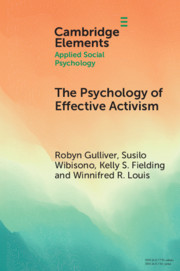
This Element reviews the social psychology of effective collective action, highlighting the importance of considering activists' goals, timeframes, and psychological perspectives in seeking to conceptualise this construct. A novel framework 'ABIASCA' maps effectiveness in relation to activists' goals for mobilisation and change (Awareness raising; Building sympathy; turning sympathy into Intentions; turning intentions into Actions; Sustaining groups over time; Coalition-building; and Avoiding opponents' counter-mobilisation). We also review the DIME model of Disidentification, Innovation, Moralization and Energization, which examines the effects of failure in creating trajectories of activists' disidentification from collective action; innovation (including to radicalisation or deradicalisation); and increased moral conviction and energy. The social psychological drivers of effective collective action for four audiences are examined in detail, in four sections: for the self and supporters, bystanders, opponents, and for third parties. We conclude by highlighting an agenda for future research, and drawing out key messages for scholars.
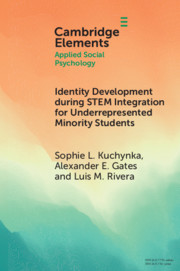
Over the past three decades, research efforts and interventions have been implemented across the United States to increase the persistence of underrepresented minority (URM) students in science, technology, engineering, and math (STEM). This Element systematically compares STEM interventions that offer resources and opportunities related to mentorship, research, and more. We organize the findings of this literature into a multi-phase framework of STEM integration and identity development. We propose four distinct phases of STEM integration: Phase 1: High School; Phase 2: Summer before College; Phase 3: First Year of College; and Phase 4: Second Year of College through Graduation. We combine tenets of theories about social identity, stereotypes and bias, and the five-factor operationalization of identity formation to describe each phase of STEM integration. Findings indicate the importance of exploration through exposure to STEM material, mentorship, and diverse STEM communities. We generalize lessons from STEM interventions to URM students across institutions.
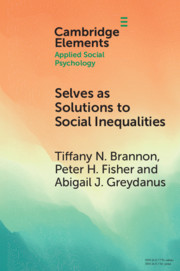
Social disparities tied to social group membership(s) are prevalent and persistent within mainstream institutions (e.g., schools/workplaces). Accordingly, psychological science has harnessed selves - which are malleable and meaningfully shaped by social group membership(s) - as solutions to inequality. We propose and review evidence that theoretical and applied impacts of leveraging 'selves as solutions' can be furthered through the use of a stigma and strengths framework. Specifically, this framework conceptualizes selves in their fuller complexity, allowing the same social group membership to be associated with stigma, risk, and devaluation as well as strengths, resilience, and pride. We provide evidence that by enacting policies and practices that (a) reduce/minimize stigma and (b) recognize/include strengths, mainstream institutions can more fully mitigate social disparities tied to inclusion, achievement and well-being. Using social groups that vary in status/power we examine implications of this framework including the potential to foster positive, recursive, and intergroup impacts on social inequalities.
The central question of this Element is this: What does it mean to be transgender - in general and in specific ways? What does the designation mean for any individual and for the groups in which the individual exists? Biologically, what occurs? Psychologically, what transpires? The Element starts with the basics. The authors question some traditional assumptions, lay out some bio-medical information, and define their terms. They then move to the question of central concern, seen first in terms of the individual and then in terms of the group or society. They conclude with some implications, urging some new approaches to research and suggest some applications in the classroom and beyond.
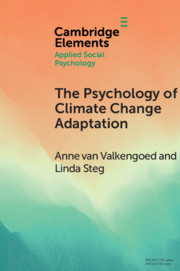
Why do some people adapt to the risks of climate change, while others do not? This Element provides an in-depth overview of the psychology of climate change adaptation. It begins with an overview of adaptation behaviour and highlights the importance of successful adaptation by individuals and households. Key psychological theories are introduced that can explain adaptation behaviour and the role of a wide variety of motivational variables in adaptation behaviour is discussed, such as risk perception, experiences with climate-related hazards, and perceived responsibility. Next, the authors examine three examples of how this psychological knowledge has been used to develop and test interventions to promote adaptation behaviour in real-world settings. After which, the relationship between climate adaptation behaviour and climate mitigation behaviour are considered and the potential for integrating these bodies of literature is put forward. It concludes with an agenda for future psychological research on climate change adaptation behaviour.
Widespread belief in the benefits of empathy and its healing power is evident in public discourse and across diverse news and social media outlets around the world. Yet research reveals that empathy can sometimes have adverse effects on individuals' intergroup attitudes and behavior. A link between empathy and concerns with negative evaluation helps explain why empathy can backfire. Accordingly, using the minimization of evaluative concerns as an organizing principle, the author makes recommendations regarding when and how to encourage empathy in intergroup contexts, so that its potential to foster stronger social bonds across group boundaries can be fully realized.
Recommend this
Email your librarian or administrator to recommend adding this to your organisation's collection.