To save content items to your account,
please confirm that you agree to abide by our usage policies.
If this is the first time you use this feature, you will be asked to authorise Cambridge Core to connect with your account.
Find out more about saving content to .
To save content items to your Kindle, first ensure no-reply@cambridge.org
is added to your Approved Personal Document E-mail List under your Personal Document Settings
on the Manage Your Content and Devices page of your Amazon account. Then enter the ‘name’ part
of your Kindle email address below.
Find out more about saving to your Kindle.
Note you can select to save to either the @free.kindle.com or @kindle.com variations.
‘@free.kindle.com’ emails are free but can only be saved to your device when it is connected to wi-fi.
‘@kindle.com’ emails can be delivered even when you are not connected to wi-fi, but note that service fees apply.
Psychiatric conditions in parents are associated not only with the same condition in offspring, but also with virtually all other psychiatric conditions. However, it remains unknown whether this intergenerational transmission of psychiatric conditions was attributable to broader psychopathology comorbidity or to specific conditions.
Objectives
To estimate associations between general and specific factors of psychopathology in parents, and a wide range of register-based outcomes in their offspring.
Methods
Based on Swedish national registers, we linked 2 947 703 individuals born in Sweden between 1970 and 2000 to their biological parents (1 705 780 pairs of parents) and followed them to December 31, 2013. First, we estimated one general and three unrelated (specific) psychopathology factors (capturing internalizing, externalizing, and psychotic problems, respectively, independently of general psychopathology) based on nine parental register-based psychiatric diagnoses and violent criminal court convictions. Second, we regressed each offspring outcome on the latent general and three specific factors simultaneously.
Results
The general psychopathology factor in parents was significantly associated with all 31 offspring outcomes (mean Odds Ratio (OR) = 1.22; range: 1.08–1.40), which means that children whose parents scored one standard deviation above the mean on general psychopathology had, on average, a 23% higher probability of all outcomes. The specific psychotic factor in parents was primarily associated with psychotic-like outcomes (mean OR = 1.17; range: 1.05–1.25), and the specific internalizing factor in parents was primarily associated with offspring internalizing (mean OR = 1.11; range: 1.11–1.13) and neurodevelopmental outcomes (mean OR = 1.07; range: 1.02–1.10). The specific externalizing factor in parents was associated with externalizing (mean OR = 1.27; range: 1.21–1.32) and internalizing outcomes (mean OR = 1.10; range: 1.01–1.13).
Conclusions
The intergenerational transmission of psychiatric conditions across different types of spectra appeared largely attributable to a parental general factor of psychopathology, whereas specific factors were primarily responsible for within-spectrum associations between parents and their offspring. Service providers (e.g., child psychologists, psychiatrists, teachers, and social workers) might benefit from taking the total number of parental mental health problems into account, regardless of type, when forecasting child mental health and social functions.
The World Health Organization declared the coronavirus outbreak a pandemic on March 11th 2020. Since then, the containment measures were leading to increasing mental health problems in the general population and worsening of some pre‑existing psychiatric conditions. To our knowledge, there are few studies characterizing the impact of the COVID‑19 pandemic on psychiatric hospitalizations across the world.
Objectives
We aimed to compare the number and characteristics of the hospitalizations in the mental health department of a Portuguese psychiatric hospital from March 2nd 2019 to October 31st 2019 with those that occurred in the same period in 2020.
Methods
We conducted a retrospective observational study including all patients admitted to hospital during these periods (n=805). Sociodemographic data, clinical characteristics and information about the context of hospitalization were collected. Statistical analysis was performed using t Student Test, Mann‑Whitney and Chi‑square.
Results
In the pandemic period there was a marked reduction in the number of psychiatric hospitalizations. There was a statistically significant difference in the median length of stay and in the percentage of involuntary hospitalizations between the two periods. In 2019, the most frequent International Classification of Diseases (10th Revision) diagnostic categories were F30‑F39 (mood disorders) and in 2020 were F20‑F29 (schizophrenia, schizotypal and delusional disorders).
Conclusions
The reorganization of services and the decrease in admissions through the emergency department may explain these results.
Traumatic childhood has increasingly high incidence rates and can be predictive of negative health outcomes. There is a large consensus indicating that childhood trauma is significantly involved in the development of mood disturbances in adulthood.
Objectives
The aim of this study was to examine the relationship between retrospectively recalled childhood trauma and adulthood anxiety and depression in a sample of undergraduate university students.
Methods
A cross-sectional study was conducted among a sample of 365 university students randomly selected from 8 universities in Sfax (Tunisia). Information about childhood maltreatment, depressive and anxiety symptoms were gathered through the Childhood Trauma Questionnaire-Short Form (CTQ-SF), and the Hospital Anxiety and Depression Scale (HADS) respectively. To test the hypothesis, examining the relationship between anxiety, depression, and childhood trauma, we used Spearman’s correlation test. Multivariate logistic regression models were used as well.
Results
The mean age of our participants was 20.3 years. More females (68.2%) than males participated in the study. Our findings showed that the five childhood trauma subtypes (emotional abuse and neglect, physical abuse and neglect, sexual abuse) were significantly correlated with anxiety and depression symptoms severity (p<0.01). Emotional abuse was the strongest risk factor for adulthood anxiety symptoms (OR=6.002, 95% CI= [3.238; 11.125]) while emotional neglect was the strongest risk factor for depressive symptoms in adulthood (OR=6.214, 95% CI= [3.428; 11.267]). Multivariate analysis revealed that, in subjects with childhood trauma, scores of anxiety symptoms were positively and highly associated with the severity of emotional abuse (adjusted B=1.438, 95% CI= [1.951; 9.092], p=0.000). Depression symptoms severity were as well positively correlated with severity of emotional abuse (adjusted B=0.848, 95% CI= [1.043; 5.224], p=0.039), and severity of emotional neglect (adjusted B=1.044, 95% CI= [1.263; 6.389], p=0.012).
Conclusions
This study highlighted the relevance of childhood trauma as a factor contributing to anxiety and depression in adulthood. Thus, early psychological support of victims of childhood trauma can reduce the rate of anxiety and depression among these subjects.
Rejection-sensitivity is a prevalent yet understudied emotional symptom often associated with adult ADHD. While ADHD research typically focuses on behavioral and cognitive facets, emerging evidence highlights the significance of emotional symptoms. Emotional dysregulation in ADHD impacts psychological well-being and mental health. Our study examines how ADHD symptoms relate to rejection sensitivity, considering factors like resiliency, self-regulation, and overall well-being.
Objectives
Our study seeks to establish a direct connection between ADHD scores and rejection sensitivity among college students. We also investigate the mediating role of well-being, creative executive efficiency, self-regulation, and resilience, while exploring the moderating role of savoring capacity.
Methods
Between February and May of 2023, we conducted a cross-sectional study using an online questionnaire, gathering data from 304 Hungarian higher education students aged 18 to 35. The majority, 78.0%, were female, and 71.4% were full-time students. Most participants were pursuing a bachelor’s degree (56.6%), followed by undivided master’s (21.7%), doctoral studies (13.8%), and traditional master’s degrees (6.9%). We administered the Adult ADHD Self-Report Scale (ASRS-v.1.1), The Mental Health Test (MHT), and the Rejection Sensitivity Questionnaire (A-RSQ) for our research.
Results
First, the ADHD scores were significantly associated with each mediator (well-being: β = -.343, p < .001; creative and executive efficiency: β = -.183, p < .01; self-regulation (β = -.230, p < .001; and resilience: β = -.321, p < .001). There was a direct effect of ADHD scores on rejection sensitivity scores (β = .466, p < .001). Finally, we also detected the indirect effects of ADHD scores on rejection sensitivity scores through the four mediators (β = .227, p < .001). Savoring capacity significantly moderated the relationship between ADHD and rejection sensitivity scores (β = -.244, p < .001).
Conclusions
ADHD scores in our study population significantly correlate with well-being, creative and executive efficiency, self-regulation, and resilience. Furthermore, these scores directly influence rejection sensitivity, suggesting a heightened vulnerability to perceived rejection among those with higher ADHD scores. The indirect effects emphasize that the relationship between ADHD and rejection sensitivity is mediated by the aforementioned positive psychological constructs. This underscores the need for holistic interventions in ADHD populations, addressing not just core ADHD symptoms but also enhancing well-being, cognitive efficiency, self-regulation, and resilience to potentially mitigate rejection sensitivity.
Disclosure of Interest
V. Müller Grant / Research support from: This project received funding from the New National Excellence Program under the Ministry for Culture and Innovation, sourced from the National Research, Development, and Innovation Fund, reference #ÚNKP-23-3-SZTE-66., B. Pikó: None Declared
Alcohol abuse is a multifaceted problem. Its harmful effects on the individual have been more studied. Less studied is the influence of a drinking person on his microsocial environment. Having an abusing person in his space makes it interesting to study the influence of some quantitative and qualitative indicators of his alcohol consumption on the microsocial environment.
Objectives
1532 people were examined during 2018-2022, who belonged to three comparison groups: patients with alcohol dependence (AD) (401 people); healthy relatives of AD patients (725 people); representatives of the general population comparable with the representatives of the first two age groups (406 people).
Methods
The main research instruments were the questionnaire of the international research consortium “GENAHTO” (Gender, Alcohol, and Harms to Others), as well as the Alcohol Use Disorders Identification Test (AUDIT). The obtained data were processed by methods of mathematical statistics (variance, correlation and regression analysis).
Results
An algorithm for regression analysis in conditions of high dispersion of the initial data has been developed. Using this algorithm, it was shown that the regression dependence of the main characteristics of alcohol behavior on the frequency of DD is non-linear, while for typical and maximum doses of alcohol it is optimally described by polynomials of the second degree, and for the severity of disorders due to alcohol use (AU), the time spent on AU, as well as self-assessment of the negative impact of AU by respondents on their environment - by polynomials of the third degree. It was found that for men (on average) to reach the border of risky-dangerous AU (according to the criteria of the AUDIT test), a lower frequency of DD is sufficient than for women, which indicates a greater vulnerability of men (compared to women) to the formation of disorders due to AU.
Conclusions
It was established that for men (on average) to reach the limit of risky and dangerous (according to the criteria of the AUDIT test), a lower frequency (2-3 times a week) is enough than for women (3-4 times a week), which once again indicates greater vulnerability of men (compared to women) to the formation of due to psychological problems and mental disorders.
Schizophrenia is associated with a reduced life expectancy, not only because of suicide, but also medical causes such as cancer. Standardized mortality for cancer is higher in patients with schizophrenia, specially for lung, breast and colorectal locations (Ni et al, 2019). Other less frequent tumor locations have not been deeply studied.
Thir mortality gap could be related to a delayed diagnosis due to several reasons, such as lower inclusion in screening programs (Solmi et al, 2019). Since cervical cancer has a very efficient screening technique, women with schizophrenia and cervical cancer could have a worse prognosis because of a delayed diagnosis. However, there is a lack of research in this tumor location.
Objectives
To analyze clinical differences in women with cervical cancer with and without a diagnosis of schizophrenia.
Methods
We carried out a retrospective cohort analysis with adult patients from the cancer registry of Hospital del Mar diagnosed between 1997 and 2021. The information was crossed with the Minimum Basic Data Set (MBDS) to identify those cancer patients with a diagnosis of schizophrenia using International Classification of Diseases (ICD) 9 codes 295*. The sociodemographic variables were age and sex. The clinical oncological variables included tumor location, place of first conultation, stage, first treatment intention, vital status and place of decease. We used t-student for continuous data and Chi-squared test for categorical variables. We performed a post-hoc analysis using Bonferroni correction for multiple comparisons to identify specifically which categories were significantly different between groups.
Results
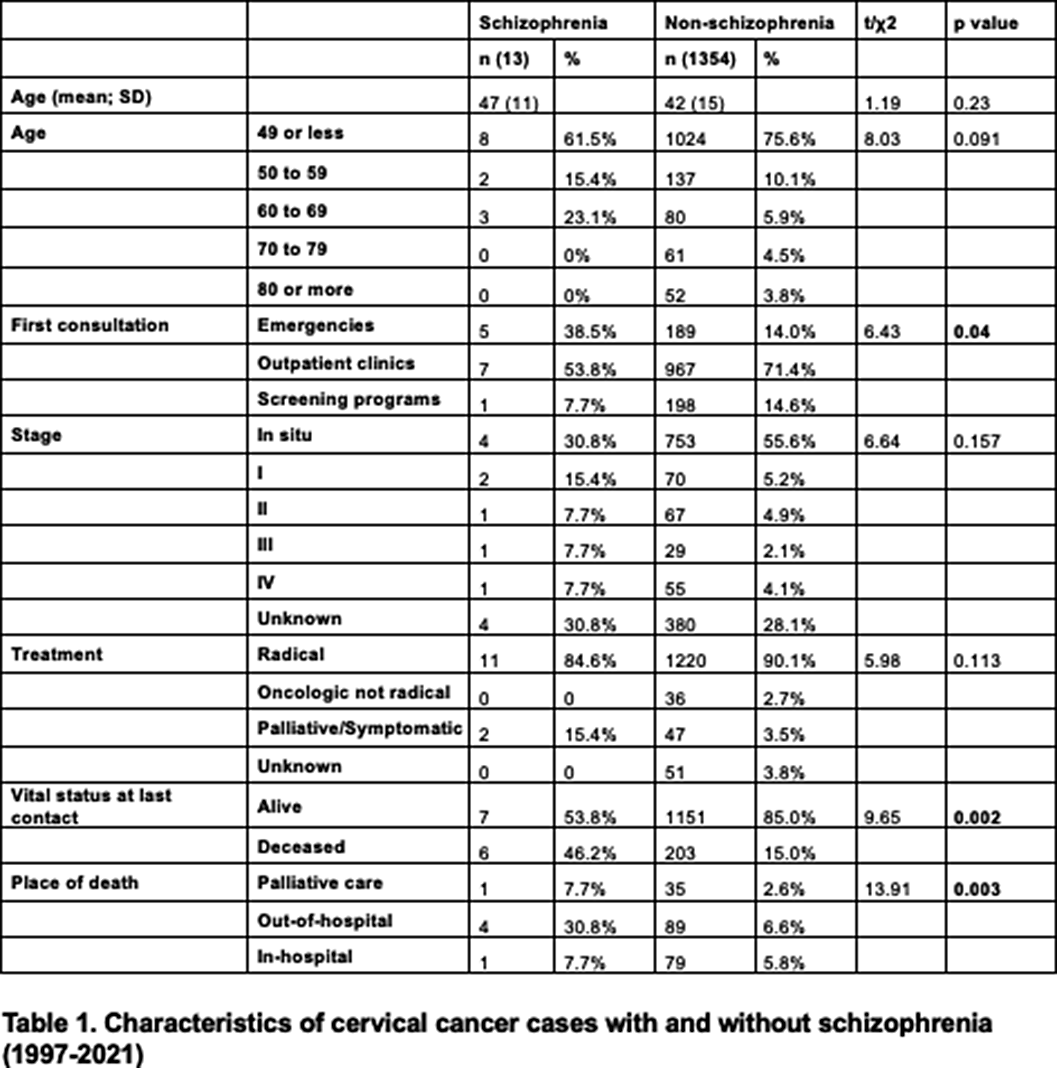
We identified 13 women with schizophrenia and cervical cancer, and 1354 women with cervical cancer without schizophrenia. The proportion of this location was higher in the schizophrenia group (8% of all cancers vs. 4.4%; p=0.03). The proportion of diagnoses through screening programm was significantly lower (7.7% vs 14.6%; p=0.04). There was a trend of fewer diagnoses in situ in patients with schizophrenia (30.8% vs 55.6%) and less radical intention as first treatment option (15.4% vs 3.5%) but without statistical significance in both cases. There was a higher proportion of deceased patients in the group with schizophrenia (46.2% vs 15% p=0.002), and also a higher proportion of deaths outside hospital facilities (30.8% vs 6.6%; p=0.003).
Image:
Conclusions
Women with schizophrenia receive less diagnoses of cervical cancer through screening programs and more in emergency facilities, which could lead to more advanced stages and fewer indication of radical treatments. This ultimately leads to a higher proportion of deaths, and more frequently outside of hospital facilities.
Our data supports the idea that the increased mortality for cancer is related to a delayed diagnosis. Women with schizophrenia need special care to ensure their inclusion in early detection programs for cancer.
Numerous studies have shown a link between hypnotic susceptibility, the hypnotically altered state of consciousness, and the intensity of experienced emotions (De Pascalis et al., 1987; De Pascalis, Marucci, & Penna, 1989; Bryant & McConkey, 1989; Crowson, Conroy, & Chester, 1991; Crawford, Kapelis, & Harrison, 1995). One of the most suitable experimental psychological methods for modeling real-life decisional conditions is the Iowa Gambling Task (IGT) (Bechara, Tranel, & Damasio, 2000). Hypnosis has the potential to provide several benefits in decision-making, although there is limited scientific research on the subject.
Objectives
The main goal of this study was to determine if a hypnotically altered state of consciousness could affect decision efficacy in a real-life modeling situation.
Methods
Forty-eight healthy students (including 28 females and 20 males) from the University of Szeged participated in both the delayed punishment and delayed reward versions of the Iowa Gambling Task under alert and hypnotic states.
Results
During the mid-phase of the tasks while in hypnosis, notably higher performance levels were recorded compared to the alert state. In a simulated real-life scenario, the delayed reward had a more pronounced effect on decision-making efficiency than the delayed punishment. It became evident that the efficient decision-making strategy evolved more rapidly under hypnosis than in an alert state.
Conclusions
The hypnotic state of consciousness in an experimental decision situation modeling real life may accelerate the development of somatic markers, leading to earlier correct decision-making.
Transitioning from mental health inpatient care to community care is often a vulnerable time in the treatment process where additional risks and anxiety may arise.
Objectives
The objective of this paper was to evaluate the progression of mental health symptoms in patients six weeks after their discharge from the hospital as the first phase of an ongoing innovative supportive program. In this study, factors that may contribute to the presence or absence of anxiety and depression symptoms, and the quality of life following a return to the community were examined. The results of this study provide evidence and baseline data for future phases of the project.
Methods
An observational design was used in this study. We collected sociodemographic and clinical data using REDCap at discharge and six weeks later. Anxiety, depression, and well-being symptoms were assessed using the Generalized Anxiety Disorder (GAD-7) questionnaire, the Patient Health Questionnaire-9 (PHQ-9), and the World Health Organization-Five Well-Being Index (WHO-5) respectively. Descriptive, Chi-square, independent T-test, and multivariate regression analyses were conducted.
Results
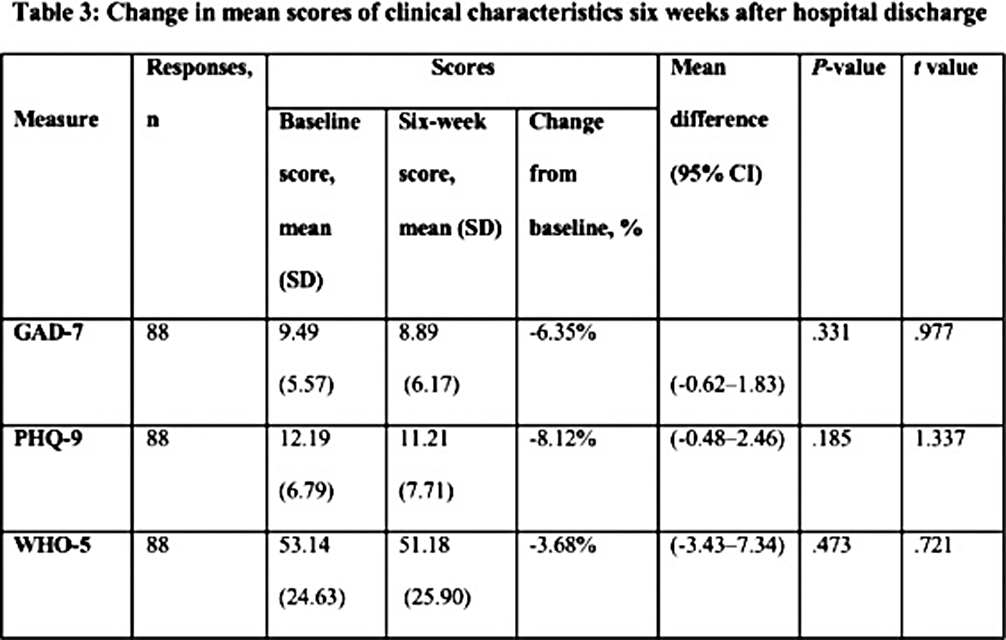
The survey was completed by 88 participants out of 144 (61.1% response rate). A statistically non-significant reduction in anxiety and depression symptoms was found six weeks after returning to the community based on the Chi-squared/Fisher exact test and independent t-test. As well, the mean anxiety and depression scores showed a non-significant marginal reduction after discharge compared to baseline. In the period following discharge, a non-significant increase in participants experiencing low well-being symptoms was observed, as well as a decline in the mean well-being scores. Based on logistic regression models, only baseline symptoms were significant predictors of symptoms six weeks after inpatient discharge.
Image:
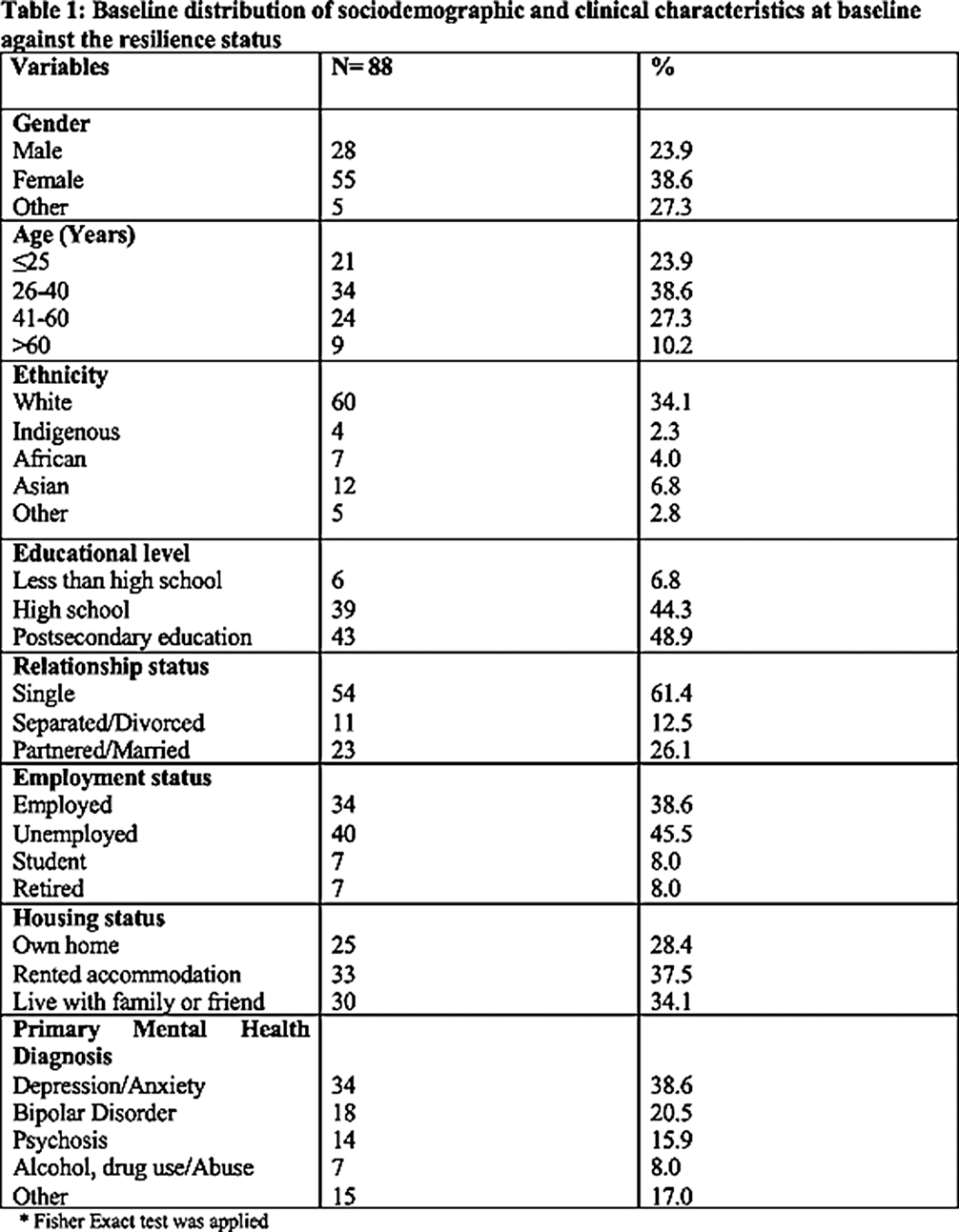
Image 2:
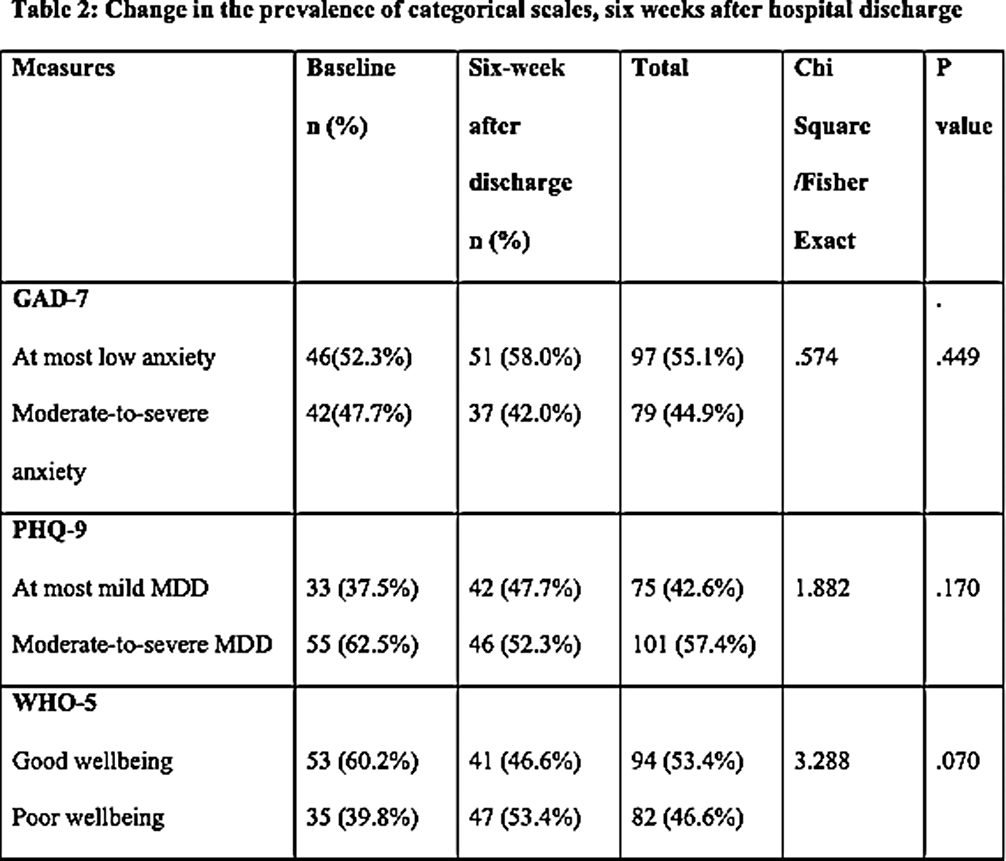
Image 3:
Conclusions
In the short term following hospital discharge, no significant changes were observed in mental health conditions. A collaboration between researchers and policymakers is essential for the implementation and maintenance of effective interventions to support and maintain the mental health of patients following discharge.
Patients’ values are relevant in patient-centred care (PCC) as awareness and recognition of these can lead to better decision making and improved outcomes. Training in decision making is sorely lacking, especially in the area of spirituality and worldview.
Objectives
Our poster describes a training workshop to provide such medical education to healthcare professionals. The half-day training covers: importance of addressing patients’ values in decision making; using decisional aids; role of spirituality and worldview of the patient.
Methods
Clinicians of the hospital, including doctors, nurses and allied healthcare professionals were invited to attend the training. The evaluations by the participants for the workshops conducted in 2021-2023 were collated and presented.
Results
Four workshops in 2021 to 2023 were conducted, with a total of 43 participants. We achieved overall ratings of above average and excellent in more than 80% of responses; content relevance and usefulness to work, presentation and facilitation were similarly rated. Most participants would recommend it to colleagues.
Conclusions
The “Addressing Patients’ Values in Decision Making” workshop for clinicians will allow the hospital to promulgate a culture of quality care through patient engagement.
The 10-item Montgomery–Åsberg Depression Rating Scale (MADRS) measures different dimensions of depression symptomatology. Digital traits may generate deeper understanding of the MADRS subscales and provide insights about depression symptomatology.
Objectives
To identify digital traits that predict specific MADRS subscales and ascertain which digital traits are important for which MADRS subscales.
Methods
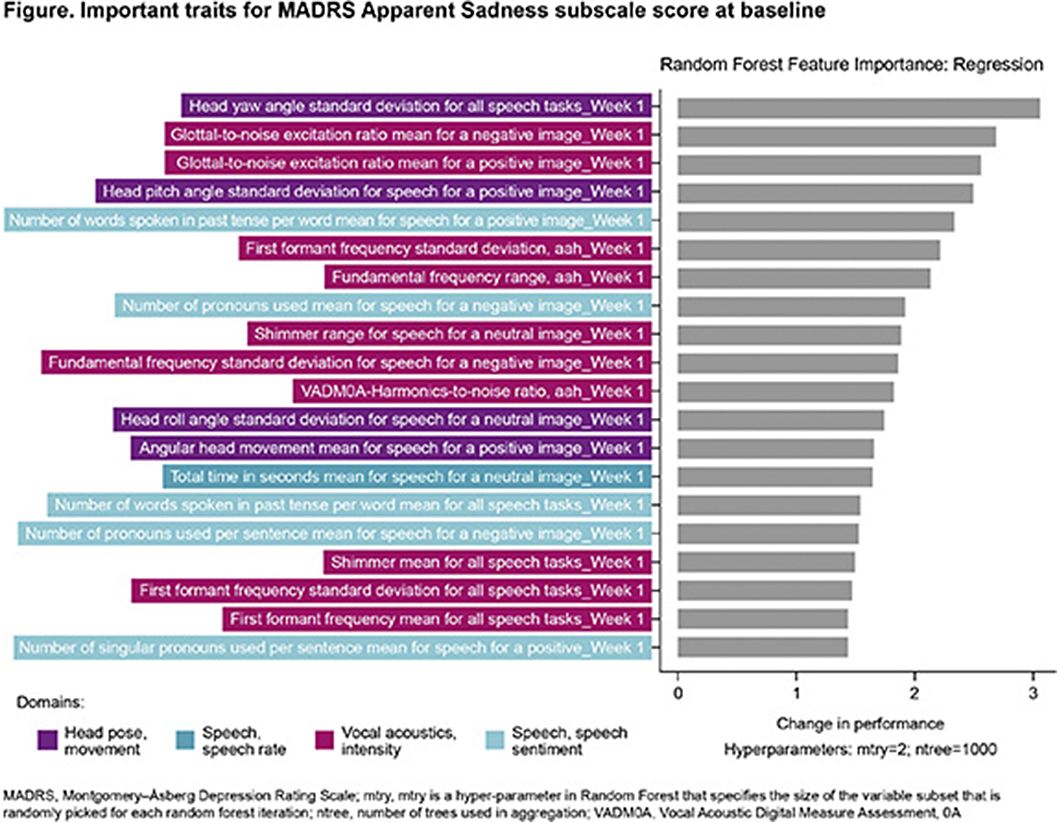
During a Phase II decentralised clinical trial in major depressive disorder (MDD), patients completed the MADRS and used AiCure (LLC, New York, NY, USA), a smartphone application, to complete image description tasks at baseline. Digital measurements identified from the literature as relevant to MDD symptomatology were conducted using audio and video data derived from the image description tasks. Digital measurements included speech (rate, sentiment and first-person singular pronouns), vocal acoustics (intensity, pause fraction and fundamental frequency), facial expressivity (regional facial movement) and head pose (Euclidean and angular head movement). Digital traits analysis involved data pre-processing followed by machine learning (ML) using Elastic Net, Decision Tree, and Random Forest models; model performance was evaluated using 5-fold cross-validation and mean absolute error (MAE). Important digital traits were calculated by percentage change in MAE after permuting a specific variable. Important digital traits for the MADRS Apparent Sadness subscale score were mapped to defined, interpretable domains.
Results
The ML model predictions varied for different MADRS subscales (Table). Overall, Elastic Net and Random Forest models outperformed Decision Tree across all subscales scores other than suicidal thoughts. Half of the literature-based digital traits contributed to the prediction of ≥1 MADRS sadness sub-scale score. The important digital traits for the Apparent Sadness subscale score could be mapped to 4 domains (Figure); this aligned with findings from the literature.
Image:
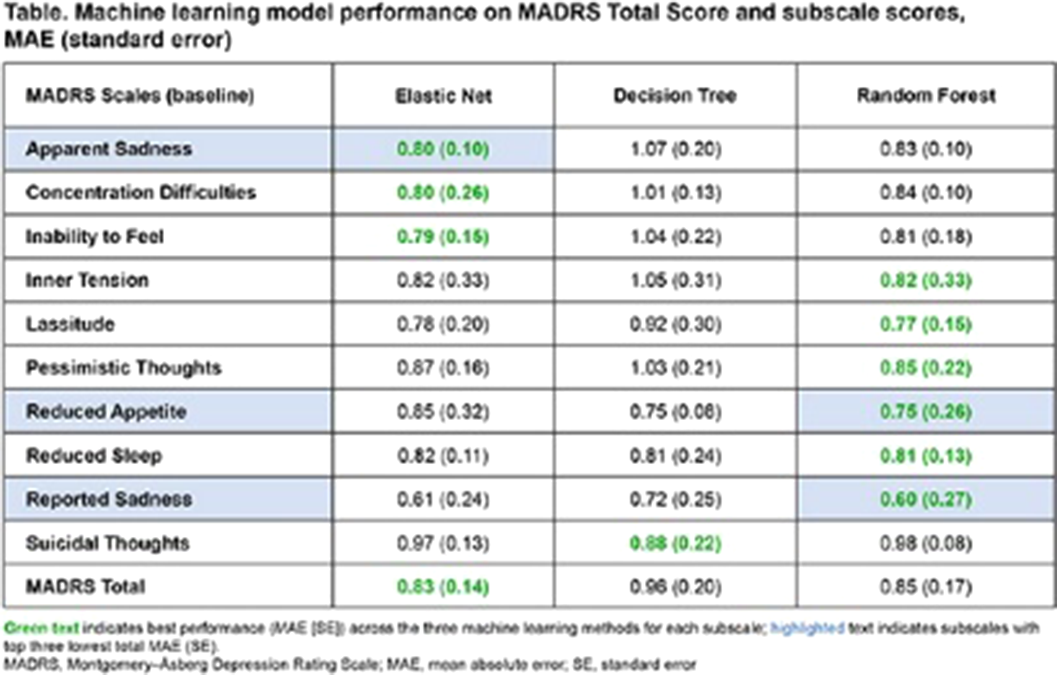
Image 2:
Conclusions
Digital traits collected from patients with MDD were able to predict certain MADRS subscales better than others.
Funding
Boehringer Ingelheim.
Disclosure of Interest
Z. Zhu Employee of: Boehringer Ingelheim Pharmaceuticals, Inc., Y. Wu Employee of: Boehringer Ingelheim Pharmaceuticals, Inc., J. Seidel Employee of: Boehringer Ingelheim International GmbH, D. Roy Employee of: Boehringer Ingelheim Pharmaceuticals, Inc., E. Salzmann Employee of: Boehringer Ingelheim International GmbH
Childhood maltreatment(CM) can precipitate a range of psychiatric disorders in individuals. Some research show that CM rates are as high as 85% in schizophrenia spectrum disorders (Larsson et al. 2013). This case report explores an instance of acute catatonic psychosis in an adolescent following a significant episode of physical and emotional abuse.
Objectives
The aim is to elucidate the clinical presentation, diagnosis, and treatment of trauma-induced acute catatonic psychosis in an adolescent. The report seeks to emphasize the potential link between acute trauma and severe psychiatric disorders in young individuals.
Methods
A thorough review of the patient’s clinical records was undertaken, focusing on psychiatric history, symptoms, treatment trials and responses. In parallel, an extensive literature review was conducted to understand the current knowledge on the association between acute traumatic stress and acute psychosis with catatonia.
Results
The patient, a 16-year-old female, presented with severe symptoms of catatonia and psychosis including mutism, posturing, stupor, negativism, auditory hallucinations and persecutory delusions, in addition; eating refusal, urinary and fecal incontinence. Symptoms started immediately following physical and emotional abuse that occurred 10 days ago. She was hitted, insulted and detained for 2 days by her parent’s friends. Abuse reported to social services and judicial authorities. All laboratory and neurologic examinations performed to exclude an organic pathology. No pathologic results founded. Olanzapine 5 mg/day and lorazepam 0.5 mg/day started and titrated to 30 mg/day and 3.75 mg/day doses. Biperiden 4 mg/day started due to extrapyramidal side effects. A significant improvement observed about her catatonic and positive psychotic symptoms but she still had acute stress disorder symptoms. Trauma-focused cognitive-behavioral therapy added to her treatment. Family-based interventions examined for CM. She discharged in full remission after eight weeks of hospital stay. Lorazepam dose reduced and stopped before discharge.
Conclusions
Neurobiological models are trying to enlight the association between experiencing highly stressful or traumatic events, such as child abuse, may impact on later expression of psychotic disorders by increasing stress sensitivity to later adversity (Fares-Otero et al. 2023). This case underscores the potential of acute traumatic stress to precipitate severe psychiatric disorders, including catatonia. It highlights the importance of comprehensive clinical evaluations and the inclusion of trauma history in children presenting with acute psychiatric symptoms. The findings advocate for the integration of trauma-focused interventions in the treatment of similar cases. Further research is needed to understand the pathophysiological mechanisms underlying this association and to develop effective treatment strategies for this vulnerable population.
The COVID-19 pandemic has had a profound impact on mental health worldwide because of complex societal disruptions and neuropsychiatric consequences stemming from SARS-CoV-2 infection. All age groups have been affected by this pandemic, with particular focus on the vulnerabilities faced by children and adolescents who have experienced multiple stressors. These stressors involve various emotional, physiological, and behavioral challenges stemming from different factors, such as mandatory social distancing due to school closures, increased parental stress caused by the incessant spread of the pandemic, severe trauma from losing family members, a surge in cyberbullying linked to higher online activity, and a worrying rise in unreported incidents of child abuse. Empirical reports document an increase in suicidal tendencies and suicide attempts among adolescents during this crisis.
Objectives
This study conducted a comprehensive review of existing literature focused on the mental health of individuals aged 0-24 years in both pre-pandemic and pandemic eras. This study conducted comparative analyses to identify significant changes.
Methods
Adhering strictly to the PRISMA guidelines, we conducted comprehensive searches on Google Scholar and PubMed to identify peer-reviewed articles published in English.
Results
Most studies revealed deteriorating mental health conditions among adolescents and young adults following pandemic onset. These conditions were characterized by high rates of depression, anxiety, and psychological distress. Furthermore, several studies have identified a notable increase in negative emotions and heightened feelings of loneliness. Primary school children experienced a decline in attention span, emotional regulation, hyperactivity, and enthusiasm for academic engagement.
Conclusions
Based on the analysis of data from both the pre-pandemic and pandemic periods, it is evident that the COVID-19 pandemic had a detrimental impact on the mental well-being of children and young individuals. Therefore, it is crucial to identify the risk factors and protective measures linked with pandemics to enhance mental health resilience and better equip societies to cope with future health emergencies and other crises.
Tourette’s syndrome (TS) is a disorder characterized by repetitive, involuntary movements, and vocalizations known as tics. While there are existing treatment options, there is a growing need for novel pharmacological approaches to manage the symptoms of TS effectively. This study delves into the emerging field of using cannabinoids as a potential treatment for Tourette’s syndrome.
Objectives
The primary objectives of this review are to examine the current evidence base for the use of cannabinoids in the treatment of Tourette’s syndrome, to assess the biological rationale supporting the use of cannabinoids in managing tic severity, to provide insights into the results of existing clinical trials involving cannabinoids and Tourette’s syndrome, and to draw conclusions regarding the potential efficacy and safety of cannabinoid-based treatments for TS.
Methods
Narrative review of the available scientific literature.
Results
There is a strong biological rationale for how cannabinoids could impact tic severity. The endocannabinoid system plays a crucial role in regulating various physiological processes, including motor control and neurotransmitter release. Activation of cannabinoid receptors in the brain may modulate these processes, potentially reducing tics. While limited, two small randomized, placebo-controlled trials of THC have been conducted in TS patients. These trials suggested potential benefits of cannabis-derived agents in reducing tic frequency and severity. Self-report and examiner rating scales demonstrated significant improvements in tic symptoms. The trials indicated that THC treatment did not result in significant adverse effects in TS patients.
Conclusions
The exploration of cannabinoids as a treatment option for Tourette’s syndrome is promising but requires further investigation. The biological mechanisms through which cannabinoids may affect tic severity in TS are sound, suggesting their potential as a therapeutic option. Existing trials with THC have shown encouraging results, demonstrating a reduction in tics without significant adverse effects. However, the limited number of trials warrants caution in drawing definitive conclusions. Despite the promising findings, the overall efficacy and safety of cannabinoid-based treatments remain largely unknown. Further trials are essential to address dosing, active ingredients, optimal administration, and potential long-term effects. Clinical use should be approached with caution. While early evidence is encouraging, additional rigorous studies are needed to establish the safety and efficacy of cannabinoid-based treatments for this disorder.
Long-acting injectable antipsychotics (LAIs) offer advantages for schizophrenic patients compared to oral antipsychotics: less frequent dosing, lower relapse rates, better adherence, and lower healthcare costs. LAIs include paliperidone, aripiprazole, olanzapine, risperidone, and zuclopenthixol. Paliperidone palmitate is the only antipsychotic with two formulations with an administration interval longer than one month (3-monthly and 6-monthly), which could be better for the patient and help ensure treatment continuity, especially in cases of limited access to the health care system.
Objectives
To assess the satisfaction of patients under treatment with 6-month paliperidone palmitate compared to other long-acting injectable antipsychotics with a higher frequency of administration.
Methods
We analyzed the satisfaction level of a sample of patients receiving treatment with LAIs at the Mental Health Center of El Escorial. All patients had a diagnosis of schizophrenia or other psychotic disorders (according to DSM-5). Patients who met the inclusion criteria completed the Treatment Satisfaction Questionnaire for Medication (TSQM), a generic questionnaire of treatment satisfaction that measures four dimensions: side effects, treatment efficacy, comfort of use, and overall satisfaction. Other clinical and socio-demographic variables were collected, as well as the type of injectable, dose, and frequency of administration.
Results
Data from approximately 30 patients will be analyzed and discussed later.
Conclusions
Less frequent administration of LAIs may result in greater patient satisfaction and be just as beneficial clinically. Treatment satisfaction is positively associated with an improvement in psychotic symptoms and seems to be related to better adherence.
Mental pain is a transdiagnostic symptom, predictive of suicide and reported as a critical outcome by patients. A previous systematic review of epidemiological and clinical research has shown a lack of consensual definition of mental pain in clinical research and high heterogeneity across the different measurement instruments of mental pain. Up today there is no systematic review synthetizing all published biological investigations on mental pain.
Objectives
This study aims to map the field of biological investigations of mental pain in human to identify what and how biomarkers are investigated with a meta-research approach, by providing a critical appraisal of the terms and definitions of mental pain, the studies’ hypotheses, the experimental paradigms used to induce or mimic mental pain and the measurement instruments used to measure mental pain.
Methods
We conducted a systematic review (compliant with PRISMA guidelines) of all primary research reporting to investigate candidate biomarkers of mental pain in human subjects as stated by the authors. We searched from inception to June 23rd, 2022, the 3 databases MEDLINE, Web of Science and EMBASE. We extracted the study characteristics (e.g., year of publication, population, etc.), the terms used for meaning mental pain, the definition of mental pain, the method to induce mental pain and its rational, the hypotheses and aims, the measurement instruments of mental pain, the candidate biomarkers, and their method of investigation. We performed descriptive statistics of the sample’s characteristics and the extracted data, a qualitative analysis of the definitions, hypothesis, aims and experimental paradigms, and a data visualization linking candidate biomarkers, experimental paradigms, and their investigation methods.
Results
The search retrieved 5685 papers of which we included 72 primary research publications constituting 78 distinct research studies. Only 37.5% of studies reported a definition of mental pain. 11.5% of studies did not show a measurement instrument of mental pain. The Cyberball (a social exclusion paradigm) was the most frequently used paradigm in experimental studies (62.7%). The cingulate cortex was the most frequently investigated biomarker category (15.3% of all candidate biomarkers), with fMRI as the most frequent investigation method (53.7% of all investigation methods).
Conclusions
The field of biological investigations on mental pain shows a marked heterogeneity of definitions, terms, hypotheses, experimental paradigms, and measurement instruments, with an over-representation of the construct of social pain and the Cyberball. These could compromise the comparison and combination of studies results in evidence synthesis and their translation into clinical practice.
An example of the unification of the contrast between artistic creativity and discipline of science, Nikola Tesla engineer and physicist, was also a prolific inventor that contributed to the transformation of modern society. Having resurfaced in the mainstream culture as a mythical figure, he appears to be enjoying a renaissance of posthumous recognition and praise. Throughaccounts available directly from his autobiography and descriptions offered by those who worked with him, the existence of the inventor´s eccentricities appear to reveal the existence of mental health disorder.
Objectives
The authors explore Tesla and the psychopathology that accompanied him throughout his periods of brilliance and as well as hardship.
Methods
The authors conducted a brief non-structured narrative literature review. The keywords used during the research, alone or in combination, included: Nikola Tesla, psychopathology and mental illness. The works consulted included: news articles, autobiographies and biographies. Of these, those that were written in the English language and deemed most pertinent to the explored theme were chosen for review in this work.
Results
The popular image of the mad scientist, which describes a brilliant but solitary and eccentric individual focused on their work is one that could be applied to Tesla. Documents reveal that he suffered a nervous breakdown, as well as having symptoms that point to a probably presence of obsessive-compulsive disorder, of which included counting and cleanliness rituals, exacerbated by chronic insomnia.
Conclusions
There appears to be anecdotal evidence pointing to an eventual relationship between creative genius and mental pathology. Although not formally evidenced through the scientific literature, exploring the life and accomplishments of Tesla serve as a significant example of a spark of genius perhaps ignited by mental illness. Tesla demonstrated suffering associated with his symptoms especially when considering the end of his life. At the time, adequate mental health interventions and treatments were not widely available, with his diagnosis probably being considered the quirks of genius and not the symptoms of disease.
Circular shell rings along the South Atlantic coast of the United States are vestiges of the earliest sedentary villages in North America, dating to 4500–3000 BP. However, little is known about when Indigenous communities began constructing these shell-ring villages. This article presents data from the Hokfv-Mocvse Shell Ring on Ossabaw Island, Georgia. Although shell rings are often associated with the earliest ceramics in North America, no ceramics were encountered in our excavations at Hokfv-Mocvse, and the only materials recovered were projectile points similar to points found over 300 km inland. Bayesian modeling of radiocarbon dates indicates that the ring was occupied between 5090 and 4735 cal BP (95% confidence), making it the earliest dated shell ring in the region. Additionally, shell geochemistry and oyster paleobiology data suggest that inhabitants were living at the ring year-round and had established institutions at that time to manage oyster fisheries sustainably. Hokfv-Mocvse therefore provides evidence for Indigenous people settling in year-round villages and adapting to coastal environments in the region centuries before the adoption of pottery. The establishment of villages marks a visible archaeological shift toward settling down and occupying island ecosystems on a more permanent basis and in larger numbers than ever before in the region.
Sleep related disorders affect around 30% of people all over the world, and evidence shows that 10% require therapeutic intervention. Insomnia represents the most common disturbance of sleep, defined as the experience of poor sleep for at least 1 month. Most of primary insomnia can be prevented by a proper lifestyle and sleep hygiene rules. Regardless, hypnotic drugs and widely prescribed, and most times, long-term used, which is not recommended because of its negative side effects.
Objectives
Review the scientific evidence about effectiveness of plant extracts for insomnia, natural products with practically no side-effects, and thus be possible to reduce or even avoid the use of hypnotic drugs.
Methods
The Medline database through the Pubmed search engine was used with the following keywords: “insomnia” and “herbal compounds”.
Results
Valerian activity on sleep disturbances has been attributed to the presence of isovaleric acids and valepotriates with reported calming action and GABA reuptake inhibition with sedative effects. Considering the data presented in the literature, despite controversial and conflicting, several studies showed that valerian (160-600mg/day) improved sleep quality and reduced sleep latency and duration; also valerian seems more effective for chronic insomnia than acute episodes.
Hop has different properties: calming, sleep inducing, gastric secretion stimulating and spasmolytic.
Increasing GABAergic activity seems to be the main mechanism of action, thus inhibiting the central nervous system and also has demonstrated binding affinities to some of the melatonin and serotonin receptor. It’s sedative characteristics have been confirmed in a clinical trial in association with valerian, where sleep latency and quality were improved. However, monotherapy studies showed no relevant effectiveness in sleep.
Kava Kava plant showed promising results, in rats and humans, with decrease sleep latency, better sleep quality and recuperation after sleep. However, raised concern about its potential of hepatotoxicity.
There is also promising evidence of the lavender efficacy for sleep disorders in a wide variety of populations and diseases, it was actually mentioned to be as effective as lorazepam in adults with anxiety and sleeping problems. With studies with dose of 80mg it was observed a reduction in sleep awakenings, sleep duration and overall sleep quality and anxiety.
Conclusions
There is a clear preference from the patient to natural compounds, and with almost nonexistent side effects, some herbal derivates are showed to have positive effectiveness in mild insomnia, but nonetheless much more studies on this field are needed.
Psychosocial and mental health-related variables are crucial determinants of individuals’ lives in society and their roles within organizations, especially in educational institutions that are characterized by social complexities. In this regard, this research aims to determine the levels of emotional intelligence among teachers in educational institutions in the Department of Magdalena.
Objectives
Determine the levels of emotional intelligence among teachers in educational institutions in the Department of Magdalena
Methods
Methodologically, it is situated within the empirical-analytical paradigm with a quantitative approach, using the descriptive method. A convenience sample of 179 teachers was used, and the TMMS-24 questionnaire was administered.
Results
The results revealed that 37.7% of the teachers completely agree, and 30.9% strongly agree with the statement that they pay a lot of attention to their feelings. On the other hand, only 12.2% somewhat agree, and 1.2% strongly disagree with the statement that they normally worry about what they feel.
Additionally, 33.9% agree with the statement that they usually take time to think about their emotions, while 25.6% somewhat agree, and only 1.2% strongly disagree with the statement that it is worth paying attention to their emotions and mood. Furthermore, 6.4% agree, and 5.2% strongly agree with the statement that they let their feelings affect their thoughts.
As for thinking about their mood constantly, 16.7% strongly disagree, and 39.1% somewhat agree. Moreover, 6.9% strongly disagree, and 21.4% somewhat agree with the statement that they pay a lot of attention to what they feel.
Only 1.1% strongly disagree with being able to frequently define their feelings. and only 1.7% strongly disagree, and 10.2% somewhat agree with the expression “I often become aware of my feelings in different situations.” 34.1% strongly agree, and 26.6% completely agree with the statement “I can always tell how I feel.” Finally, 5.1% strongly disagree, and 19.4% somewhat agree with the statement “Sometimes I can tell what my emotions are.”
Conclusions
In conclusion, the study emphasizes in the importance of teachers’ emotional intelligence and its potential impact on their performance and students’ learning outcomes. It also highlights the need for intervention strategies to strengthen this psychosocial variable in educational institutions in the Department of Magdalena.
Mental health in the deaf community is a complex issue. Challenges in diagnosis and treatment arise from a lack of experienced interpreters and difficulties in translating Sign Language to spoken language. Deaf individuals, due to auditory limitations, are more vulnerable to abuse, increasing their risk of mental health disorders, including bipolar affective disorder (BPAD). BPAD is a prevalent, debilitating condition with varied prevalence estimates. Managing it is tough due to its lifelong, unpredictable nature. A new approach called Psychiatric Home Hospitalization Unit aims to provide acute mental health care at home as an alternative to hospitalization.
Objectives
To show the management of severe bipolar disorder with comorbidity from a Psychiatric Home Hospitalization Unit
Methods
A clinical case of bipolar disorder with deafness attended at the Psychiatric Home Hospitalization Unit of our hospital is presented.
Results
A 24-year-old deaf woman borned in Pakistan and later moving to Catalonia, she faced educational challenges but ultimately completed her studies with sign language support. Afterward, she struggled to find suitable employment, and her family had a history of bipolar disorder.
She exhibited a sudden change in behavior, characterized by irritability, paranoia, and distrust. Communication was challenging due to her speech difficulties, but assessments using sign language and observation were conducted. Her physical examination was normal, but her speech was disorganized and pressured, suggesting possible auditory hallucinations and thought disturbances. She was hospitalized and diagnosed with bipolar disorder with psychotic features.
During her initial hospitalization, she received lithium, olanzapine, clotiapine and benzodiacepines. After discharge, she continued treatment through a home hospitalization service during almost 4 month. During follow-up she presented a course with high affective instability, rapid cycling alternating brief periods of stability with other presenting manic and mixed features with high disorganization.
Due to the rapid cycling pattern Valproic acid was considered. Valproic acid was introduced up to 700 mg/d (97.1 mcg/mL). Treatment with lithium carbonate 800 mg/d (0.91 mEq/L) was maintained. Previous antipsychotic regimen was changed to quetiapine 400mg/d, olanzapine 5mg/d. Her condition improved significantly with the adjusted treatment regimen. She was discharged to an outpatient service.
Conclusions
Diagnosing and treating bipolar affective disorder (BPAD) in a deaf and mute patient posed unique challenges. The rapid mood cycling pattern and complexity of her case made treatment challenging. Family information and interpreter support were vital. Cultural factors were considered, and home hospitalization was crucial in managing symptoms that lasted over four months.
