To save content items to your account,
please confirm that you agree to abide by our usage policies.
If this is the first time you use this feature, you will be asked to authorise Cambridge Core to connect with your account.
Find out more about saving content to .
To save content items to your Kindle, first ensure no-reply@cambridge.org
is added to your Approved Personal Document E-mail List under your Personal Document Settings
on the Manage Your Content and Devices page of your Amazon account. Then enter the ‘name’ part
of your Kindle email address below.
Find out more about saving to your Kindle.
Note you can select to save to either the @free.kindle.com or @kindle.com variations.
‘@free.kindle.com’ emails are free but can only be saved to your device when it is connected to wi-fi.
‘@kindle.com’ emails can be delivered even when you are not connected to wi-fi, but note that service fees apply.
The second wave of the COVID-19 pandemic had a significant impact on the quality of life and emotional well-being of the Russian population, with increased emotional disorders such as depression and anxiety. This study focuses on the specific context of Russian university students studying humanities disciplines, who had to adapt to remote learning and self-education during the pandemic.
Objectives
This study aimed to assess the quality of life and measure the levels of depression, anxiety, and stress among Russian humanities students. Additionally, it examined the correlations between quality of life and emotional disorders.
Methods
Data collection was conducted between January and April 2021 using a customized Google form. The study included 35 students from Russian universities. Quality of life was assessed using the WHOQOL-BREF questionnaire, and levels of depression, anxiety, and stress were determined using the DASS-21 methodology, both adapted for use in Russia.
Results
The mean values for the quality of life domains were as follows: “physical and psychological well-being” (M = 20.65±3.85), “self-image” (M = 19.21±3.54), “microsocial support” (M = 10.39±2.36), and “social well-being” (M = 27.93±4.15). Notably, 54% of respondents exhibited no symptoms of depression, 66% showed no signs of anxiety, and 69% reported no stress. Correlation analysis revealed that there was no statistically significant relationship between stress and quality of life, and social well-being did not correlate with emotional disturbances.
Conclusions
During the second wave of the COVID-19 pandemic, the majority of Russian humanities students did not experience clinical manifestations of depression, anxiety, or stress. To improve their emotional well-being, students should prioritize their physical and psychological health, self-perception, self-esteem, and relationships with their immediate social circles, particularly their families. In this pandemic context, broader social factors such as recreational opportunities took a back seat in students’ priorities.
The Clinical High Risk (CHR) group for transition to psychotic disorders (PD) is usually defined by the severity of positive symptoms, help-seeking and impairment in level of functioning. However, the CHR concept has a limited transition risk to PD. Recent studies have shown that some of the risks might be attributable to other symptoms.
Objectives
This study investigates the association between affective and negative symptoms and the risk of transition to PD in a community-based population of 2185 participants in Turkey.
Methods
At baseline, psychotic and affective symptomatology were assessed. The same participants were contacted again 6-years later. The initial analysis aimed to assess the link between affective and negative symptoms, and the progression to PD. The independent variable, baseline symptomatology, was categorized into five groups: no Psychotic Experiences (PE)(reference), subclinical PE, subclinical PE accompanied by affective/negative symptoms, clinical PE, and clinical PE with affective/negative symptoms. In the subsequent analysis, the association between affective and negative symptoms at baseline and the onset of PE and PD at follow-up was evaluated. For this analysis, the baseline symptomatology was restructured into two categories: neither PE nor affective/negative symptoms (reference), and the presence of affective/negative symptoms without PE.
Results
The findings from the initial analysis indicated that being part of the ‘subclinical PE only’ group at baseline was not associated with an increased risk of developing PD at follow-up. Being part of the ‘subclinical PE+affective/negative symptoms’ group was not significantly associated with PD at follow-up, although a trend was observed (OR: 3.22; z=1.90; p=0.057). Moreover, being classified as having ‘clinical PE only’ (OR: 6.23; z=2.57; p=0.010) and ‘clinical PE+affective/negative symptoms’ (OR: 8.48; z=4.17; p=0.001) at baseline was associated with an increased risk of developing PD at follow-up. Results from the subsequent analysis showed that being in the ‘affective/negative symptoms’ group at baseline was associated with an increased risk of new subclinical PE (RR: 1.98; z=3.20; p=0.001), new clinical PE (RR: 3.14; z=4.84; p=0.001), and new PD (RR: 4.21; z=2.17; p=0.030) at follow-up, compared to the ‘neither PE nor affective/negative symptoms’ group.
Conclusions
The results confirm that baseline severity of positive symptoms is significant in predicting transition to PD. In addition, the findings imply that not only positive symptoms but also affective and negative symptoms might contribute to the risk of transition to PD as well as incident psychotic symptoms. Defining CHR groups based on a combination of positive, affective and negative symptoms instead of focusing only on positive symptoms likely will help more accurately predict the transition to psychosis.
Stigma towards mental health has been described as a major obstacle to seek help and access to mental health services. This could result in a worsened Quality of Life (QoL). There is a little evidence of stigma in Mental Health Professionals and its consequences, especially in Early Career ones (ECMPH), who can be a more vulnerable group. There is even more lack of studies with multicultural approaches. Exploring stigma, support systems and access to these, and the link of these factors with QoL is essential to develop effective strategies to support ECMHP, for both their own mental health and providing care to patients.
Objectives
This study aims to explore the association between ECMHP’s stigma towards mental health and their QoL, and to identify predictors of QoL among this population.
Methods
In this cross-sectional study, we designed an online survey to collect data among ECMHP, identified as having completed training since less than 7 years. QoL was assessed using the WHO-QoL. Stigma towards mental health was measured with the Opening Minds Stigma Scale for Health Care Providers (OMS-HC). Other general sociodemographic data were also collected. Descriptive results are resumed in absolute and relative frequencies for categorical variables. Student’s t-test and ANOVA were used to analyse scores in WHO-QoL and OMS-HC according to categorical variables. Pearson’s correlation coefficient was used to assess the association between WHO-QoL and OMS-HC. Simple and multiple linear regression were used to study the effect of stigma on QoL, taking into account potential confounders.
Results
We collected data from 277 ECMHP from Europe (54.15%) and Asia (45.85%). Only 20% of our sample knew that their workplace has staff dedicated for mental health practitioners support, and among those, only 44% had visited it. OMS-HC total scores were significantly higher (p<0,05) in nurses and practitioners without a sufficient support system and without a mental disorder. WHO-QoL total scores were significantly higher in participants with sufficient support systems, and without a mental or physical illness. There was a negative correlation between OMS-HC and WHO-QoL total scores. Univariate analysis showed that OMS-HC total scores predicted WHO-QoL total scores. In the multivariate analysis, OMS-HC total scores, having a mental illness and having sufficient support, independently predicted WHO-QoL total scores, even when adjusted for sociodemographic variables.
Conclusions
Stigma towards mental health is related to QoL in ECMHP. Also, having sufficient support in the workplace improves QoL in this population. More studies are needed to help clarify the relationship between stigma and QoL using a longitudinal design.
In this study we have studied the impacts of natural disaster yash on the development of PTSD in a rural hamlet of West Bengal.
Objectives
Correlation of natural calamity and trauma ie post traumatic stress disorder in exposed population.
Methods
Setting of the study was a relief camp operated for victims of climate change and natural disasters ie cyclone yash 2021.Tool for data collection - PCL 5 questionnaires, socio demographic pro forma, data was analyzed by using statistical SPSS.
Results
Analysis shows that there is statistical correlation between post traumatic stress disorder and subjects exposed to climate change events such as cyclone Yash.
PCL-5 cut-off score between 31-33 is indicative.
Conclusions
Our study clearly demonstrates the impact of climate change and natural disasters on the development of post traumatic stress disorder in the study group.
The study of the clinical and phenomenological features of psychopathological complications of cardiac surgery (CS) in artificial circulation conditions (ACC), the development of modern approaches to early diagnosis and prognosis of psychopathology is an effective way to solve this problem has valid medical and social significance.
Objectives
To increase the effectiveness of prevention of psychopathological disorders in cardiosurgical interventions based on personalization of their correction.
Methods
The examination included the use of socio-demographic, instrumental, biochemical, clinical-psychopathological, psychometric, and statistical methods.
Results
The study sample consisted of 700 patients who were treated by CS in ACC at the SI “Heart Institute of the MH of Ukraine”.
It was found out that the most common complication is postsurgeon cognitive dysfunction (PCD) (72.0% of patients), postsurgeon encephalopathy (PE) (31.0%) is less common, and cerebral infarction (CI) is the least common (12.2%).
It was revealed that the core psychopathological symptoms associated with CS are cognitive disorders (72.0% of the examined) and affective symptoms, represented by depressive (38.1%) and anxiety (33.9%) manifestations of mild and moderate expressiveness, and auxiliary constructs – dyssomnic (29.7%), asthenic (17.9%) and somatovegetative (9.0%) disorders. The highest prevalence of psychopathological symptoms was found in patients with CI, somewhat less in patients with PE, and the lowest in patients with PCD.
Signs of mild depressive disorder were found in patients who underwent CS in ACC, elevated levels of adynamic depression indicators, depression with fear and agitated depression, as well as increased levels of anxiety: the average level of anxiety, mental and somatic anxiety. The indicators of expressiveness of depression and anxiety in patients with CI turned out to be the highest, in patients with PE – lower, and in patients with PCD – the lowest.
We proposed a mathematical model for predicting the development of psychosocial maladjustment (PM) in patients who have undergone CS in ACC. It is based on a comprehensive assessment of three key vectors that can have a mutually potentiating pathogenetically related effect on the course of the formation of PM: surgical, neurological, and psychopathological. A complex of diagnostic, corrective and preventive measures for each of the risk groups has been developed.
Conclusions
Verification of the proposed model on a representative sample of patients confirmed its high predictive ability and reliability in use.
Alcohol use and alcohol use disorder (AUD) is related to numerous somatic and psychiatric disorders resulting in a high contribution to global burden of disease and premature death. The need to identify and treat alcohol use disorder is high. Yet there is a large treatment gap. Too few people with AUD are recognized and are being offered treatment. In some countries well under 10 percent of those with a treatable AUD are ever offered treatment. Furthermore, there is a dearth of effective treatments and relapse rates remain high. This symposium will address some topics that may change this situation.
The harmful consumption of alcohol is known for how tortuous its management can be in mental health, encouraging introspection of it as a serious problem is perhaps the main key to starting to battle against its damaging influence on the development of a functional and full life.
Objectives
To describe a clinical case showing an unpredictible complication in an alcohol detoxification process.
Methods
54-year-old man, native of Cádiz, widowed for half a decade, without children. He resides with his parents in the family home. Currently unemployed for approximately a year. He has previously worked in the IT sector. As a notable somatic history, we found long-established arterial hypertension and a total hip replacement. He has been under irregular follow-up with a mental health team for anxiety-depressive symptoms in the context of grief. He goes to the emergency service brought by his family to begin the detoxification process in the hospital setting. He acknowledges ethanol consumption since he was widowed, which began when he awakes; quantities that ranged between one or up to three bottles of distilled liquor per day, generally consumption is in the home environment. A little less than a year ago, he began to isolate himself in his room and abandon his self-care, eating increasingly insufficient food intake, refusing to receive professional care to quit the habit, mainly because he did not recognize it as disruptive.
The patient was admitted to hospital with symptoms suggestive of withdrawal, making it extremely difficult to control blood pressure levels. On the third day of admission to the acute care unit, fever peaks, blood pressure levels well below normal parameters, and compromised level of consciousness began to be evident.
Results
Blood tests were performed that, together with the clinical picture, suggested imminent septic shock, so critical care was contacted for transfer and stabilization. A germ of probable urinary etiology sensitive to a broad spectrum of antibiotics was isolated in blood cultures, and the medication of the detoxification process was progressively optimized. Once clinical stability was achieved at all levels, an inpatient cessation resource was managed, which the patient accepted and considered suitable for his complete recovery.
Conclusions
A holistic approach to the alcoholic patient is important, since serious problems of an organic nature often arise. This is why a multidisciplinary intervention is necessary, as well as a holistic approach to care, involving both classic pharmacology and assiduous long-term psychotherapeutic intervention.
The potential involvement of the immune and inflammatory systems has been extensively studied in mood disorders (MDs). Despite these findings and despite the fact that the pathogenetic role of altered immunologic and metabolic profiles in MDs is being confirmed in many current studies, there is still a lack of consensus about it, due to controversial results.
Objectives
The present study aimed to appraise peripheral metabolic parameters (blood glucose, lipoproteins, triglycerides, uric acid, blood urea nitroge [BUN], transaminases and others9 and plasma/serum levels of essential nutrients (vitamin D, B12, folate and homocysteine) in a group of inpatients affected by MDs, as compared with healthy controls.
Methods
Methods. Ten ml of venous blood was drawn from fasting subjects. The metabolic parameters and vitamins were measured according to common clinical-chemistry methods.Comparisons for continuous variables were performed by the Student’s t-test for variables that follow a normal distribution, and by the Wilcoxon-Mann-Whitney test for variables not normally distributed. The correlations between biological markers were explored by calculating the Pearson’s correlation coefficient or Spearman rank correlation.
Results
Most patients showed loer circulating vitamin D levels, in respect to both control subjects (P< .0001) and the normative cut-off values. This finding was paralleled by increased serum homocysteine concentrations i (P<.0001), indicating an imbalance in their methionine metabolism. Homocysteine levels were negatively correlated with vitamin D, vitamin B12 and folate in control subjects, but not in patients. In addition, patients displayed higher blood glucose and lower BUN than controls, indicating an impaired protein-to-carbohydrate metabolism and/or altered nutritional/dietary status.
Conclusions
We provide herein further support to the notion that MD patients are a population where vitamin deficits, dysmetabolism and/or dietary defects are common feature, and, s such, they might be more vulnerable to a variety of somatic illnesses than the general population. This cross-sectional investigation, albeit preliminary, might contribute to improve the characterization and the monitoring of the clinical status of mood disorder patients, as well as to identify new molecular targets for more tailored treatments ad of more pointed health-care intervention,
Gaming disorder has become a global concern and it could have a variety of health and social consequences. The trauma model has been applied to the understanding of different types of addictions as behavioral addictions can sometimes be conceptualized as self-soothing strategies to avoid trauma-related stressors or triggers. However, much less is known about the relationship between trauma exposure and gaming disorder.
Objectives
To inform prevention and intervention strategies and to facilitate further research, we conducted the first scoping review to explore and summarize the literature on the relationship between trauma and gaming disorder.
Methods
A systematic search was conducted on the Web of Science, Scopus and ProQuest. We looked for original studies published in English that included a measure of trauma exposure and a measure of gaming disorder symptoms, as well as quantitative data regarding the relationship between trauma exposure and gaming disorder.
Results
The initial search generated 412 articles, of which 15 met the inclusion criteria. All of them were cross-sectional studies, recruiting participants from both clinical and non-clinical populations. Twelve of them (80%) reported significant correlations between trauma exposure and the severity of gaming disorder symptoms (r = 0.18 to 0.46, p < 0.010). Several potential mediators, including depressive symptoms and dissociative experiences, have been identified. One study found that parental monitoring moderated the relationship between trauma and gaming disorder symptoms. No studies reported the prevalence of trauma or trauma-related symptoms among people with gaming disorder.
Conclusions
There is some evidence supporting the association between trauma and gaming disorder, at small to medium effect sizes. Future studies should investigate the mediators and moderators underlying the relationship between trauma and gaming disorder. The longitudinal relationship between trauma exposure and the development of gaming disorder should be clarified. A trauma-informed approach may be a helpful strategy to alleviate gaming disorder symptoms.
In the first years of life, parents and a secure family environment are essential to the survival and development of young children.
Attention is focused on the undeniable importance of mothers’ role in childcare. But it’s also important to involve fathers, who are often sidelined from the responsibilities of this role, not least because of cultural factors linked to the separation of roles. In some situations, this is compounded by the psychological suffering that men may feel, without being able to admit it or express it, as a result of representations linked to masculinity.
Objectives
The aim of the intervention was to strengthen the psychosocial and parenting skills of men, while taking into account their distress. The objective was to reduce intra-family violence, to involve men more in family life and in the care of young children, and to work on cultural representations of the role and cultural dynamics within the family and the community.
Methods
Men, fathers and future fathers were recruited in the Mweso region in the Democratic Republic of Congo, following community psychoeducation. The group protocol took the form of five weekly sessions covering various themes linked to psychological distress, emotion management, psychosocial skills as well as gender roles and child development.
Results
Between 2021 and 2023, 727 men participated in the program. They showed an improvement in well-being (reduction in anger, symptoms of anxiety, depression and PTSD), better management of emotions and the acquisition of strategies to address cultural factors linked to fatherhood within the family unit and the community.
Conclusions
The use of this protocol allowed men to become more aware of the issues of psychological suffering and fatherhood linked to cultural factors by allowing them better inclusion in the family dynamic.
Cognitive test anxiety and dysfunctional metacognitions can significantly impact an individual’s performance and overall mental health. However, the effectiveness of various treatment strategies, including Virtual Reality (VR) therapy, is yet to be fully explored.
Objectives
This study aimed to examine the effectiveness of VR therapy in reducing cognitive test anxiety and dysfunctional metacognitions in adults.
Methods
A total of 64 participants were enrolled in the study, with 40 in the treatment group and 24 in the control group. Data were collected using the Metacognition Questionnaire-30, Cognitive Test Anxiety Scale, and a sociodemographic questionnaire. Paired samples t-tests were used to compare pretest and posttest scores, while independent samples t-tests were used to compare the means between the groups.
Results
The findings suggest that the treatment group experienced a significant reduction in cognitive test anxiety and negative metacognition scores following VR therapy. No significant changes were observed in the control group, and there were no significant differences in pretest scores between the treatment and control groups.
Conclusions
The study indicates that VR therapy may be an effective treatment strategy for reducing cognitive test anxiety and dysfunctional metacognitions. Further research is recommended to validate these findings and explore the potential of VR therapy in treating other psychological disorders.
Internet gaming disorder has been associated with an excessive number of hours spent playing video games, which leads to a detriment of other daily activities and interests. In addition, it is associated with personality traits such as aggression and anger. In Portugal this relations are almost unexplored.
Objectives
To explore the relationship between video game use, internet gaming disorder and aggression.
Methods
This study was applied to a sample of 202 subjects, aged between 18 and 29 years old (M = 22.5, SD = 3.006). Subjects fulfilled a sociodemographic and viodeogame pattern questionnaire, and the Portuguese versions of the Internet Gaming Disorder Scale (short form), and the Buss-Perry Aggressiveness Questionnaire.
Results
In this study 20.3% (n = 27) of the males and 5.8% (n = 4) of the females use excessively videogames, considering the screen time recommended by the American Academy of Pediatrics. However, 81% (n = 70) of the sample have a positive self-perception of their use. 21.4% (n = 45) use videogames during day, 71% (n = 49) during night and 3.8% (n = 8) during dawn. The total score for internet gaming disorder was of 15.17 (SD = 6.006), but only 1 subject (0.5%) presented probable videogame disorder considering the sutt-off points. A positive and significant correlation was found between internet gaming disorder and physical agressiveness (.32**), verbal agressiveness (.28**) and hostility (.45**). Finally, a positive correlation was found between internet gaming disorder and time spent playing video games.
Conclusions
Our results, despite being merely exploratory, show us the relationship that exists between the use of video games, internet gaming disorder and aggressiveness. In that sense it is important to continue to explore internet gaming etiology and consequences.
Natural disasters are a risk for significantly disrupting the quality of life as a result of changes in life circumstances they bring, such as endangering health, property, existential issues, and can lead to social exclusion. They can also affect mental health and increase the risk of developing psychiatric disorders.
Objectives
To show the impact of natural disasters on the psychosocial functioning of people in the affected area and the importance of adequate preparedness of the social community, including mobile teams, with an emphasis on providing somatic, psychological, and social support.
Methods
Data were collected from research on the consequences of major natural disasters and providing psychological, psychiatric and social support to the affected population.
Results
After natural disasters, there are significant changes in social functioning with the possible development of mental health problems. It is especially evident in sudden and intense catastrophic events.
Conclusions
In addition to the immediate provision of psychiatric and psychological assistance to victims, people who have experienced a catastrophic event need to be provided with immediate and continuous assistance and socioeconomic support, due to the need for better social inclusion and return to their role in the community.
Medical students at the University of East Anglia (UEA) complete a psychiatry rotation in the fourth year of their MBBS degree. There are four rotations each academic year, in 2022-2023 there were 24 students per rotation. The rotation consists of two weeks of lectures, a four-week clinical placement, and then a further two weeks of lectures. Students are based across Norfolk and Suffolk for their clinical placements. Although case-based discussions occurred every Wednesday morning via Teams, there were no face-to-face small group teaching sessions during placement.
Objectives
To design an interactive set of tutorials for medical students covering a wide range of psychiatric topics which can be easily delivered by other facilitators.
Methods
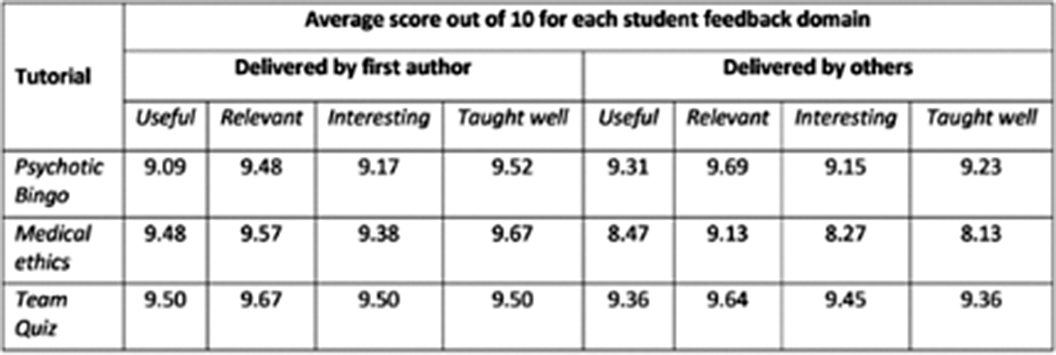
Three 1.5 hour tutorials were created: 1)” Psychotic Bingo” - Students have a unique card with terms used in descriptive psychopathology to play Bingo, 2) “Medical ethics, mental health and the law” – Explores the case of Kerrie Wooltorton to discuss the mental capacity act, advanced decisions, and the mental health act, 3) “Team Quiz” – Played in groups and covers the different sub-specialties of psychiatry and pharmacology. Tutorials were only mandatory for students in Norwich (average 11 students per tutorial) due to a large geographical area across placements. Tutorials were delivered for three rotations between December 2022 – May 2023, the initial two rotations by the first author and the third rotation by other facilitators. Facilitators were provided with a tutorial guidance document to ensure consistency. The same feedback form was used to obtain qualitative and quantitative feedback from students at all tutorials.
Results
The table below shows that feedback from students was consistently high, and there was little difference in average students rating between tutorials delivered by the first author and other facilitators. The predominant qualitative feedback was that the tutorials were “very interactive”, “engaging” and “fun”.
Image:
Conclusions
This tutorial programme consistently received excellent feedback. The results show that the tutorials can be effectively delivered by other facilitators whilst maintaining a high standard, which ensures the programmes longevity. The tutorial programme is being formally implemented for all medical students at UEA from October 2023.
Microaggressions, or subtle expressions of discrimination directed towards individuals because of their membership in marginalized social groups, are the subject of a growing body of literature (Sue, 2010). As a result of growing understanding of politically correct beliefs over time, they’ve been defined as subtler types of discrimination that have replaced formerly overt discrimination. Microaggressions differ from traditional prejudice in that they are frequently perpetrated by well-intentioned people who are oblivious of the negative implications and consequences of their conduct. Microaggressions have been documented in a variety of social groups, including racial/ethnic minorities (Sue et al., 2008; Torres et al., 2010), gender (Swim et al., 2001), sexual orientation (Shelton and Delgado-Romero, 2011), and ability status (Shelton and Delgado-Romero, 2011). Many people with mental illnesses have reported social rejection experiences that are similar to microaggressions, according to research (Cechnicki et al., 2011; Lundberg et al., 2009; Wright et al., 2000; Yanos et al., 2001).
Objectives
Existing measures of stigmatizing attitudes and behaviors may not capture much of the nuance in behavior that people with mental illness report to be particularly upsetting, so we thought it would be important to examine reliability and validity of the mental illness microaggressions scale-perpetrator version (MIMS-P) for measuring microaggression behavior in the general public in Turkey.
Methods
The methodological study will be conducted to establish the validity and reliability of the The mental illness microaggressions scale-perpetrator version (MIMS-P) scale to Turkish Culture and to determine the microaggression levels against individuals with mental illness in the general population. The sample of the study will consist of individuals who are reached through an online questionnaire and who agree to participate in the study. Individuals who have psychiatric disorders will not be included in the study.
Results
Data collection process is still ongoing. Description of studies and the key findings will be presented.
Conclusions
The MIMS-P is designed to aid future study on the frequency of endorsement of microaggressions performed against people with mental illnesses, with the ultimate goal of understanding the mechanisms that lead to these acts.
The development of an extra scale to measure microaggressions from the perspective of people with mental illnesses who encounter them is one of the future research objectives.
With a better knowledge of these viewpoints and how they interact, effective therapies and public policy initiatives for reducing stigma against mental illness can be developed.
We have previously found significant alterations in activities of glutathione dependent enzymes in blood cells of patients with late-life depression (LLD) compared with age-matched controls.
Objectives
The revealing subgroups of LLD patients by glutathione-metabolism enzymes’ activities in blood cells using cluster analysis.
Methods
LLD patients (n=101) of 60-86 age (69 patients with recurrent depression (RD), 23 with bipolar disorder (BD) and 9 patients with a single depressive episode (DE)) were assessed by Hamilton depression rating scale (HAMD-17), and Hamilton Anxiety Rating Scale (HARS). Activity levels of glutathione reductase (GR) and glutathione S-transferase (GST) were determined in patients’ platelets (-pl) and erythrocytes (-er). The control group consisted of 51 peoples 55-84 years old without mental pathology. Cluster analysis module of the STATISTICA software was used for clustering the patients by baseline blood parameters.
Results
Three clusters of patients were obtained: C1, n=39, C2, n=31, C3, n=31, differing significantly in all biochemical parameters (Kruskal-Wallis test, p<0.001), except GST. When compared with control group by Mann-Whitney test, GST-pl, GST-er, and GR-er were significantly decreased in C1; GST-er was significantly increased in C2; GST-pl, GR-pl, and GR-er were significantly decreased in C3. Several significant correlations were found between the measured parameters and scores by HDRS or HAMD-17. In C1, baseline activity of GST-er correlated with total scores by HAMD-17 (R=0.335, p=0.043) after treatment. In C2, baseline activity of GR-er correlated with total scores by HARS (R=-0.376, p=0,037) after treatment and GR-pl correlated with delta scores by HAMD-17 under the treatment (R=0.484, p=0.006). No significant correlations were found in C3. Patients with BD distributed significantly unevenly between C1, C2, and C3, with significantly more BD patients clustering in C1 (61%) compared with C2 and C3 (Yetes-corrected Chi-square =7.73, p=0.0054), whereas patients with RD and DE distributed evenly.
Conclusions
Patterns of activity levels for glutathione-dependent enzymes in patients with BD differ from those in patients with RD and DE. Significant correlations of the measured biochemical parameters with scores by HDRS or HAMD-17 assessed after the treatment and evidenced for the treatment efficacy seem to be promising biomarkers for further evaluation of the treatment efficacy in heterogeneous group of LLD patients using the proposed approach to their stratification into subgroups.
I present the case of a 58-year-old patient who developed frequent, unpredictable and prolonged suicidal impulsivity (more than 8 years of evolution) after one year of suffering a traumatic brain injury, with very serious suicide attempts in the context of very brief periods of dysthymia and no history of mental illness or any other accompanying psychopathology.
Throughout this admission, a progressive dehospitalization has also been carried out, with afternoon outings in the company of his wife or son up to a full weekend.
Objectives
Shortly before, frequent “déjà vu” crises had also begun. Additional imaging tests (CT and cranial MRI) had been performed privately, which had been normal, and an EEG with sleep deprivation had been requested, but the patient had not attended.
For 8 years he had started various successive antidepressant treatments that had always been ineffective or had produced agitation, which was diagnosed as akathisia, after a week of treatment. In a single previous hospital admission, with the initial diagnosis of major depressive disorder finally ruled out, he was discharged apparently asymptomatic, and was readmitted after making three new successive serious attempts at self-lysis a week after discharge.
Methods
Throughout this hospitalization (37 days), a practically invariable mental state is observed from the first day in which only rambling thoughts with very limited content stand out, with permanent and apparently credible criticism regarding previous self-harming behaviors, without appearance of new impulses or self-harming behaviors and reporting a significant decrease in the frequency and emotional impact of “déjà vu” type crises, which are now limited to the moment of waking up in the afternoon, after a brief nap, and occasionally.
Results
He was discharged from the hospital with the diagnosis of post-concussive syndrome (ICD 10-F0.78.2) and remains stable for the moment (one month later) in improvement, maintaining anxiolytic and antidepressant treatment, as well as anticonvulsants, and pending continuation of the study for part of neurology.
Conclusions
We think that this case shows how, within the immense etiological variety of suicidal behavior, there may be a cause conditioned exclusively by brain damage.
This retrospective study analysed the clinical efficacy, tolerability and treatment satisfaction of patients who switched from receiving palmitate paliperidone monthly (PP1M) to palmitate paliperidone six-monthly (PP6M) after 12 months of follow-up. A total of 48 patients (31 men and 17 women) with recently diagnosed schizophrenia were included.
Objectives
To assess the clinical efficacy, tolerability and treatment satisfaction in a sample of recently diagnosed schizophrenic patients who switched from receiving palmitate paliperidone monthly (PP1M) to palmitate paliperidone six-monthly (PP6M)
Methods
The sample included a total of 48 recently diagnosed schizophrenic (1-5 years) from three Mental Health units in the province of Toledo (Spain). The inclusion criteria were a diagnosis of schizophrenia (based on the ICD-10 criteria), the start of treatment with Long Acting Injectable Paliperidone Palmitate six-monthly (previously with palmitate paliperidone monthly), and the non-utilization of another neuroleptic treatment. A series of demographic variables were recorded, PANSS scale was used to to identify the presence and severity of psychopathology symptoms and the CGI scale was used to assessed the severity of the symptoms finally time to relapse was measured (primary outcome). The scales were again applied at baseline, 3 and 6 and 12 months after the start of treatment
Results
N=48 patients (31 males and 17 females), with a mean age of 31 years. 4.3 years of evolution of illness. During the follow-up period only 2 patients (4%) relapsed. Results showed an improvement in PANSS (baseline 50.8, 3 months 41.9, 6 months 37.3, 12 months 26.1), likewise and improvement in CGI was observed (baseline 4.1, 3 months 3.4, 6 months 2.9, 12 months 2.5).
In terms of tolerability, no secundary effects were reported after treatment change, suggesting a good safety profile and predictable tolerability of PP6M. Patient satisfaction with treatment also improved over time. The study reports that 87% of patients accepted the switch from PP1M to PP6M, with reasons for switching including reduced frequency of administration and increased comfort. Most patients (95%) received antipsychotic monotherapy.
Conclusions
In conclusion, this study suggests that switching from PP1M to PP6M in patients with recently diagnosed schizophrenia was associated with maintained clinical stability, good tolerability and improved patient satisfaction with treatment. These findings support the efficacy and clinical utility of PP6M as a convenient and effective treatment option for patients with schizophrenia.
The Honest, Open, Proud (HOP) program is an effective peer-led group program to support people with mental health problems in their disclosure to manage self and public stigma. The HOP program will be integrated into the National Anti-stigma Program in Hungary, which was initiated in 2020.
Objectives
Our goal was to develop the Hungarian version of the HOP program. We conducted the following measures to achieve our aim.
Methods
The adaptation process was conducted using community-based participatory research (CBPR) between September 2022 and January 2023. Over ten sessions, a group of eight individuals, consisting of both males and females with varying mental health conditions (mean age = 39.6 ± 8.5), participated in the online-led CBPR. The adaptation process was systematically documented, and regular supervision was provided.
Results
The program comprises three lessons and a follow-up section. We have translated the text of the manual and workbook into Hungarian and adjusted the tone, language, locations, and examples as per the Hungarian context. Although our adaptation process did not involve changes to the content and implementation strategies, we will perform structural modifications and adjustments to ensure the content is suitable for the predefined number of sessions and Hungarian participants.
Conclusions
The HOP could be feasibly implemented in the National Anti-stigma Program in Hungary; both online and in-person programs are planned. Given the lack of such a program in Hungary, it will likely be warmly welcomed and strongly supported for the benefit of people with mental health problems.
Disclosure of Interest
D. Őri Grant / Research support from: Fulbright Association supported research, P. Corrigan: None Declared
Public safety personnel (PSP) encounter traumatic events in their workplace, elevating the likelihood of mental health issues. Delivering efficient, evidence-backed interventions, like supportive SMS text messaging programs, can significantly enhance PSPs’ mental well-being, garnering high user satisfaction rates.
Objectives
This study evaluates users’ satisfaction, receptiveness, and perceptions of the supportive SMS text messaging intervention (Text4PTSI).
Methods
Participants enrolled in the Text4PTSI program and received one-way cognitive behavioural–based supportive text messages for six months. They participated in a web-based survey delivered through SMS text messages at enrollment, six weeks, three months, and six months after enrollment. The participants’ perceptions and receptiveness of the program were evaluated through a 5-point Likert scale. Data were represented as categorical variables, and overall satisfaction with the Text4PTSI program was assessed on a scale ranging from 0 to 100.
Results
Of the 131 Text4PTSI program subscribers, 81 participants responded to the survey, yielding 100 responses across the three follow-up time points. The average satisfaction score was 85.12 (SD 13.35). A significant portion of respondents, constituting 79%, agreed or strongly agreed that Text4PTSI helped them manage anxiety. Additionally, 72% reported relief from depressive symptoms, and 54% (54 out of 100 responses) felt less lonely. Moreover, the majority (84%) of participants expressed that Text4PTSI connected them to a support system, improving their mental well-being, felt more hopeful about managing concerns about their mental health or substance use (82%), and helped enhance their overall quality of life (77%). The data also revealed that most participants consistently read the supportive text messages (84 out of 100 responses, 84%), took time to contemplate each message (75 out of 100 responses, 75%), and revisited the messages more than once (76 out of 100 responses, 76%).
Conclusions
PSP participating in the 6-month Text4PTSI intervention expressed significant satisfaction and gratitude in the follow-up surveys. Their positive feedback indicates a promising path towards increased service utilization, potentially enhancing its effectiveness and impact on end users.
