To save content items to your account,
please confirm that you agree to abide by our usage policies.
If this is the first time you use this feature, you will be asked to authorise Cambridge Core to connect with your account.
Find out more about saving content to .
To save content items to your Kindle, first ensure no-reply@cambridge.org
is added to your Approved Personal Document E-mail List under your Personal Document Settings
on the Manage Your Content and Devices page of your Amazon account. Then enter the ‘name’ part
of your Kindle email address below.
Find out more about saving to your Kindle.
Note you can select to save to either the @free.kindle.com or @kindle.com variations.
‘@free.kindle.com’ emails are free but can only be saved to your device when it is connected to wi-fi.
‘@kindle.com’ emails can be delivered even when you are not connected to wi-fi, but note that service fees apply.
Clozapine is the standard treatment for managing treatment-resistant schizophrenia (TRS). However, concerns arise due to potential hematologic side effects, such as agranulocytosis, especially during the COVID-19 pandemic.
Objectives
This study aims to investigate the association between clozapine treatment and an increased risk of severe COVID-19 infection in patients with TRS.
Methods
A retrospective study reviewed clinical records of forensic patients with TRS from 2020 to 2022 at Razi Hospital’s forensic psychiatry department in Tunisia. Twenty-five patients, including 18 on clozapine treatment, were included.
Results
All patients were male, with an average age of 39.7 years. Twenty-three patients received at least one vaccine dose. Twenty-two patients contracted COVID-19. Among those treated with clozapine, two required intensive care unit admission and oxygen therapy without intubation. Clozapine treatment remained uninterrupted, with no dose escalation during infection episodes. Lymphopenia was the most commonly reported hematologic abnormality.
Conclusions
While there may be an association between clozapine use and an increased risk of COVID-19 infection, no clear correlation with infection severity and antipsychotic treatment was established in this study. Further research is needed to explore this potential association comprehensively.
In the review of recent literature, we found very few presentations of case reports in which the presumed association between psychiatric disorders and arachnoid cysts is discussed. Arachnoid cysts are rare brain tumors with little apparent symptomatic impact and in most cases, they are diagnosed incidentally. We present the case of a 15-year-old adolescent with a personal history of a previous severe depressive episode, as well as suspicion of serious mental pathology in the family. It presents a subacute onset episode, in the context of regular cannabis consumption, consisting of intense emotional lability and psychomotor restlessness, a tendency toward irritability, decreased sleep needs, and the appearance of delusional ideas of harm and self-referential interruption. During the study of the case, and incidentally, the cranial magnetic resonance imaging revealed the presence of an arachnoid cyst located in the left frontotemporal location, approximately 4 cm in diameter.
Objectives
(1) To describe the clinical particularities of this case, focusing on the diagnostic difficulties we faced. (2) To review current scientific evidence regarding the possible association between neuropsychiatric symptoms and arachnoid cysts.
Methods
A review of the patient’s clinical history was carried out and complementary tests were performed. Likewise, a review of the available scientific literature was also performed in relation to the appearance of neuropsychiatric symptoms associated with the presence of arachnoid cysts.
Results
The literature regarding the possible association between psychosis and arachnoid cysts is scarce. However, it is proposed that arachnoid cysts may be associated with various neuropsychiatric alterations, such as affective alterations, schizophrenia-like psychosis or amnestic symptoms. The atypicality in the symptoms sometimes leads us to suspect an organic origin of the condition, with some features such as associated memory deficits, emotional incontinence, movement disorders or neurological focal data; some of which are present in the case at hand.
Conclusions
There is controversy among different sources regarding the role of the cyst in the development of symptoms or, on the contrary, its presentation only as a chance finding. Further investigation focusing on clinical observations and neuroimaging is needed.
According to immunological theories of schizophrenia prenatal and postnatal exposure to pathogens may contribute to the etiopathogenesis, suggesting that chronically activated immune system cells (macrophages and T lymphocytes) constantly secrete proinflammatory cytokines which affect the development and function of central nervous system.
Objectives
In the present work we aimed to evaluate IL-1β plasma levels in schizophrenic patients during their first psychotic episode and to compare the obtained results to those from healthy subjects.
Methods
Plasma was obtained from 32 drug-naive schizophrenic patients, without history of substance abuse or addiction, immediately after their admission to the medical ward, while the control samples were obtained from 20 healthy volunteers.
Results
Levels of IL-1β were measured using ELISA assay, which measures IL-1β protein in a range from 7.81 to 500 pg/ml. Results revealed that the levels of IL-1β in patients with first psychotic episode were not increased and were below the limit of detection in all studied samples. The same was found in the samples belonging to the control group.
Conclusions
These data contribute to the poll of knowledge and a still unresolved dogma about the etiopathogenesis of schizophrenia since the results obtained by some studies are also questioning this marker. Thus, whether or not an increase of IL-1β is congenital, acquired during the prodromal phase or absent until the time of first psychotic episode has not yet been investigated.
Early onset psychosis (EOP) and bipolar disorder (EOBP), occurring before the age of 18, have been linked to early signs of atherosclerosis and an elevated risk of cardiovascular disease (CVD). Physical exercise is a well-established factor in reducing the risk of developing CVD. However, it remains unclear whether regular physical activity can mitigate cardiovascular risk factors and signs of atherosclerosis in individuals with EOP and EOBP.
Objectives
This study aimed to explore the impact of physical exercise on cardiovascular risk factors in these populations.
Methods
We assessed the physical exercise habits of 71 individuals, including 22 with EOP, 21 with EOBP, and 28 age-matched healthy controls. Participants’ physical exercise routines were categorized as 0, 1, 2, or 3 or more times per week, with each session lasting at least 30 minutes. Our analysis included adjustments for conventional CVD confounders. Additionally, we used high-frequency ultrasound (22 MHz) to evaluate different layers of the arterial wall in the left common carotid artery (LCCA).
Results
Compared to the control group, adolescents with EOP and EOBP exhibited significantly thicker LCCA intima thickness (0.132 vs. 0.095 mm, p<0.001) and intima/media ratio (0.24 vs. 0.17, p<0.001). Remarkably, adolescents with EOP and EOBP who engaged in physical exercise three times or more weekly (n=13) displayed significantly less intima thickness (0.142 vs. 0.116 mm, p<0.01). However, we did not observe a significant association between exercise and other CVD risk factors. Even when considering factors such as the extent of antipsychotic medication use or the severity of the disorders in our regression analysis, the significant association between exercise and reduced intima thickness persisted (p<0.05).
Conclusions
Among adolescents with EOP or EOBP, those who engaged in physical exercise three or more times weekly exhibited less pronounced LCCA intima thickness compared to their less active counterparts, although it remained thicker than that of healthy controls. These findings, if replicated, suggest that regular physical exercise, specifically three or more times a week, could potentially offer protection against the future development of CVD in individuals with EOP and EOBP. Further research is warranted to confirm and expand upon these promising results.
- problem focused coping strategies aim to change the reaction to the stressful situations
- self-compassion may reduce anxiety and depression. It is associated with happiness, it increases with age, it is negatively correlated with perceived stress and in older adults seems to be associated with higher levels of wisdom, integration, acceptance of one’s past life experiences and higher levels of meaning in life.
- job related low LPLA (Low pleasurable Low arousal emotions) and high LPHA (Low pleasurable High arousal emotions) levels corelate to depression, anxiety, and stress.
Objectives
Case report of 60 years old computer scientist
Methods
Psychiatric interview and scales:
Self-reported questionnaires: The Brief-COPE, The Self-Compassion Scale (SCS-SF), The Perceived Stress Scale (PSS 10), The Depression Anxiety Stress Scale (DASS-10), The Job-related Affective Well-being Scale (JAWS), The Subjective Happiness Scale (SHS), The Meaning in Life Questionnaire (MLQ)
Results
60 years old male computer scientist, single, without children, multiple times a week in recreative activities and physical activities. He is not satisfied with close friendships, he sleeps 6 hours in day, he didn’t have traumatic experiences in life. He is not religious. He works 45 hours per week, from that 5-10 hours weekly works at the site of primary employment.
The Brief-COPE: High score for using problem focused coping strategies-acceptance, planning, positive reframing, and informational support. Maladaptive coping strategies used in lower grade: self-blame and self-distraction.
SCS-SF: Much higher levels of self-compassion than the norms established by previous research.
DASS-10: low.
SHS: lower happiness level than the norms established by previous research.
JAWS: High negative emotional reactions to job and low level of overall job-related affective wellbeing together with lower HPHA, higher LPHA, and lower LPLA in comparison to previous research. According to previous research this person is not satisfied with his job and have a lot of negative emotions regarding his job.
PSS 10: Levels of perceived stress are lower than the norms established by previous research.
MLQ: this person scored below 24 on the scale- presence of meaning and below 24 on the scale search for meaning. According to previous research person with this score do not feel their life has a valued meaning and purpose and they do not not actively explore that meaning or seeking meaning.
Conclusions
Problem focused coping strategies and high self-compassion can be seen as protective factors to lower stress, negative emotional reactions to job and anxiety
In Europe there is significant variability of attitudes, procedure and strategies in clinical care between psychiatrists and settings across different regions and countries. However, there is a significant overrepresentation of data from mental health services from Western and Northern European countries, due a lack of data from Eastern and Central European countries as it has been suggested the Eastern and Central European regions are a “blind spot on the global mental health map”. In respect to community mental health services, Northern and Western countries introduced a large array of multidisciplinary community-based services for people with mental health problems and reorganized the mental health care services towards the community mental health care, replacing largely large hospitals and hospital-based care following recovery-oriented care models with introduction of numerous services which supported full recovery, including supported employment and housing. This process is only in the beginning in the majority of countries in the South and East of Europe. Here we present the data from these countries including the results of the RECOVER-E study (Large-scale implementation of community based mental health care for people with severe and enduring mental ill health in Europe), which incorporated the implementation of community mental health services in five South-eastern European countries.
Pre-service teachers must confront emotionally demanding situations associated with the profession, and they must be prepared for it. Previous literature has shown that two variables are important for managing mental health in this population: emotional intelligence (EI) and mindset. EI is the ability to perceive, facilitate, understand, and manage emotions, while mindset refers to beliefs about the malleability of various life domains. According to their mindsets, those who believe that attributes are malleable are called incremental theorists, and those who believe attributes are fixed are entity theorists.
Objectives
This study aimed to explore the influence of intelligence and EI mindset on self-report and ability EI in a sample of 224 female pre-school pre-service teachers (M= 21.27, SD = 4.72).
Methods
Participants completed a questionnaire battery, including intelligence mindset, EI mindset, the Mayer–Salovey–Caruso Emotional Intelligence Test, the Trait Meta-Mood scale, and paternal and maternal educational status.
Results
The results showed that incremental EI theories — but not intelligence — were related to higher scores on self-report and ability EI. Specifically, being an incremental theorist of EI predicted 11% and 20% of the variance in global EI and the managing branch of ability EI, respectively
Conclusions
These results suggest that EI mindset training programs could be implemented and evaluated to explore their impact on the EI of female pre-service teachers
Psychiatric care faces a significant challenge in the regular monitoring of patient states, predicting relapses, and ensuring treatment adherence. To address this, we aim to develop a mobile application tailored to individual patient needs. This application will revolutionize mental health care by offering real-time monitoring, education, evidence-based interventions, and enhanced communication between patients and clinicians.
Objectives
This ongoing study seeks to develop and evaluate a mobile application for individuals with schizophrenia spectrum disorders, aiming to transform personalized mental health care by addressing critical challenges in psychiatric care.
Methods
The study follows a multi-phase approach, incorporating prototype development, a proof-of-concept trial, and a Randomized Controlled Efficacy Study (RCT). Each phase is informed by iterative stakeholder feedback, ensuring responsiveness to real-world needs and experiences. The research was approved by the Semmelweis University Regional and Institutional Committee of Science and Research Ethics (SE RKEB: 85/2023).
Results
In the pilot phase, we have effectively tracked the daily well-being of participating patients through interactive activities and structured questionnaires. Our experiences in this phase promise to offer valuable insights for the psychiatric community, shedding light on the potential of personalized mental health care interventions.
Conclusions
This ongoing study represents a pivotal step towards redefining interventions for individuals with schizophrenia spectrum disorders. Early results signal a transformative potential in enhancing symptom management. As the study advances, deeper insights will emerge, emphasizing the profound impact of leveraging mobile technology in personalized mental health care.
Medical students have been shown to experience mental health problems more frequently compared to their non-medical student peers. This can manifest in pathological levels of stress and depression, and can lead to substance abuse, reduced academic performance, or even suicide.
Objectives
A credit course on professional socialization is offered for medical students at the University of Debrecen in the form of peer education. Our goal was to evaluate experiences of this course delivered in the past 5 academic years.
Methods
After reviewing the relevant literature, the structure of a focus group interview was developed. The focus group consisted of 8 participants and was moderated by the course supervisor with the help of an assistant moderator. The group summarized the number of students completing the course, and narratives of teaching experiences between 2018/19 and 2022/23. They also revised relevant versions of the tutors’ handbook containing the topics and methodology of the course. The duration of the interview was 90 minutes, and it was tape recorded by the assistant moderator, who also made notes in case the tape is inaudible.
Results
Between 2018/19 and 2022/23 61 students finished the course with the help of 23 tutors. The course is offered for students of general medicine, dentistry and pharmacy to improve their positive professional attitudes and social skills through group work and practical exercises. The medical curriculum includes mandatory courses with practical opportunities for developing professional and social skills, but due to the limited number of contact hours and the varying levels of student interest and motivation, these skills are difficult to master. The credit course was developed using the concept of Bálint groups, offering peer-supervised opportunities for motivated students above year 2 to practice their professional skills in controlled conditions while also receiving feedback from their peer group leaders. The course complements the traditional medical curriculum and sensitizes students in a protected environment in which they can observe their own communication more consciously and recognize unfavourable behaviour patterns. Developing the ability to work in a team, learning to listen, and practicing assertiveness during study years can also reduce performance-related stress and future medical errors along with increasing job satisfaction and patient adherence.
Conclusions
Based on the narrative summary of the focus group, both the experiences of participating students and peer teachers are positive, the handbook is a useful tool. The structured focus group provides a suitable method to evaluate the credit course which should be held once every academic year to evaluate the implemented course and explore options to improve future courses.
Difficulties in emotion regulation are known to be associated with various mental health problems, particularly depression, and anxiety.
Objectives
This study aimed to explore the relationship between emotion regulation, depression, anxiety, and stress symptoms in a Tunisian university setting.
Methods
A cross-sectional, descriptive, and analytical study was conducted among Tunisian students from August to September 2023. Data were collected through an anonymous online questionnaire, assessing sociodemographic characteristics, the Arabic version of the difficulties in emotion regulation scale short form (DRES-SF), and the depression, anxiety, and stress scale (DASS-21).
Results
A sample of 307 university students were enrolled. The sex ratio (M/F) was 0.28. In the assessment of emotional regulation difficulties, participants reported a mean total score of 42.47 ± 12.68. The mean score of stress was 18.2 ± 11.36, reflecting a mild severity. Participants with higher stress levels have more difficulties in emotional regulation (r=0.658, p=0.00). Participants with depressive symptoms showed a higher DRES-SF total score (r= 0.629, p=0.00). Participants had a mean anxiety score of 15.6 ± 10.57, reflecting a severe severity. A significant correlation between total DRES-SF score and anxiety (r=0.606, p=0.00).
Conclusions
Our study concluded significant positive correlations between depressive symptoms, anxiety, and stress symptoms with emotion regulation difficulties.
During the perinatal period lithium is proven effective as maintenance therapy and to prevent postpartum psychosis. Pregnancy affects all aspects of kidney physiology altering the pharmacokinetics of lithium. To minimize the risk of both maternal and neonatal complications around delivery, several authors have provided clinical advice on lithium dosing around delivery: decreasing dose by 30-50%, suspend lithium therapy 24-48 hours before scheduled cesarean section or induced delivery or even discontinuing lithium after first signs of labour.
Objectives
To evaluate the validity of these recommendations by investigating 1) maternal lithium serum concentrations changes around delivery, 2) the lithium trasplacental passage at delivery and 3) the association between neonatal lithium serum concentration at delivery and neonatal outcomes.
Methods
Psychopathologically stable women with a singleton pregnancy (n=66) who used lithium around delivery, were included in this retrospective observational cohort study (HCB/2020/1305). All women were advised to suspend lithium administration at the onset of labour in the event spontaneous deliveries. Study date: demographic, psychiatric, obstetric and neonatal outcomes for each mother-infant pair obtained from the hospital medical records.Lithium serum concentrations were determined by means of an AVL 9180 electrolyte analyzer based on the ion- selective electrode (ISE) measurement principle. Limit of quantification (LoQ) was 0.20 mEq/L.
Results
The most common psychiatric diagnosis was a bipolar disorder type I (n=54, 90%). Forty mothers (61%) were on lithium monotherapy. Mean (SD) umbilical cord and intrapartum maternal lithium serum concentration was 0.59 (0.13) mEq/L and 0.55 (0.13) mEq/L respectively. There was a strong positive correlation between umbilical cord and maternal lithium serum concentrations (Pearson correlation coefficient 0.95 (95%IC: 0.91,0.97). In a subsample (N=22) a paired t test indicates that the maternal serum lithium concentrations at delivery were significantly lower (mean difference=0.19 mEq/L, 95%CI=0.13-0.25) than those during obtained the day before delivery hospitalization, after a mean (SD) of 31.29 (±11.92) hours (SD=11.92) have elapsed since the taking the last dose of lithium prior to delivery. Four women (6%) relapsed early postpartum.There were no significant differences between lithium monotherapy (N=18/40) and polytherapy (N=11/26) groups with regard to acute neonatal complications (p>0.05). The only acute neonatal complication associated to umbilical cord lithium serum concentration was hypotonia [0.712 (0.298) vs. 0.534 (0.214) (F=5.065; df=1,60; p=0.028)].
Conclusions
When lithium is used around delivery, maternal and neonatal well-being can be maximized by maintaining maternal serum lithium concentrations at the minimal effective level and discontinuing briefly when presenting to hospital for delivery.
Bipolar disorder (BD) is a complex mental illness described by recurrent episodes of mania and depression. One subtype of the illness is rapid cycling BD, characterized by experiencing four or more extreme mood swings within a year. Diagnosing and treating BD can be complicated by comorbid conditions, such as atypical anorexia nervosa (AAN), marked by disordered eating and disturbing weight-related thoughts.
Objectives
To discuss the diagnosis and treatment plan of a patient with rapid cycling BD, who experienced adverse effects from prescribed medication and later was diagnosed with comorbid AAN.
Methods
We present a case of a 21 year-old man initially presenting with anxiety, low mood, and obsessive weight-related thoughts, ultimately diagnosed with major depression and mixed anxiety disorder.
Results
21 year-old man was diagnosed with major depression and mixed anxiety disorder, initially treated with mirtazapine and fluoxetine (limited success), later attempting escitalopram and bupropion combination (partial remission). After 2 years the patient discontinued the treatment due to feeling “euphoric”, subsequently experiencing depression and manic episodes – the initial diagnosis was rapid cycling BD. The treatment was changed to sodium valproate (up to 1500 mg/day) and aripiprazole (up to 10 mg/day), however extremely rare adverse medication effects (nosebleeds, diarrhea with blood admixture, “high-frequency sounds”) were reported. Throughout valproate treatment, the patient experienced persistent diarrhea. During hospitalization for treatment adjustment lithium carbonate was introduced at a starting dose of 900 mg/day, maintaining blood lithium levels between 0.4 mmol/l and 0.49 mmol/l. Later the dose was adjusted and a therapeutic lithium blood level was reached with 1575 mg/day of lithium carbonate. Additionally, risperidone was prescribed, however, the patient experienced an uncommon adverse reaction – nasal congestion. Subsequently, amisulpride was introduced, which provoked severe anxiety and fear, resulting in medication discontinuation. During the latest outpatient visit, fluoxetine was added to the treatment due to observed depressive symptoms. Throughout the treatment, the patient episodically intermittently starved, had persistent distressing thoughts about weight and was diagnosed with AAN. While planning further treatment it was hypothesized that comorbid AAN might affect drug metabolism and the patient was referred to a specialized inpatient facility for eating disorder management.
Conclusions
This case report highlights the complexity of psychiatric disorders and the importance of monitoring and adjusting treatment based on patient response and side effects. Additionally, it emphasizes comorbid conditions significance in influencing the primary disorder’s dynamics as well as the metabolism and effectiveness of psychiatric medications.
Cognitive reserve (CR) refers to the ability of the brain to cope with damage or pathology. In bipolar disorder (BD), it has been seen that the effects of the disease may potentially reduce CR, thus compromising cognitive outcomes. This concept takes on special relevance in late life in BD, due to the increased risk of cognitive decline because of the accumulative effects of the disease and the potential effects of aging. Therefore, we believe that CR may be a protective factor against cognitive decline in older adults with bipolar disorder (OABD).
Objectives
The aim of this study was to study the CR in OABD compared with healthy controls (HC) and to analyze its association with psychosocial functioning and cognitive performance.
Methods
A sample of euthymic OABD, defined as patients over 50 years old, and HC were included. CR was assessed using the CRASH scale. Differences in demographic, clinical, and cognitive variables between patients and HC were analyzed by t-test or X2 as appropriated. Lineal simple and multiple regressions analyses were used to study the association of CR and several clinical variables with functional and cognitive performance.
Results
A total of 83 participants (42 OABD and 41 HC) were included. Compared to HC, OABD exhibited poorer cognitive performance (p<0.001), psychosocial functioning (p<0.001) and lower CR (p<0.001). Within the patient’s group, the linear simple regression analysis revealed that CR was associated with psychosocial functioning (β=-2.16; p=0.037), attention (β= 3.03; p=0.005) and working memory (β = 2.98; p=0.005) while no clinical factors were associated. Age and CR were associated with processing speed and verbal memory, but after applying multiple regression model, only the effect of age remained significant (β =-2.26; p= 0.030, and β =-2.23; p= 0.032 respectively). CR, age, and number of episodes were related to visual memory, but the multiple regression showed that only age (β = -2.37; p= 0.023) and CR (β = 3.99; p<0.001) were associated. Regarding executive functions only the number of manic episodes were significant. CR and age at onset were associated with visuospatial ability, but multiple regression only showed association of CR (β =2.23; p=0.032). Other clinical factors such as number of depressive or hypomanic episodes, illness duration, admissions, type of BD, and psychotic symptoms were not associated.
Conclusions
To the best of our knowledge, this is the first report that studies the CR in a sample of OABD. We demonstrated that OABD had lower CR than HC. Importantly, we observed that CR was associated with cognitive and psychosocial functioning in OABD, even more than disease-related factors. These results suggest the potential protector effect of CR against cognitive impairment, supporting that improving modifiable factors associated with the enhancement of CR can prevent cognitive decline.
Disclosure of Interest
L. Montejo: None Declared, C. Torrent Grant / Research support from: Spanish Ministry of Science and Innovation (PI20/00344) integrated into the Plan Nacional de I+D+I and co-financed by the ISCIII-Subdireccion General de Evaluacio ́n and the Fondo Europeo de Desarrollo Regional (FEDER), S. Martín: None Declared, A. Ruiz: None Declared, M. Bort: None Declared, G. Fico Grant / Research support from: Fellowship from “La Caixa” Foundation (ID 100010434 - fellowship code LCF/BQ/DR21/11880019), V. Oliva: None Declared, M. De Prisco: None Declared, J. Sanchez-Moreno Grant / Research support from: Spanish Ministry of Science and Innovation (PI20/00060) integrated into the Plan Nacional de I+D+I and co-financed by the ISCIII-Subdireccion General de Evaluacio ́n and the Fondo Europeo de Desarrollo Regional (FEDER),, E. Jimenez Grant / Research support from: Spanish Ministry of Science and Innovation (PI20/00060)integrated into the Plan Nacional de I+D+I and co-financed by the ISCIII-Subdireccion General de Evaluacio ́n and the Fondo Europeo de Desarrollo Regional (FEDER),, A. Martinez-Aran: None Declared, E. Vieta Grant / Research support from: Spanish Ministry of Science and Innovation (PI18/ 00805, PI21/00787) integrated into the Plan Nacional de I+D+I and cofinanced by the ISCIIISubdireccio ́n General de Evaluacio ́n and the Fondo Europeo de Desarrollo Regional (FEDER); the Instituto de Salud Carlos III; the CIBER of Mental Health (CIBERSAM); the Secretaria d’Universitats i Recerca del Departament d’Economia i Coneixement (2017 SGR 1365), the CERCA Programme, and the Departament de Salut de la Generalitat de Catalunya for the PERIS grant SLT006/17/00357; the European Union Horizon 2020 research and innovation program (EU.3.1.1. Understanding health, wellbeing and disease: Grant No 754907 and EU.3.1.3. Treating and managing disease: Grant No 945151)., B. Sole: None Declared
Previous research demonstrated that disasters have adverse mental health outcomes. Preventive mental health interventions in the golden hours/days after a disaster may reduce psychological harm by getting in the way of emerging mental disorders or alleviating existing ones. The widespread use of smartphones and broad internet access enabled remote mental health interventions during disasters. After the 2023 Turkey earthquake, observing the mental health burden of the earthquake, The Psychiatric Association of Turkey conducted an online platform for psychological first aid. The aim was to unite volunteer psychiatrists and disaster survivors.
Objectives
This study presents the organization of an online mental health service during a disaster while reporting the characteristics of the service users.
Methods
The Psychiatric Association of Turkey called its members to volunteer for an Online Support System for Mental Problems After the Earthquake. The group regularly united to set standards of care. An action plan and algorithm were set up for applicants with acute suicidal, homicidal risk, or active psychotic symptoms in collaboration with local institutions and field volunteers. Volunteer psychiatrists were asked to collect information on the applicant’s sociodemographic characteristics, disaster experience, and mental health status.
Results
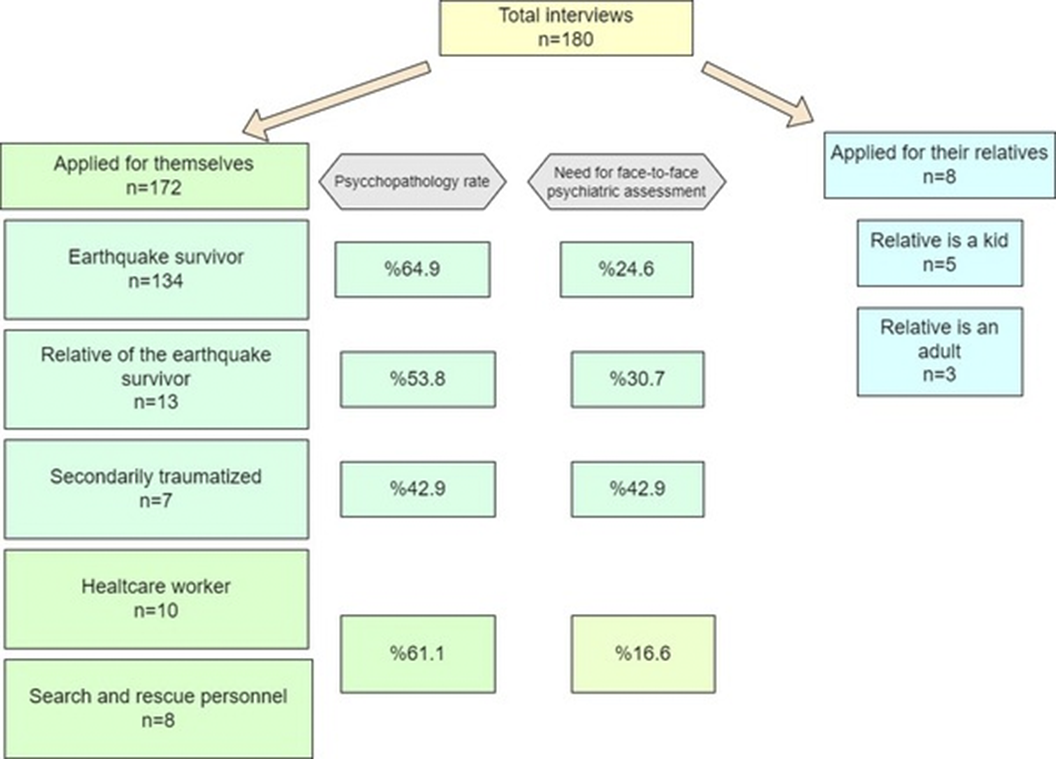
Volunteer psychiatrists collected data on 180 applications. Most cases applied for themselves (%95.5), and some asked for advice to care for their relatives (%4.5). Earthquake survivors have the highest psychopathology rate (%64.9), followed by healthcare workers and search and rescue personnel (%61.1). Figure 1 summarizes the subgroups of the service users. The earthquake survivors group had a mean age of 34.45, % and 76.1 of them were female. Only %15.7 of them had lower educational levels than high school. %75 cases reached safe places on the 5th day of the disaster. Applicants reported discrimination and aggression after the catastrophe, related to experiencing mental health problems, owning a pet, looting, and being seen as less traumatized since their relatives are alive.
Image:
Conclusions
The present experience of the Psychiatric Association of Turkey is an example of a fast and collaborative response to a disaster regarding mental health. Our results also represent the characteristics of online mental health service users during a disaster.
There are studies showing that the systemic inflammation response in patients diagnosed with schizophrenia is different from healty controls. Neutrophil-lymphocyte ratio (NLR), platelet-lymphocyte ratio (TLR), monocyte-lymphocyte ratio (MLR), monocyte-HDL ratio (MHO) and systemic immune inflammation index (SII) have recently been used as inflammation indicators.
Objectives
NLR, TLR, MLR, MHO and SII have been evaluated in many studies in schizophrenia patients. The aim of our study is to evaluate the relationship between NLR, TLR, MLR, MHO, SII values and antipsychotic treatments of patients diagnosed with schizophrenia.
Methods
203 individuals diagnosed with schizophrenia who were followed up in the psychotic disorders outpatient clinic of Selçuk University Faculty of Medicine were included in the study. Neutrophil, lymphocyte, platelet and monocyte counts and HDL values were obtained retrospectively from blood tests. NLR, TLR, MLO, MHO and SII were calculated. The study approved by the ethics committee of Selçuk University Faculty of Medicine.
Results
45.3% of the patients were female (n = 92); the mean age was 45.8±14.0. The average number of hospitalizations was 3.0±2.7 years; the mean disease duration was 17.0±9.6 years. 56.7% (n=115) use long-acting antipsychotic treatment, 21% (n=43) use monthly paliperidone long-acting (PP1M) treatment, and 14.8% (n=30) use 3-month paliperidone long-acting (PP3M) treatment. No significant difference was observed in NLR, TLR, MLR, MHO and SII values between individuals using and not using long-acting antipsychotics. However, a significant difference in NLR value was observed between PP1M and PP3M treatment (p = 0.039). Oral antipsychotic use was 71% (n=137), 19% (n=38) used clozapine monotherapy, and 25% (n=51) used non-clozapine oral monotherapy. No significant difference was detected in inflammatory markers between clozapine monotherapy and other oral monotherapies.
Conclusions
According to our findings, NLR levels in patients diagnosed with schizophrenia were found to be significantly higher in those using PP1M treatment compared to those using PP3M. This finding can be interpreted in favor of the fact that PP3M contributes to the reduction of inflammation due to its longer duration of action compared to PP1M. It is thought that schizophrenia progresses through inflammatory processes and antipsychotic treatments play a role in anti-inflammation. It is envisaged that future studies may be helpful in evaluating the onset, exacerbation and remission periods of the disease, including treatment doses and durations, and revealing the relationship between inflammatory markers and schizophrenia disease and the effects of antipsychotic treatments on inflammatory markers such as NLR, TLR, MLR, MHO and SII.
Psychological factors, such as emotional regulation strategies, play a crucial role in the management and care of chronic somatic health conditions among adolescents. In the existing literature, catastrophising has been associated negatively with health-related quality of life in the context of chronic health conditions in general. However, there is limited knowledge about its role in specific illness types.
Objectives
We aimed to evaluate the impact of catastrophising on the health-related quality of life in two distinct illness groups: diabetes and oncology, within a Hungarian sample.
Methods
A cross-sectional study using self-report measures was carried out, involving a total of 273 adolescents (mean age: 14.72 years, SD: 1,82 years; 50.2% females) in the two paediatric samples. The diabetes group consisted of 171 participants, while the oncology group was comprised of 102 individuals. No significant differences were found between the two chronic condition groups in terms of gender (χ2 = 116.51; p = 0.50), or mean age (F(-0.82; 0.77) = 1.66; p = 0.19). The short-version of the Cognitive Emotion Regulation Questionnaire (CERQ-short) was used to assess the cognitive emotional regulation strategies of the children, specifically focusing on the catastrophising subscale. Health-related quality of life was measured using the 4.0 version of the PedsQL, which included subscales for Physical, Emotional, Social, and School Functioning.
Results
A Hayes-moderation analysis with an interaction effect was conducted, controlling for gender, age, and the duration of the illness. A significant interaction effect was observed between catastrophising and the illness groups, impacting School Functioning (F(1, 243) = 4.17; p = 0.04), Physical Functioning (F(1, 245) = 4.67; p = 0.03), Social Functioning (F(1, 245) = 4,23; p = 0.04), and Emotional Functioning (F(1, 245) = 4.20; p = 0.04). The association between catastrophising and health-related quality of life remained stronger in the oncology group.
Conclusions
Catastrophising appears to be a risk factor that affects the quality of life of children facing oncology illnesses. Therefore, addressing catastrophising in interventions tailored to this paediatric illness group may be beneficial.
Keywords: catastrophising, health-related quality of life, adolescents, chronic somatic
This study was supported by the Hungarian National Research, Development and Innovation Office (K143764).
Toxoplasma gondii, a ubiquitous protozoan parasite, has been previously associated with psychiatric disorders.
Objectives
To assess the prevalence of IgG antibodies against T. gondii in psychiatric patients from Western Romania.
Methods
We included 464 psychiatric patients admitted to the Psychiatric Clinic, County Emergency Hospital of Arad, Western Romania. Clinical evaluation and laboratory tests were conducted in these patients, including serological tests to determine the presence of T. gondii IgG antibodies.
Results
Of the 464 psychiatric patients, 258 (55.5%) were residing in rural areas and 245 (52.7%) were female. T. gondii IgG antibodies were demonstrated in 325 (70.04%) of 464 study participants and the seroprevalence tended to increase with age.
A significant higher T. gondii IgG seroprevalence was found in psychiatric patients aged between 40 to 59 years (p<0.001) and in patients aged ≥60 years (p=0.001) compared to patients aged 19 to 39 years. A higher T. gondii IgG seroprevalence was determined in psychiatric patients residing in rural areas compared to those residing in urban areas (p=0.04). T. gondii IgG seroprevalence was higher in females compared to males (p=0.04).
Assessment of seroprevalence by diagnostic revealed that T. gondii IgG antibodies were identified in 23 (85.19%) of 27 patients with delusional disorders, 24 (82.76%) of 29 with dementia, 51 (70.83%) of 72 with organic disorders, 75 (70.75%) of 106 with schizophrenia, 81 (70.43%) of 115 patients with depression, 17 (62.96%) of 27 with bipolar disorders, 27 (58.7%) of 46 with mood disorders and 7 (53.85%) of 13 with impulsive-control disorders.
Conclusions
The presence of T. gondii antibodies was demonstrated in a significant number of patients who attended the Psychiatric Clinic in Arad County, Western Romania. Results of this study suggest that T. gondii may be associated with several psychiatric disorders.
Beekeeping is a peculiar activity able to connect people both to nature and to other people. Extant research shows how it provides beekeepers with meaning, opportunities for learning, and a sense of connection to bees as well as to the surrounding ecosystem. The relationship of care and interdependence that is established supports well-being, encourages collaboration and positive social relations.
Objectives
“Beenomies” is a pilot project inspired by the union of opposites symbolically associated with bees: love and war, sweetness (honey) and bitterness (venom), the individual and multiplicity (society), regeneration and death. As CG Jung observed, honey expresses, psychologically, “the joy of life and the life urge which overcome […] the dark and the inhibiting. Where spring-like joy and expectation reign, spirit can embrace nature and nature, spirit”. Drawing on this psychological and philosophical basis, the project aimed to introduce beekeeping in a therapeutic community placed in the Alpine environment (Mondovì, Italy), to explore its rehabilitative potential and its ability to promote well-being in the field of mental health.
Methods
The project stems from the collaboration between mental health services, a local agriculture high school, and a farm involved in social agriculture. Initially, some beehives have been settled on the land surrounding the therapeutic community. Activities of beekeeping have been conducted and supervised by experienced beekeepers of the farm involved, who engaged a selected group of users hosted in the community (n=15), instructed them and worked side by side for several weeks, according to the bees’ needs and the seasonal rhytms. Once the training was completed, teaching activities have been co-conducted by beekeepers and participants, to introduce and train a group of students from the local agriculture high school. A study encompassing observational data, surveys, and semi-structured interviews was conducted to monitor and evaluate the project as it unfolded.
Results
The performance of practical activities (i.e. beekeeping operations) proved successful in relaxing social norms around talking, lowering the emotional intensity of the encounter, allowing non-verbal communication and normalizing silence. These features supported participants with relational difficulties and encouraged the gradual development of skills in the social area. In the second part of the project, the involvement of high school students that needed to be trained allowed participants to have an active role as teachers; this contributed to the development of positive feelings, increased self-esteem and self-efficacy, eventually supporting the recovery process.
Conclusions
Preliminary findings suggest further collaboration between different social actors and further research to develop inclusive, effective, and community-based interventions in the field of mental health and rehabilitation.
In recent years, there has been a growing recognition of the importance of involving people with lived experience of mental health issues in psychiatric research. User involvement in research goes beyond being merely instrumental and is deeply intertwined with ethical and political considerations. Shifting from traditional research paradigms to collaborative partnerships with users is seen as a crucial step in ensuring that research is more relevant, meaningful, and respectful of the diverse perspectives within the mental health community. While there is a growing interest and responsibility regarding this matter, there is still a need to better understand the differences between participation, engagement, and user-led research alongside a respectful integration of user perspectives.
In this presentation, the state-of-the-art regarding user involvement in psychiatric research will be reviewed and possible ways to practically implement such practice will be discussed.
Video game disorder has been a subject of increasing interest, being associated with patterns of insecure attachment and authoritarian and permissive parenting styles. However, there is still a gap concerning the relationship between video game disorder and parent-child communication, one of the fundamental components of attachment to parents. Particularly in the Portuguese context, research on these topics and their interrelations is still scarce, thus remaining relatively unexplored.
Objectives
To explore the pattern of video game usage and video game disorder, as well as their relationships with parental and peer attachment, parenting styles, and communication in parenting within a sample of Portuguese adolescents.
Methods
150 Portuguese teenagers, recruited at public Portuguese schools, aged between 10 and 19 years old (mean age = 14.37, DP = 3.12; 52.7% girls (n = 79), and mostly living with both parents (79.7%, n = 106) fulfilled a sociodemographic and an academic questionnaire, a questionnaire on video game use patterns, the Video Game Disorder Scale - Short Version 9, the People in My Life Questionnaire, the Portuguese hetero-report version of the Parenting Styles and Dimensions Questionnaire: Short Versionand the Perception Scale of Parenting Communication.
Results
The majority of the sample indicated 3rd childhood (n = 81, 54.0%), specifically at 8 years old, as the age of video game initiation and a playtime of less than or equal to 2 hours (n = 111, 74.0%), with only 2 participants found to have a video game disturbance index (1.3%). A positive association was found between video game disturbance and the average hours of gameplay, as well as a negative association with the age of game initiation. Additionally, relationships were explored, revealing that video game disturbance is negatively related to lower quality of attachment to parents and peers, positively related to an authoritative parenting style, and negatively related to less available, open, and affectionate parent-child communication.
Conclusions
This study provides an in-depth understanding of adolescents’ behavior regarding video games, contributing to the knowledge of the topic in the Portuguese context. Furthermore, the identification of factors associated with video game disturbance allows for the development of remediation and prevention programs for this addictive disturbance, which are essential tools in psychological practice.
